Wellington Chamber Music – Sunday Afternoon Concert Series 2024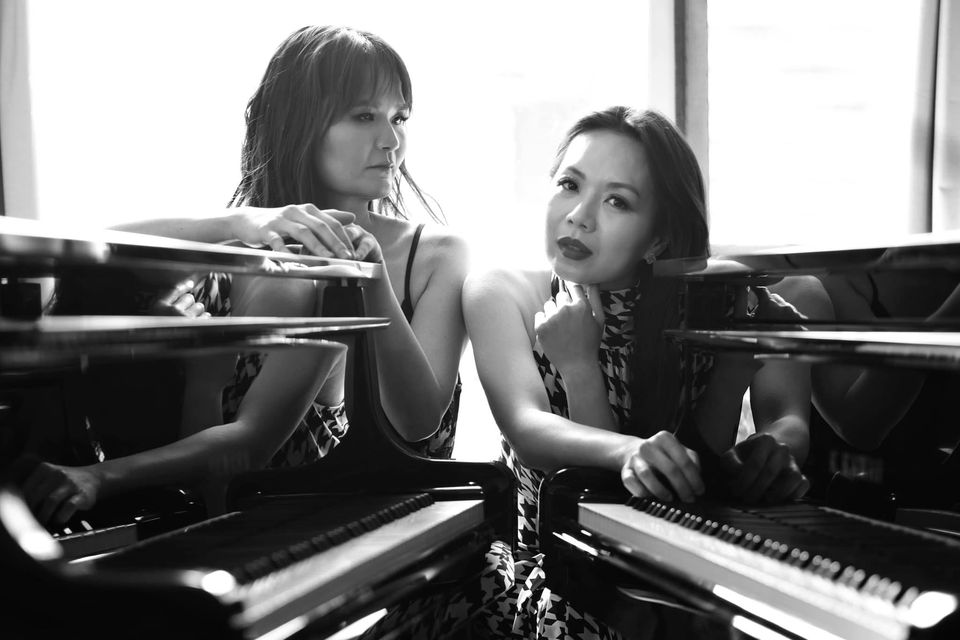 Duo Enharmonics – Beth Chen and Nicole Chao (piano duo)
J S BACH – “Gottes Zeit ist die allerbeste Zeit” (from Cantata BWV 106 – arr. György Kurtág)
FRANZ SCHUBERT – Fantasy in F Minor D.940
MAURICE RAVEL – La Valse (arr. Lucien Garban)
JOHN PSATHAS – Fragment (2001)
SERGEI RACHMANINOV – Six Morceaux Op.11
J.STRAUSS Jnr. – Blue Danube Fantasy (arr. Greg Anderson)
St.Andrew’s-on-The-Terrace, Wellington,
Sunday, 7th July, 2024
This concert was a further instalment in the wondrous evolution of my exposure to the astonishing talents of Duo Enharmonics, the piano duo team of Nicole Chao and Beth Chen, the most recent of Wellington Chamber Music’s Sunday Concert Series. Until that sensational presentation I attended almost two years ago, featuring the duo’s performance of Stravinsky’s “The Rite of Spring”, I’d been something of a voyeur regarding the talents of these musicians, relying upon enthusiastic reports from other reviewers of things such as the “energy and force” of their “outstanding teamwork” (Steven Sedley, Middle C, September 2020), and especially in regard to music I myself dearly loved, such as Mozart’s KV 381 Duo Sonata, or Ravel’s “La Valse” in a four-hands transcription. Here, now, was a second chance for the word to become flesh for me in musical terms, and especially with the delectable Ravel work on today’s programme!
What struck me with increasing force and intensity as today’s programme unfolded was the sheer depth of musicality of what we heard in both compositional content and its presentation. Any sense of the four-handed piano repertoire being a “lesser” or even somewhat “contrived” art-form was properly negated by the purity of focus and the surety of vision displayed by the performers in each of the pieces presented. Even in instances such as the transcription of “La Valse”, which one might regard as a lesser entity compared with the orchestral version, I felt the spirit of the latter evoked as surely as if I had been listening to Ravel’s original sound-world.
With the exception of the last piece on the programme, a fantastical four-handed arrangement of Johann Strauss Jnr’s famous “Blue Danube” Waltz by Greg Anderson (of its kind, a stunningly colourful demonstration of the range of sonorities possible on a keyboard played by four hands), the pieces presented today by Nicole Chao and Beth Chen needed no further augmentation as sound for their essential messages to reach out to and enfold our sensibilities – in other words, I found it hard to imagine any of the performances today done better, revelling as I did in the enchantment of each and every recreated moment throughout.
The concert was a model of its kind in terms of the range and scope of the pieces – and it couldn’t have begun more enticingly than with György Kurtág’s arrangement of the beautiful introductory music to JS Bach’s funeral cantata “Gottes Zeit is die allerbeste Zeit” (God’s time is the very best time). Begun by the secondo player, Beth Chen, the opening textures were augmented by an intertwined combination of secondo and primo hands, the end result interesting to watch, but absolutely enchanting to listen to – a brief but ravishing introduction to the afternoon’s music-making.
Has anybody composed a more poignant amalgam of conflicting emotions than in the Fantasy in F Minor of Franz Schubert’s? The work’s rolling, undulating Allegro molto moderato opening suggested a vast interior landscape of quiet despair, Nicole Chao and Beth Chen finding a proper “Schubertian pulse” in the music – a brief major-key flirtation prompted more agitated sequences, before the opening returned. The players threw down the gauntlet for the dramatic, almost operatic Largo with its declamatory utterances, double-dotted phrasings and long trills – there was but momentary relief from a more conciliatory episode before the music lurched into an allegro vivace Scherzo, the players performing miracles of varied touch and phrasing by way of conveying the music’s multifaceted mood, bringing out the piquancy of the Trio’s music as a contrast to the almost grim determination of the Allegro vivace. And the dramatic return of the work’s opening music here generated feelings both of reprieve and inexorable futility, the players generating a torment of fugal-like conflict and variance, but all to no avail in the face of the theme’s grim final triumph.
After this, Ravel’s “La Valse” was almost a relief at first for the individual spirit, suggesting, as it did a different, more societal kind of fatalism and dissolution – interesting, though, that, despite the plethora of commentary in the interim suggesting the music as representing the decline of the “old” pre-First World War era of European civilisation, Ravel himself categorically denied any such scheme in his music, stating that the work expresses nothing more than his “intense attraction to these wonderful (waltz) rhythms”….still, this having been said the composer was seriously affected by the horrors of warfare, gleaned from his own personal experiences as a soldier (he was a truck driver and often near the front) as well as the deaths of numerous friends in combat, though stoically managing his grief and despair in works like “Le Tombeau de Couperin” and “La Valse”.
I’d gotten to know this music well in its orchestral guise, ever since hearing the piece at the very first orchestral concert I attended, back in the 1960s! – what a thrill that memory still evokes! Though unfamiliar with the piano duo version, I felt Nicole Chao’s and Beth Chen’s all-embracing touch uncannily breathed life into those ghostly, inchoate scenarios at the work’s beginning, gradually liberating both form and movement from the “whirling clouds” of the composer’s own description, and bringing various dancing couples into view – and what dancers gradually emerged! – all of them seemingly refracting themselves into “an immense hall, peopled with a whirling crowd”, with every detail of the composer’s recaptured by Lucien Garben’s faithful transcription.
As well as Ravel’s score glitter and glamour we heard its darker, more sinister and grotesque aspects, evident in a couple of the dance’s more disruptive sequences, and calling for some spectacularly-essayed keyboard figurations from both ends of the sound-spectrum before order was restored and the music continued. From beneath the seemingly tireless and supercharged fingers of the duo the waltz displayed all of its glamour, allure, charm and coquettishness, recovering anew from whatever irruption bubbled up from beneath the music’s surfaces – but suddenly reaching the point at which it realised its moments of glory were numbered and the game was up! The music gathered itself from within and transformed its hitherto lilting rhythms into thrusting, flailing gestures signifying death-and-glory oblivion. Our pianists seemed transfigured at this point, imbued with this same all-or-nothing spirit and with flailing arms and fingers pushing and thrusting themselves, the music and us into a vortex of chaos and confused silence, hammered home by those apocalyptic final chords! Sensational stuff!
Judicious programming gave us the interval to recover from the onslaught; and the two pianists themselves re-emerged differently garbed and with their primo and secondo roles reversed, Nicole Chao as secondo beginning a piece by New Zealand-Greek composer John Psathas, called Fragment, originally written for two marimbas – beautifully-modulated repeated chords made a hypnotic effect, which the entry of the primo player, Beth Chen attenuated with birdsong-like notes, together creating a kind of “moment in time” stillness, a kind of aural metaphor of solitariness, but with awareness of a surrounding environment rather than mere emptiness – by the piece’s end the different elements seemed to have merged, with either the solitary individual subsumed by the surroundings or the ambience enhancing or elongating, or even being redefined by the presence of the “new” element, perhaps a redefinition of sorts reading “To be solitary is to………”.
Sergei Rachmaninov’s Six Morceaux Op.11 was new to me, but had especially excited my interest with its relatively early composition date, 1893 – two years before the completion of the composer’ First Symphony, which had its disastrous premiere in 1897. I’ve long believed that the failure of the first Symphony had an adverse long-term effect on the composer’s compositional abilities, and have accordingly been interested in hearing anything he wrote before the symphony’s first performance. For me, this work bore out that view, in that the pieces exuded the kind of confidence and originality of a young composer who hadn’t yet been told that his work was a failure (as Rachmaninov was to experience to a devastating degree in 1897 after the symphony’s first unfortunate performance).
In six movements, the Op.11 set began with a Barcarolle in G Minor, built simply from a rocking rhythm at the outset, with a melodic line that patiently builds an elongated and fruitful utterance whose central section spontaneously breaks into amazing filigree figurations which briefly return as a potent echo at the piece’s ending. The second piece, Scherzo, has a mischievous, almost devil-may-care insouciance, requiring incredible virtuosity as well as a quixotic, tongue-in-cheek sense of fun – a great piece! The Theme Russe was simpler, more soulful and melancholic, its theme given various accompaniments, incorporating thunderous octave-scales, whirling figurations and grand and celebratory, imperial-like chordal passages. Next came a Valse, more salon-like than Chopin’s, with some cheeky descant counterpoints and some gorgeous AWOL harmonies, including a “wrong modulation” ending to boot! A darkly passionate, somewhat obsessive Romance revealed a young composer unafraid to express his feelings – and the last of the pieces was Slava, which rather wonderfully used the well-known Russian “choral theme” from Musorgsky’s “Boris Godunov”, Rachmaninov indulging in his obvious love for church bells of all different kinds. These near-thunderous sonorities came to dominate the latter stages of the piece, the playing making the precincts of St. Andrews ring with more-than-usually-Slavic intensities!
Fittingly, the concert’s final item was the duo’s act of homage to the astounding Piano Duo team of Elizabeth Joy Roe and Greg Anderson which had toured New Zealand in 2018, and whose Wellington concert I had the good fortune to attend as well. Certainly, the choice by Nicola Chao and Beth Chen of one of the American duo’s “calling card” items as today’s concert finale indicated that the Duo Enharmonics pair had little to fear from any comparison, and the latter’s performance here in my mind put the seal on that viewpoint. The astonishing “Blue Danube Fantasy” obviously represented the ”display” aspect of a two-piano combination, of which Chao and Chen proved entertainingly more than capable; but the rest of the programme brought to the fore the pair’s musicianship of a deeper, and more satisfying kind, making their activities on our behalf something of an ongoing treasure to be cherished and deeply valued.