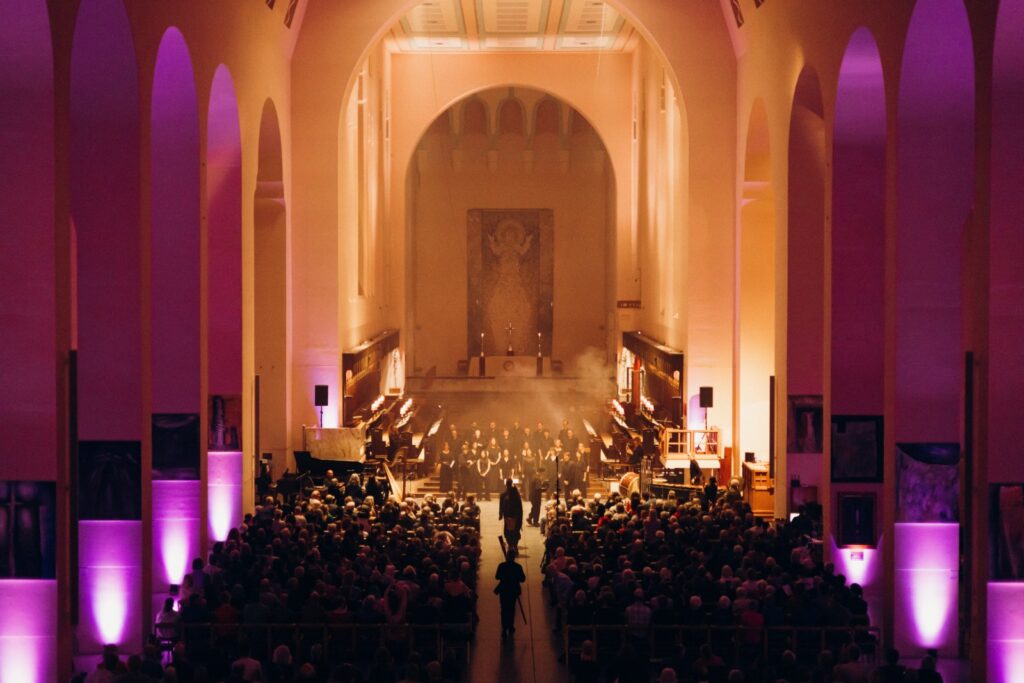
 Sound Cathedral – assembled forces, Wellington Cathedral of St Paul – all photo images courtesy Nick George, Creative
SOUND CATHEDRAL: Almost 500 years of music and sound collaboration brings together Renaissance composer Orlande de Lassus’s Sibylline Prophecies from1550, traditional Taonga Puoro from Aotearoa, and present-day composer Michael Norris’s reconstructive configurations of Renaissance polyphonies.
The Tudor Consort – directed by Michael Stewart
Rangatuone Ensemble – conducted by Riki Pirihi
Stroma Ensemble – directed by Michael Norris
Organist – Max Toth
Bellringers, Wellington Cathedral – Dylan Thomas, Jamie Ben
Wellington Cathedral of St.Paul, Molesworth St., Wellington
Sunday, Ist March, 2026
Presented with the auspices of Aotearoa New Zealand’s 2026 Festival of the Arts
Over half-an-hour before the event’s beginning there were groups of people forming lines in the foyer of Wellington’s Molesworth Street Cathedral of St. Paul, drawn by the prospect of experiencing what composer Michael Norris had described in the pre-concert publicity as an enlivening of “the sonic architecture” of the Cathedral. Those of us who had in the past revelled in the Cathedral’s inherent aural capabilities with music written especially for large spaces were irrevocably drawn to the prospect. And, inside, our programme notes contained effusively elaborations on the venue becoming “an immersive bath of sound that emanates from every corner”. No better introductory build-up to the event’s efficacy could have been devised.
The musicians involved in “Sound Cathedral” began taking up positions at the beginning which enclosed the audience in a kind of surrounding web, the atmosphere further enhanced by diaphanous streams of mist emanating from the altar end of the nave and creating veritable swathes of ambient mystery. A hush suddenly prevailed as the Dean of Wellington Cathedral, Katie Lawrence welcomed and addressed us both in Te Reo and English from the pulpit, enjoining us to “open our hearts and enjoy the spectacle”.
The Karakia is delivered, sonorously and scalp-pricklingly, augmented with impressively sonorous, even baleful-like trumpet tones from the taonga puoro players – others join in from the surrounding areas, with the sounds taking on a less confrontational, more “inclusive” kind of ambience as we begin to discern voices amongst the instrumental sounds. Gradually the voices were made manifest by the singers’ one-after-the-other appearance from the back and up the central aisle to the front, as the instrumentalists continued with their all-enveloping array of sounds from all precincts of the nave. It was an enchanting cornucopia of sound, in constant swirling flux, unexpectedly reminding me at this point of those “river sounds” which build up in the same way in Wagner’s Prelude to his opera “Das Rheingold”.
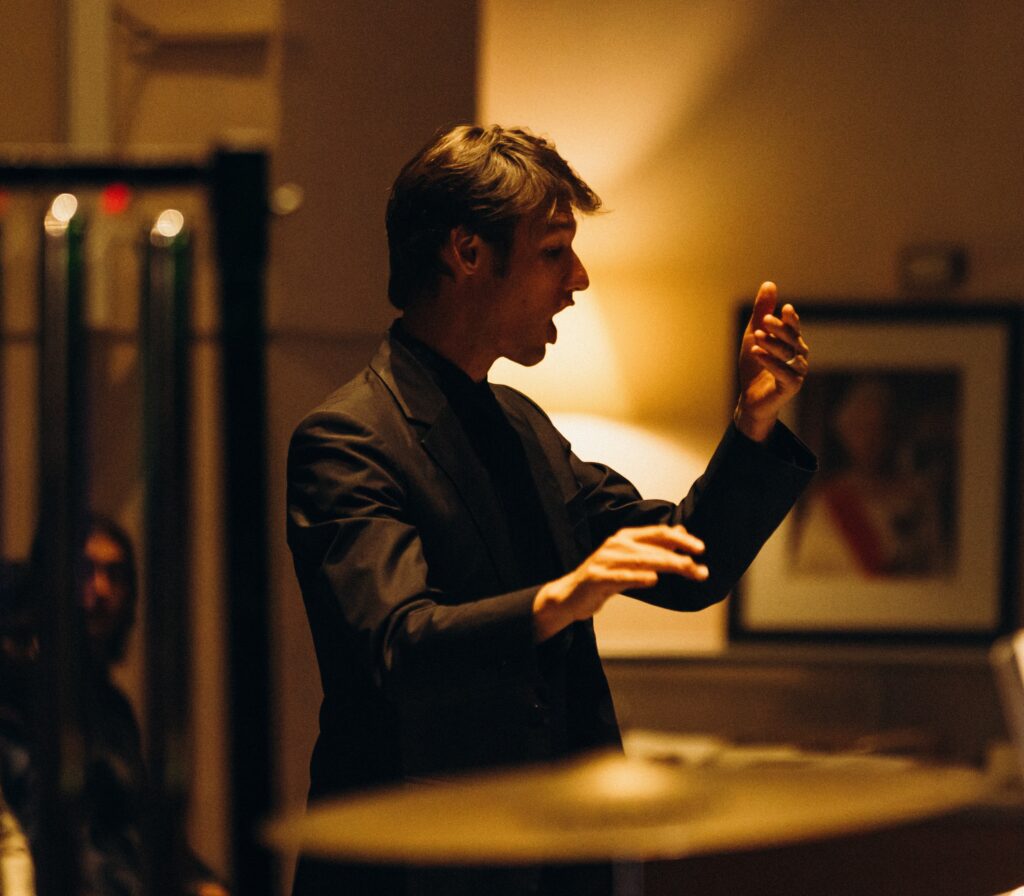
MIchael Stewart
Following his singers was music director Michael Stewart, whose appearance occasioned a withdrawal of tones from the various instrumentalists in favour of eerie, almost spectral percussive sounds, intended to accompany the Consort’s singing of the Prologue – in effect, Lassus’s own sung introduction to his set of Sibylline Prophecies which were to follow. Beginning with the words “Carmina chromatico” , this enchanting episode ( performed by the Consort Voices just as the composer had written) struck me in that instant as the kind of musical “sound” this building was surely created for, as celestial an effect as was the singers fan-like dispersal at the end to both sides, whilst still singing, the sounds augmented by soft percussion and harp in a seamless, dream-like flow!
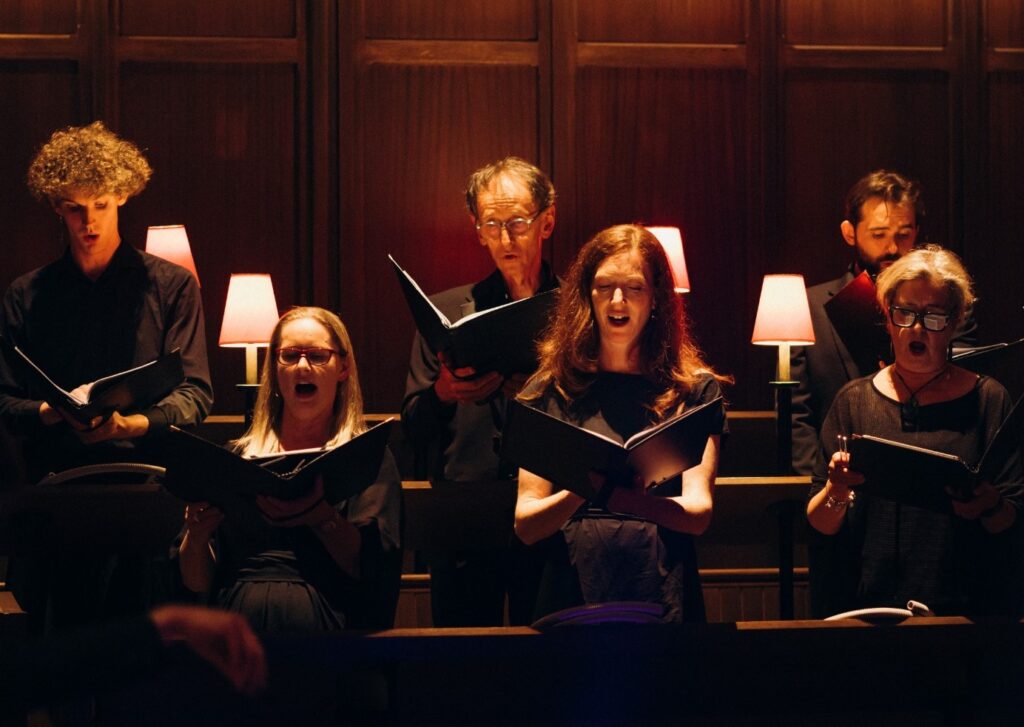
Tudor Consort Singers
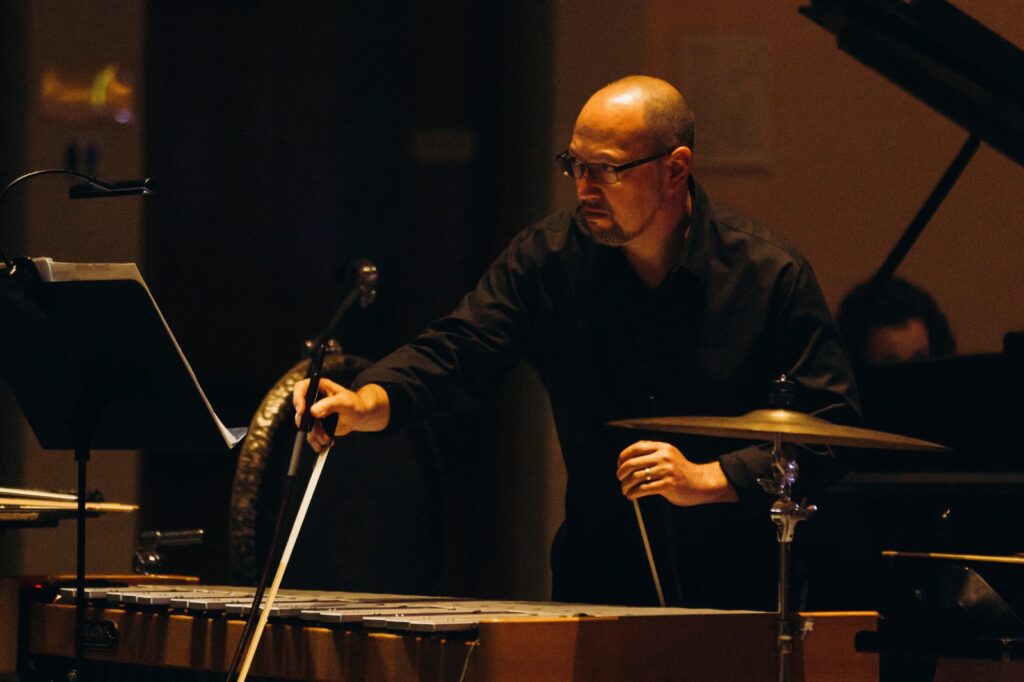
Lenny Sakofsky, percussion
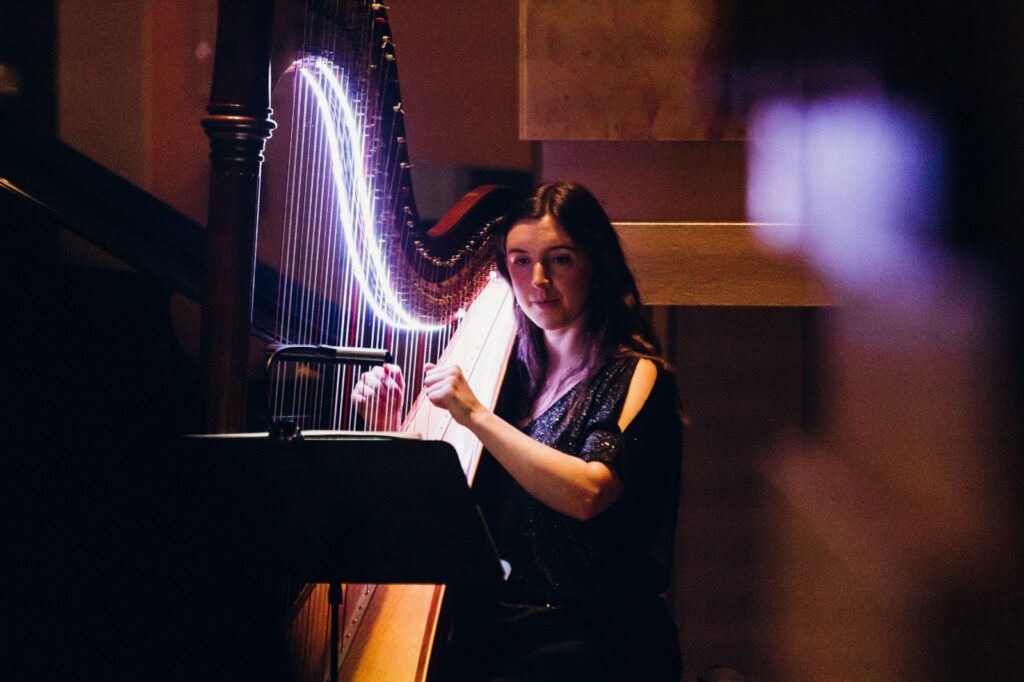
Michelle Velvin, harp
At this point one sensed that the music was preparing to “take flight” from its place of origin, as if we were present at the very act of creation, with the sounds inspired by Lassus’s following “Sibylla Persica” seeming to themselves resonate and augment their own existing ambiences – I could make out some of the Sibyl’s words at the beginning – “Virgine Matre satus…” but with the sounds seeming to follow composer Michael Norris’s idea of introducing qualities of utterance such as “cloud-like time-stretching”, encouraging our listening sensibilities to perhaps soar, or, conversely, cease physical movement in favour of hitherto unexplored realms. This delightfully disorientation of time and space accompanied a rich resonance of taonga puoro instrumental detail, sounding for all the world like birdsong as if emanating from a deep and hitherto undiscovered adjoining valley.
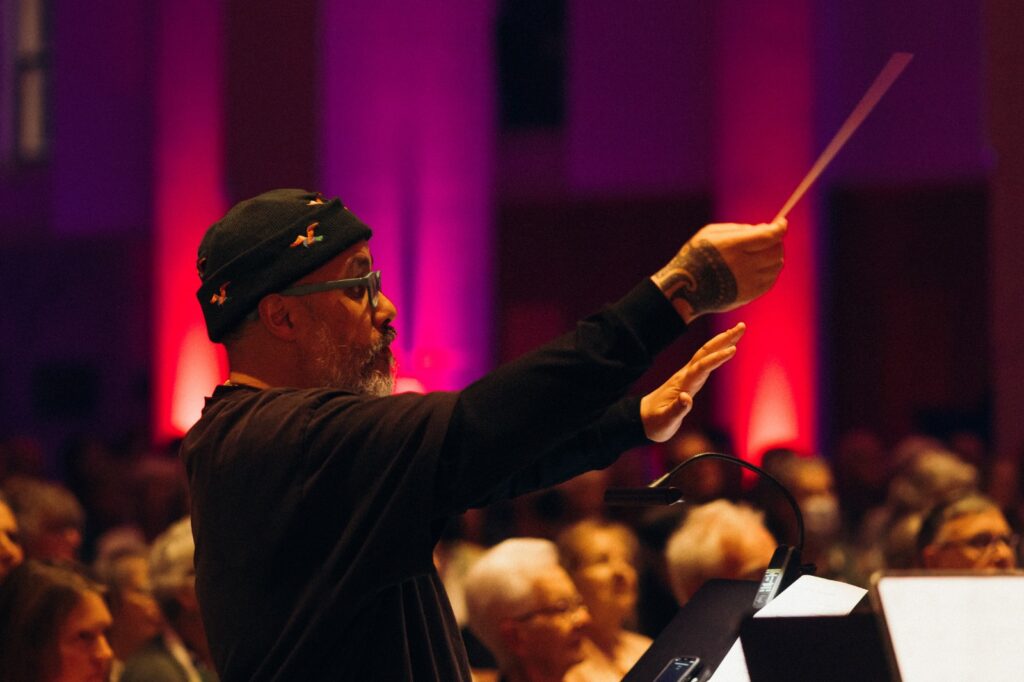
Riki Pirihi – director, Rangatuone Ensemble
What this did was disengage me from the singers words’ and their meaning from here onwards, save for the occasional phrase, such as the emphasis given to the line “…ille Deus casta nascetur virgine magnus”, with those birdsong ambiences rising to a great outpouring of forest amplitude with voices and instruments. I presumed this was a depiction of ”Whirl / Komiro” with the splendid bullroarers helping to build up the ambieces leading to the “Oscillate/Kopiupiu” with its almost visceral pendulum-swings, expressing the idea of surpassing nature’s work “by he who governs all things”. For the rest I simply gave myself over to the repeated phrases and their mesmeric effect bearing my sensibilities aloft, the sounds again vindicating the building’s capacity to creatively augment any such potential resonances to their utmost effect.
I found myself led by instinct by an upsurge of beatific vocal lines floated in “Sibylla Cimmeria” , with its reference to “Eco lucebit sidus ab orb Mirificum” (And the star shines from a wonderful orb), sounds which here create as celestial and unworldly an ambience as any music has a right to sound. A subsequent dark and portentous episode enabled me to surmise that we had reached “Sibylla Phrygia” with its punitive words “…punire volentem Mundi homines stupidos” (…wishing to punish the stupid men of the earth)…..the grim, forceful accents which characterise the sequence strike an appropriate contrast afforded by the final “Sibylla Agrippa” with its music’s return from the dark depths.
With the choir reducing its size and the taonga puoro taking up a “cleansing” sound-palate, the time for reconciliation seemed at hand. Nature is returned to accord as the whole choir gathers, inviting the furthest-flung strands to renew unanimity and kinship. All is heightened by euphoric sequences of aleatoric vocalism, creating a kind of hubbub of renewal into which all strands are gradually wound – the choir pauses to allow the natural world its primacy, before the voices join in, the lighter voices overlapping with stratospheric tones representing a kind of “on high” overlordship, with tones constant and glorious, to which the organ adds its mighty voice.
Standing ovations can become cliches, but in this case one found oneself propelled upwards and on one’s feet by the sheer force of delighted response to join in with the acclaim. Afterwards, reactions and opinions I shared stressed the magnitude and splendour of the occasion, with some, like me, admitting to the expectation of hearing more clearly other parts of Lassus’s music in the manner presented by the Prologue – but instead his music became the deep well from which irresistibly gushed all kinds of time-and-place elaborations upon his themes and texts, proving in a very visceral sense the fantastical “onreach” of artistic impulse!
One certainly with which to grace the capital’s music performance chronicles – and perhaps even to record for posterity (the latter already done and dusted?) However caught and held, this was a memorable addition to our part of the world’s distinctive sonic voice!