Deliciously unfamiliar/eminently listenable music from little-known French composer Michel Corrette

MICHEL CORRETTE (1707-1795) France
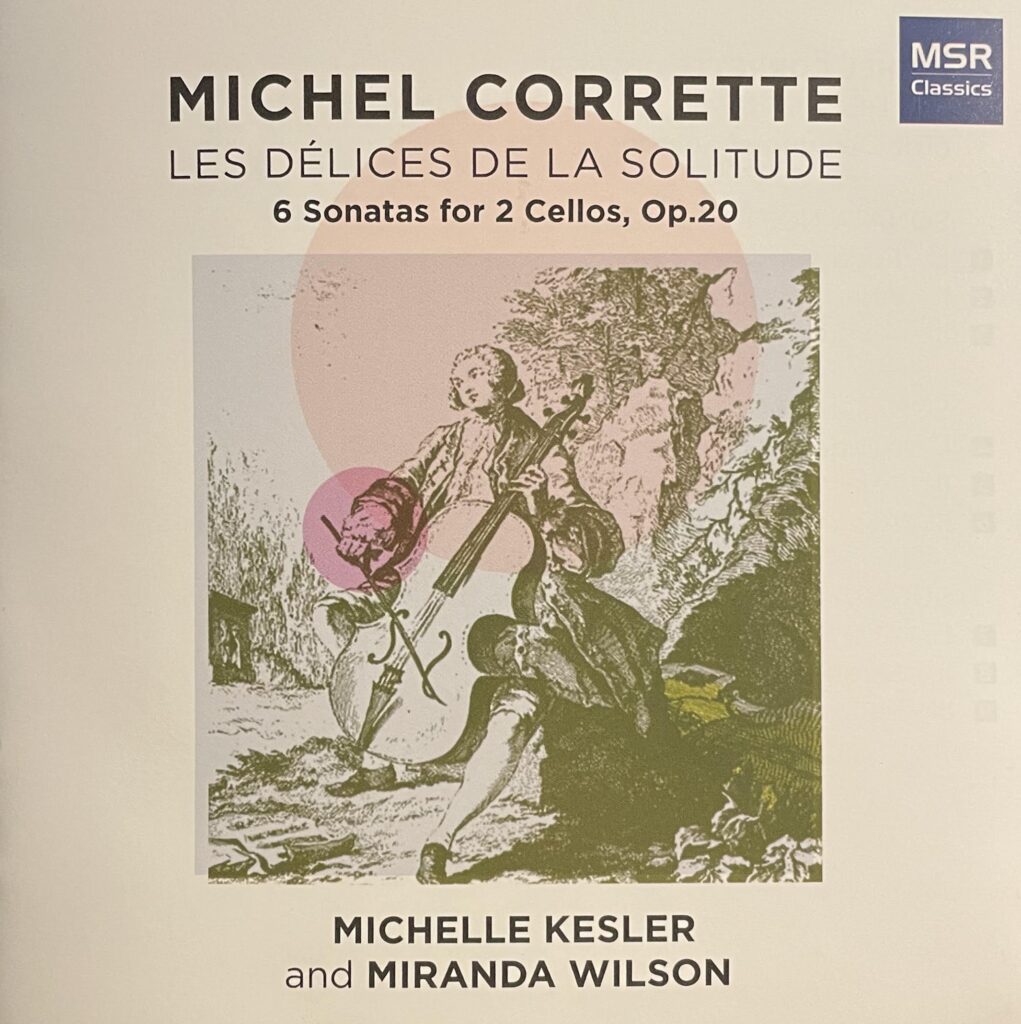
LES DELICES DE LA SOLITUDE – Sonatas Op. 20 Nos.1-6

Michelle Kesler –  ‘Cello I Sonatas 2, 4 & 6  / Cello II
Miranda Wilson – ‘Cello I Sonatas 1, 3 & 5  / Cello II

MSR Classics MS 1832

Recorded November 2024 in the Recital Hall at Brigham Young University, Provo, Utah, USA

“In the spirit of friendship between ‘cellists, we hope listeners will enjoy this lively conversation between instruments” writes ‘cellist Miranda Wilson in her notes accompanying a delightful recording that has come my way, of music by a composer whose name I did not know, one Michel Corrette, born in Rouen, France in 1707. In this case, it’s amusing to associate the ready camaraderie between the two musicians featured on this recording with a work whose six sonatas have the collective subtitle  Les délices de la solitude (The Delights of Solitude) – however, although it would seem that Corrette’s set of six sonatas were originally for solo ‘cello plus basso continuo, they’re here assigned to two ‘cellos, whose demonstrably equal share of the lines makes for great satisfaction, as much obviously in performing as in our listening!

Cellists Michelle Kesler and Miranda Wilson are the players on this recording, made in November 2024 at Brigham Young University in Provo, Utah – at the time both were Professors of ‘Cello at their respective teaching places, Kesler at the aforementioned Brigham Young University, and Wilson in the neighbouring state of Idaho at the eponymously-named State University in Moscow, Idaho. We’re given detailed guidance as to which player is “Cello I” in each of the sonatas, Kesler conveniently taking the “lead” in Sonatas 2, 4, and 6, and Wilson in the other three. The presentation nicely completes the collaborative nature of the whole by presenting the works in numerical order.

My first listening impression (Sonata No. 1 in F Major) was of a slightly more spacious acoustic for the two instruments that I thought I was going to fully enjoy, but, as with any concert or recording one encounters, one’s ears can take a little while to, in Michael Flanders’ immortal words on his and Donald Swann’s “At the Drop of A Hat” live recording, “get the pitch of the hall” – and by the first movement’s end the sounds had found and “inhabited” their places for me with music which had by this time amiably teased, cajoled and enlivened my spirits!

Miranda Wilson entertainingly draws attention to Corrette’s music corresponding with the rise of the ‘cello as a solo instrument at the expense of the viola da gamba in popularity at this time, one taken advantage of by, firstly, the publication of these sonatas at around 1739, and the composer’s 1741 treatise Theoretical and Practical Method for Learning the ‘Cello to Perfection in a Short Time. Something of the ferment of the controversy is excitingly suggested by a pamphlet circulated in 1740 by a French lawyer and amateur viola da gamba player Hubert Le Blanc, one which bore the contentious title Defence of the Bass Viol against the Enterprises of the Violin and the Pretensions of the ‘Cello! – wot larks! Le Blanc’s somewhat intemperate rationale regarding his instrument’s superiority has since seen its consignment to the realm of the specialist, by no means obliterated, but put in its place by history!

Here, we are invited to indulge in the composer’s obvious enthusiasm for the then still new-fangled instrument (Corrette’s aforementioned treatise was the first French publication of “a theoretical and practical method” for aspiring cellists) – and the sonatas as recorded here feature a kind of “coming together” of solitudinous delights, with each ‘cellist by turns blending their instruments’ solo lines with their partners’ roles as contrapuntal voices, the modes somewhat antithetical in these pairings but, in situ, delightful.

Sonata No. 1 straightaway dances into a Fuga, marked Allegro, the counterpoints unselfconsciously switching from first to second voice in non-hierarchical exchange, its composer obviously allowing his originally-wrought basso continuo a satisfyingly comparable response to the soloist here, and also in the Affetuoso Aria that followed – and the Allegro finale makes for as “companionable” a solitude as could be imagined!

The D Minor Sonata No. 2 begins with a more driving Allegro, with lots of “fizz” to some of the exchanges, and the ensuing Affetuoso, with its contrasting Arias I and II underlining a poignant operatic-like interaction, not unexpectedly calling for some resolution – a CPE Bach-like Allegro staccato did the trick, those brusque, attention-grabbing initial notes making for a splendid “what’s all this, then!” kind of denoument!

I loved the easy, loping stride of the C Major No 3’s Allemande – a kind of relaxed “bustle” of an Allegro, and then with both this and the equally bucolic concluding Fuga da capella third movement enclosing an unexpectedly concentrated middle-movement Sarabande. More concentrated intensities came with both players’ deep-diving into the following E-flat Major Fourth Sonata’s opening Adagio, one that conveyed a more-than-usual sense of solitude on the music’s part. This dramatically tipped over and into a Corrente, an exhilarating running-sequence leaving one breathless but energised enough to take on board the music’s almost hymn-like Aria which followed – little did we realise we were being primed for a “call-to-arms” with the succeeding “Brut de chasse” here rousing and enthralling our sensibilities with sounds and sensations of an army on the march!

Further excitement came with the galvanic Presto Prelude to the Fifth Sonata in G Major, in which one imagined our two cellists enjoying an “Anything you can do” exchange, with hair and resin flying! The following Allemande, though more leisurely an Allegro took us on a reasonably aerobic stroll, a mood which was at once echoed and calmed by a graceful Sarabande – here, a winsome and exploratory partnership that brought peace to one’s soul. As well for such respite, with the sharply-etched Presto finale that followed mischievously breaking the mood, snapping playfully at dancers’ heels.

Glorious and celebratory were the Handelian flourishes which opened the final sonata of the set, the 6th in a joyous D Major. Here, strangely, it seems the MSR Classics booklet prints the incorrect names and tempi for the movements – the opening Preludio has a grand, ritualistic character which should be Allegro Moderato, not Presto. And this suits the solemn, ceremonial gait of the second movement Aria, not Allemande – Allegro as listed here. Finally, the players skip merrily into a concluding Gigue (not in the least bit like a Sarabande!). It all made for a bit pf a puzzle on a first listen, but one well worth solving, and which Michel Corrette himself might possibly have regarded with amusement rather than annoyance  – after all, among his prodigious output were no less than twenty-five “Concerti Comiques”, pieces for vocal and instrumental ensembles which were often “fun” settings of popular tunes and well-known opera themes, and written largely to be used as “entractes” during performances of comic theatre.

This was revelatory stuff for me – listening to the disc right through was like being taken on some kind of “tour” of a specific time and place in European musical history – though he lived in the same era as his fellow countrymen Rameau, Leclair, Boismortier and Mondonville, and at the same time as Handel, CPE Bach, Gluck and Pergolesi,  Corrette’s music survives comparison with these more famous figures due to its craftsmanship and its composer’s penchant for capturing elements of different styles and blending them in singular ways. The voices of his influences are in places unmistakable but he manages to make the results of their synthesis his own. The only comment I wanted to make of a questioning nature concerned repeats in the various movements, so many of which seemed to finish before I wanted them to! –  and moments such as those made me wonder what the scores of these works indicated were the options for the players who perform this music. I would be interested to find out more regarding this subject. For the rest, to the composer and performers, simply “Bravo! C’est magnifique!”

Music that unfurls the Colours of Karori’s splendid Futuna Chapel


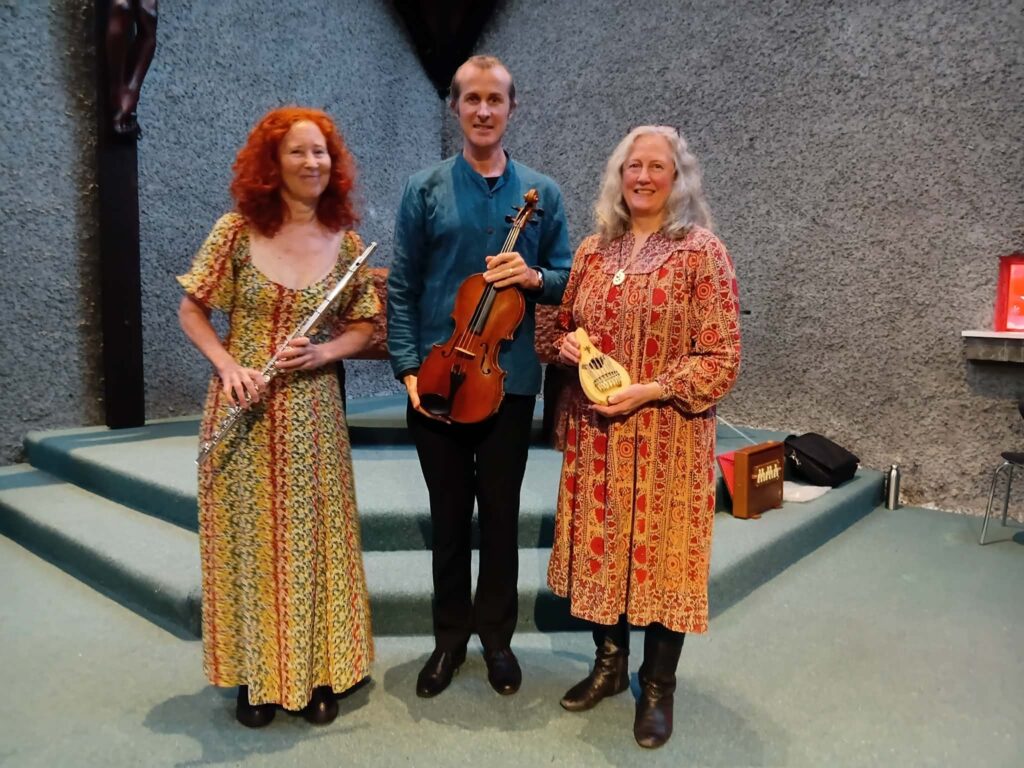
“Something old, something new…”  – the Elementi Trio at Futuna Chapel, July 2026Monica Verburg, Nicholas Hancox and Pepe Becker

ELEMENTI TRIO –
Monica Verburg – flute, alto flute
Nicholas Hancox – viola
Pepe Becker – soprano, thumb piano (mbira)

Futuna Chapel, Karori, Wellington
Sunday, 5th July 2026

Sitting in Futuna Chapel, in Karori, on a recent Sunday afternoon, listening to a concert of music given by a trio of extremely talented performers (flutist, violist and soprano vocalist), I found myself thinking at various stages of the concert about the sheer beauty of the sounds being brought forth by these musicians. I’m sure that, given the singular beauty of the venue’s overall atmosphere, ambience and amalgam of design and colour, I was allowing those qualities to infuse the music’s impact beyond the realms of a simple auditory response and into a kind of totality of experience that transcended “normal” listening. Be that as it may, the effect of these different factors conspired to produce a level of enjoyment of this concert’s music-making that has stayed with me right up to this moment.

Interestingly, the very first item of the concert seemed to me as much a “test run” by the performers, almost a “getting the pitch of the hall” kind of run-through with an audience present for the musicians to be able to sound out things like the balances between the instruments and the voice, and the degree to which the sounds “come back” from the peopled ambient spaces. I did find this first item (Thomas Morley’s madrigal “Arise, get up, my dear” a trifle chaotic in its full-blooded amalgam of sounds – and yet the music is actually about incidental chaos, being Morley’s musical description of the hustle and bustle of a new bride’s wedding day. More spacious and wide-ranging was Pepe Becker’s singing of Hildegarde of Bingen’s “O Euchari” which followed, the singer enabling her voice to “ring down the ages” from Hildegard’s time, with Nicholas Hancox’s viola steadily recreating the age-old drone accompaniment. A third item completed an opening “triumvirate” of the concert’s range and scope, featuring a home-grown work, Pepe Becker’s own setting of a sixteenth-century poem “T’amo mia vita” (I love you, my life) by Giovanni Battista Guarini, originally written for three voices and mbira “thumb piano” but here recast by Becker for soprano, viola and mbira – the latter is an African instrument and was played here by Becker herself, its sound creating a kind of timeless, tonally transcendent “voice”. The words of the poem have a universality which here seemed to fit the composer’s revised setting as much as it must have her all-vocal original!

We heard three more of Pepe Becker’s by turns playful, declamatory and darkly visionary pieces placed separately throughout the concert, the delightful “Two Tui” a work for flute premiered by Bridget Douglas in 2010, and essayed here most viscerally by Monica Verburg, the music based on two separate calls associated with different places in Wellington, and brought together as a kind of dialogue, with a petulant dismissive squawk of one bird at the other’s expense at the end! Becker’s more expansive, almost ritualistic piece, “Scorpio II – From the far point of the Rising Sun” featured her soprano voice enacting a kind of ritual exchange with the solo flute. Long, sonorous lines alternating with stately roulade-like flourishes before the dialogues become intricate and earnest (though no words were provided – I presumed the singer’s phrases were in Latin), the lines occasionally mirroring one another before concluding the piece with some brief mirror-image shared phrasings. Most suggestive for me was her darkly resonant tribute to Sagittarius, a setting of William Blake’s “The Tyger” a work Becker dedicated to her father, along with her “many Sagittarius friends” – something of a “Do not go gentle into that good night” work of darkness and angst, the sombre tone set by Nicholas Hancox’s opening viola chord, though the trio fetched up more incisive and trenchant tones for the poem’s “fearful symmetries” (it was a work composed for this concert, in fact!).

Bringing her own creative talents to this cornucopian assemblage was flutist Monica Verburg, who contributed no less than two recently-completed pieces for premiering at this concert, the first one a heartwarming and environmentally topical work titled “To the Hills” (Ki ngā puke), being inspired by a recent campaign of conservation of Otago’s Dunstan Mountains. Verburg drew our attention to the piece’s influences, a certain “Celtic flavour” in accord with early European settlement of this area, and which the trio of musicians made much of in performance throughout the piece’s three sections, The other recent work of Verburg’s was  “In the Slipstream” a delight for the ear in its interplay between two instruments, flute and viola (the flutist often swapping between flute and alto flute in her performances, which variation, to my shame, I seem to have neglected to draw any attention to in my notes – mea culpa!) Here, the two instrumental  lines  imitated, shadowed and mimicked one another constantly, with (I thought) occasionally bluesy inflections spicing the sounds ever so slightly, as the music, by turns teased and blended its two strands before drifting into a pensive ending.

Monica Verburg was as well responsible in full or in part for four other items, two of them original works and two arrangements, the first original work “Turn Your Eyes”, originally composed in 2024 for soprano and alto recorder, and then rewritten for soprano, flute and viola – the words were based on the text from Proverbs 4:25 “Let your eyes look straight ahead….” Though the combination of tones made it impossible for me to decipher any of the actual text, the sounds in tandem, though brief, were themselves glorious! We then heard a song “Ocean Breeze” (aha! – in my notes is a mention of the ALTO flute!) – here, Pepe Becker’s soprano and Monica Verburg’s instrument were wistful companions at the song’s opening, one whose melody readily caught the ear in balladic fashion! The two arrangements made by Verburg were for larger-scale forces as one might have expected in her grand setting of Giovanni Gabrieli’s “Jubilate Deo” with its splendidly ceremonial trappings, not to mention the fulsomeness of the text – “Shout joyfully to God, all of the earth!” – what attention-grabbing gesturings (suggesting, of course, antiphonal voices) and declamatory utterances, complete with brief, wistful occasional minor-key harmonic turns, just for variety! Great stuff!

Before I mention in conclusion the concert’s final item (Verburg’s second “arrangement”) I need to recap with still more “gems” which came up in passing  – one was non-vocal, Jack Body’s “Aeolian Harp”, here most evocatively realised by Nicholas Hancox’s viola, capturing the piece’s extraordinary and irresistible frisson of intensities gleaned from nature’s random impulses. Then there were three medieval “pop” numbers from the fourteenth and fifteenth centuries, the earliest of which was Guillaume de Machaut’s “Douce Dame Jolie”  (Sweet. Lovely lady)  – performed here with the viola as the drone instrument and the flute as a companion for the voice – what an uncanny sense of time and place, here, with music making its way to us centuries later! Of the two other later works, one (“Quel fronte signorille” (That noble brow) by Guillaume Dufay) had a similar “courtly love” sentiment no less resonant and focused than de Machaut’s, while the other (a motet “Quam pulchra es” by John Dunstable) was by contrast an unashamedly erotic setting of words from the Biblical “Song of Songs”, its performance here suggesting a parallel musical “enchantment by beauty”.

By the time we reached the programme’s final item everything seemed suffused with a spirit of complete capitulation towards the music and its making, one suitably enhanced by Monica Verburg’s inspired arrangement of this concluding music. Flute and viola began the “thistledown on the wind” introduction, the former extempore and the latter holding a firm foundation line. The scene having been set, the voice then entered with the famous melody “Hine e Hine”, one written famously by Princess Te Rangi Pai (the stage-name of Fanny Rose Poata – b.1868 d.1916), composed in or around 1907. It felt like a kind of “homecoming”, one returning to something deeper than the present, and with enveloping tendrils of belonging, easier to “feel” than to explain. But in tandem with the glories of the venue in which we had enjoyed these sounds it “rounded off” for me (and for others I spoke to at the time) a most agreeable afternoon’s music-listening!

Lights which keep us from darkness – CLAUDIO MONTEVERDI – Vespro della Beata Vergine 1610

CLAUDIO MONTEVERDI – Vespro della Beata Vergine 1610

The Tudor Consort, directed by Michael Stewart

Sopranos: Anna Sedcole, Erin King, Jane McKinlay, Lydia Joyce, Pepe Becker,
Rebecca Stanton   Altos: Andrea Cochrane, Alexandra Granville, Helene Page,
Alexandra Woodhouse-Appleby, Kassandra Wang, Maaike Christie-Beekman
Tenors: Axel Tie, John Beaglehole, Josh Long, Phillip Collins, Philip Roderick,
Richard Taylor   Basses: Brian Hesketh, David Houston, Frazer MacDiarmid,
Joshua Jamieson. Keith Small, Matthew Painter

Violins: Greg Squire, Anne Loeser   Violas:  Sophia Acheson, Lynsey Mountford
‘Cello: Jane Young    Viola da gamba: Imogen Granwal   Violone: Joan Perarnau Garriga
Cornetti: Danny Lucin, Matthew Manchester, Peter Reid   Recorders: Kamala Bain,
Katrin Eickhorst  Sackbuts: Peter Maunder, Byron Newton, Jon Harker
Dulcian: Ben Hoadley   Lute; Jonathan Le Cocq   Organ: Bethany Angus

St.Mary of the Angels Church, Boulcott St., Wellington
Saturday, 13th September 2025

Claudio Monteverdi’s 1610 Vespro della Beata Vergine (Vespers of the Blessed Virgin) could well lay claim to be the composer’s equivalent “signature work”  to that of Georg Frideric Handel’s  Messiah. Of course the latter’s popularity has never been in doubt,  triumphantly surviving even its somewhat grotesquely-inflated periods of presentation throughout the nineteenth and early twentieth-centuries, and continuing (in more “authentic” formats) to be widely-performed today. Monteverdi’s work, on the other hand, written well over a century earlier, has by comparison both a mystery-shrouded genesis and early performance history.  The work’s 1610 publication was in the form of eight partbooks rather than as a single, complete score, of which it seems only one has survived – and no performance of the Vespers in the composer’s lifetime has been documented. It wasn’t until 1932 when the first “complete” edition of Monteverdi’s works appeared that the work as a whole began to receive attention from scholars and performers, attention which has since come to represent almost iconic status!

Today with the help of both recordings and (happily, here in Wellington) “once-in-a-blue-moon” stellar live performances, we can be freshly astonished at the grandeur and splendour wrought by such an opulently resonant sound-window as that thrown open by the present performance. My own introduction to the work was in 2010 at the same venue through St Mary of the Angels’ then music director Robert Oliver’s magnificent celebration of the work’s 400-year existence with local singers (Baroque Voices) and instrumentalists (Academia Sanctae Mariae) – see the review at https://middle-c.org/2010/08/resplendent-monteverdi-at-st-mary-of-the-angels/  A quote from that review equally applies to what I heard just the previous evening (incidentally, with a few of the same singers and instrumentalists who performed the work in 2010) – one that remarked upon “virtuoso singers and players with a brilliant command of all the instruments and techniques”.

Tudor Consort director Michael Stewart chose not to use the Antiphons included by Oliver in his performance  (antiphons are texts, sung or spoken, used in conjunction with Psalms (quotations from the Old Testament) to rejuvenate the meanings of the latter in a more “Christian” sense). Monteverdi pairs each Psalm with a Motet, the latter termed  “sacred concertos” intended more as a contrast to, rather than an expansion of the Psalms – the wonderful verses Nigra sum and Pulchra est, for example, both being texts from the Biblical “Song of Solomon” – though the Psalm Lauda Jerusalem, is followed by a Sonata sopra Sancta Maria. Such differences between performances serve to indicate (here, admittedly, in a relatively minor way) how arguments might have developed regarding what ought/ought not to be included in the Vespers, and which have continued over the years since the work’s new-found world-wide popularity. Like all great music, it remains a work in progress rather than a museum piece!!

Long before the first note of the work was sounded, the atmosphere in the church was burgeoning and vibrant, the venue having almost filled up half-an-hour before the starting-time – amazing! If ever one wanted an indication that the city’s receptiveness towards and appetite for the performing arts was demonstrative and urgent, this all seemed as propitious a sign as any. To enthusiastic applause the musicians at last appeared to take their positions, the work beginning with tenor John Beaglehole’s ringing entreaty of the Almighty  – the opening of Psalm 70, with the words  “Deus, in adjutorium,meum intende” ( O God, make haste to deliver me!)  – followed immediately by the choir’s equally sonorous “Domine,  adadjuvandum me festina”!  (O Lord, make haste to help me!) accompanied by a fanfare-like orchestral panoply that its composer had previously used to begin his opera La favola d’Orfeo, a melody whose impact holds fast to its theatrical and emotional glory here as much as elsewhere.

What an amazing roller-coaster ride Monteverdi gives both his musicians and his listeners! Time and space obviously precludes a detailed description of the entire performance, so a modicum of description will serve to illustrate – suffice to say that Michael Stewart’s consistently vital direction infused his singers and instrumentalists with an infectious sense of joy and purpose throughout even the most complex figurations and deeply-felt sonorities realised by the presentation. And, as much to the work’s sense of the momentous and ceremonial, we were drawn into its rather more personal and intimate moments by the singing’s and playing’s beauties, evident in particular during those various “sacred concerto”  motets.

Beginning with that solo-voiced declamation, and those answering fanfares and choral entreaties came the first psalm setting, “Dixit Dominus”,  with its six-part choir combining steady sonorities in places (Sede a dextris meis – “Sit at my right hand”) with exciting rapid-note and -phrase emphases (Donec ponam inimicos – “Until I make  your enemies your footstool”). Sopranos Anna Sedcole and Erin King  voiced beautiful exchanges and adroit teamwork (Virgam virtutis tua emittet Dominus ex Sion – “The Lord shall send out the rod of thy strength from Zion”), while the choir’s different voice strands created great excitement with Dominus a dextris tuis confregit in die ira sua reges (“The Lord at thy right hand shall destroy kings in the day of his wrath”), the whole, with its interspersed contrasts between tonal beauty and physical excitement enticingly preparing us for what was to follow further.

An unfortunate audience sneeze briefly interrupted (but fortunately didn’t impede) the beginning of the beauteous Nigra Sum one of two excerpts from the “Song of Solomon” – texts used here in both cases for motets intended to be “antiphon substitutes” in a Vespers Service.  Here, tenor soloist Richard Taylor Taylor relished the delicious word-painting describing a black woman’s beauty, and the music’s animation at the King’s response to her charms, concluding with a gracefully-delivered final Tempus putationes advenit (“The hour of pruning is at hand”).Though the texts of this and Pulchra Es seem almost to border on the erotic, there was at this time in certain quasi-sacred works something of a sensual view of the soul of the Mother of God in line with being a spiritual kind of “Bride for the Church” – a similar attitude voicing this somewhat elevated kind of eroticism in relation to Mary appears also in the Psalm Audi Coelum later in the Vespers.

The ensuing Psalm Laudate Pueri Dominum was suitably adorned by warm and fluid texturings from the outset, individual voices  introducing separate strands beautifully cohering into descriptions of “the rising and the setting of the sun” (A solis ortu usque ad occasum) and of transformations of peoples lives – the men’s voices proclaiming Suscians a terra inopem (“He raises the simple from the dust”) and joining with the women’s voices to simply proclaim Ut collocet cum cum principibus (“That he may set him with princes”) – so beautiful! I enjoyed also (as did the singers) the “happy ending” of the phrase concerning the “barren woman” as becoming  matrem filiorum latantem  (“A joyful mother of children!”).

While not effacing my memory of Pepe Becker’s and Jayne Tankersley’s voices in 2010 with the erotic charge of their “Pulchra Es”, sopranos Anna Sedcole and Erin King here blended and intertwined their voices with echoes of the same, if with a notch or two’s gentler suggestiveness. In “Duo Seraphim”  it was the turn of the “Three Tenors” to shine, with Phillip Collins’ and Richard Taylor’s voices both floating their individual lines and negotiating their repeated-note phrases with confidence, joined by Philip Roderick at Tres sunt, qui testimonium  (“There are three who bear witness”) to reaffirm the Trinity. The ten-part double-choir forces of the succeeding “Nisi Dominus” gave us great, rolling sound- trajectories at the beginning, with energies aplenty enlivening both  Vanum est vobis ante lucem surgere (“It is vain for you to rise before dawn”)  and the rapid-fire triplet passages at Sicut sagitta in manu potentis (“As arrows in the hands of the mighty”), followed by a grand and rollingGloriawith a blazoned “Amen”.

The second half brought us an exquisite setting of the Psalm Audi Caelum, tenor Phillip Collins  pouring  whole draughts of feeling into the opening words Audi verba mea plena desidero et perfuse gaudio (“Hear my words full of longing and pervaded by joy”)and straightaway beginning a paean of fulsome praise of the Virgin Mary as a woman, again enthusiastically blurring any boundaries dividing secular worship from  sacred devotion, the text somewhat coming to its senses as the declamations continued! Throughout, the echoed responses of the distantly-placed Philip Roderick seemed to exert a charged, “time-standing still” effect on the scene giving rise to a kind of magical wonderment of being.

“Lauda Jerusalem” which followed was guaranteed to break such a spell with gusto! – the singers seemingly to “melt” the bar-lines and fuse the irresistible trajectories of the  music into a kind of unstoppable flow! A stately and solemn Gloria at the end brought us to an equally conclusive and undisputed “Amen”, From these unbridled energies we were able to rest on what seemed like the immutable structures of the hymn “Sancta Maria”, the sopranos resembling snow-capped mountain peaks rising from the plethora of forests, ravines and plateaus suggested by the variegated instrumentql forces in their tireless, priestlike task of constant accompaniments of the “same-but-different” choral repetitions of the prayer.

In what seemed like no time at all we had left the mountaintops and were gazing at a star whose light spanned a vast ocean – Monteverdi’s first three verses of the hymn Ave Maris Stella (Hail, Star of the Sea) praise the Mother of God, rename Eve, the first woman, with the word “Ave”, and petition her with putting wrongs to right, light to darkness and bad to good. Each verse was followed by a different instrumental scoring with the aforementioned three choral (all delightful), the next three with solo voices (all characterful – soprano Rebecca Stanton, alto Maaike Christie-Beekman and bass Frazer MacDiarmid) and with a return to the choir for the last one. And with that we came to the Magnificat, the equivalent of a skyful of stars!

Monteverdi included two setting of the Magnificat in the 1610 Vespers publication, the first seven-voice part one being that used here. The twelve sections each feature a vocal line, either solo or with other voices, sometimes silent and at other times joining the instruments in the elaborations – the clear, long tones of the chants are thus festooned with what must have seemed like “music of the spheres” to Monteverdi’s musicians and listeners – as one critic put it, “dazzling variety married to simple unity” – as if it were the “Maris Stella” of the piece,  the steady light to which all else seems drawn. I enjoyed the vigour of Matthew Painter’s and Joshua Jamieson’s  Quia fecit (“For he that is mighty”), as I did the evocative echo-play between Phillip Collins and Philip Roderick against the women’s beautiful “Gloria”  – but found myself equally touched by two well-remembered voices from that 2010 Vespers, soprano Pepe Becker’s and alto Andrea Cochrane’s blending beautifully and indeed appropriately at Esurientes implevit bonis (“He hath filled the hungry with good things”).It was an apt metaphor for the musical feast to which we were being treated.

Such works as these Vespers stay in the memory as do lights which keep us from darkness  – what can one say, except to express boundless gratitude to the composer and his work’s devoted performers!


“The Choicest Songs” – an Anniversary concert from Baroque Voices at Futuna Chapel, Karori

Baroque Voices at Futuna Chapel,  Karori,  Wellington,
June 2024
David Morriss (bass), Pepe Becker (director, soprano), Douglas Mews (keyboards), Robert Oliver (bass viol)

                                  Futuna Chapel, Karori

Baroque Voices presents “The Choicest Songs”
A presentation celebrating the 30th anniversary of Baroque Voices
and commemorating various other anniversaries pertaining to Futuna Chapel and its creation

Music by John Dowland and his contemporaries
also Henry Purcell, Monica Verburg and Pepe Becker

Baroque Voices – Pepe Becker (soprano), David Morriss (bass)
Douglas Mews (virginals and recorder), Robert Oliver (bass viol)

Futuna Chapel, Friend St., Karori, Wellington

A review by Peter Mechen (Middle C)

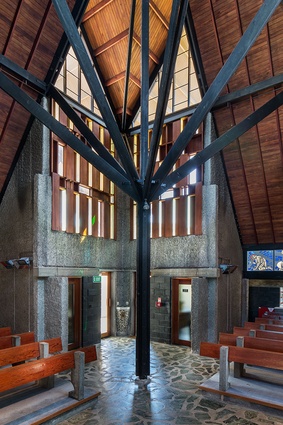
On a still and sunny day, Futuna Chapel (built in 1961) in Karori exudes a unique interior atmosphere wrought by the play of light through angularly-placed stained-glass windows  contrasting  with rather more secluded interior vistas. It’s a singular version of a kind of eternity, one vaster than the actual limited spaces might give one to suggest, but compensating with the mystery wrought by the contrasts. It’s no longer a consecrated chapel, as was the case when I first arrived there as a wide-eyed student from a Palmerston North Catholic school in the 1960s, making one of two separate live-in spiritual retreats here, and relishing  on each occasion what used to be (alas, no longer) a surrounding hinterland of native bush through which one could walk and contemplate what seemed like a natural extension of the intangible mysteries I and my classmates were steeped in at that age.  (I freely admit it wasn’t entirely a haven of concentrated spiritual refurbishment, as we fifteen year-old boys seemed to all too readily find clandestine ways to entertain ourselves in more worldly pastimes thru  games of cards and dice in more secluded parts of that magnificent stand of bush!).

Today, however, was dull and overcast in Karori, as it was elsewhere in Wellington, with the chapel interior having all the more austere and gloomy an atmosphere for our promised concert, organised by the indefatigable Pepe Becker, the “guiding Light” behind the Wellington group “Baroque Voices”, whose 3O-year performing anniversary fell this month. Fortunately the bustle and atmosphere created by an enthusiastic (and practically full-house) audience created an ambience of its own which even the “ticky-tacky suburbia” that has ravaged the once-verdant surroundings couldn’t entirely spoil once we were inside and registering the chapel interior’s still-stunning evocations of its own kind of spirituality.

Pepe Becker’s programme notes reminded us that today’s concert was an occasion of anniversaries, being the 100th birthday of Futuna Chapel’s architect John Scott, who died in 1992 at the age of 68. And, coincidentally, it was the first anniversary of another important creative artist, Jim Allen, four of whose sculptures are embedded in the chapel’s architectural fabric. These anniversaries prompted the Futuna Chapel Trust to commission from Pepe Becker a new work commemorating both architect and artist, one called “concrete, wood and light” and  to be performed at today’s concert.

But there were premieres aplenty today, with two others featuring songs Pepe had written dedicated to two of her performing colleagues, bass David Morriss and the viol player Robert Oliver. First, we heard a song called “Fog”, with words written by the poet Carl Sandburg, and secondly an “Ave Maria” setting , one with an extra dedication to Pepe’s former mother-in-law, Mary Becker, who died in 2022. These songs all included the overall title “Capricorn”, alluding to the star-sign all of the people involved (including the poet!).  Adding further distinction to the concert were two more premieres by a different composer, a pair of songs called “Reflections”, with both words and music written by a flute-player friend of Pepe’s, Monica Verburg, interested in the combination of voice and recorder. Pepe remarked upon the pleasure of performing so many of these songs in close association with the people they were dedicated to.

Besides all of this there were works whose sounds, sentiments and spirit expressed a defining aspect of Baroque Voices’ raison d’etre, songs variously by John Dowland and Henry Purcell rubbing shoulders with a couple of instrumental performances featuring music by lesser-known contemporaries, Tobias Hume (1579-1645) and a name I didn’t know, William Inglot (1553-1621). Though one often encounters the quote “Semper Dowland, semper dolens” from the composer’s own title for one of his consort pieces, not all of his music is steeped in melancholy, as the concert’s opening number demonstrated – Up merry mates, from Dowland’s last book of songs the 1612 A Pilgrimes Solace, was presented here as a lively dialogue song between a ship’s master (Pepe) and his crew (David) on the occasion of rough weather, one which contains a philosophical response to the whims of nature (and some extremely low notes which David Morriss did well to negotiate!). The following heartfelt Toss not my soul was, by comparison, more characteristically sombre, beautifully voiced by the singers and sensitively accompanied.

We then got two delightfully contrasting instrumental solos from Robert Oliver featuring the relatively unknown Tobia Hume’s music – firstly Adieu Sweet Love from the composer’s 1605 book The First Part of Ayres, and then the livelier The spirit of Gambo; then it was back to Dowland again, for an attractive, open-hearted Sleep, wayward thoughts, again expressing a mood somewhat removed from the melancholic character usually accorded his work. I do recall my mother, who was a music teacher, being extremely fond of some of the composer’s Lute Dances which had been transcribed for piano, a number of which were anything but melancholic (the cheerful My Lady Hunsdon’s Puffe being one that particularly sticks in the memory).\

Next were three Purcell songs, each demonstrating the composer’s gift for expressing the actual “energy” of words, the first song Come, let us leave the town from “The Faerie Queen” replete with lively, oft-repeated canonic “comes” and other persuasively impressive urgencies from the two singers, all in stark contrast to the following Lost is my Quiet, a soulful lament for what each singer describes as “life’s happiest part”, though we were given a semblance of contentment by the rather more lively While bolts and bars my days control,  a song describing the mind as unfettered and “freeborn” though the body be held in captivity.

Came the first of the “Capricorn” premieres, with Pepe Becker’s “Fog” leading the way, Sandburg’s text brief and unprepossessing, characterising the fog as a cat-like in its movements and aspect, David Morriss’s voice suitably dark and restrained, and Robert Oliver’s viol-playing spare and stark as befitted the scenario. This was followed by Monica Verburg’s “Two Reflections” for soprano and recorder, written earlier this year, the first “Turn your eyes” imploring the listener with stepwise figurations to “follow a path that’s good and true”, and with the final words “see the beauty all around” reminding one of Mahler’s use of Chinese poetry in part of his “Das Lied Von der Erde”.

The second song “Ocean breeze” had a more meandering kind of opening, one whose phrasings took up a gentle kind of siciliana rhythm, Pepe’s voice and Douglas Mews’ recorder-playing beautifully delineating their own courseways through scenarios lit up by the setting sun and framed by oceanic surgings. I remember at one point the text “ocean breezes come by with the promise of a new day” coincided with a gust of wind outside the chapel which we all heard make its presence felt!

The last of the three Capricorn settings was an “Ave Maria” written by Pepe last year (2023) but only now receiving its premiere performance – set for soprano, bass and bass viol, and dedicated to both David and Robert, the work was written also for Pepe’s “lovely former mother-in-law”, Mary Becker, and was performed today in her memory. The opening of the work had a kind of prayerful, reverential beginning, with a second part that became more interactive between the voices and more imploring via some beautiful ascending phrases, before concluding with repeated “Amens”.

More songs, firstly from Purcell and finally, Dowland – the two Purcell songs brought out some truly satisfying singing from both voices, firstly, we enjoyed Leave these useless arts in loving, the nimbleness of both voices a real delight, and then the absolutely delicious Come let us agree, from the composer’s “Timon of Athens”, the words containing sentiments than no-one present would have dreamed of disputing! – and especially in the wake of this performance!

The return of Dowland for the last three items in the “song” bracket brought a beautiful solemnity to the first of these, Flow my tears, a song that contained the words “Where night’s blackbird her sad infamy sings”, and featured a virginals-only accompaniment (I read somewhere that this became Dowland’s single most famous song, a kind of “signature-tune” – certainly, on the strength of this stirring performance one could understand why!).

At this point we were treated to the second of our instrument-only interludes, this one courtesy of Douglas Mews at the virginals, and featuring a work by another lesser-known composer, one William Inglott (c.1553-1621). Although obscure today, Inglott carved out a sufficient reputation for himself in his lifetime to have a plaque at Norwich Cathedral erected at his death (and after being restored in the 18th Century, one which survives to this present day). Douglas Mews read a poem on which Inglott’s composition, The Leaves Bee Greene, was based – one which I haven’t been able to locate for this review, unfortunately, but was still eminently worth hearing.

Of the two remaining Dowland songs, the first, the renowned Fine knacks for Ladies again most delightfully gave the lie to the idea of the composer being “semper dolens”, the words tripping over the tongues and from the mouths of both singers, and mellifluously accompanied not only by the bass viol, but additionally by Douglas Mews’ recorder in the second and third verses.  After this the last of the songs was always going to sound relatively subdued, but perhaps not inappropriately – words and music of Now, O now I needs must part took on a strong hymn-like character as the singers and instrumentalists (from Verse Three onwards Robert Oliver’s bass viol was joined by Douglas Mews’ recorder once again) gave the sentiments all due sonorous and characterful strength up to the end – very beautiful and heart-warming!

So to the concert’s final item, another premiere, this time a joint commemorative tribute from composer Pepe Becker and poet/writer Gregory O’Brien (whose words had already been written for an earlier publication, and were now set to Pepe’s music for this occasion) to the work of architect John Scott and sculptor Jim Allen. This work, called “Concrete, Wood and Light” was crafted for what the composer called  “an aptly unconventional” Quartet of soprano, recorder, bass and bass viol, with additional wood, stone and body-percussion added to the mix – what Pepe called a “sonic homage” to the building’s many colours and textures.

Begun by vocal humming and various kinds of other vocalisings, singers and instrumentalists began intoning the text, along with ambient irruptions of various percussion sounds, and the recorder joining in with the voices. The work reached a focal point at the words “You are a shelter or clearing in which we find our voices”, continuing towards the text’s final reference  to “the L-shaped silence of your body”. The rest was resonance and presence and awareness, and with a great oneness at the end – all that seemed to matter was the space itself and the renewed and reaffirmed life into which the  artists, performers and audience had poured themselves today.


\

Expressions of joyful energies – JS Bach’s Brandenburg Concertos from the Amici Ensemble

Waikanae Music Society presents:

The Amici Ensemble
JS BACH – The Six Brandenburg Concertos

Waikanae Memorial Hall

Sunday, 23rd July 2023

Time can easily wrong-foot one’s perceptions of things through distraction and/or inattention  – to read in Sunday afternoon’s Waikanae programme featuring the splendid Amici Ensemble that the group is currently in its 34th season was for me something of a jaw-dropping realisation, not the least because the performers themselves all seemed as imbued as ever with youthful zest and boundless enthusiasm! – how on earth could it be so many years’ worth? Where did all the time go?

And if that wasn’t enough, what a stupendous undertaking it all was on this present occasion! – one with which a music ensemble could justly demonstrate its capabilities and proclaim its calibre! I don’t know whether this was actually the first time all six of Bach’s Brandenburg Concertos had been performed in a single concert in this country, but the music’s sheer variety of invention and its technical and interpretative challenges seemed to me the perfect vehicle with which a group could make a “who-we-are” and “what-we-do” statement that would resonate so readily and widely among audiences.

Pretty well every instrumental ensemble worth its salt world-wide would have had a “go” at the Brandenburgs at one stage or other, and the recordings on all kinds of carriers are, of course, legion! Longer-term listeners like myself have found ourselves living through different “eras” of style and performance practice that have variously established and then turned on their heads ways of doing things over the duration, but leaving us, I think, enriched in the process. I still treasure my 1950s Stuttgart Chamber Orchestra LPs of these works, for example, while being newly invigorated by some of the later and totally different efforts of various modern-day ensembles.

As is the case with all music performance the listener’s “individual preference” factor continues to lend a fascination to hearing performances that can differ to what’s hoped for and/or expected. Of the performances we heard, I can say that I unreservedly enjoyed every one of the “middle” concertos, Nos 2, 3, 4 and 5, while finding myself responding positively to PARTS of the First and Sixth Concertos – I simply didn’t want to feel quite so “rushed” in either of the latter two’s opening and (in the First Concerto) closing movements. (I’ll get such subjective niggles out of the way, first, in order to be able to express my unreserved joy regarding the rest of the concert!)

I did think the playing order that the group devised made good sense, particularly concerning No. 1 being placed last, this being the grandest of all of the concertos, with the most instruments and the greatest number of movements. It was an obvious choice for the concert’s finale, and especially with the horns making their only appearance across the entire set, and, in a sense stealing the show with their spectacular playing. Still, here, I wanted the tempi for the first and last movements to be “chunkier”, more bucolic and rustic-sounding, and not create quite such a “hurried along” impression as I gleaned. I found myself thinking “Why rush through such delightfully detailed music?” as, to me, if felt that that this performance of the “grandest” of the works didn’t evoke quite enough grandeur…..

My other bout of “modified rapture” came with the opening of No. 6, where I wanted the violists to phrase more “affectionately” and relaxedly together, instead of the crisp repartee it seemed we got – (this is a “preference” of course, as I’ve said) – and I straightaway must add that violists Nicholas Hancox and Beatrix Francis beautifully dovetailed their phrasings in the finale, which more than  made up for the impression of undue haste in the first movement – I particularly enjoyed the ensemble’s’ wholehearted  “plunge” into the minor-key section of the finale – real “temperament” at work here, and most enjoyable!

As I’ve said, the rest of the concert was sheer undiluted delight! Beginning with No. 2, and its joyous and energetic opening, we were enchanted by the stellar playing of trumpeter Michael Kirgan, whose dexterity upon his instrument was little short of wondrous, both here and in the finale, a single note during the latter at one point failing to “sound” being neither here nor there!  His fellow-soloists (Donald Armstrong, violin, Bridget Douglas, flute, and Robert Orr, oboe) were not to be outdone in this work, as the slow movement gave them the opportunity to bring out a most touching melancholy, so creating something of this great music’s “eternity” in their evocations of sounds amid a deep sense of stillness.

No. 5 seemed to lap up the musicians’ energies with glee, with flutist Kirsten Eade and violinist Donald Armstrong at first sharing the solo limelight with harpsichordist Michael Stewart, whose “concerto” this work ostensibly is, and whose solo cadenza on this occasion was momentarily “held up” by a page-turning mishap which necessitated some quick rearguard action by the player to regain his place in the music before launching into the movement’s cadenza – which he eventually did with what seemed like unflappable surety! – (I noted one of the ensemble helping him out by becoming his page-turner for the next little while!) The slow movement of this work – harpsichord, flute, violin and cello – was gorgeously done; while the gigue-like Allegro finale resembled a dance to which all the players gradually joined, with both spring and girth making an irresistible combination of buoyancy and energy!

I remember my first “live” encounter with these works in earlier days was through the Third Concerto, a kind of Baroque “Concerto for Orchestra” played at an NZSO concert, though I can’t remember who conducted – in any case, it all made for a vastly different sound-world to the one which the Amici Ensemble recreated here at the second half’s beginning, a briskly energetic, light-footed dance with crispy-wrought lines and plenty of tonal and textural variation in the strings-and-harpsichord sound. It all worked so well, especially the finale, whose wonderfully-wrought crescendi were irresistibly grown out of the molto-perpetuo rhythms before scintillatingly breaking at their apexes like finely-modulated oceanic waves – all very exciting and visceral an experience!  Incidentally, the  famous “chordal modulation” that constituted the slow movement was made into a satisfyingly “mysterious and enigmatic moment” from which the work’s finale whirled us into those “other realms” outlined above.

This was followed by the contrasting No. 4, one probably vying in popularity with No. 3, and perhaps even surpassing the latter in terms of having singable melodies! Two flutes (Bridget Douglas and Kirsten Eade) and a solo violin (Donald Armstrong) were the soloists, supported here by strings and harpsichord. Light and vivacious on its feet, the music featured delectable duetting from the flutes, and some violin pyrotechnics from Donald Armstrong that caused sparks to fly, both in the first and last movements. In between were sequences of exchange between flutes and strings, creating a fanciful aura that evoked exchanges between mythical beings, such as Echo and Narcissus, Apollo and Daphne, or Pan and Syrinx. The finale brought the strings into the limelight via a brilliant Presto, during which all the instruments adroitly interwove their lines, while revelling in the sharing of songful expressions of joyful  energies.

Certainly, such “songful expressions” and “joyful energies” were readily brought out by the musicians, keeping my sensibilities on the boil for practically all of the concert, a response obviously shared by the Waikanae audience, judging by their prolonged applause at the concert’s end. I haven’t mentioned all the musicians by name thus far, and want to pay tribute to both their individual and collegial skills in helping to make this “Brandenburg journey” such a delightful and resounding experience – Anna van der Zee (violin/ piccolo violin), Malavika Gopal (violin/viola), Andrew Thomson (violin/viola), Ian Greenberg (‘cello), Ken Ichinose  (‘cello), Damien Eckersley (bass), Louise Cox (oboe), Michael Austin (oboe) Justin Sun (bassoon), Alex Hambleton (horn), Kate King (horn). All deserve acclaim for their part in making these works for our pleasure at once a wondrous evocation of an era and such living, thrusting expressions of timeless human relevance.

“Sing Joyfully” sings its name – The Tudor Consort’s 400th-year anniversary tribute to William Byrd

The Tudor Consort presents:
SING JOYFULLY –

A 400th Year Celebration of the works of William Byrd (c.1540-1623)

Mass for Four Voices
– Kyrie, Gloria, Credo, Sanctus & Benedictus, Agnus Dei
Ave Verum Corpus
Ne irascaris Domine satis
– Civitas Sancti tui
The Great Service
– Kyrie, Venite, Credo, Benedictus, Te Deum
Praise our Lord all ye Gentiles
Sing Joyfully

The Tudor Consort
– sopranos:  Erin King, Jane McKinlay, Melanie Newfield, Rebecca Stanton
–  altos:  Emma Drysdale, Alexander Granville, Tahlia Griffis. Kassandra Wang
–  tenors:  John Beaglehole, Peter Liley, Joshua Long, Herbert Zielinski
–  basses:  Brian Hesketh, Joshua Jamieson, Matthew Painter, Isaac Stone

Music Director;  Michael Stewart

Instrumentalists (The Great Service)
–  Cornetti:  Andrew Weir, Paula Weir
–  Sackbuts:  Jonathan Harker, Byron Newton, Peter Maunder, Luke Spence

Wellington Cathedral of St.Paul, Molesworth St.

Saturday, 1st July 2023

Being a music-lover but still made occasionally aware of certain “gaps” in my knowledge of and love for various musical eras and their characteristic styles, I was forced to confront head-on such a one of these unchartered spots over recent days when asked to review a concert presented by the Tudor Consort, one devoted to the music of William Byrd on the occasion of the latter’s 400th anniversary. I make this statement knowing fully well that my opinions as expressed below of the quality of music-making I heard at the scheduled concert inevitably consist more of the fruits of nascent revelation than of prior knowledge or experience. Rather than striving to somehow “paper over” such gaping holes in my musical education I thought I would readily acknowledge my defects and seek to present my “delight in discovery”, hopefully, in the process of doing so conveying a measure of the extent to which the performers brought the music to glorious life for everybody present, including the uninitiated, such as myself.

Happily, much of the background information relating to the concert was provided in a pre-concert talk by the Tudor Consort’s Director Michel Stewart, who outlined some of the flavour of the times in which William Byrd lived and worked as a musician and a composer in England. It was of course a period dominated by religious and political upheavals brought about by both the Reformation and the changes in succession to the English throne, resulting in the older Roman Catholicism having to eventually give way to Protestantism as decreed by the Monarch of the time. Byrd, who was a devout Catholic, found himself unable to publicly practise his faith when the 1559 Act of Uniformity forbad the celebration of the Catholic liturgy. He was fortunate, however, that Queen Elizabeth I, who had taken the throne and firmly established the Protestant Church of England, was herself a music-lover and musician, and was at first tolerant of both Byrd’s and his fellow-composer (and former teacher) Thomas Tallis’ religious beliefs. Both composers were members of and wrote for the prestigious Chapel Royal, Byrd continuing to produce a substantial amount of English liturgical music, among which can be found numerous English Anthems, and “The Great Service”. The latter was not published in Byrd’s lifetime, about which there has been considerable conjecture – was this due to potential difficulties for Byrd caused by increasing anti-Catholic sentiment, even though the work was probably his most significant contribution to the Anglican liturgical world? He was, as well, engaged in writing settings of the Latin mass after he’d left London, removing himself from the scrutiny of the Queen’s “informers” regarding his participation in and contributions to secret Catholic rites of worship.  He continued to write settings in English as well, both sacred and secular, though his music’s Latin texts frequently made allusions to the plight of the Jews in Biblical times, relating the same to the English Catholic community’s present privations. After living for a while at Harlington, in Middlesex, he eventually moved his family to Stondon Massey in Essex where he died 400 years ago.

Michael Stewart drew our attention to several examples of what the evening’s programme would present us with, beginning with the “Catholic” first half, and mentioning in particular an item which the Consort had performed in their inaugural 1986 concert – the five-part motet Ne Irascaris Domine – Civitas sancti tui (Be not angry, O Lord…). The text consists of verses from Isaiah (64:9,10) interpolated into the Mass, an example of text derived from Scripture which could easily pertain to the situation of Catholics wanting to practise their faith in England at Byrd’s time. Another, earlier interpolation in the mass was the motet “Ave Verum Corpus”, for centuries a “forbidden pleasure” in England, being a Catholic work, but more recently a staple of what one might describe as almost interdenominational worship – and at Evensong, no less (all of this according to what I’ve recently read about the work!)

Regarding the concert’s “Anglican” second half, Stewart spoke of Byrd’s “The Great Service”, telling us that the evening’s performance would be augmented by instrumentalists in places (along with an accompanying organ, there were to be cornetts and sackbuts) as was sometimes done (and, according to some accounts I read, to the “indignation” of some more Puritan listeners!).  A particular feature of tonight’s performance was that, as well as two cornetts, it featured no less than four sackbuts accompanying the singers, and (as one of the players told me) was the first time so many of these particular instruments had been assembled for a concert in this country!

So it was with a good deal of anticipation that we awaited the arrival of the Tudor Consort voices for the concert’s first half, sixteen soloists in groups of four per single part, to firstly perform for us Byrd’s Mass for four voices. This was probably the first of his three Mass settings to be written, but the exact dates are unknown, due to the composer’s reluctance to publish these works in complete form at a time when such pro-Catholic activity was a potentially punishable offence. This also explains in part the simpler resources required for this music compared with those compositions by the composer for the Chapel Royal.

The opening Kyrie was exquisitely realised, sounded with a delicacy that suggested an awakening – with the following Christe came an increased sense of space, not merely from the cathedral acoustic, but a kind of widening of vocal possibility, as if after an awakening came a flowering.  The Kyrie’s return imparted a strengthening of this resolve, and a plaintiveness whose edge could be felt amidst the sound’s beauty, fully drawn by the end.

A tenor solo introduced the Gloria, an announcement followed by some concerted vocal excitement, even, I felt, a touch of urgency here and there, the lines thankfully binding together at Gratias agimus tibi, and building joyfully towards the soprano line at Deus Pater Omnipotens. The voices brought out Byrd’s different portrayal of Jesus Christi as unigenite (Only Son) and Agnus Dei (Lamb of God) – in other words as a sacrifice! And what ritualistic beauty and wonderment the ensemble imparted to Qui tollis peccata mundi, an amalgam of radiance and faith, all the more intensified by Qui sedes a dextram Patris, with its sense of majesty. By contrast, the juices start to run with  Quoniam tu solus sanctus, building up to exhilaration at Cum Sancto Spiritu right through to the conclusive Amen!

It seems as though Byrd intended his movements of his masses to be interspersed with other material, perhaps randomly, perhaps in conjunction with various feast-days on the liturgical calendar, Whatever the case, the Tudor Consort chose firstly the motet Ave Verum Corpus, written by Byrd for the feast of Corpus Christi, a holy day outlawed in England following the Reformation, but still celebrated secretly – which circumstance would have given rise to its insertion in a Mass, as here. Its beautifully harmonic blend of tones at the opening has a resonance and richness befitting the sacredness of the image – Ave verum corpus natum – Hail, the true body! – while the voices’ incisive, pinpoint attack upon the words at Cuius latus perforatum (from whose pierced flank) readily pierced the flesh of one’s listening sensibility. And what a touching contrast we heard with O dulcis, O pie, O Jesu Filii Mariae, the lovely thirds of Miserere mei giving a real sense of mercy implored. The repeat of O Dulcis, and Miserere Mei was even more “covered” and replete with intent, which the defiant and resolute Amen strengthened splendidly.

The Credo, announced by the tenor once again, began with the women’s voices in a canon-like opening exchange which filled out as the men’s voices joined the mosaic-like textures of Patrem omnipotentem  and the abstracted word-painting of visibilium omnium et invisibilium with celestial assurance. I relished all over again my distant but still well-remembered delight in “bouncing” some of these words back and forth as a child in our penny-plainchant parish church version – Deum de Deo, lumen de lumine, Deum verum, de deo vero…. Such quasi-celestial pleasures were brought down to earth at Qui propter nos homines, the singers allowing a haze of luminosity to descend from the heights via a lovely cascading soprano line at de caelis. The almost lullabic Et in carnatus est was beautiful, culminating in a swaying factus est from the sopranos and tenors, before the pitiless announcement of the Crucifixus  darkened the spirits. What relief the announcement Et resurrexit tertia die here brought! And how thrillingly visceral was Et ascendit in coelum, along with the roulades of tone that accompanied Sedet ad dexteram Patris, and the reassuring cujus regni non erit finis.  Then the ceremonial declaration of faith at “Et unam sanctam catholicam Ecclesiam” gave all the more more life and overt purpose to the final Et expecto resurrectionem mortuorum, which made leaps and bounds through Et vitam venturi saeculi to a resounding “Amen”.

By way of another break from the liturgical narrative we then heard the motet Ne Iracaris Domine – Civitas sancti tui (Be not angry, O Lord…), whose commentary regarding the plight of the Jewish people at the hands of  the oppressors would have resonated in the hearts and minds of Byrd’s fellow Catholics under a similar yoke of oppression. It received a performance from the Consort which, in my humble opinion produced the most beautifully sustained singing of the evening – begun by the male voices, the opening “Be not angry, O Lord” registered as a gentle lament rising from the depths, the words repeated with the entry of the women’s voices, the music growing in intensity as the “iniquities” of privation are mentioned, and bursting forth at Ecce, respice (the building’s resonances wondrously activated at this point!), continuing the beseechment with populus tuus omnes nos (Behold, we are all your people!) – everything long-breathed and intertwined, as if the whole world was raising its voice! The motet’s second part, Civitas sancti tui (Your Holy City),refers to the resultant desolation of Jerusalem (Zion), the music imparting more sorrow than anger throughout, and in places seeming to evoke memories of past glories and the iniquities that have brought desolation to the place of these glories.

I thought the Sanctus strangely austere and lament-like at first, the singers solemnly and intensely drawing us into the ceremonial realm, with the Hosanna at last bringing us some relief! All very beautiful……similarly, the Benedictus invited us to contemplate, at first, the “one who comes”, before giving voice to joyful energies with the concluding Hosanna. The Agnus Dei seemed like an extended return to the opening Kyrie at first, with the women’s voices beautifully filling out the two-part textures; but the music morphs into perhaps the most moving part of the whole Mass with the intensification of tones and textures towards the third Agnus Dei and its beautiful Dona Nobis Pacem at the end.

This was, as previously outlined, very much a concert of two halves, and it was possible to sense a different kind of excitement regarding the Consort’s presentation of the second part, featuring Byrd’s “The Great Service”, in addition to two “interpolations”, the 1611 “Praise Our Lord all ye Gentiles”, and the earlier anthem “Sing Joyfully”, both written for use in the Anglican service. What galvanised one’s interest was the appearance of the instrumentalists, whose task was to accompany those parts of “The Great Service” performed this evening – incidentally, two of these, the Magnificat and Nunc Dimittis, were omitted, to be included instead at the Cathedral‘s Evensong service the following day.

Byrd wrote the work for the Chapel Royal, which accounts for the elaboration of the writing, both vocal and instrumental, compared with that for his Masses – he therefore had sufficient scope for six, eight and even ten-part counterpoint, often contrasting solo and small-ensemble lines with the larger groupings for dramatic and structural effect. According to what I’ve read Byrd was not averse to sackbuts and cornetti accompanying the voices alongside the organ, though various commentaries and reviews seem to differ on this point. My only comment as to their use in this present context is that their presence certainly contributed to the overall magnificence of the music’s sound, but made it even more difficult for the actual words to be deciphered – in the voluminous spaces of Wellington Cathedral, size (i.e., the number of performers) is one of the considerations which does seem to really matter!

For this reason most of the second half was a markedly different listening experience to that heard before the interval – the exceptions were the aforementioned “interpolations”, the texts of both of which I could follow more readily, as with the Mass and the motets we heard before the interval. In a less cavernous acoustic I would imagine we could experience (and enjoy) much of the added magnificence of the wind-and-brass sounds without sacrificing the clarity of the words to the same extent. After the deliciously light and airy opening “O come, let us sing unto the Lord”, the full range of voices and instruments in most of the other movements created an overwhelming impression which one simply had to relish for its own, (admittedly at times thrilling!) sonorous qualities. The sound by no means lacked variety, but the contrasts in tone and colour I found difficult to pinpoint in the text. I wasn’t alone in this as my companion similarly attested afterwards to a strain throughout in making out where the voices had gotten up to in the ensembled passages.

The difference became obvious with the following unaccompanied Praise our Lord all ye Gentiles, in which the singing and word-pointing had such an infectious sense of unbridled energy throughout, as if “all ye peoples” around the globe were helping to make it spin, the final “Amen” being particularly vertiginous for all concerned, with the acoustic actually heightening the sense of abandonment.

Next was the Creed, introduced by the tenor, then with voices uplifted at first to God alone, then with the sounds opened up to creation at And of all things visible and invisible  (my familiarity with the text here helping to identify the words!).The Almighty was suitably solemnised at God of Gods, Light of Light, Very God of very God, the voices then descending and imparting a more human voice at who, for us men, then celebrating at and was incarnate by the Holy Ghost. The voices beautifully resonated the words He suffered and was buried,  the day of resurrection “grown” within the music as if by divine will, as was the following and ascended into heaven, drawn upwards by the airborne voices.

I found both the Benedictus and  the Te Deum from “The Service” more difficult to follow through unfamiliarity with each of the texts, despite having the words to hand, though there were compensations afforded by the music’s kaleidoscopic textures, the constant shifting of form, pattern and colour in the music making for endless fascination, especially as these qualities were so writ-large in such a listening environment, if at the expense of the words’ clarity. The instruments themselves never obtruded in an unseemly or ill-balanced sense – as an orchestral texture they blended richly and colourfully, providing a fascinatingly flavoured contrast with the other music in the evening’s programme. Perhaps because of my relative inexperience with these genres, I had no “puritan” objection whatever to the presence of the instruments, which, if performed in a less resonant location would have given more ambient space to word-sounding while still making a world of difference.

Happily, I also took away from the concert the impression made by the programme’s second-to-last item, the name of which, incidentally, Sing Joyfully, was  given to the presentation by the group – an impression of joyful immersion in singing and musicality from all concerned, and of communication to listeners via sound, aspect and movement. I had an opportunity to briefly talk with one of the singers afterwards whose only complaint regarding what they’d done was that they were only getting one chance at performing the music – quite apart from any idea that they might be able to “improve” things that didn’t quite come off as hoped, the singer lamented the “end” of the experience as it was, rather than having the opportunity to do something all over again that was so wonderful! Apart from the sadness at it coming to such an abrupt end, I thought the sentiment paid a richly-deserved tribute to the composer and his music and to the excellence of what was achieved by those who took part – Tudor Consort Director, Michael Stewart, and his wonderful singers and (for the second half) instrumentalists. It’s a tribute I’m pleased to be able to endorse as a listener new to this music and duly captivated by the beauty and lasting relevance of it all.
 

An evocative blend of liturgy, history, and magisterial polyphony

PALESTRINA –  Missa Papae Marcelli 

The Tudor Consort,
director, Michael Stewart

Wellington Cathedral of St Paul

3rd September 2022

For readers without a keen interest in Renaissance polyphony performance practice, let me say upfront that the Tudor Consort gave a luminous, beautifully tuned, highly polished and uplifting performance of Palestrina’s most famous mass setting, one which could easily hold its own against the many existing recordings of the piece by eminent choral ensembles. Arguably, the first challenge of performing such a well-beloved masterpiece is simply to live up to people’s memories of it; not to place unwanted obstacles on the well-worn path the audience has looked forward to treading. This, however, gives rise to a second challenge: how to make the experience of listening new, interesting, and worth showing up for on a chilly Wellington evening?  The Tudor Consort (henceforth TC) is more than capable of meeting the first challenge, and one could easily imagine the live recording of this performance taking up a place in RNZ Concert’s regular rotation. I could end this review here were it not for the much more interesting question of how Michael Stewart and his singers addressed themselves to the second challenge.

Per the concert programme, the Missa Papae Marcelli (henceforth MPM) was presented “in the form of a Mass reconstruction for the Feast of the Nativity of the Blessed Virgin Mary.” This practice of liturgical reconstruction, established by TC’s founding director Simon Ravens, might seem a straightforward idea enough, but in fact it raises more questions than it answers: which liturgy is to be reconstructed? How strictly? On the basis of what information? And to what artistic end?  

In the given case, one might have expected to hear a Catholic Mass as Palestrina himself would have experienced it – a literal reconstruction of the historical context from which the MPM arose.  What we got, however, was something more creative and nuanced. Michael Stewart’s programming is always thoughtful and intelligent, and here he made strategic departures from both liturgical and historical fidelity for the sake of musical interest. These included (1) the selection of Gregorian chants, (2) the inclusion of polyphonic settings of some of the chants, and (3) the voicing of the Gospel reading. Essentially, the programme presented the music of the Tridentine Mass as it might have been heard in the century before Vatican II (i.e., well after Palestrina) with a few additional flourishes that, while extra-liturgical, made sound artistic sense.  

First, the selection of chants. The liturgical chants that comprise the fabric of the Mass fall into two categories, ordinary (performed at every Mass) and proper (specific to the date in the liturgical calendar). Mass settings like Palestrina’s provide polyphonic versions of the ordinary chants (the Kyrie, Gloria, Credo, Santus, Benedictus, and Agnus Dei), leaving space for the propers (Introit, Gradual, etc.) to be filled in as appropriate; for this Mass reconstruction, Stewart selected the chants proper to the Feast of the Nativity of the Blessed Virgin Mary, which falls on 8 September.  Gregorian chant itself underwent a significant “reconstruction” process in the nineteenth century, led by the monks of Solemnes Abbey in France, whose editions provide the basis of most contemporary chant performance, including this one (though many conductors, including Stewart, disregard the Solemnes rhythm markings, which are controversial). While the Solemnes editions purport to restore the chants to their “original” forms, this is precisely why they don’t reflect what Palestrina himself would have heard – since he lived in the very midst of the ongoing process of revision (“corruption”!) that the Solemnes monks would later seek to reverse.

The legend that Palestrina “saved” church polyphony from a death sentence at the Council of Trent by writing the MPM – in which the wordiest texts, those of the Gloria and Credo, are pronounced simultaneously by (almost) all the singers, making the words easy to hear – makes the juxtaposition of the Mass with the “restored” 19th-century chants particularly piquant. While the Palestrina-as-saviour story is considered apocryphal, the textual transparency of the MPM is undeniably striking, and probably does reflect the composer’s awareness of contemporary concerns about the intelligibility of liturgical texts – concerns that would also have influenced ongoing revisions to the plainchant sections of the mass. The refurbished Solemnes chants, however, are often quite complex and ornate, making few concessions to intelligibility! This complexity was underscored by the slow, careful chanting of TC’s tenors and basses during the Introit, as the choir processed to the front of the church; though monodic, the chant is not so simple that walking and singing at the same time comes easily. They got palpably livelier once they had arrived in place and had a conductor in front of them.

In a second departure from strict authenticity, Stewart followed the plainchant Introit, “Salve, Sancta Parens,” with a polyphonic setting of the same text by Adrian Willaert (1490-1562), who (as maestro di cappella at St Mark’s in Venice 1527-62) was a dominant figure in the musical landscape of Palestrina’s youth. Willaert’s motet is scored for six voices: two free-composed and the others paired off in canons, one of which paraphrases the plainchant melody. This produces the effect of a self-propelling machine in perpetual motion, as each new phrase interrupts the echo of the preceding one and sets off its own echo, which is in turn interrupted.  Although the plainchant melody – which we had just heard – serves as a cantus firmus, it is virtually indistinguishable in the complex interplay of voices, even in TC’s crisp and disciplined performance. Their ensemble singing here was spectacular; I particularly enjoyed their smooth braking at the end of the piece, with Stewart’s conducting imposing an orderly ritardando and clearly laying out the resolution of each line into the final cadence. 


By the time we got to Palestrina, then, the audience had already heard two ways in which a liturgical text could be both beautified and, to some extent, obscured by a musical setting. The comparative transparency of the MPM settings – the Kyrie and Gloria are sung back-to-back – was immediately palpable, underscored by TC’s crisp singing, clear entrances, and (in the Kyrie at least) perfectly simultaneous consonants.  These were followed by a brief Collect, then the Gradual and Alleluia chants, both gloriously melismatic, followed by the Gospel reading, also chanted in Latin (I should mention that the performance was accompanied by slides which gave the Latin text and English translation of each piece of liturgy, an excellent idea, much better than forcing people to squint at program notes, and only slightly marred by typos in the Latin).  Here we met Stewart’s third piece of artistic licence, which was to split up the Gospel reading among many (all?) of the male voices, rather than having one singer impersonate the priest.  This innovation was inspired by the form of the text, which for this Feast Day happens to be the first chapter of Matthew’s Gospel – the genealogy of Jesus stretching all the way back to Abraham, a long, long series of “begat”s. Scattering these among a series of soloists, entering as it were on each other’s heels, both added textural interest and sped things up.  By breaking up the monotony of the text, it paradoxically underlined it, adding a new dimension of meaning to the text by calling our attention to the sheer number of generations that had to survive, and meetings (each a small miracle in its way) that had to occur, to get from Abraham to Jesus via King David.  As a scholar of literature, I appreciated this – but nonetheless welcomed the relief of Palestrina’s exuberant Credo setting, performed with a beautifully blended tone and perfect diction to round off the first half of the concert.


The Credo marks the end of the Mass of the Catechumens, which is followed in the Tridentine rite by the Mass of the Faithful, so this was a liturgically as well as musically appropriate place to break for a short interval before recommencing with the Offertory, this time chanted by the treble voices. The Offertory text, “Beata Es, Virgo Maria,” would return at the end of the concert in Palestrina’s glorious 8-part setting, another inspired moment of liturgical deconstruction. First, however, we had to get through the central drama of the Mass, the liturgy of the Eucharist.  The choir gave beautiful renderings of Palestrina’s Sanctus and Agnus Dei movements, with legato lines so sinuous they could plausibly pass for angelic. If I had a wish here, I’d have liked to hear the sopranos open up more – I’m a fan of the adult soprano sound in early music, a huge improvement over the children favoured by some – and similarly in the Merulo motet that duplicated the Communion chant, “Beata viscera,” later on (bookending the duplication of the Introit at the start of the programme).  Merulo, eight years younger than Palestrina, provided an interesting contrast to their older contemporary Willaert, and to Palestrina himself, but I can’t say this piece made a huge impression on me; in contrast, the choir absolutely lit up when they returned to Palestrina with the closing “Beata Es” motet. Whether this reflects my taste, or theirs, or the solemnity of the Roman liturgy, or simply the mastery of Palestrina as compared to everyone else, who can say, but the choir felt like a different instrument performing Palestrina than they did in the rest of the programme; here, they genuinely soared.  

Congratulations to the Tudor Consort on this moving and evocative concert, a compelling tribute to Palestrina as well as an intellectually and artistically coherent performance.


The Queen’s Closet’s 2022 “Judgement of Paris” a winner

The Queen’s Closet presents:
Opera – THE JUDGEMENT OF PARIS  (words by William Congreve)
with music by John Eccles, Daniel Purcell, John Weldon and Godfrey Finger
(a new edition by The Queen’s Closet)

CAST:  Paris, a humble shepherd – Toby Gee
Mercury/Hermes, messenger of Jove – David Morriss
Juno/Saturnia, Goddess of Power – Barbara Paterson
Pallas Athena, Goddess of Victory in War – Rowena Simpson
Venus/Aphrodite, Goddess of Love – Anna Sedcole

MUSICIANS: Leader – Gregory Squire: Violins – Gregory Squire, CJ Macfarlane, Sarah Marten, Emma Brewerton: Violas – Lyndsay Mountfort, Gordon Lehany: ‘Cellos – Jane Young, Robert Ibell:  Hoboys –
Sharon Lehany, Rebecca Grimwood: Recorders – Sharon Lehany, Gordon Lehany: Guitar – Peter Maunder: Harpsichord – Kristina Zuelicke: Trumpets – Gordon Lehany, Peter Reid, Chris Woolley, Peter Maunder: Timpani/Percussion – Larry Reese:

The Queen’s Closet Artistic Director: Gordon Lehany

Foxglove Ballroom, 57 Customhouse Quay, Wellington

Sunday 20th February, 2022

It was all as promised! – “…..With our sense of style and fun we will bring this 300 year-old music to life for Wellingtonians today” ran the Queen’s Closet’s online advertising blurb……..at the conclusion of all the fun and gaiety a roomful of Wellingtonians at the Foxglove Ballroom venue on the city’s waterfront readily testified to the success of this venture with sustained applause and subsequent babblings of excitement and satisfaction at the entertainment’s end. What might have appeared on paper to be a somewhat dusty-and-fusty, quasi-restoration of a musical event that happened a world away in London several centuries ago was here brought to life with confidence, elan and style, an operatic production refreshingly without the myriad theatrical trappings of a conventional staging – sets, lights, and  elaborate costumes – and in terms of cheek-by-jowl accessibility all the better for it!

Originally, “The Judgement of Paris” was the subject of an event set up in 1700 by a group of “patrons of the arts” in London wanting to promote interest in “through-sung” opera in English, a form which, up to that time mostly consisted of works combining song with spoken drama. A “Musicke Prize” was offered to composers for the most effective setting of a libretto of the same name by William Congreve, already an established dramatist of the day. Four composers, John Weldon (1676-1736), John Eccles (1668-1735), Daniel Purcell (1664-1717) – a nephew (?) of the famous Henry Purcell – and Godfrey Finger (ca.1655/6-1730) entered the lists, their works being first performed individually during 1701, then staged in a kind of “grand final” in June 1703. By all accounts the result, an audience choice, caused some acrimony, with the supposed favourite, Eccles, beaten into second place by the least-favoured Weldon, with Purcell third, and an extremely disgruntled Finger placed last!

Only three of the four finished versions survive in score today, Finger’s having been lost, though other music of his is still extant – however, this didn’t deter the BBC Proms in 1989 from restaging what they could of the competition’s “Grand Final” in the Royal Albert Hall with the three extant operas (Anthony Rooley conducted the Consorte Of Musicke and Concerto Koln). Once again the audience was invited to choose the winner – and on this later occasion it was Eccles!

This production enterprisingly reconstructs a single performance of the work made up of selected excerpts from the three different complete scores, and compensates  for the “missing composer” with an excerpt from one of Finger’s extant theatrical works, his 1701 suite for “Alexander the Great”, in this instance an aria “Morpheus, gentle God”. In this way we’re given a resounding “overview” of the achievement of the original enterprise and the individual composers concerned – alas, at that time the currents of the tides of fashion were set against the objectives of the promoters of “English opera”, with the new craze for Italian opera dominating the London scene, and setting in train a dearth of “true” English opera until the early twentieth century.

One of the most helpful features of the Queen’s Closet’s presentation was the accompanying written programme, which contained a good deal of the background information to the work summarised above, and a detailed synopsis of the opera’s plot complete with the individual musical numbers named and paired with their composer. We in the audience thus knew “where we were” at every step of the proceedings, adding enormously to our relish of the story, the characters and their interactions!

Interestingly, if one counts the numbers assigned to each composer in this realisation, Daniel Purcell wins the “musicians vote” by fourteen numbers to John Eccles’ twelve, with John Weldon scoring a discreet five. The unfortunate Godfrey Finger is represented by a single but important number, the first-half closer “Morpheus, gentle God”, no less!

It would take far too long to go through the entire work, commenting on each of the numbers, so a precis of the action will suffice for this review’s purposes – Paris, a humble shepherd, is visited by the celestial messenger Mercury/Hermes, who tells the amazed mortal that the gods wish him to award a golden apple to the most deserving of three important goddesses, Juno, Pallas Athena, and Venus. Paris is overwhelmed at the prospect and fearful for his survival in the face of the goddesses’ attentions, but Mercury assures him of his protection during the process. The goddesses arrive on the scene and each tries to persuade the shepherd to award her the prize. Paris’s response is to faint into a sleep during which Morpheus, God of Dreams is evoked to guide the shepherd in his choice.

The second half begins with Paris’s reawakening and interacting with the three Goddesses, each of whom he asks what she would offer him in return for the apple. Juno tempts Paris with power to rule over men, while Pallas Athena offers the shepherd victory in war. Lastly Venus reminds Paris of the true joy of love, which she promises will be his. As much through exhaustion as reason, Paris chooses Venus as the victor and gives her the apple, to the relief and satisfaction of the gods.

I was charmed by how well the semi-staged aspect of the presentation worked – everybody, musicians and audience, shared the same floorspace in the Foxglove Ballroom, with the singers moving through and around the musicians, spread in a semi-circle, to a rostrum at the left of the acting area immediately in front of the audience. The immediacy of it all made everything come alive, both the formal and more improvisatory aspects of what everybody did, the magic of stage transformation as strong as if in a more conventional theatre, perhaps by dint of the performers inviting its audience to participate creatively by “imagining for ourselves” each character’s fuller ramifications instead of having it all already “done” for us.

Each of the singers conveyed her or his character’s essence easily and naturally, Toby Gee’s “Paris” properly simple, rustic and unpretentious, set at first against the easy suavity and insouciance of David Morriss’s Mercury, the latter’s black-and-white garb a touch Mephistophelean, I first thought, if complete with a “sacred rod” (an umbrella, used with a “Singin’ in the Rain” kind of flair in places to great effect! The three Goddesses  made the most of their respectively singular qualities, Barbara Paterson’s suave, worldly Juno by turns kittenish and commanding as required, making the perfect foil for both Rowena Simpson’s no-nonsense, forthright and ‘spot-on” Pallas Athena, and Anna Sedcole’s softer, sweeter, wide-eyed and winning Venus/Aphrodite. The stage business had a certain homespun quality which I found endearing, in the sense that nothing seemed overlaid, but instead “grew out of” both the music and the dramatic situations in an unforced way.

The singing, too, shared these qualities, in each case the vocal qualities managing to fit the characterisation splendidly – Toby Gee’s Paris sounded consistently and believably overawed in the situation he inadvertedly found himself, making the most of his bewilderment in “Distracted I turn, but cannot decide”, and aided by John Eccles’ engagingly “swinging” rhythms.  I’ve never heard David Morriss sing with greater beauty, agility and tonal variety as here, with his Mercury – and his promised protection to Paris, “Fear not Mortal, none shall harm thee!” was suitably bolstered by some wry “umbrella-semaphoring”, to hilarious effect.

Each of the goddesses shone whilst vocally plying their respective virtues and powers – Barbara Paterson’s Juno was at her most imperious with Eccles’ “Let Ambition fire thy Mind”, the voice ringing out, bolstered by the other characters in the music’s reprise, to a most exciting and invigorating string accompaniment. Equally authoritative was Rowena Simpson’s Pallas Athena, with bright, pinging notes supported by stirring work from trumpets and drums as she sang “Hark, hark, the glorious voice of war!”, with the following Handelian “O how glorious ‘tis to see!” further underlining the warlike sentiments.

After such entreaties it was a relief for the finer sensibilities to encounter Anna Sedcole’s Venus imploring Paris to listen to her very different message with, firstly Eccles’  “Stay, lovely Youth” (accompanied winningly by recorders, ‘cello and harpsichord), and then Weldon’s “One only joy mankind can know”, the latter becoming a kind of “Ode to Joy”-like chorale with the other singers joining in – heart-warming! – and if that wasn’t sufficiently disarming, then Sedcole’s singing of  Purcell’s “Gentle Shepherd”, with a delicate guitar accompaniment, was the “piece de resistance” which disarmed Paris (and the rest of us!) completely – the rest, as they say, is – um, history! – with the shepherd completely undone and gladly bestowing upon Venus the golden apple –  Paris’s “I yield” made a particularly moving and solemn impression, the voice alternating phrases with a hoboy, while  guitar, ‘cello and harpsichord murmured in attendance.

There remains to extol the virtues of the band – most authoritatively led by Gregory Squire, the players delivered in spadefuls what seemed to me the essential character of each Symphony, Sonata movement and vocal accompaniment, be it grand or intimate, energetic or graceful. Perhaps the “shared space” venue had something to do with a ready quality of infectious enjoyment, evident in the relish with which each number’s singular quality was delivered by the players – the strings en masse stirred the blood in so many and different places (from stern grandeur to energetic abandonment throughout Eccles’s “Let Ambition fire thy Mind”, for example) as did the thrills and occasional spills of the trumpets, all adding to the excitement and stirringly supported by Larry Reese’s timpani (in the same composer’s music for Pallas Athena – ‘Awake! Awake! Thy spirits arise!” and “Hark, hark! – the glorious voice of war!”). Contrasting most beguilingly with all this were the gentler, softer accents of the recorders, the hoboys, the guitar and ‘cello, invariably partnered by Kris Zuelicke’s eloquent harpsichord continuo, in much of the music for Paris (Finger’s “Morpheus, Gentle God”, where the singers’ voices are echoed by the recorders; and Venus’s appearance to Paris, coloured beautifully by recorders and the continuo instruments).

I, for one, would hope to hear more along these lines from the Queen’s Consort, whose efforts brought to life a world of musical and dramatic expression we don’t often get to experience in such a vivid and well-rounded way – very great honour to all concerned!

Christmas in 1677

‘SALVATORIS’  – Christmas music from THE QUEEN’S CLOSET

Works by Vejvanovsky, Fux, and Volckmar

Old St Paul’s, Mulgrave St., Wellington

Saturday, 18th December, 2021

The Queen’s Closet is an early music ensemble specialising in ‘historically-inspired’ performance of music from the English Restoration (1660-1714, approximately) on period instruments at Baroque pitches.  The focus of this concert was two works by the Habsburg composer Pavel Vejvanovsky (c. 1633-1693), with a piece each by Fux and Volckmar. The performers were members of The Queen’s Closet (Sarah Marten and Emma Brewerton (violins), Lyndsay Mountfort (viola), Jane Young (cello), Peter Reid and Chris Woolley (trumpets), Peter Maunder (alto and tenor sackbut), Sharon Lehany (hoboy), Gordon Lehany (director, and also trumpet, horn and viola), Anna Sedcole (soprano), Andrea Cochrane (alto) and David Morriss (bass))plus Paul Rosoman (organ).

There was no printed programme. What follows is gleaned from the brief oral introductions to the works given in the concert by Gordon Lehany, the ensemble’s artistic director; his answers to my questions after the concert; and The Queen’s Closet web site; as well as what my imperfect ears told me. Should you seek more information from the web site, note that the URL is https://thequeenscloset.net (.com will take you somewhere quite different). The programme is up on the web site on the ensemble’s “Past Performances” page

The first work was Vejvanovsky’s Sonata Natalis, featuring strings (two violins, a viola, and a cello), the organ, and two natural trumpets played by Gordon Lehany and Peter Reid. The instruments were tuned to ‘about A 415’, a semitone lower than the organ, although Lehany described the pitch for the concert as ‘a compromise’, saying that the work by Vejvanovsky should probably be played at A 466.  The Sonata Natalis was charming, with a beautiful slow movement featuring solo first violin bookended by two faster movements demanding much of the trumpets.

The sound of the natural trumpet is much softer and warmer than that of modern trumpets. It has no valves and the tubing is twice as long. The mouthpiece is both wider and shallower than a standard trumpet mouthpiece. All of that requires a softer attack than is used on a modern instrument. No valves means that the instrument is restricted to the notes of the harmonic series and all the tuning is created by the player’s embouchure. . Thanks to the physics of natural brass instruments, certain notes in the harmonic series sit higher or lower than most of us expect to hear today.  Vejvanovsky was himself a trumpet player and he wrote sensitively for the instrument, skilfully contrasting pure consonances created by two natural trumpets in harmony, with the dissonances that stem from writing the high or low partials. It was immediately apparent that two trumpets did not overwhelm the strings (the players use gut strings, baroque bows and baroque technique) as modern trumpets would have done, and the balance between brass, strings, and organ was consequently very attractive. Old St Paul’s is a sympathetic venue for early music, and its size and acoustics seemed just right.

The next work was a setting of the Marian hymn ‘Alma Redemptoris Mater’ by Fux, featuring solos by alto sackbut and soprano. Peter Maunder played the sackbut elegantly and Anna Sedcole sang the soprano part with style. The sackbut is the Renaissance and Baroque ancestor or cousin of the modern trombone. It comes in various sizes, from alto to contra-bass, and has a smaller and more cylindrical bore and a less flared bell. The sound is more covered and blends well with voices. (A duet between a soprano and a modern trombone would tax both singer and audience beyond endurance.)

Johann Joseph Fux wrote Gradus ad Parnassum, the textbook on counterpoint that educated Bach and Mozart and is still quoted today. So it is no surprise that he was a dab hand at managing the various voices. Like Palestrina, whom Fux greatly admired, he allowed the music to illuminate the text, without using excessively melismatic ‘look at me’ passages. I especially loved the melisma on the ‘ran’ syllable of ‘natura mirante’, which made it sound even more marvellous. It was a tribute to Sedcole’s diction and Fux’s writing that I could follow every word without the aid of a written text. The sackbut sometimes supported the voice, sometimes imitated it; there were also delicious imitative rhythms. The sackbut was in supportive mode on the words ‘virgo prius’; and together they sincerely sought the Virgin’s intercession for their sins on the final ‘peccatorum miserere’. Gorgeous!

The Volckmar work was written around 1720, which makes him a contemporary of Bach. ‘Little is known about Volckmar,’ Lehany told us, ‘except that he was a Kapellmeister somewhere in Germany.’ The work was not titled – the manuscript is headed ‘In tempore Adventus’, i.e. to be performed during Advent – but it was an aria for bass-baritone and natural horn. I think it was a setting of Psalm 95 from the Lutheran Bible, judging by the fragments of German I caught. Lehany swapped his trumpet for a horn, and a viola was added to the string section. The bass-baritone was David Morriss, whose speaking voice is well known to RNZ Concert listeners.

The structure seemed to be as follows: the singer would cant (introduce) the introduction to each verse (e.g. ‘Der Herr ist gross’ – God is great) and the instruments would comment on it; then the singer would join them in a harmonic elaboration of the musical idea. The natural horn, like the trumpets, is softer than the modern instrument and also allows the composer to make the most of the dissonances generated by high and low partials in the instrument’s harmonic series. Morriss’s bottom notes were lovely, though not loud. The pitch at A415 may have been an issue for him in the lower register, when he was sometimes covered by the horn. But I was struck by his beautiful upper register, when he and Lyndsay Mountfort (viola) had duets. I also very much liked Morriss’s baroque technique in the semi-quaver runs. Overall the Volckmar was interesting and pleasant to listen to, but I felt that practically any bass aria by Bach would knock it into a cocked hat.

The final work was the Missa Salvatoris by Vejvanovsky. ‘Imagine yourself in the year 1677, in a church in Kroměříž….’. The mass is scored for soprano, alto, tenor and bass  with optional sackbuts, plus two trumpets as well as violins, violas (the versatile Lehany played viola, with Peter Reid and Chris Woolley playing trumpet), cello, and organ. Morriss and Sedcole were joined by alto Andrea Cochrane. With only three singers, Peter Maunder performed the tenor line on the tenor sackbut, and Sharon Lehany added hoboy to the mix. The Missa Salvatoris consisted of the Kyrie, Gloria, Credo, Sanctus, Benedictus, and Agnus Dei.

Immediately I could hear why the Queen’s Closet are so excited about Vejvanovsky’s music. Andrea Cochrane sounded glorious, with Sedcole’s upper register stylish and beautiful. (Morriss was sometimes a bit buried by the sackbut.) The opening to the Gloria was canted by the bass, followed by lovely brass writing, and immediately a beautiful matching of alto and trumpets on ‘gloriam tuam’. ‘Suscipe, suscipe,’ sang the bass, answered first by the women, then the trumpets. There was a trio on ‘Et incarnatus est de Spiritu Sancto’; then a separate entry by the alto for ‘Crucifixus’, followed sombrely by soprano and then bass, with ‘etiam pro nobis’ stated as plain fact. ‘Et unam sanctam catholicam et apostolicam ecclesiam’ was announced by the trumpets playing their highest notes of the whole concert.

And so it continued. The setting of the text was sensitive, and the deft use of instrumental and vocal colour by composer and performers was a joy to the ear.

The Queen’s Closet, like the rest of us, had a difficult year, with cancelled concerts and stalled projects. But coming up next year is a collaboration with playwright (and trumpeter) Dave Armstrong: a completely new semi-opera with Purcell’s music re-imagined with a contemporary New Zealand text. Count on it: I’ll be there!


Dramatic and innovative Haydn in the Church from Camerata with soprano Carleen Ebbs

Camerata – Haydn in the Church

HANDEL – Overture Berenice
HAYDN –  Scena di Berenice (from Metastatio’s “Antigono”)*
HAYDN – Symphony No. 14 in A Hob 1:14

*Carleen Ebbs (soprano)
Camerata
Anne Loeser (leader)

St.Peter’s-on-Willis-St
Wellington

Friday, 5th November 2021

At the end of a busy and distracted Friday I found myself headed for St.Peter’s-on-Willis-St Church for Camerata’s latest “Haydn in the Church” concert series, which I’d been looking forward to ever since attending and enjoying the last one, though on this occasion I’d not been as assiduous in my preparation for the evening’s music as per usual – I had seen the programme on-line a couple of days previously, and was, of course expecting the accustomed delight of an early Haydn symphony to match that readily afforded by others in the series thus far, but I found myself scratching all about my memory-banks to recall what else I’d glimpsed on the  items “list”. I definitely recalled a soprano’s name, and an operatic scene to do with “Berenice”, which I had always thought was a work by Handel! – so I think at that point I gave up the conscious struggle, and consoled myself at the thought of everything being “revealed” once I’d gotten into the church.

Even then I didn’t get my hands on an actual programme, but  did talk briefly with Greg Hill, who was sitting next to me in a socially-distanced sense, and who actually had written the programme notes for the concert – at the interval he was able to confirm that there had been both a Handel and a Haydn work, each with the name Berenice, on the items list! So I had been on the right track after all.

I knew the Menuetto from Handel’s “Berenice” as my parents had owned a 78rpm disc of the work which I’d often heard when a child, and still remembered. This was, however, the whole of the Overture, a sprightly beginning, with the dotted rhythms beautifully “sprung”, leading to an Allegro whose trajectory had a joyous kind of enlivening energy, the oboe attractively colouring the string textures. The Menuetto featured the oboe-and-string sound prominently at first, before the strings repeated the material, playing the concluding lines of the second part with a beautiful and graceful legato. A lively Gigue rounded off the Overture in suitably festive fashion.

The name of the soprano Carleen Ebbs was one to conjure with, as she had made a richly favourable impression on the one occasion I’d previously seen and heard her, as the nymph Calisto in Cavalli’s eponymous opera, performed in 2015 by Days Bay Opera – on that occasion I was moved to voice the opinion that “Ebbs’ is a voice to listen out for”. She’s now returned to New Zealand after being based in London for 15 years, training at the Guildhall in London and at the Cardiff International Voice Academy, and working with a variety of prestigious coaches and at the great UK Opera Houses.

On the strength of her performance this evening of Haydn’s 1795 Scena di  Berenice, that promise, evident in the Days Bay La Calisto, has been more than fulfilled – Ebbs took us right inside the character of Berenice’s plethora of moods from the outset, capturing our sympathies from the very opening recitative Berenice che fai?, in which she first bemoans her own fear and weakness at the prospect of her lover Demetrio’s death, then expresses a longing to die alongside her beloved, through to the first impassioned aria in which the singer begs to be allowed to “cross that river” with him; and, finally, in some kind of delirium, raging against the cruelty of the gods with a fiery vocal brilliance throughout a second recitative and aria, the music storming to a passionate (and virtuosic) conclusion – tremendous stuff!

It seems from her website information that Ebbs has commitments in the UK regarding ongoing tutelage, and has already made the most of freelancing opportunities with various UK companies, activities which would have established her as a “sought-after” performer, particularly with her avowed enthusiasm for Baroque and early classical repertoire – whatever the uncertainties of the present situation world-wide regarding opportunities for performing musicians, one hopes for her continued successes, including, wherever possible, more appearances back here in New Zealand.

While all eyes (and ears) were on the singer during the drama of Haydn’s “scena”, the ensemble again became the centre of focus for the performance of Haydn’s Symphony No. 14, the latest in Camerata’s exploration of the composer’s early symphonies. I note that, in a diverting on-line Classic FM post which featured a music critic asked to numerically “rank” the qualities of ALL of these  works, the hapless commentator gave this Symphony No.14 a high rating, after according some of the other “early” works what I thought were some unduly harsh verdicts regarding their “quality” – this A  Major work Hob 1:14 was actually placed 35th, ahead of many other “tried-and-true” works such as the “Military”, the “Farewell” and the “Surprise” symphonies – doubtless a case of “chacun a son goût” with the choices, as much as any other considerations!

This work’s high-spirited opening featured a repeated octave descent, followed afterwards by an even more vertiginous downward leap of a 10th (I think!), giving the music an attractively energetic character underpinned by the unrelenting bass line – I loved the horns’ ascents into high-wire material,  the oboes providing a less strenuous “echo” effect with their material, joining forces with the horns to great effect in the development, before the energetic rhythms marshalled their forces, the splendid playing driving the music to a part festive, part rustic conclusion.

The Andante moves a dignified but characterful processional along its course, the striding aspect of the melody augmented with graceful decorative notes upon repetition, the strings alone supplying the melodic interest. More fun was to be had from the Minuet (Menuetto)  with its ceremonial horns and chuckling winds, though the oboe introduced a sombre note with its minor-key melody in the trio – all very pastoral, with its hunting-horn ambiences and touches of out-of-doors melancholy!

The finale builds its material almost entirely on a descending figure (the reason for the aforementioned “critic” rating the work’s cleverness and innovation so highly), giving the whole movement a festive, bell-like atmosphere. Here the playing imparted a real sense of “schwung”, the musicians seeming to make their instruments dance to the joyous strains of the figurations, alternating delicacy with delight, and grace with energy. As is often the case with delectable pleasures, it all seemed over in a trice – so it was a good thing that Anne Loeser bade us remain for an “encore”, one which happened to continue the concert’s connection with the story from which Haydn’s scena had been taken. This was an excerpt from Gluck’s Overture to his opera seria Antigono, one which again featured the character of Berenice, the Egyptian princess in love with Demetrio, son of the King of Macedonia, to which monarch Berenice had been “promised” in marriage. Being Gluck, the music had a lyrical “Dance of the Blessed Spirits” quality, the two flutes adding to the ethereal character of the string-writing, and the sensitive accompaniments similarly transported, the whole given a resonant “music of the spheres” kind of sonority, which continued to enchant the senses long after the sounds had ceased.