A “significant birthday” concert of decades – Schubert’s Schwanengesang from Roger Wilson and Terence Dennis

St.Andrew’s-on-The-Terrace Lunchtime Concert Series presents:
FRANZ SCHUBERT – Schwanengesang  (1828) D957
Roger Wilson (baritone) and Terence Dennis (piano)
St.Andrew’s-on-The-Terrace, Wellington
Wednesday 21st October, 2026

St Andrew’s on-The-Terrace Wellington’s remarkable Lunchtime Concert Series continued to delight its regular attendees besides scoring notably extra interest in its latest Wednesday concert – this was a complete performance of Franz Schubert’s eponymously-titled song-cycle “Schwanengesang” given by Wellington baritone Roger Wilson and Dunedin pianist Terence Dennis, an occasion marking both singer’s and pianist’s significant nearby birthdays, and a fifty year-old musical partnership involving countless song recitals, live and recorded, throughout the country. We relished the fruits of that near-lifetime rapport between singer and pianist in ways both evident and concealed throughout the cycle’s range of situation and feeling,  perhaps enjoying first and foremost the naturalness and ease with which the music here was made to give meaning to the words, the musicians’ accord intuitively inhabiting the same outer dwellings and inner mind-spaces.

The idea of “Schwanengesang” as an integral cycle was a publisher’s rather than Schubert’s, whose tragically early death prevented him from completing what might have become a comparable cycle of settings by a single poet similar to the great earlier ones the composer had undertaken, Die Schöne Müllerin and Winterreise. All of this presentation’s songs were composed by Schubert in 1828, with seven settings of texts by Ludwig Rellstab, six by Heinrich Heine and one by Johann Seidl (Taubenpost). The publisher Tobias Haslinger wished to present the songs as Schubert’s “last testament” by giving the collection its “swan-song” title and placing Seidl’s single song as a final, positive-sounding utterance, one described by another commentator as “a fitting, happy epigraph to his (Schubert’s) life as a song-writer”.

Though this collection lacks the constant mood or intensities of the composer’s two previous song-cycles, the feelings relating to love or longing permeate the Rellstab settings, maintaining a lyrical, sometimes regretful manner, whereas Heine’s lyrics move the songs to a darker, more despairing aspect in places, such as with Die Stadt and Der Atlas, and perhaps reaching its tragic apogee in Der Doppelgänger. All the more alleviated, then, are the listener’s feelings upon encountering the hopeful whimsicality of the final Taubenpost, probably the composer’s actual final song, and here distilling a life-enhancing, if fanciful optimism.

From the beginning singer and pianist struck a balance between robust youthfulness and questioning concern, each phrase and echoed reply expressing a thoughtful expectation sharpened by a strand or two of anxiety, voice and piano mirroring a shared naturalness  which oversaw the whole presentation’s interactive process –  Liebesbotschaft, the first song, was such a joy in that respect, setting the parameters for the rest to follow.

The sterner, angst-ridden Kriegers Ahnung here suitably caught the warrior’s forebodings and longings with ringing top notes and gentler remembrances, while the following Frühlingssehnsucht tracked a different circumstance’s conflict between longing and uncertainty, though here, my listener’s own self-indulgent instincts wanted a touch more “caressing” of the concluding repeated words at each stanza’s end. With the deservedly famous Ständchen that followed, I loved the interactive “shaping” of the melody between singer and pianist, the two strands so affectingly merging as one, though again, the sentimentalist within me wanted each final phrase-note here to be savoured a mere tad more…

I so enjoyed the forthright tones of Aufenthalt, a real, primal nature-song, expressing throughout “des Felsen uraltes Erz” (the rock’s age-old core), the self-identification so resolutely made. With the following In der Ferne I wasn’t so sure – I imagined it would be the very devil of a song for a singer to perform as one would need huge reserves of breath to hold those phrases’ lines to their ends! Their repetition in places sounded like “appendages” rather than integral to the phrases, almost a kind of “list of instances” that distracted from the message. The song’s deeply pessimistic overall atmosphere was certainly realised, but for what proved to be the only time in the presentation, I felt somewhat relieved when we were taken to the next song!

This was the enchanting Abschied, which I’ve always loved, and which feeling was buoyantly and exuberantly conveyed by the singer and pianist – what a pleasure, and what resonances for anybody recalling pleasant or otherwise times spent in a since “let go of” place! The performers certainly deserved their “midway round of enthusiastic applause” from us at this point in the music’s journey!

Having farewelled the Rellstab verses Roger Wilson and Terence Dennis then addressed the Heine settings, rather more symbolically abstracted and darker in general effect, though the first one here, Das Fischermädchen, was as charming and unclouded as anything else in the composer’s oeuvre, almost artlessly teasing and hopeful. Not so the succeeding Am Meer, another difficult song to bring off, but here adroitly handled, with the lyrical verses calmly and gently realised, and their companion “responses” painting a suitably despondent scenario of love’s rejection. Even more overtly bleak was the spooky Die Stadt with its obsessive piano octaves and repeated spectrally minimalist flourish – a masterpiece in its own right! The appearance of the Sun in the song was an amazing moment, not a relief but an intensification of the dark mood’s despair! We got a splendid high note from the singer at the climax of this angst-ridden point, before the opening piano flourish mercilessly returned, indicating the absence of any hope or joy. A great performance!

We continued our Winterreise-like journey with Der Doppelgänger, another great song, and here even more powerfully and relentlessly presented by the performers– perhaps the emotional highlight (if one is into despair and phantasmal confrontation) of the collection (one, of course, could choose differently, depending upon one’s inclination!). The trajectories were weightily-paced, the atmosphere suitably spectral, and the inexorable confrontation with the “self” something out of a nightmare! The song which then followed, Ihr Bild, seemed, in fact, an almost macabrely-resigned “reality version” of Der Doppelgänger, featuring an image of the “beloved” whose rejection of the unfortunate would-be lover had brought about all of this suffering and nightmarish despair!

The same lover’s inner torment in response to the beloved’s outward beauty then exploded via the angriest and most nihilistic utterances of these songs with Der Atlas, in a performance here which took no prisoners, expressing “Die ganze Welt der Schmerzen” in the most vehement vocal and pianistic terms, the singer regarding himself as bearer of an unspeakable emotional burden of sorrows – an amazing archetypal characterisation of human suffering!  How quixotic, therefore, that fate decreed the following and final song of this collection as Schubert’s own unintended swan-song – Taubenpost, written just weeks before Schubert died, and here given a truly life-enhancing lilt and sparkle by these two heroes, at the conclusion of a momentous journey of song from voice and piano! We showed our heartfelt appreciation at being invited to share Roger Wilson’s and Terence Dennis’s deservedly-enduring realisation of a composer’s treasured vision.
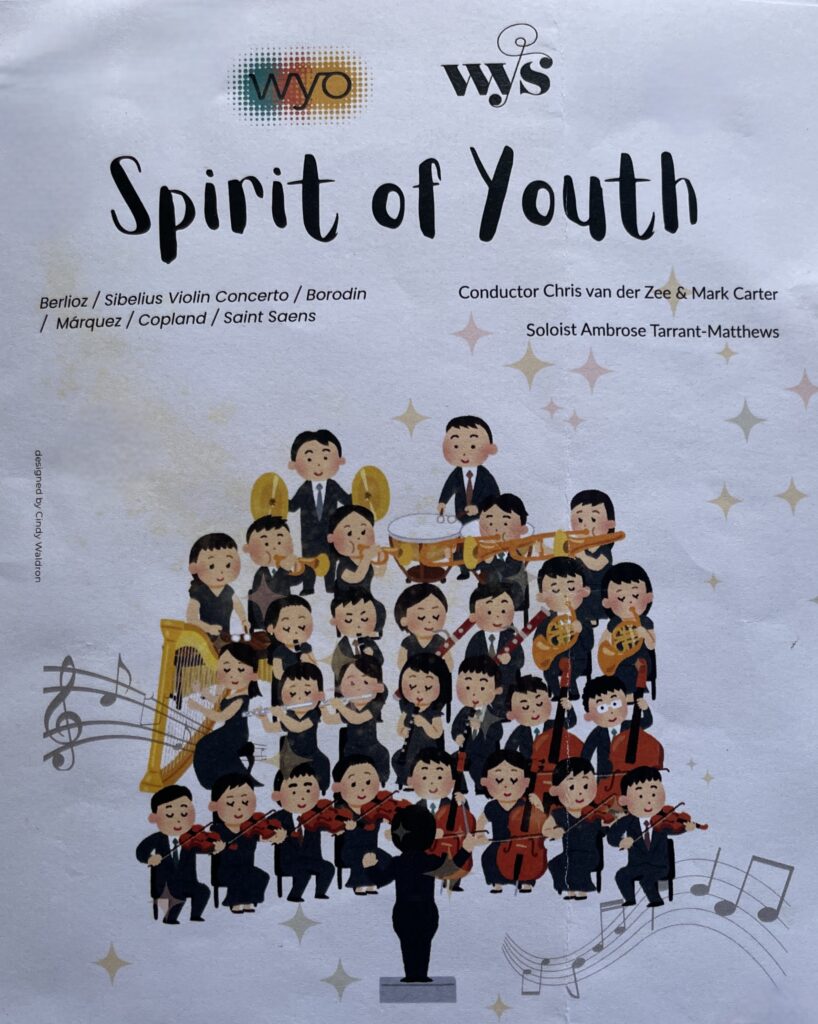
Spirit of Youth effervesces and overflows at Wellington Youth Orchestras’ combined 2026 concert

Wellington Youth Orchestras present: –

BERLIOZ – “Roman Carnival” Overture
SIBELIUS – Violin Concerto in D Minor Op.47
BORODIN – “Polotsvian Dances” from “Prince Igor”
SAINT-SAENS (arr. Isaac) “Bacchanale” from “Samson et Dalila”
COPLAND – “Hoedown” from “Rodeo”
ARTURO MARQUEZ – Danzon No.2

Ambrose Tarrant-Matthews (violin)
Mark Carter / Chris van der Zee (conductors)
Wellington Youth Orchestra
Wellington Youth Sinfonia

Memorial Hall, Alan Gibbs Centre
Wellington College
Dufferin St., Mt. Victoria, Wellington

Saturday, 17th October 2026

Review for Middle C by Peter Mechen

“Spirit of Youth” was this concert’s banner heading on the frontispiece of the programme I collected at the Memorial Hall’s entranceway – an illustration worth reproducing, here, as it  conveyed the overall atmosphere, excitement and enthusiastic participation of the young musicians taking part in this event. It also marked instances of notable brilliance. both individual and collective, throughout the concert,  particularly  from the featured soloist, violinist Ambrose Tarrant-Matthews, in his remarkable performance of the Sibelius Violin Concerto, one of the acknowledged “great” works of the violin repertoire.

As conductor Mark Carter was to point out to us, the achievement rested as much on the orchestral support given their soloist by the young orchestral players throughout the concerto! In a speech of introduction to the work’s performance, the conductor confessed to us that, in the concerto competition which produced today’s “winner” , of the four works nominated by each of the entrants, he had secretly hoped that the winning work WOULDN’T be the Sibelius , simply because the technical difficulties of the orchestral part for the conductor and players were, to put it in a nutshell, proverbial!  That said, the overall resulting achievement of these performers in presenting the work was all the more remarkable ! – and indeed, I was astounded at the performance’s splendid ‘give-and-take” qualities, let alone at the soloist’s enthralling playing!

The programme seemed on paper to tend more towards the “brilliant” than the “lyrical” in the choice of items – with the exception of the slow movement of the concerto, the items promised action and excitement over beauty, lyricism and depth of feeling. But my observation gradually lost ground as the performances proceeded – not only did the playing of this music snap, crackle and sparkle when required to do so, but had in places markedly significant moments of gentleness and lyrical quality.  To begin with, once the opening quicksilver flourishes of Hector Berlioz’s “Roman Carnival” Overture  were negotiated, the whole first episode of the work was taken up by one of the composer’s loveliest inspirations, a melody “sung” firstly by the cor anglais (nobly and securely played, here!), and then taken up by the strings – this was, in fact  the “love duet” from the opera “Benvenuto Cellini”. And again taken from opera, one of the most famous sequences from Alexander Borodin’s “Polotsvian Dances” from his opera “Prince Igor” is the enchanting “Fly on the wings of the Wind” melody sung by the captive slave women towards the end of the Second Act (a melody most famously used in a Broadway musical “Kismet” and popularly known by the title “Stranger in Paradise”) – again, an achingly beautiful sequence in an otherwise lively piece!

These two items shared the concert’s first half with a performance of the aforementioned Sibelius Concerto given by the WYO’s Concerto competition winner, Ambrose Tarrant-Matthews. From the beginning, I was able to feel the work’s distinctive “northern” atmosphere, the soloist’s line pure and intense, the accompanying string ostinati properly haunting, and the wind figurations echoing the soloist’s laying-out of the musical landscapes. The violin’s solo passagework “caught” the lines’ urgencies and were splendidly answered by the orchestra, with the winds beautifully blending  Tarrant-Matthews’ violin addressed both the double-stopped harmonies and the octaves with great aplomb, catching also the tender character of the octave spannings just before the great orchestral allegro, building up to confident and assertive brass-and-timpani statements sending the music on its purposeful forward journey in great style! A couple of stray notes in the following passagework didn’t lessen the player’s command of the recitative-like statements, but highlighted his willingness to take risks inherent in the music-making. A confident bassoon solo brought the soloist back to the work’s recapitulation of the opening theme, colouring the textures in suitably rustic fashion with an oboe solo and beautifully warm clarinets in thirds – we had by this time been taken into the composer’s sound-world firmly and securely by the performance. And the plunge into the ferment of activity over the final pages of the movement was exhilarating in its “thrills and spills” fronting up to the work’s virtuoso demands exerted upon soloist and players!

The second movement’s lovely wind-led introduction brought out some warm-hearted tones from Tarrant-Matthews’ violin, the horns and lower winds intently accompanying the soloist’s meditative tones. Strings and brass spearheaded a powerful challenge, met fearlessly by the solo violin, the movement resolving the heartfelt fervencies of the lines with tenderly-voiced responses, whispered strings and floated crepuscular horn tones adding to the soloist’s almost self-confessional utterances.

The well-known description of the finale as a “polonaise for polar-bears” came into force at its beginning, with riotous rhythmic exchanges criss-crossing the dance, Tarrant-Matthews again throwing himself into the fray, enjoying the interactions of his violin with the orchestra, and eschewing a sense of well-drilled order in favour of an exuberance of energies, the sense of spontaneous pleasure of engagement  to the forefront in the performance, not forgetting touches of dishevelment in places! The soloist was accorded a most deservedly enthusiastic reception at the end, to which he responded in the time-honoured manner with some appropriately-presented Bach, an elegantly-crafted and warmly-voiced performance of the composer’s Fuga/Allegro movement from the Sonata for Violin in G Minor BWV 1021.

The following riotous concluding strains of Borodin’s aforementioned Polotsvian Dances brought an interval to us, after which the orchestral numbers were extended by the addition to the band of the Youth Sinfonia players, as a new conductor, Chris van der Zee, took the podium. His repertoire choice  merrily maintained the excitements and momentums of the concert’s first half, beginning with Camille Saint-Saens’s eponymously-titled Bacchanale from his opera Samson et Delila (in an arrangement by Merle J.Isaac). I liked Chris van der Zee’s approach to the music, not rushing the rhythms off their feet at the outset, but allowing the orchestral trajectories to build up the intensities as the excitement of the dance generated increasing tumult and abandonment. The players gave him snappy rhythms and generous tones, enabling the music’s exotic colours to enhance the ambiences of the revelries – a terrific performance!

A “same-but different “ kind of agglomeration of excitements coloured the next piece, Aaron Copland’s “Hoedown” from his ballet “Rodeo”, a work I knew well at first hand, having myself played in a performance in my local orchestra in Palmerston North a number of years ago  (and I remembered how the syncopations of some of the percussion parts were the very devil to get right at the time!). These young  players seemed to take any such difficulties in their stride, by comparison, and a riotous performance ensued! The gala atmosphere of the occasion was enhanced by the conductor, who turned to us before he had begun the music and rehearsed us in a single corporate audience “Yee-haa!!” to be uttered boisterously by us at a moment in the piece when he would “cue us in!”. Well, we did our best, and it was great fun! – and the players also adroitly managed the composer’s somewhat peculiar hiatus at one point depicting the music “running down” like a machine losing its power and stopping completely, before suddenly springing into life for a few more bars brought a more abrupt and final ending!

Something I didn’t know at all (either work or composer) was the programme’s final item – a piece called Danzón No.2, by a Latin American composer, Arturo Márquez. It began elegantly and sinuously, featuring a beautiful clarinet solo, and other winds and brass joining in, with percussion and piano providing additional sensuous, ambient atmosphere. I enjoyed the crisp attack of the instruments in the sped-up middle section of the music, the strings impressing with spot-on unanimity and the brasses giving the music a tingling raspiness contrasting with a quixotic piccolo solo (and I loved the trombones’ occasional touch of vulgarity – hopefully that’s the right word!!)A piano-led section sensuously slowed the music down, before the strings “leaned” into the rhythmic trajectories, with the help of lively counterpoints from the brasses, including a raunchy trumpet solo!  At the height of the dance the ‘cellos insouciantly “twirled” their instruments as if demonstrating a “new order” of  freedom or nonchalance or self-determination – it  expressed something of the concert’s ease and relaxed enjoyment in between the moments of excitement and exhilaration the musicians had so readily and enjoyably displayed throughout a marvellously-wrought afternoon’s music-making!


Richard Strauss and Johannes Brahms – music of free and sonorous measure!

RICHARD STRAUSS
Der Rosenkavalier – Suite Op. 59
Four Last Songs Op. posth. (texts by Hermann Hesse and
Joseph von Eichendorff)

JOHANNES BRAHMS
Symphony No. 3 in f Major Op. 90

Madeleine Pierard (soprano)
Sir Donald Runnicles (conductor)
New Zealand Symphony Orchestra

Michael Fowler Centre, Wellington
Friday, October 2nd, 2026

Review for Middle C by Peter Mechen

What a glorious concert! – firstly, in the space of less than an hour and across the span of two otherwise unconnected compositions, we were caught up in a contrivance of enchantment, thanks to composer Richard Strauss and his characteristic depictions of life and love in both human and fairy-tale  terms. First was an orchestral suite from his opera “Der Rosenkavalier”, one straightaway drawing candid and sympathetic references to youth and age in the various depictions of the work’s key moments – and then, with the composer’s final composition, his “Four Last Songs”, came the tranquil inevitability of both nature and human life taking their full interactive courses.

We enjoyed, in the concert’s opening, the exuberance of youth in the Prelude to the opera  as the young hero, Octavian, the title’s “Knight of the Rose” makes passionate love to his mistress, the beautiful Marschallin (Mrs. Field-Marshal)  making use of the convenient absence of her husband, while knowing all along that she will in time lose her”knight” to a younger woman. The story quickly addresses this circumstance, as Octavian is sent away by the Marschallin to be the Bearer of the Silver Rose of Betrothal to a young girl, on behalf of the “real” would-be-suitor – but in the process Octavian himself falls deeply in love with the intended bride-to-be, Sophie, who, as per usual in these situations, reciprocates.

Trouble inevitably ensues between the gallant Rose-bearer and the prospective Bridegroom, the boorish Baron Ochs, who’s then wounded in a brief skirmish between the two, after which Octavian himself sets a trap for the profligate suitor (returning to the scene in the disguise he had already affected as the chambermaid whom the Baron had previously ogled on a previous visit to the Marschallin!) Anticipating his “good luck” via a sexy waltz tune the foolish Baron is of course subsequently exposed, disgraced and sent packing, while the remaining  “trio” of would-be-lovers express in a famous three-way exchange the situation’s complications and resolutions. Octavian and Sophie are left together alone to sing a final duet which proclaims their union and ends the opera – though the suite’s conclusion hearkens back to the riotous music accompanying Baron Och’s none-too-graceful withdrawal from the scene.

Despite the opera’s title, the story’s central character is the Marschallin whose story, briefly told, epitomises  a kind of “Frauenliebe und Leben” scenario though one vastly different to Robert Schumann’s famous song-cycle – the Marschallin, in contemplating her affair with her young lover Octavian recalls her own earlier experience as a young girl, with, like Sophie, its arranged marriage, and her eventual turning to affairs for emotional fulfilment.

Following the suite we were then taken to the world of Strauss’s “Four Last Songs” whose opening setting also suggests the trappings of young love, if through the poet’s older eyes, and with the return of the Spring in “Fruhling” used as a symbol of love’s renewal. In the same symbolic fashion the words of September farewell the Summer as Autumn turns the leaves to gold as each one falls from the tree; while the third song, Bein Schlafengehen (Time to Sleep) equates the day with a life’s work, and sleep while obeying life’s “deeper laws” of rest, allowing the soul to be set free. How infinitely touching, therefore, is the final song Im Arbendrot  (At dusk), where a life of shared love is epitomised by pairs of woodwinds imitating the two skylarks taking flight as the music inexorably surrenders to nightfall, and to “Stiller Friede” (Silent peace), with the song’s final line “Ist dies etwa der Tod?” (Can this perhaps be death?)

All of this was the course taken by the concert’s first half – exuberant and resplendent at the beginning, as young love has every right to be, and splendidly and quixotically plotting and achieving its course throughout the “Rosenkavailer” music. Conductor Sir Donald Runnicles vigorously and viscerally encouraged the orchestral depictions of the lovers’ extra-marital congress (what wonderful, orgasmically-whooping horns!), even if the  “afterglow” ironically took us abruptly to the scene of the Rose’s Presentation by Octavian to Sophie with all due pomp and ceremony.  This prompted some of the most exquisite writing (winds, harp, celesta and muted violins) ever to be crafted for opera – the playing here was as exquisite and heart-rending in its beauty as any performance I’ve previously heard, those famous “rose chords” variants of the theme first heard played by the strings at the opera’s beginning after the opening horn call!  They of course represented the Marschallin as much as they did Sophie, depicting moments of time that resembled  glimpses of eternity in their “transported” nature, though subject, like everything else,  to time’s passing.

The undoing of the boorish Baron, victim of his own salacious instincts, was unreservedly expressed by his lascivious waltz-tune, outrageously distended with self-satisfaction in places, and, here, spared no indulgence by conductor Runnicles with his players, to our great delight! Then came the opera’s final scenes, firstly the great vocal Trio of self-abnegation whose lines were given heartfelt emotional juice befitting each character’s conflicting emotion and resolution, tender solo violin, oboe and horn lines gradually subsumed by the full orchestral panoply at the climax – but just as moist-eyed for me was the effect of the lovers’ final duet, punctuated by those haunting “rose” chordings once again!  Here, there was just enough closure to allow the music to jump outside the opera’s strict chronology and finish with the ever-imperturbable Baron’s exit music, the character bloodied but nevertheless unbowed, as demonstrated by the animal vigour of the orchestral playing of yet another, more exuberant waltz-tune, conductor and players  pulling out, as the saying goes, all the stops  in a spectacularly brilliant orchestral display.

Love’s youthful dream was then taken on a life-journey, a perspective reaching fulfilment in the aging composer’s “Four Last Songs”, a product of his final, reflective years, and the result of two of his passions, intertwined in his love for his wife, Pauline and for the soprano voice (as Pauline de Ahna, she was herself an accomplished operatic soprano). Written the year before Strauss’s death, and written for the great Kirsten Flagstad, these songs had to wait until 1950 to receive their first performance by Flagstad, with Wilhelm Furtwangler conducting the Philharmonia Orchestra in London’s Festival Hall – incidentally, the title of the work and the order of the songs were not the composer’s but contrived by the publisher.

With so many previously-admired performances sounding in my ears I was obviously interested with how I would react to Madeleine Pierard’s singing of such an iconic work (with any much-recorded “classic”, always a fascinating experience!). Suffice it to say that I didn’t wish at any time for a single note or phrase of hers to be delivered otherwise, so much did I “grow into” her voice’s ambient presence, generating colour and tonal responses which for me “went with” each of the songs’ structural and emotional journeyings. As I’ve observed on previous occasions I’d heard and observed Pierard, she “owns” so profoundly the text of anything she sings – as was the case here, across the emotional gamut of the four “same-but-different” songs. Both singer and conductor moulded the energies of the words of “Fruhling” (Spring) with a freshness and clarity that grew with the song’s blossoming, in places like “von deinem Duft und Vogelgesang” (Of your scents and the songs of birds) and then in the radiance of “Wie ein Wunder vor mir” (like a wonder before me). as nature reveals its charms.

The yearning melancholy of the next song, “September”, vied with autumnal beauties, so that one felt the sadness of the singer’s  “Der Garten trauert” (The garden mourns) and also later, at “terbenden Gratentraume” (dying Garden dreams), and, just before the beautiful horn solo at the song’s end, with “müdgewordnen Augen zu” (tired eyes closed). I also enjoyed the gentle, “out of the ether” opening of “Beim Schlafenhegen” (While going to sleep), leading to NZSO leader Vesa-Matti Leppanen’s gorgeous violin solo, and the singer’s rapturous response, beginning with “Und die Seele unbewacht” (And my soul, unobserved), and relishing “…..im Zauberkreis der Nacht” (in the magic circle of the night)…….

As for the final Eichendorff song “Im Abendrot” (At Dusk) (the others were settings of Hermann Hesse), this was a gorgeous, spaciously- delivered “passage into eternity”, from the positive, life-affirming orchestral opening – and the confidently-floated  words “Wir sind durch Not und Freude gegangen Hand” (We have gone through Joys and distress hand in hand),  the music transcendent in its timeless beauty as the voice acclaims “O weiter, stille Friede” (O vast and silent peace!) before both vocal and instrumental tones are magically transmorgrified, it seems, into a timeless state of non-being  the voice becoming “as yesterday’s sev’n thousand years” with the words “Ist dies etwa der Tod?”  (Could this perhaps be death?)– everything so rapturously calm and eventually still as sleep overtakes, and life ebbs away. In the ensuing silence before the applause I suddenly felt that it couldn’t have been played and voiced better than what we heard on this occasion, and that we were blessed by it all.

Strauss’s unequivocal celebration of life and acceptance of death made the music of the concert’s second half sound more than usually enigmatic – this was the Third Symphony of Johannes Brahms, a work I’ve always regarded with a degree of bemusement after each encounter, as I’m invariably left with a disconcertingly different impression of  “what this music might be about!”– this is hardly a revolutionary or jaw-droppingly unique response to music and its performance in general, of course, but in the case of this work it’s an ongoing process of interaction. Here, my encounter with Sir Donald Runnicles’s vitally-urgent performance of the opening movement brought out the piece’s drama more than usually for me, and especially with the first-movement repeat observed for good measure (not always!). I especially enjoyed the dramatic and deep-toned swirling aspects of the music’s central section, led by the horns, whose heroic tones repeatedly put one in mind of Robert Schumann’s “Rhenish” Symphony (also a “No. 3!”).

The work’s two middle movements emphasised the work’s lyrical qualities, the Andante swiftly and deftly dancing its way through a pastoral setting, with delicious exchanges between the winds and lower strings at the beginning, and moments of full-throated song vying with circumspectly “signalling” notes, as if the music was giving itself directions and go-aheads! – the Poco Allegretto movement which followed  was more serious stuff, a long-breathed theme soulfully intoned firstly by the ‘cellos, and then the rest of the strings, and taken up also by a “wind choir of oboe, flute and horn. These had also a disconsolate-sounding contrasting theme which the strings attempted to “cheer up”, but to no avail – it was  left to the solo horn to try and save the day, returning to the opening long-breathed theme, and emboldening the oboe to ”give it another try”!  More discussion led to the strings’ rendition of the melody (gorgeous-sounding!) – but the movement’s highlight was the concerted, heart-bursting effort of the whole orchestra in giving sonorous, hymn-like voice at the end to the melody’s complete span (climbing from C to B-flat) and returning to its beginning – almost like a solemn act of homage to music itself!

Came the finale, something of a mini-drama in itself, with its sotto-voce opening on strings and bassoon, almost like undercover preparations being made for an oncoming conflict, with a theme which first appeared in the Andante movement, and here used as a kind of “warning” for the heavy brass to sound the alarm before the first shots were fired (or the invaders came over the wall!). The mood was intrepid, but flexible – sharp-edged and syncopated in its minor-key  aspect, and warmly heroic in the major, alternating the moods and energies to what seemed almost like exhaustion point, before quietly drifting back to the symphony’s beginning, with its distinctive F-A-F chord progressions. For the composer those notes represented the words “frei aber froh” (free but happy) – Runnicles’  vividly-characterised performance with the NZSO players readily gave, I thought, the composer’s delight in such feelings, however enigmatic, their full and sonorous measure!


Wellington’s VU NZ School of Music’s Piano Extravaganza Concert lives up to its name

St.Andrew’s Lunchtime Concert Series

An NZSM Piano Extravaganza, presented by four of Victoria University School of Music’s advanced piano students –

MICHELLE CORVERA
MOZART – Piano Sonata in G Major KV 283 – Mvts II (Andante) and III  (Presto)
SALINA FISHER – Moths in the Light (2007)
HAILEY ZHOU
MOZART – Piano Sonata No 17 in B-flat Major  KV 570 – Mvt III (Allegretto)
SCHUBERT – Impromptu D 935 Op.142 – Mvt.IV (Allegro scherzando)
JUNWEI CHEN
BEETHOVEN – 6 Variations on “Nel cor piu non mi sento” – Wo0 70
LISZT – Paraphrase de concert sur “Rigoletto” (Giuseppe Verdi)
TAL SHIRI
MOZART – Piano Sonata No, 9 in D Major KV 311 – Mvt.I (Allegro con spirito)
RAVEL – Miroirs No. III – “Une Barque sur L’Ocean”
BRAHMS – Piano Sonata No.1 in C Major Op.1 – Mvt.IV (Allegro con  fuoco – Presto non troppo ed agitato)

St Andrew’s-on-The-Terrace, Wellington
Wednesday, 30th September, 2026
Review for “Middle C” by Peter Mechen

A stimulating and heart-warming experience – four of the Victoria University School of Music’s most talented and proficient young piano students performing for us in turn, each demonstrating the various aspects of their musicianship in terms of technique, personality, ownership of the work and communication with the audience. What I particularly enjoyed regarding each of these musicians was their individuality – in each case a singularity of response was evident to the different aspects of performance which served each performer in different ways and indicated their strengths, with occasional indications regarding aspects that might benefit from some attention.

We were given no information regarding each performers’ background, and none concerning their status as regards the courses they were pursuing  – whether they were mid-stream, close to finishing, or even post-graduate wasn’t made clear, which actually enabled our receptivities to respond directly and unmitigatingly to what we heard. The students did have the opportunity to talk briefly to us before each presentation, but the microphone facility at St.Andrew’s, almost never in my experience producing a clearly-focused result save for a very few cases (they did manage to introduce themselves), wasn’t up to the task in this instance, leaving us having to rely on what each of the pianists did with their actual music-making rather than with their words – which is how it should be, anyway!

In general I though the repertoire chosen was enterprising and (in a couple of cases) even daunting!  – however, I recall long ago hearing a brilliant young pianist give a recital in which he dispatched a Schumann work of the utmost difficulty with ease in the more virtuosic passages while having less to say about the work’s poetry and thoughtfulness. In complaining about this to an older and wiser friend, I was told to enjoy the performance as that by a “young artist”, expressing something “unique and precious” for the moment, whatever the insights of succeeding years might bring. It was advice that has stayed with me in my listening to the playing of young musicians to this day…..

The concert was begun by Michelle Corvero with Mozart – the Andante movement from Piano Sonata No. 5 in G major – I thought her phrasing at the outset brought out the liquid flow of the music so beloved by the composer, and observed enough ear-catching dynamic variation to show an awareness of the line’s use of different voices. Now and then there was a slight lumpiness in the phrasing as if the music was made slightly unsure of its characterisation – but the player’s overall mode of “discourse” during the music’s exchanges was nicely observed.  She plunged into the Finale’s Presto, bringing out the music’s “Sturm und Drang”aspects with elan, keeping the music’s energies to the fore, and undeterred by the occasional spurious detailing, while working hard at the almost Haydnesque plethora of energies in the music. Mozart’s music is, of course, that which gives the performer nowhere to hide, but the impulsive energies of the playing carried the day. We heard her at her best in the second item, Salina Fisher’s Moths in the Light, bringing into the light an almost surreal piece which contrasted different kinds of delicacies, from the opening’s shimmering  figurations, through the darker suggestiveness of the middle section, and then realising the evanescent texturings of the concluding bars – an enchanting evocation in both conception and performance.

Hailey Zhou was the next pianist, one whose remarks regarding the music she was about to play I couldn’t hear at all, but whose playing interested me as soon as she touched the piano. She also began her segment of the programme with Mozart (good to hear student pianists tackling this seemingly straightforward but deceptively difficult repertoire!) –  the final Allegretto movement of Piano Sonata No.17 in B-flat K.570.  This movement, one of Mozart’s most exploratory, even wayward in places, opened simply and affably, before asserting its more quixotic character with occasional minor-key nudgings and a second-subject group featuring droll chromatic descents that make one wonder where the composer is taking us – all of which was played with a winning combination of great spirit and near-nonchalant ease. Her presentation’s companion piece was one of Schubert’s Impromptus, Op.142 No.4 in F Minor, D.935, also a somewhat characterfully quirky piece, one whose singularities were given a touch of impetuosity in the playing that I instantly responded to. She negotiated the mood-change in the swirling middle section with beautifully-articulated  phrasings, barring an occasional touch of “ahead-of-the-notes’ impatience here and there, but the quixotic lead-back figurations that returned us to the main theme were given with real elan – an absorbing performance!

Next was Junwei Chen, whose opening item varied the presentation with some Beethoven, albeit in a somewhat post-Mozartean mood with his Six Variations on “Nel cor piu non mi sento” WoO 70 , the text of a duet from Giovanni Paisiello’s opera La Molinara (The Miller-Woman). The pianist’s seamless-flow legato still managed to exude plenty of character, with his voicings between the hands – a lovely minor-key episode brought a deftly-etched sense of real personality  to the music-making, helped by the filigree detail (and I really enjoyed the variation with the decorative left hand!) – it was all playing of considerable charm! His other piece chosen couldn’t have been more different in some aspects, save for a comparable strength of personality. This was Liszt’s famous Rigoletto Paraphrase (after Verdi’s opera), playing which unhesitatingly brought out the music’s multifaceted qualities of characterisation, theatrical atmosphere and technical display, giving each of these a requisite energy, refinement and colour. Both the individual character  portraits and the more concerted interactive sequences were beautifully gradated. As was remarked by my aforementioned friend long ago when considering the playing of a brilliant young pianist we both encountered, this was similar piano-playing that joyfully expressed youthful exuberance in keeping with the present, and which will return deeper qualities in times to come – that said, I still registered the refinement of the more reflective section of the music just before the delivery of the tumultuous cadenza-like finish to the work – most impressive!

In some ways the playing of Tal Shiri, the last of the concert’s four pianists, had a similar kind of impact, perhaps even more so than did the Liszt/Verdi piece – the performer’s choice of Brahms’s tumultuous finale to his First Piano Sonata –  was obviously chosen to show off the pianist’s athleticism as much as his more musical responses. Having said this we were still gobsmacked by the playing, though I would have preferred to have hear the first movement of the Brahms rather than the last.  And this was in the wake of two other pieces, the first being Mozart’s opening movement, Allegro con spirito, of the Piano Sonata in D Major K.311, followed (with far too short a pause in between for me) by Ravel’s astonishing Une Barque sur L’Ocean from his Miroirs – this was quite a programme with those two pieces alone! Perhaps the Mozart movement’s  “Allegro con spirito” marking accentuated the sense of “a musician in a hurry”, here, accomplished though the playing was. More seriously, the Ravel piece was disconcertingly upon us before we knew where we were!  Having said that, the playing was compelling in its vivid detailing – a storm-tossed oceanic voyage making for a very exciting, in places, hair-raising a voyage.  The pianist’s descriptive patterning was sharply-etched throughout, though the variety of touch differentiated between structural (clearly-wrought) and colouristic (fascinatingly varied) – when it came to the ostinato-like patternings gradually leading up to the storm, the effect was satisfyingly visceral and inexorable.

IN all, a remarkable display, reminding me all the more of the exuberances of youth and its special and unique qualities!