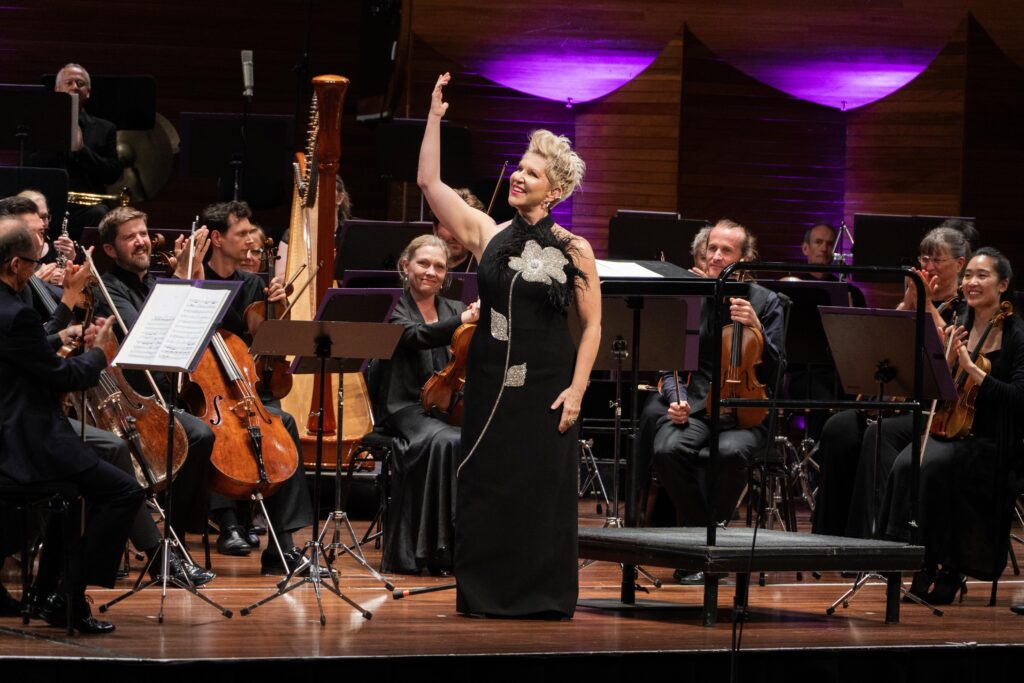
 Joyce DiDonato sings Berlioz with the NZSO and Gemma New – photo credit Phoebe Tuxford
HECTOR BERLIOZ – Les Nuits d’ete
ANTON BRUCKNER – Symphony No. 7 in E Major
Joyce DiDonato (mezzo-soprano)
Gemma New (conductor)
New Zealand Symphony Orchestra
Michael Fowler Centre, Wellington
Friday, November 28th. 2025
We would have been forgiven, at the conclusion of this Wellington concert’s first-half-outpouring of glorious vocalism from American mezzo-soprano Joyce DiDonato, for imagining that the rest of the evening’s music-making would prove at best worthy, but perhaps not scaling the heights to which we’d been taken. And with good reason, as we had just heard one of the most beautiful of all orchestral song-cycles, Hector Berlioz’s “Les Nuits d’ete”, here performed in a way that simply embodied the idea of a singer “inhabiting” a piece of music, with every note, phrase, expression and gesture savoured as if parts of a living entity. For Joyce DiDonato, it’s music that, in her own words, is “emotional, beautiful and identifiable – it has both the light and the dark, a little bit of humour, and then the pathos.”
From the moment she stepped onto the Michael Fowler Centre stage DiDonato had her audience’s attention (as befitted a renowned international singer making her New Zealand debut) and, on this occasion transfixed her listeners with the first few notes of “Villanelle”, the cycle’s opening song, a charming “pastorelle” describing the onset of the spring, and the simple peregrinations of lovers, and with the singer’s voice by turns eager, wry, teasing and tender. As with the other songs, not a phrase or gesture went for nothing – we saw the “pearled dewdrops” and heard the “blackbirds call”, in “the month that lovers bless”, all delivered with a natural-sounding fluency, an artistry concealing art and revealing living feeling.
So it was with the different world of “Le Spectre de la Rose”, the renowned song which depicts a dream-like sequence of a rose plucked and worn at a ball, and promising to return every night to haunt its wearer’s dreams – the singer firstly galvanised us with the splendour of words such as “..j’arrive du Paradis” (I come from Paradise) – but then, how different a world the same voice plunged us into with the following “Sur les lagunes” (On the Lagoons), with the opening words “Ma belle amie est morte” (My beautiful love is dead), with each of the verses’ chilling and prescient Mahlerian final line “Ah! Sans amour s’en aller sur la mer!” (Alas! – to go over the sea without love).
My favourite from the cycle has always been the radiant “Absence” – and DiDonato didn’t disappoint, tugging at the heartstrings even more than Regine Crespin and Janet Baker in favourite recordings, with her luminous “ownership” of the opening “Reviens” (Return) and her pitiable “Comme une fleur loin du soleil” (like a flower away from the sun). So bewitched were we, the audience, with her “moth-to-the-flame” detailing and resonating lines of ambience in “Au Cimetière” (In the cemetery) that, when what sounded like a stray cell-phone tone broke the ending’s silence, the audience hurriedly applauded to cover the intrusion! The musicians then, in turn, broke into the applause to deliver the final, exuberant “L’ile inconnue” (The Unknown Isle) – here done with irresistible verve and detachment sense of release from what had been up to that moment the composer’s longed-for and sadly unrealised “Toujours” (always) from the opening “Villanelle” – acknowledged here by DiDonato with wry equanimity, rather than bitter resignation to “la jeune belle”, with the open-hearted words at the end – “Ou voulez-vous aller? – La brise va souffler….” (Where would you like to go? – the breeze is about to blow….).
Having received rapturous audience accolades for her efforts, DiDonato repaid us handsomely, with, firstly, the “Habanera” from Carmen (orchestra AND even some audience voices supplying the chorus’s “Prends garde a toi!” response here, in each verse!), and then what the singer called “a present to us in return from her part of the world”, a verse and chorus of Harold Arlen’s song “Somewhere, over the Rainbow” from the film “The Wizard of Oz”. At that, even this diehard critic found himself on his feet, applauding!
But then! – the evening’s biggest surprise for me, however, came with the Bruckner! I had heard the NZSO give radiant performances of some of the symphonies over the years with maestri such as Franz-Paul Decker and more recently Simone Young, both of whom held established “Bruckner credentials” – so the orchestra had proven itself as a “Bruckner ensemble” in distinguished company. And while I’d been impressed over the last couple of years with Gemma New’s conducting of Mahler I’d never been one to “presume” (as many seem to do) that proficiency with the latter automatically guarantees the same with Bruckner’s similarly large-scale but vastly different worlds of expression. And I hadn’t been able to find any record of New having conducted Bruckner before, so this seemed to me like something she was undertaking for the first time.
Straightaway I was frustrated by the symphony’s opening, since New, after ascending the podium, very quickly gave the orchestra the signal to begin – which meant that the whispered string tremolando with which the work opens was for me on this occasion almost totally inaudible due to audience “rustle” as part of the settling-down process. I SAW the violins begin, but simply heard the “E” of the lower strings “begin” the music! I wish she’d instead secured absolute stillness in the auditorium before beginning, and allowed the sound to magically conjure itself as it were out of the ether –
And then the surprise unfolded – not instantly, but as a slowly growing and evolving feeling as the symphony progressed that I was actually witnessing a superbly-played and wondrously-articulated performance. The symphony’s very first theme, for me had a pliable elasticity contributing to a parallel expansion and intensification of the sound as the trajectories proceeded, and with everything beautifully voiced. New kept the tempi of the different sections related to what seemed like a single inner pulse so that nothing had to speed up or slow down appreciably to properly “speak” its character – for instance, the massive brass entry featuring a minor-key inversion of the opening theme seemed more organic than disruptive in this overall context –- and how beautifully the composer used his wind players’ material to elaborate on existing themes when these variants were brought back later in the movement.
The majestic slow movement, Bruckner’s tribute to Richard Wagner, was just as successfully unfolded by New’s unhurried, but vitally-phrased tempi at every turn – the first upwardly thrusting string phrase taking the lead in exuding emotion of a vigorous and resounding kind – while the deep brass, at first contained, still made so eloquently the perfect foil for the following full-throated strings-and-winds’ songbird manifestations. As the movement developed so did the urgency and vigour of New’s marshalling of the music’s tectonic forces towards and into a spaciously resplendent climax, one superbly delivered by conductor and players. However, it became as much a funeral oration with the news of Wagner’s death “capturing” this music for history from that moment on, the flute sonorously summonsing the resplendent “Wagner tubas” and their tones of sorrowful tidings, and bestowing upon the music a kind of immortality.
After this, there’s a lithe, muscular Scherzo, here splendidly directed and delivered in every way imaginable, the normally bucolic impulses of Brucknerian scherzi in this case to my mind worthy of elevation both by association and sheer exuberant excellence to the realms of “sport for the Gods”. But then, for me, it was New’s and the orchestra’s playing of the finale as much as anything else in the symphony that lifted the experience beyond my expectations, transforming what I’d always previously regarded as a somewhat “poor relation” of a movement to a piece that suddenly seemed bristling with nuance, impulse, spontaneity and variety while appearing to know unto itself exactly where it was going! And, what was more, as with the symphony’s beginning, I had another brief questioning “moment” at the end , thinking that New had begun the work’s coda too abruptly, and that what was needed was more time and space to “savour” the whole of what we had heard, and to bring the work to a “grander” conclusion. Halfway through the coda I found myself thinking, “This actually works! – in fact, it’s exhilarating!” – and by the end, my thought was “Wow! What a performance!”
Joyce DiDonato and her extraordinary singing will remain an ineffable memory for me! – but Gemma New’s Bruckner was also a revelation, one that I hope we’ll get even more chances to experience in times to come!