JS BACH – The Six Motets (BWV 225-230)
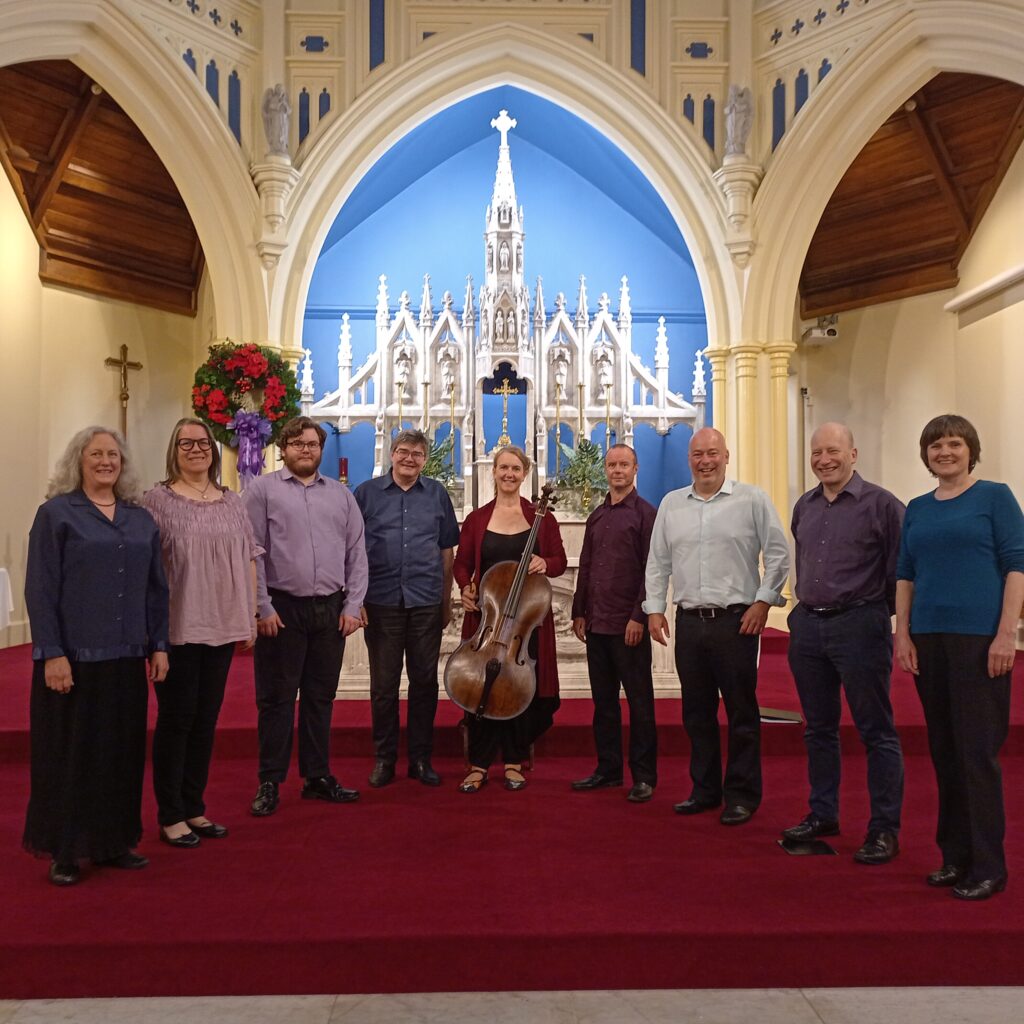
Baroque Voices (directed by Pepe Becker)
Pepe Becker, Rowena Simpson (sopranos)
Andrea Cochrane, Toby Gee (altos)
Samuel Berkahn, Jamie Young (tenors)
David Morriss, Simon Christie (basses)
Imogen Granwal (baroque ‘cello)
St.Mary of the Angels Church, Boulcott St., Wellington
Sunday 30th November, 2025
To my shame, I had never before heard a single one of JS Bach’s Motets before finding out about this concert – I’d “heard of” a couple of the titles of famous ones, such as “Komm, Jesu, komm” and “Jesu, mein Freude”, but had never taken the step of getting to know them, thinking that the “Passions” and the “B Minor Mass” and the “Christmas Oratorio” and the “Magnificat”, plus a clutch of Cantatas sufficiently qualified me as an accredited “Choral Bach listener”. So I was both delighted and intrigued upon being told by Baroque Voices’ director Pepe Becker some time ago that this concert was coming up, and DID managed to track down a couple of recordings and fit in some “listening” beforehand so as to get something of an idea of what I was in for…..
The concert date duly arrived and the presentation took place with the succinct title “Back to Bach” for the Voices’ heady “whirlwind tour” through all six of the composer’s sacred motets, performed by the Wellington ensemble in the sumptuous (perhaps a tad too much so acoustically!) setting of St.Mary of the Angels church in the heart of the city. The director, Pepe Becker, described these works in her programme notes for the concert as “sublime, complex and deeply moving”, though one could add plenty of further epithets to the description of the afternoon’s performance by the ensemble. We warmed as readily to the exuberance of the writing, its enjoyment generated as much by the music’s own urgencies of feeling as by the voices’ different physicalities, all with their own channelled energies. These things all came together, the pieces amply reflecting their creator’s unquenchable human spirit and belief in a higher divine authority.
Unlike the cantatas, which Bach wrote regularly for every Sunday of the church year, the motets were infrequently produced for special occasions in Leipzig, and some may have even been lost. The six surviving ones were in fact the only choral works of Bach which didn’t disappear entirely from view until the renowned “Bach revival” of the 19th Century. The famous story of Mozart’s joyful response, upon hearing in Leipzig in 1789 a performance of Singet dem Herrn ein neues Lied (Sing to the Lord a new song) bears witness to these works carrying a torch for future generations.
It’s unclear what Bach’s intentions were regarding the instrumental accompaniment of these works – only one of the motets, Der Geist hilft unser Schwachheit auf (BWV 226) has extant orchestra parts, and two other Motets have separate continuo basslines written, Furchte dich (BWV 228), and Lobet den Herrn (BWV 230). So there is no “final word” regarding instrumental accompaniment, according to the composer. The works would probably have been accompanied at least by basso continuo (an organ or a melodic bass instrument) – Baroque Voices use a bass stringed instrument in all but two of the Motets – Komm, Jesu, komm (BWV 229), and Jesu, meine Freude (BWV 227), here a baroque cello, played by Imogen Granwal.
Singet dem Herrn ein neues Lied got the concert away to a stirringly festive beginning, with the wonderful “pinging” calls of the opening Singet, the tones brightly shining, and the lines mellifluously blending, swirling nicely together at Die Gemeine der Heiligen sollen in loben, (Sing His praise in the congregation of saints). As well, the infectious “dancing” tones of Die Kinder Zion sei’n frölich über ihren Könige (Let the children of Zion be joyful in their King) were delightful, leading to the splendid all-in tones of the climactic Mit Pauken und Harfen sollen sie im spielen! (Let them sing praises unto Him with the timbrel and harp)! The second-movement Chorale Wie sich ein Vat’r erbarmet (As a father is merciful) had one group singing the chorale, and the other interspersing lines from the aria Gott, nimm dich ferner unser an (O, Lord, continue to care for us) – beautiful, heartfelt exchanges! A suitably zestful Lobet den Herrn in seinen Taten (Praise the Lord for His mighty acts), then moved without a break in momentum to a triple-time Alleluia for a satisfying finish.
Next was the tremulously-expressed Komm Jesu, Komm (Come, Jesu, Come), so very theatrical at the outset, and with the individual voices then conveying the hardship of life’s vicissitudes with Die Kraft verschwindt je mehr und mehr (My strength is fading more and more), and the solace of expectation, freed from “Der saure Weg” (the stony path). The voices put an infectious eagerness into the renewed cries of “Komm, komm”, and a renewed strength of certainty (with touches of elation!) into the trajectories of Du bist der rechte Weg, die Wahrheit, und das Leben (The Way, the Truth and the Light). The concluding Chorale, Drum schliess ich mich in deine Hande (So I entrust myself into Thy hands) quietly exalted in its certainty here, right to the final long-breathed notes.
Though written for the funeral service in October 1729 of Johann Heinrich Ernesti, longtime rector of the St. Thomas School in Leipzig, Bach was perhaps inspired by the great man’s positive qualities by writing some attractive and inspirational music for this motet, Der Geist hilft unser Schwachheit auf (The Spirit also helpeth our infirmities). Its cheerful, forward-pressing gait and general overall tone includes some droll references to the “Spirit’s” intercession for our prayers “mit unaussprechlichem Seufzen” (with unutterable groanings)! The music’s lovely 3/8 trajectory at the beginning changes to common-time for both the “groanings” and the references to “Der aber die Herzen forschet” (He that searcheth the Heart). My only other thought was that the Chorale could perhaps have been a little more hushed, and varied in delivery at the outset, as befitted the words “Du Heilige Brunst, süsser Trost” (Heavenly Fire, sweet consolation) – which sounded as if they might have come from Schiller, for goodness sakes!
The interval gave us time to reflect on the magnificence of the music and the manifest qualities of the performances, which were considerable – brightly-shining tones, nimble trajectories, neither rushed nor dragging, distinctive individual voices, and, despite some idiosyncratic vocal “blends” in certain places, still successfully ensuring the voices’ clarity and the words’ flavourings and colourings were imparted. I wondered in places whether the acoustic was actually a bit “too much”, resulting in some of the singers’ tones being amplified more than others, and wondered whether a smaller, sparser acoustic might have integrated the sounds better. However, it was a “sometimes” effect, as more often the ensembled sounds came together most mellifluously.
The lovely opening of Fürchte dich nicht (Fear not) with its euphonious exchanges continued our pleasure, as did, in an entirely different way, the dramatic interpolations of recitative-like utterances of “Ich stärke dich!” from individual singers, and the contrast between the austere chromatic fugal passages and the radiant chorale excepts from the sopranos in the ensuing fugue, a vocal contrast that continued to delight us until the final concerted statement “Furche dich nicht – Du bist mein!” Heartwarming!
The longest and most complex of the motets is Jesu, meine Freude (“Jesus, my Joy”). Essentially scored for five voices, including a second soprano line (as with Bach’s Magnificat) it alternates a chorale tune by Johann Crüger with settings of texts by Johann Franck and from Paul’s Epistle to the Romans. It’s uncertain just when this motet was composed, or for what particular purpose, with one scholar even advocating the idea of Bach using the work just for educational purposes with his St.Thomas’s Leipzig choir.
The beautiful opening sang out gloriously, the singers relishing the third of each group of lines of text, arching each towards a moment of intense feeling – a marked contrast with the beginning of the next movement’s Es ist nun nichts Verdamliches (There is therefore now no condemnation) with the word “nichts” separately and pointedly repeated, and the following line “Die nicht nach dem Fleische wandein” (Who walk not after the flesh) which wanders graphically in a kind of wilderness! The wonderful third movement Unter Deinem Schirmen (Protected by Thee) returned to the chorale tune, whose serenity was “roughed up” with references to Kracht und Blitz (“Thunder and Lightning”) and then Sünd und Hölle (“Sin and Hell”) adding to the dramatic effect. The three women’s voices then consoled our fears with the fourth movement’s Denn das Gesetz des Geistes (“For the Law of the Spirit”).
More drama and contrast was depicted by the fifth movement’s Trotz dem alten Drachen (“Defy the Old Dragon”), the singers hurling the word “Trotz” (Defy!) upwards and outwards, and agitatedly word-crafting a world raging and quaking (Tobe, Welt und Springe – ”Rage, world, and quake!”), before painting a picture of the soul standing and singing in perfect peace with God (Ich steh’ hier und singe in gar Sicher Ruh). The following movement Ihr aber seid nich Fleischlich (“For ye are not of the flesh”) most winningly here contrasted a quick-moving fugal opening with a sonorous chorale-like conclusion Wer aber Christi Geist nicht hat, der ist nicht sein! – (“Yet one who has not the Spirit of Christ is not His!”).
The vigorous and wonderful Weg mit allen Schätzen(“Away with all earthly treasures!) that followed featured the soprano with the chorale line set against such deliciously contrasting and detailed figurations from the others – the urgently-delivered opening from the lower voices and with its first word Weg! repeated, was such a delight! And the singers conveyed the “strongly-felt essence” of other utterances such as Elend, Not, Kreuz, Schmach und Tod (“Poverty, distress, Cross, disgrace and death”) so very vividly at the conclusion.
The winsome So aber Christus in euch ist (“And if Christ be in you”) was gentle and dance-like, here, until the words Der Geist aber ist das Leben “But the Spirit is life”, when the figurations quickened, though leaving us with a somewhat unresolved conclusion – this was supplied by the following Gute Nacht, O Wesen (“Goodnight, O earthly Life”) – here, a stunningly beautiful piece whose lines I thought the sopranos took a little time to settle into at the beginning, but which achieved a magic by the end.
After these heartfelt articulations, So nun der Geist des (“Now that the Spirit of him”) seemed businesslike and anecdotal by comparison, almost a case of the narrator moving the story on to its inevitable conclusion! Bach replicates the manner of the work’s second movement in the use of a repeated word (here, “Geist” is repeated, as was the word “Nichts” in the second movement) and the text has the same instruction-like tone as Es ist nun nichts Verdamliches. The true frisson of feeling came with the final Weicht, ihr Trauergeister (“Disperse, sombre spirits”), with the original opening Chorale melody taking us back to the work’s beginning in the most disarming and direct way – all truly wonderful!
There remained the “orphan” of the bunch to give some attention to – the motet Lobet den Herrn, alle Heiden (“Praise the Lord all ye nations”), the one that there’s “doubt” as to whether or not it’s by Bach at all. Pepe Becker put it succinctly in her programme note about the piece, saying that “it’s hard to imagine who else could have written such a vital, well-crafted piece”. And who could blame her, with such material to perform? At the beginning a sprightly combination of lines led to a splendidly-voiced fugue at “Und preiset ihn, aller Völker”, after which an appropriately slower section made reference to Seine Gnade und Wahrheit (which will) waltet uber uns in Ewigkeit “His mercy and truth (which will) reign over us for all eternity” – and with everything then enlivened by a sequence of triple-time Alleluias – an appropriately joyful way to end such a concert!
What to say? – except that the experience for me of hearing these works in concert for the first time was life-changing. To Pepe Becker and her Baroque Voices grateful thanks for a truly resounding experience!