Still more musical miracles reported and evidenced in Wellington, this time at Roseneath’s The Long Hall!

The creative spirit continues to work wonders in Te Whanganui-a-Tara, Aotearoa – (“Kei te ora tonu te wairua auaha ki Te Whanganui-a-Tara o Aotearoa”)
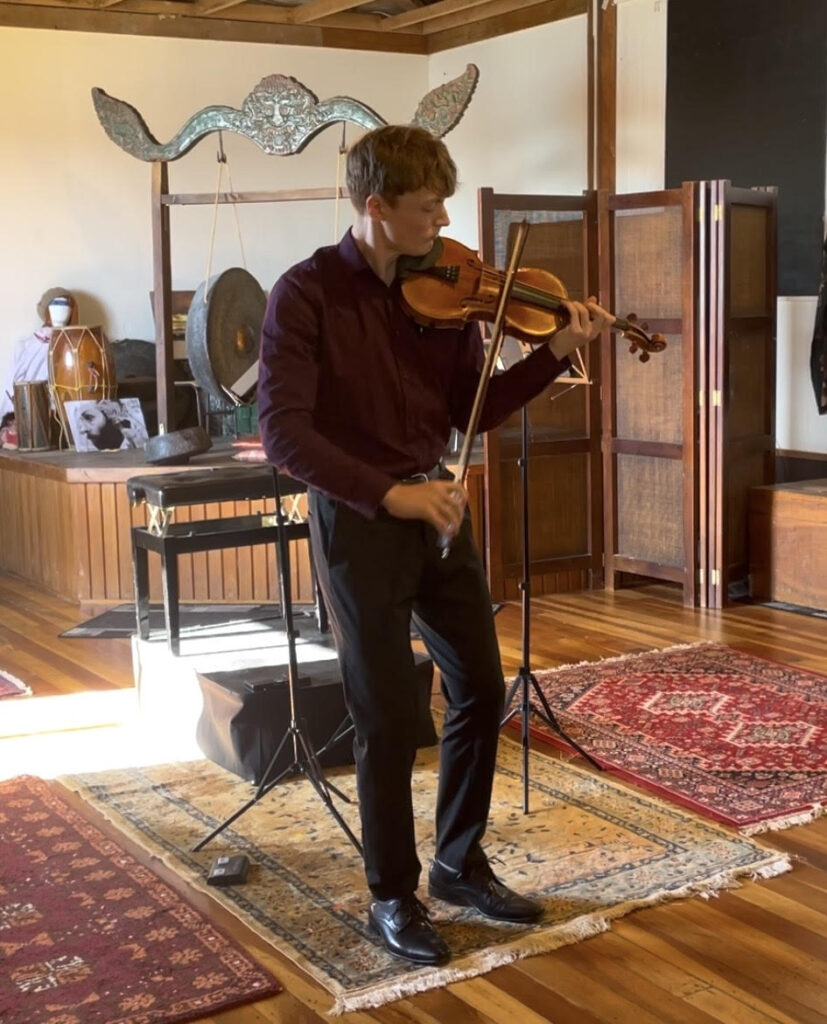
Peter Gjelsten tackles a Bach Violin Sonata (No. 2 in A Minor BWV 1003) at The Long Hall, Roseneath

The Chamber Pot-Pourri Ensemble
A Kaibosh Food Rescue Benefit Concert

ROSS HARRIS – 2 Micro-Trios (2020)
Helene Pohl, Peter Gjelsten (violins), Rolf Gjelsten (‘cello)
NICCOLO PAGANINI – Caprice No. 9 for solo violin
JS BACH – Sonata for solo violin in A Minor BWV 1003
Peter Gjelsten  (violin)
CRAIG UTTING – Four Wellington Dances for violin and cello
Helene Pohl (violin), Rolf Gjelsten (‘cello)
FRANZ JOSEF HAYDN – String Quartet in G Major Op.33 No. 5
Helene Pohl, Peter Gjelsten (violins)
Sophia Acheson (viola), Rolf Gjelsten (‘cello)

The Long Hall, Point Jerningham, Roseneath
Saturday 21st March, 2026

Fresh from attending my first St.Andrew’s-on-The-Terrace lunchtime concert earlier in the week, I had the good fortune to catch another. not dissimilar kind of musical happening – this one a 2026 “first” for the capital of a series instigated a year ago by violinist Helene Pohl at Roseneath’s “The Long Hall”, situated on the Point Jerningham lookout reserve next to Roseneath Primary School. The concerts are designed to alternatively support the Kaibosh Food Rescue charity, and the Arohanui Strings, the Sistema-inspired early intervention music education programme. The Kaibosh charity makes a significant difference to food and energy waste and carbon emissions, enabling thousands of kilos of food to be redistributed to community groups, resulting in renewed efforts by the same musicians over the present in continuing and supporting an eminently worthwhile venture.

Thanks to the inspiration, skills and capacity for hard work of Helene Pohl and ‘cellist Rolf Gjelsten, the 2025 concert series was a great success. The two musicians, aided by various colleagues, were able to simultaneously commemorate and take advantage of composer Dmitri Shostakovich’s 50th death anniversary, performing a number of the composer’s chamber works in tandem with a wide range of other pieces, including a couple of contemporary works written specifically for these concerts (and therefore both world premieres!) by composers currently both on-and off-shore, Ross Harris and Gao Ping, respectively.

Now, to begin the 2026 series the Long Hall’s opening Kaibosh Food Rescue programme paid appropriate homage to some of the previous year’s delights, including works by “resident” composers (two of whom were present today!), as well as instrumental solos which illustrated the power of a single voice’s communication, and a string quartet by the composer who effectively defined the form and whose efforts provided all kinds of “springboards’ for those others who followed suit.

First up was music representing a kind of timely antidote to Aotearoa New Zealand’s present version of Trumpish madness, two Micro-Trios by Ross Harris, written during the much-discussed lockdown period of 2020 for the Pohl/Gjelsten family members present today. The two works, as if conceived with different personalities in mind, displayed contrasting characters, the first beginning in a restless, slightly anxious 5/4 which developed more forthright impulses befitting a kind of “confused turmoil of being” in response to the isolated circumstances. The second work took a more lyrical approach, with long-linked lines attracting all kinds of impulses which attached themselves to the lines before dropping off the pace and wandering quizzically through unfamiliar vistas (like an ageing process, perhaps – with apologies to the composer!).

Violinist Peter Gjelsten followed up his 2025 performance of Eugène Ysaÿe’s Third Sonata (“Ballade”) for Solo Violin with another work by a virtuoso violinist-composer, perhaps the doyen of them all, Niccolo Paganini – The Ninth of his 24 Caprices for solo violin was given here with plenty of confidence and elan, the opening “hunting calls” resounding their thirds with spirited effect in dynamically-contrasted episodes readily suggesting the shouts of purpose and encouragement from the riders relishing the chase.  The “sport”was given plenty of incident by the violinist’s confident throwing-off a middle-section’s skitterish runs broken by stentorian phrases, suggesting both mishap and success in the pursuit!

Sterner stuff followed these hi-jinks, with Peter Gjelsten giving us JS Bach’s wonderful A Minor Sonata for solo violin, one of three Sonatas for the solo instrument, all of which are often coupled as a performing edition with three Partitas for the same instrument. An all-purpose differentiation between the two titles “Sonata” and “Partita” is that the former is traditionally a four-movement structure which often features linked slow-fast sections  and a fugue, whereas a Partita consists of different types of Renaissance/ Baroque dance movements. True to type this Sonata includes a fugue as the second movement.

First impressions of this work emphasised seriousness over gaiety, the solemn, declamatory opening commanding our attention with the player’s presence of intonation and command of nuance giving his listeners an engaging sense of exploration right to the movement’s final questioning note. The Fugue’s elegance and poise at the outset opens out, Gjelsten finding plenty of room for variations of tone and presenting an astonishing array of different voices – the music’s trajectories buildup and carry us along with wonderful ”heads of steam”, so that the phrases and statements really resonate.

Gjelsten’s control of the Andante’s pulse enabled both melody and rhythm to coexist, often in little more than whisperings, but with an underlying strength of overall purpose. We felt taken to another world by the second half of the movement, with the composer  seeming to allow us a lingering glimpse of his serenity of outlook and purpose of faith – I could imagine a young player in future years delving even further into the music’s timelessness that allow these sounds to linger long after the player ceases. The concluding Allegro is here excitingly launched and teasingly sustained with the antiphonal alternating phrases made here to dance through our sensibilities’ spaces. The rapidly-executed impulses have an exhilarating ring to them, and we’re “teased” with what seems like the approach of a final cadence, but with geyser-like irruptions that suddenly push the boundaries out further – tantalizing playing that keeps us on our toes and  enables us to relish the music all the more.

We had been promised a quick, “straight-through” concert at the beginning, so our kaleidoscopic musical journey  suddenly whirled us homewards via local composer Craig Utting’s engaging “Four Wellington Dances”, for violin and ‘cello (written in 2025 for Helene and Rolf.) The work began with an entirely apposite “Wind Dance”, a nagging 7/8 perpetuo-molto rhythm  by turns driving, teasing and cajoling the notes into sound-impulses whose insistence any Wellingtonians would recognise, and with alternating instruments adding a moaning-sighing figure over the agitations, catching their constant unpredictabilities. Next was the strangely mesmeric “Whale Song”, introduced by spectral “con sordino” violin tones (which set the scene for strangeness) and galvanised further by hauntingly-charged “vocalisings”, firstly in the lower and then upper registers of the ‘cello – an incredible soundscape, tapping into a “natural world” communication, with the instruments conveying a real sense of ambient surroundings and language essentially removed from human interaction.

“Seagulls”, the third dance, has an introduction flecked with further atmospheric touches, such as the ‘cello playing eerie glissandi to the violin’s arpeggiations and rather touching “seafarer’s song”, first played, incidentally, lower than the ‘cello’s accompaniments, though the instruments exchange their roles at certain points – the melody is a real charmer, replete with nostalgia! Finally, the “Habanada” imbues a well-known operatic rhythm with a mischievous spirit during short sequences of dance-tunes and  illicit collaborations with ostensibly unlikely partners such as Saint-Saens’s “The Swan” and Rimsky-Korsakov’s “Bumble Bee”, with even Mendelssohn’s “Wedding March” making a brief appearance before falling down the stairs and (thankfully) coming to its concluding senses!

After all of this, what better finale than to be given a masterwork from a composer whose music paralleled the conditions that produced each of the concert’s preceding works – isolation, compositional mastery, instrumental fluency, and a need for entertainment? All these things come together in the string quartets of Franz Joseph Haydn, whose Op.33 set of six string quartets were written in 1781, and became known as the “Russian” Quartets, due to the dedication to the Grand Duke Paul of Russia. Another nickname given to these works is Gli Scherzi  (The Jokes) referring to the replacement of the older style Minuet with a quicker, more dynamic movement.

Here, then was the fifth of the Quartets from this Op.39 set, a work which itself has been nicknamed with the English sobriquet phrase “How do you do?”, drawing attention to the Quartet’s very beginning, a pianissimo galant cadence which actually returns to conclude the movement with which it started. the opening “How do you do?” cadence is only a prelude to the ensuing Molto Allegro, which seizes hold of the argument and propels it excitingly forwards. The mood lightens for the lyrical second subject, only to unexpectedly plunge into the almost “groaning downwards” chromatic modulation towards the end of the exposition. The volatile development dances, swoops and plunges as the music unfolds, releasing almost operatic surges of energy in places, with the “how do you do” cadence realigning the music’s focus for a recapitulation – we are, by this time, agog at the music’s volatilities, and marvel at how quickly the music races to its concluding cadences without missing a beat!

Our heartstrings are tugged immediately by the slow movement’s intensities, most strenuously propelled forwards with almost unrelenting energy, to which one simply has to surrender and allow oneself to be borne aloft and taken somewhere. What a contrast, therefore, with the impishly impulsive Scherzo, filled with all kinds of hesitancies and impulses!  The Trio brings a steadier, more genteel character, as if wishing to reform such excesses, though to no avail when the opening returns, as quirky and ornery as ever, though with a touch, perhaps, of guilt via its almost evanescent ending!

After this, the finale’s music is almost prim and proper, in what seems like variation form, with the first violin decorating and elaborating on the melodic line in both subsequent variation movements, and then, the viola and cello taking turns to decorate the dance steps for a subsequent movement. Finally, there’s a Presto which scampers to a satisfyingly breathless conclusion!

Such a lot packed into a relatively short time! Nevertheless, we were replete – delighted by the music and the playing, and honoured by the good and prestigious company – a truly memorable occasion!
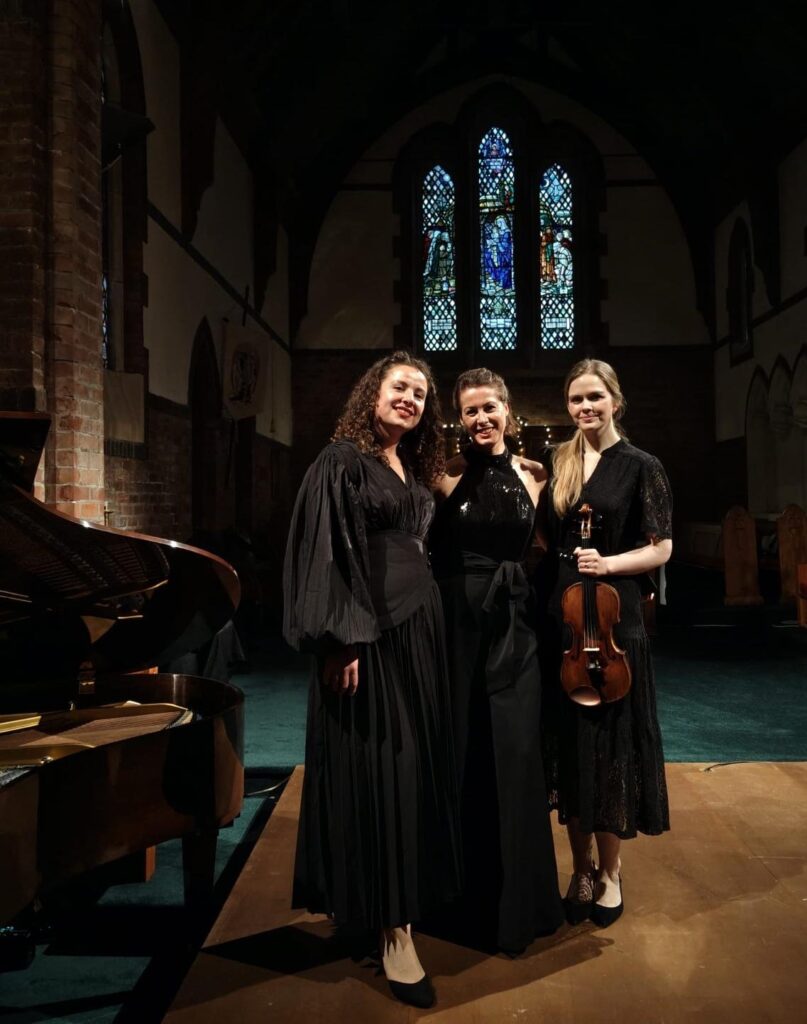
 

Masterpieces from masterly musicians – A St. Andrew’s lunchtime concert, from Rolf Gjelsten and Nicole Chao

St.Andrew’s-on-The-Terrace Church, Wellington  – Lunchtime Concert Series

BEETHOVEN – ‘Cello Sonata No. 3 in A Major Op.69
TCHAIKOVSKY (arr. Fitzenhagen) – Variations on a Rococo Theme Op.33

Rolf Gjelsten (‘cello) and Nicole Chao (piano)

Wednesday 18th March 2026

Review for “Middle C” by Peter Mechen

“Two masterpieces for the ‘cello-and-piano repertoire, delivered by a pair of musicians regarded as among the country’s top players of their respective instruments” – well, it  sounds like nothing less than a dream prescription for a concert!  Alternatively, the blurb for the occasion could have fixed as easily upon its contrast with present-day scenarios – ranging from world-wide upheavals undermining one’s sense of national and personal security to localised disillusionment and desperation faced with escalating dysfunctional infrastructure and cost-of-living price-hikes – and invited us “to escape from it all into the relative bliss of St.Andrew’s-on-The-Terrace Church for a free lunchtime concert of uplifting music”.

However one chooses to view these regular Wednesday lunchtime concert occasions they have given many Wellingtonian classical music-lovers much joy with a stimulating variety of performers and repertoire. In this case we were thoroughly spoilt as regards the concert’s essential ingredients, with cellist Rolf Gjelsten, late of the New Zealand String Quartet, but more recently affiliated with Korimako, a piano/string trio formed with pianist Michael Endres and violinist Helene Pohl, and here joining forces with pianist Nicole Chao, most readily associated with the much-acclaimed Duo Enharmonics together with fellow-pianist Beth Chen.

I had heard Rolf Gjelsten’s solo playing on a couple of occasions, most recently in an absolutely delightful performance of JS Bach’s Third Violincello Suite in C Major at a “Long Hall” Roseneath concert; but I’d not heard Nicole Chao as a solo recitalist since briefly at a 2009 song-recital concert with soprano Nicola Holt, where for an instrumental interlude she gave an atmospheric, by turns finely-detailed and splendidly volatile performance of Chopin’s Fourth Ballade. Though not solo performances this time round, today’s offerings readily demonstrated the technical and interpretative skills of each of the players, brought together beautifully here in St.Andrew’s.

As befitted such a positive partnership, the occasion featured an actual milestone in the repertoire of the solo ‘cello with Ludwig van Beethoven’s ground-breaking Cello Sonata in A Major Op.69. Though this was the third actual sonata of five written for the instrument by Beethoven, this one was the first which gave “equal partnership” status to the ‘cello in a sonata, instead of  (as with the composer’s two Op.5 works, described as “piano sonatas with accompaniment by the ‘cello”) merely providing a supporting role for the keyboard. In fact Beethoven wrote this work for the same cellist, Nikolaus Kraft, who had taken part in the first performance in 1808 of the composer’s Triple Concerto.

At the work’s beginning the ‘cello celebrates its new-found status with its solo announcement of the opening theme, effortlessly floated into being by Rolf Gjelsten  before intensifying the tones with the instrument’s alighting upon a sustained E – to which Nicole Chao’s piano then replies with a lyrical “rounding -off” of the theme and a brief flourish. What follows is an enthralling exchange of ideas which each player acts upon in a sense of both thoughtful contribution and impulsive challenge to the music’s argument – I’ve always loved the music’s ascending runs in this movement, figurations that seem to me to almost “dare” each player (but especially the cellist in the second, higher figuration!) to markedly “sound” and relish these ascents, a kind of “flight of fancy” that’s contrasted with the earthily, no-nonsense agitato plungings into the succeeding episodes by both instruments. The minor-key passage which constitutes the development is delivered with the same focused combination of energy and fancy, breathtaking in its “give-and-take” rapport throughout lyrical and impassioned sequences. And ‘cellist’s and pianist’s instinctive capacity for mutual understanding beautifully bring off the sequence which transforms what sounds like a “third exposition” into the movement’s coda, turning Beethoven’s simplest of phrase-resolutions into a precious kind of homecoming, complete with a “grandstand finish” for the pundits!

The allegro molto Scherzo became something of an “anything you can do” game of syncopated daring, exhilarating to give oneself over to and feel “borne along“ by the players’  sharply-focused trajectories – again, music with contrasting episodes afforded by an obsessively grumbling trio and a po-faced pizzicato coda. No slow movement as such – but an opening sequence of rapt lyrical beauty, wrought by playing that seemed to commune with listeners in mutual enjoyment, before abruptly and mischievously breaking into a precipitous, fleet-fingered (footed?) dance, one which delights as much in contrast of mood as anywhere else in this sonata. So Gjelsten and Chao revelled as much in the music’s “sotto voce” excitement as in the hell-for-leather passages, enabling the energies unleashed by Beethoven to tingle expectantly throughout both exuberant and more circumspect passages – such a COMPLETE performance!

Those of us who had seen the concert’s original listing were expecting the Tchaikovsky Rococo Variations to follow, but the printed programme at the church had listed only the Beethoven work – so some people (feeling with every good reason satisfied with what they’d already heard) were getting up to leave when the musicians reappeared for the second item. As well most returned, because the Tchaikovsky work, normally heard in concert played by ‘cello and orchestra, was given simply gorgeous treatment by Gjelsten and Chao, to the point where I found myself preferring the ‘cello-and-piano combination to the original!

I would imagine most cellists are aware of the controversy accompanying this work from its inception, largely due to the activities of its dedicatee, Wilhelm Fitzenhagen, a German cellist and fellow-professor at the Moscow Conservatory, who had given the first performance of the work in 1877. Fitzenhagen had been asked by Tchaikovsky for advice regarding his finished “first-draft” for ‘cello and piano, but the composer wasn’t prepared for the extent to which his dedicatee then “revised” the score with the changes (both in the solo and accompaniment parts) then being incorporated into the published ‘cello-and-orchestra score). Though Tchaikovsky was documented as being furious at Fitzenhagen’s changes, his displeasure never actually translated into action, and the score was published in 1889 in the dedicatee’s version.

Tchaikovsky’s own version of the work wasn’t performed until 1941 in Moscow, but the score of the original had to wait until 1956 to be completely reconstructed, along with the cello-piano arrangement (though even the reconstructed version has been questioned because of the methodology used!). Several recordings have now been made of the original, though the Fitzenhagen version still regularly appears in concert and on record. It wasn’t made clear at today’s concert whether the version used by the musicians was Tchaikovsky/Fitzenhagen, or echt-Tchaikovsky (enquiries to this end are proceeding!).

I grew up with the “Fitzenhagen edition” of the work (used by practically all the  versions on record at the time), as per the recording by Rostropovich with Rozhdestvensky and the Leningrad Philharmonic, and loved it to pieces, though I also heard Janos Starker play the work with the NZSO in the1980s in Palmerston North (also a fabulous concert!). I bought what I believed to be the first-ever recording of Tchaikovksy’s original version of the work, made by cellist Raphael Wallfisch as long ago as 1983, but haven’t played it as much as I have the earlier recording, preferring to my shame the “dark side” territory of Fitzenhagen’s version – it seems to me that the only crime regarding the latter’s rearrangement of the work was that he wasn’t Tchaikovsky!

What we got here from Gjelsten and Chao sounded to my ears pretty well like the version I’d become accustomed to – and the playing gave me such pleasure I hardly stopped for a moment to consider just whose work I was hearing. Undoubtedly the sheer elan and sensitive beauties of the playing here influenced my feelings concerning the matter, but I felt the music in this instrumental format reflected even more deeply the composer’s love for Mozart and the classical style surrounding his work – and the “theme” itself wasn’t an existing rococo or classical melody, but Tchaikovsky’s own.

The work’s two concluding sequences here sounded particularly captivating – the Andante presented a sorrowful minor-key song, with the melodic line augmented by echo-like effects from both instruments, the whole rounded off by piano musings and a wistful ascending ‘cello phrase. It had an intimacy which the piano-and-orchestra version couldn’t replicate. Then, with the Allegro vivo Finale and Coda we got a spirited, exhilarating finish, with the cello’s vigorous utterances made playful by the piano’s counter-melody before both instruments finished the piece with suitably demonstrative gestures. We couldn’t have asked for anything more satisfying from two musicians in absolute accord with one another and with the music!


An anniversary concert with delights aplenty from performers, music and venue – Benjamin Britten’s “Les Illuminations”

Benjamin Britten – Les Illuminations  – 50th Anniversary Concert
Gabriela Glapska (piano), Carleen Ebbs (soprano), Jessica Oddie (violin),
St.Michael’s Church, Upland Road, Kelburn, Wellington
Monday 9th March 2026

Review by Peter Mechen (Middle C)

The last time I heard Benjamin Britten’s haunting song-cycle “Les Illuminations” make an appearance in a Wellington concert programme was in 2009, featuring tenor Benjamin Fifita Makisi , with Marc Taddei conducting the Orchestra Wellington Strings. So, already feeling in “overdue  mode” regarding this work “live”, I suddenly found my interest in this particular 50th anniversary tribute to its composer compounded all the more by the prospect of hearing the work from a trio of soprano, violin and piano.

Britten had originally written the work for soprano and string orchestra, though it came to be strongly associated with his long-time partner, tenor Peter Pears, via a famous composer-directed recording! But rather than inhibiting further divergence, “Les Illuminations” has enjoyed almost more interpreters that one could count, and with each that I’ve heard imparting a singular kind of pleasure in bringing out a particular aspect of this music’s many-faceted character.

The opening declamations proclaimed a magnificent unity of purpose from all three musicians – Gabriela Glapska’s piano sounding the fanfares whose exhilarating insistence brought forth soprano Carleen Ebbs’ wonderfully stentorian declaration of confidence –“I alone hold the key to this savage parade”, to which violinist Jessica Oddie’s highlighting of certain of the instrumental lines made a perfect foil in places for both voice and piano, enriching the instrumental texturing, and deepening and diversifying  a character of exchange between the voice and its accompanying phrases on both instruments. In places the “ensemble” between the vocal tones and its accomplices recalled the richness of a chamber group rejoicing alike in an alternation of unity and divergence.

The second verse, “Villes” captures and revels in all kinds of excitable physicalities and profane imaginings  – “Des cortèges de Mabs” generates from voice and players a positive whirlwind of propulsion, while “Les sauvages danset sans cesse” (the savages dance unceasingly) until body and mind remove themselves and us to calm confusion.

Then what a change comes with the following “Phrase”, the eeriness fully captured by violin and piano, as Ebbs’ voice transports us to tremulously ecstatic heights from which we serenely fall without a moment’s discomfort at the end. Her serenade “Antique” has a kind of adoring idolatry, whose longing is betrayed by the loveliness of the descending vocal line, beautifully filled out, here; while the following “Royaute” depicts a kind of commoner’s gentility in a fanciful world of heroic, quixotic music.

I enjoyed Ebbs’ courting impulses of abandonment and confidence in  riding the syncopations in “Marine”, just as I relished her different treatment of the ”savage parade” motif in the following “interlude, sounding “entranced” rather than savage and determined, and imparting poise and feigned indifference at first to the subject of her “Being Beauteous” – a mood that turns to urgency as ecstasy and its darker side crystallise our responses to beauty – piano and violin similarly “play” with the singer’s anxieties.

No time was wasted with “Parade”, with singer, pianist and violinist busily cooking up the sloughs of misery and malcontent, depicting the “cruel procession of tawdry finery” and Ebbs’ voice and characterisation enjoying the deliciousness of the descriptions, the whole scenario put in perspective by the singer’s authoritative “I alone hold the key to this savage parade”. How beauteous, after all of this, was the end, with Ebbs’ voice serenely rising and falling with the instrumental lines, and partly heartbreakingly, partly stoically leaving the instruments to allow the silences to surge softly backwards at the end – all as satisfying as it was harrowing.

On the strength of this I would readily encourage groups performing this work without an orchestra to consider employing at least a violinist to join with the singer and pianist – would a cellist joining such a group work? – Though I found the violin’s addition amply satisfying, one might try, perhaps even with a string quartet! – however, this present trio of musicians made moments of real magic in St. Michael’s with this work – Britten himself could well have been amazed and possibly even delighted with it all!

There were other things on the programme as well, two works in arrangements by Britten and two adorable pieces by Elgar preceding the main work – and afterwards, we heard the trio perform an excerpt from Handel’s opera, from “Theodora – the ravishing  – “O Sleep, why dost thou leave me”; and Reynaldo Hahn’s “A Chloris”, the latter a beautiful setting remarked on by one commentator as beyond doubt the summit of Reynaldo Hahn’s art as a pasticheur”, so readily does it reflect the Classical world.

The Britten settings, firstly of the folk-song “Down by the Sally Gardens”, followed by an arrangement of Purcell’s “If Music be the Food of Love”, set a delicate, nostalgic folkish sweetness against Purcell’s  wonderfully elaborate concoction, both songs given appropriate vocal colour and elegant “turnings of phrase” to bring out their respective characters, as well as  enabling us to enjoy the sound and vocal artistry of Carleen Ebbs’ voice, further anticipating the major Britten work on the programme.

From another time and place came the two works for violin and piano by Edward Elgar, neither of which I’d heard before as solo violin and piano arrangements. Jessica Oddie and Gabriela Glapska deliciously charmed us with both of these pieces, performed with just the right amount of simplicity and subtlety of nuance that left one hanging upon each note as a kind of object to be savoured – very much a a listener’s delight in small pleasures.

Just as significantly, these introductory items also gave us ample opportunity to enjoy the glorious sound of the human voice as captured by St,Michael’s Church, whose existence as a concert venue I hadn’t discovered until relatively recently, and whose qualities I would certainly enjoy exploring again in the near future. In sum, a delightful and memorable concert experience


Sonic Architecture and Musical Splendour at Wellington Cathedral of St.Paul

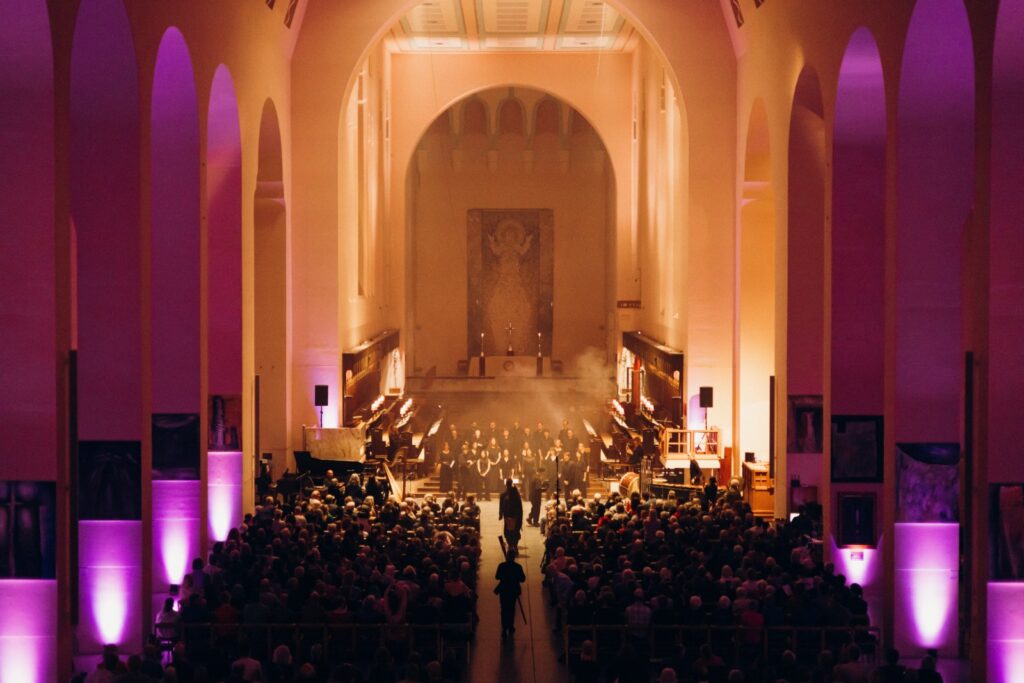
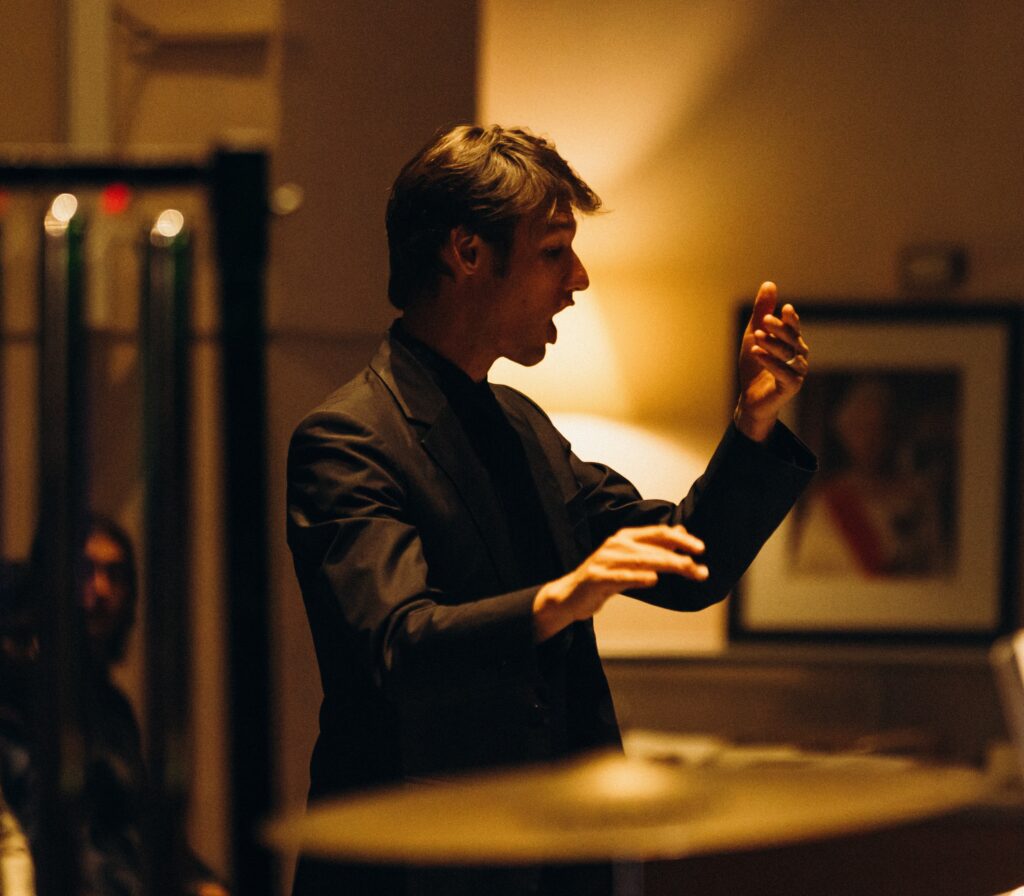
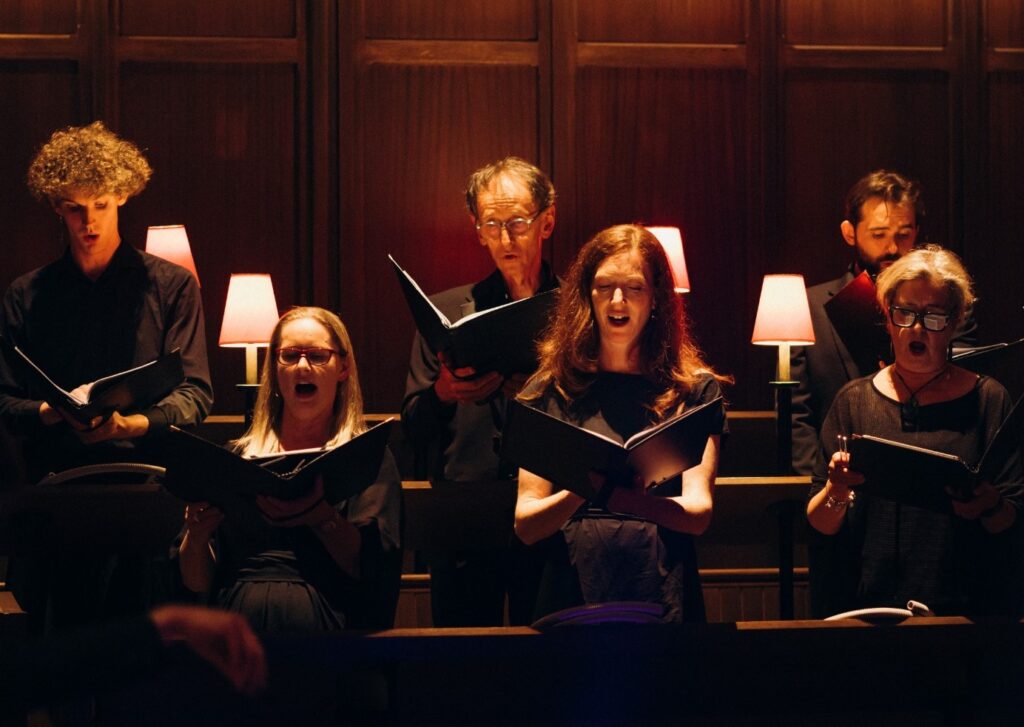
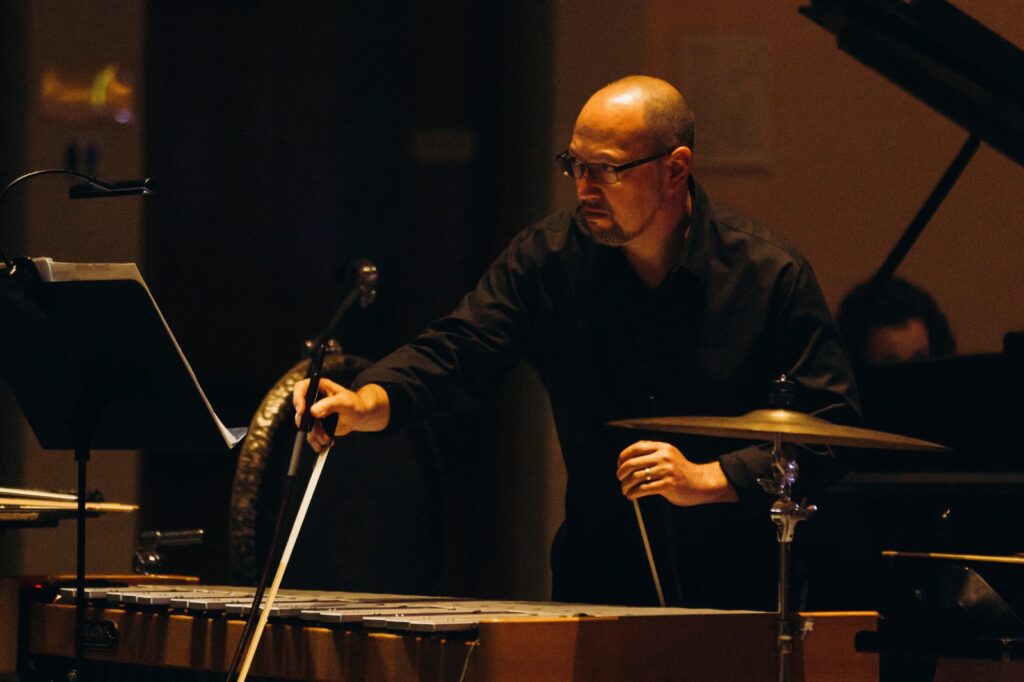
Sound Cathedral – assembled forces, Wellington Cathedral of St Paul – all photo images courtesy Nick George, Creative
SOUND CATHEDRAL:  Almost 500 years of music and sound collaboration brings together Renaissance composer Orlande de Lassus’s Sibylline Prophecies from1550,  traditional Taonga Puoro from Aotearoa, and  present-day composer Michael Norris’s reconstructive configurations of Renaissance polyphonies.
The Tudor Consort – directed by Michael Stewart
Rangatuone Ensemble – conducted by Riki Pirihi
Stroma Ensemble – directed by Michael Norris
Organist – Max Toth
Bellringers, Wellington Cathedral – Dylan Thomas, Jamie Ben

Wellington Cathedral of St.Paul, Molesworth St., Wellington
Sunday, Ist March, 2026

Presented with the auspices of Aotearoa New Zealand’s 2026 Festival of the Arts

Over half-an-hour before the event’s beginning there were groups of people forming lines in the foyer of  Wellington’s Molesworth Street Cathedral of St. Paul, drawn by the prospect of experiencing what composer Michael Norris had described in the pre-concert publicity as an enlivening of “the sonic architecture” of the Cathedral.  Those of us who had in the past revelled in the Cathedral’s inherent aural capabilities with music written especially for large spaces were irrevocably drawn to the prospect. And, inside, our programme notes contained effusively elaborations on the venue becoming “an immersive bath of sound that emanates from every corner”. No better introductory build-up to the event’s efficacy could have been devised.

The musicians involved in “Sound Cathedral” began taking up positions at the beginning which enclosed the audience in a kind of surrounding web, the atmosphere further enhanced by diaphanous streams of mist emanating from the altar end of the nave and creating veritable swathes of ambient mystery. A hush suddenly prevailed as the Dean of Wellington Cathedral, Katie Lawrence welcomed and addressed us both in Te Reo and English from the pulpit, enjoining us to “open our hearts and enjoy the spectacle”.

The Karakia is delivered, sonorously and scalp-pricklingly, augmented with impressively sonorous, even baleful-like trumpet tones from the taonga puoro players – others join in from the surrounding areas, with the sounds taking on a less confrontational, more “inclusive” kind of ambience as we begin to discern voices amongst the instrumental sounds. Gradually the voices were made manifest by the singers’ one-after-the-other appearance from the back and up the central aisle to the front, as the instrumentalists continued with their all-enveloping array of sounds from all precincts of the nave. It was an enchanting cornucopia of sound, in constant swirling flux, unexpectedly reminding me at this point of those “river sounds” which build up in the same way in Wagner’s Prelude to his opera “Das Rheingold”.


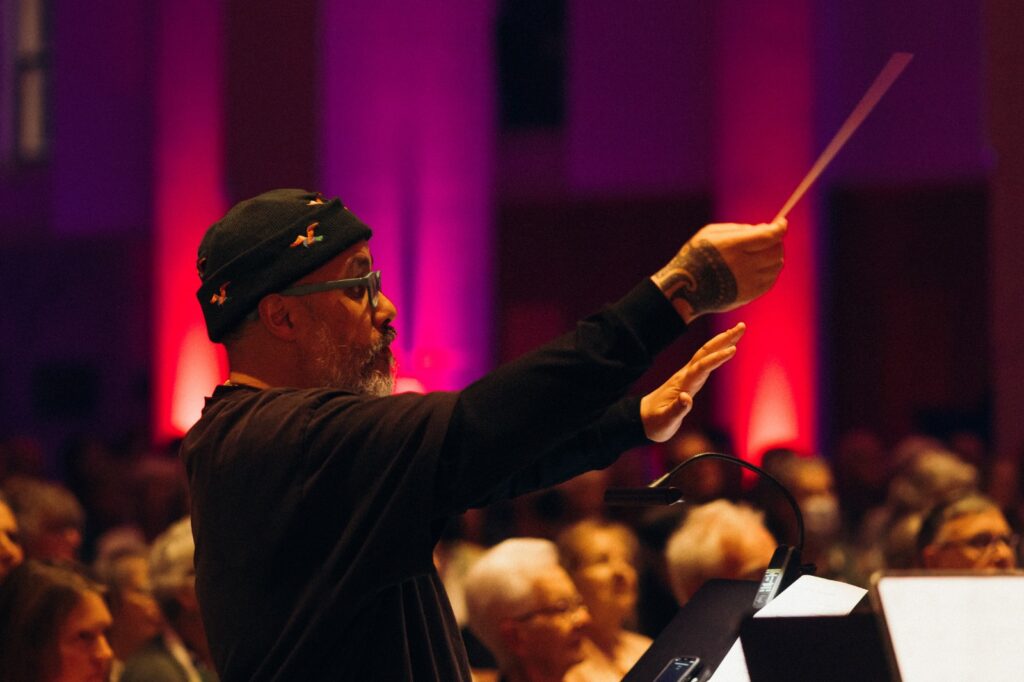
MIchael Stewart

Following his singers was music director Michael Stewart, whose appearance occasioned a withdrawal of tones from the various instrumentalists in favour of eerie, almost spectral percussive sounds, intended to accompany the Consort’s singing of the Prologue – in effect,  Lassus’s own sung introduction to his set of Sibylline Prophecies which were to follow. Beginning with the words “Carmina chromatico” , this enchanting episode ( performed by the Consort Voices just as the composer had written) struck me in that instant as the kind of musical “sound” this building was surely created for, as celestial an effect as was the singers fan-like dispersal at the end to both sides, whilst still singing, the sounds augmented by soft percussion and harp in a seamless, dream-like flow!


Tudor Consort Singers


Lenny Sakofsky, percussion


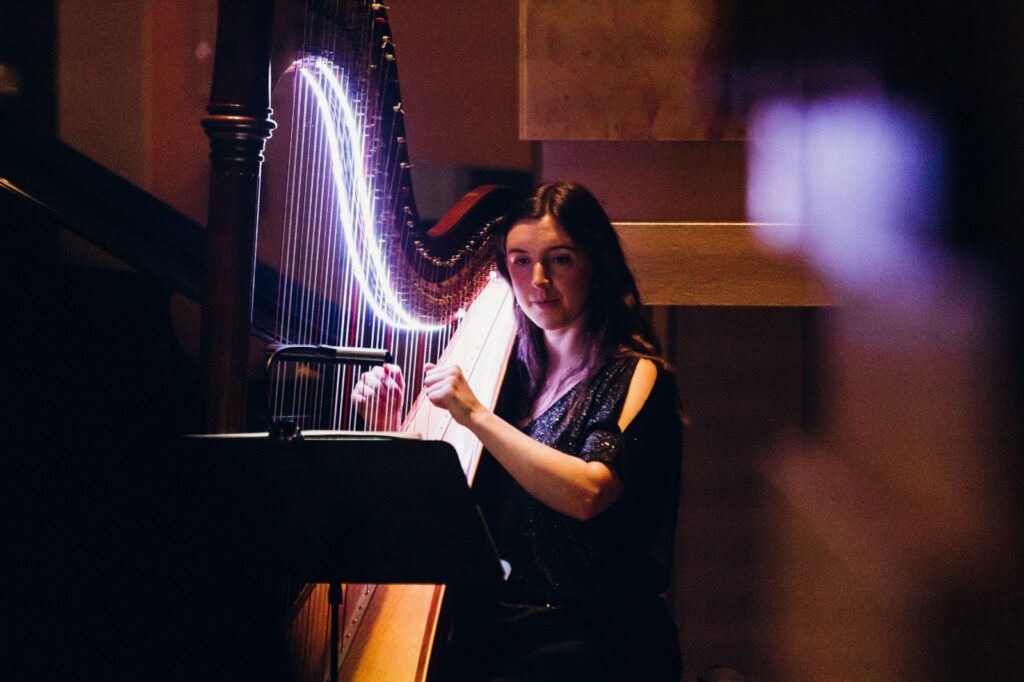
Michelle Velvin, harp

At this point one sensed that the music was preparing to “take flight” from its place of origin, as if we were present at the very act of creation, with the sounds inspired by Lassus’s following “Sibylla Persica” seeming to themselves resonate and augment their own existing ambiences – I could make out some of the Sibyl’s words at the beginning – “Virgine Matre satus…” but with the sounds seeming to follow composer Michael Norris’s idea of introducing qualities of utterance such as “cloud-like time-stretching”, encouraging our listening sensibilities to perhaps soar, or, conversely, cease physical movement in favour of hitherto unexplored realms. This delightfully disorientation of time and space accompanied a rich resonance of taonga puoro instrumental detail, sounding for all the world like birdsong as if emanating from a deep and hitherto undiscovered adjoining valley.


Riki Pirihi – director, Rangatuone Ensemble

What this did was disengage me from the singers words’ and their meaning from here onwards, save for the occasional phrase, such as the emphasis given to the line “…ille Deus casta nascetur virgine magnus”, with those birdsong ambiences rising to a great outpouring of forest  amplitude with voices and instruments. I presumed this was a depiction of  ”Whirl / Komiro” with the splendid bullroarers helping to build up the ambieces leading to the “Oscillate/Kopiupiu” with its almost visceral pendulum-swings, expressing the idea of surpassing nature’s work  “by he who governs all things”. For the rest I simply gave myself over to the repeated phrases and their mesmeric effect bearing my sensibilities aloft, the sounds again vindicating the building’s capacity to creatively augment any such potential resonances to their utmost effect.

I found myself led by instinct by an upsurge of beatific vocal lines floated in “Sibylla Cimmeria” , with its reference to “Eco lucebit sidus ab orb Mirificum” (And the star shines from a wonderful orb), sounds which here create as celestial and unworldly an ambience as any music has a right to sound. A subsequent dark and portentous episode enabled me to surmise that we had reached “Sibylla Phrygia” with its punitive words “…punire volentem Mundi homines stupidos”  (…wishing to punish the stupid men of the earth)…..the grim, forceful accents which characterise the sequence strike an appropriate contrast afforded by the final “Sibylla Agrippa” with its music’s return from the dark depths.

With the choir reducing its size and the taonga puoro taking up a “cleansing” sound-palate, the time for reconciliation seemed at hand. Nature is returned to accord as the whole choir gathers, inviting the furthest-flung strands to renew unanimity and kinship. All is heightened by euphoric sequences of aleatoric vocalism, creating a kind of hubbub of renewal into which all strands are gradually wound – the choir pauses to allow the natural world its primacy, before the voices join in, the lighter voices overlapping with stratospheric tones representing a kind of “on high” overlordship, with tones constant and glorious, to which the organ adds its mighty voice.

Standing ovations can become cliches, but in this case one found oneself propelled upwards and on one’s feet by the sheer force of delighted response to join in with the acclaim. Afterwards, reactions and opinions I shared stressed the magnitude and splendour of the occasion, with some, like me, admitting to the expectation of hearing more clearly other parts of Lassus’s music in the manner presented by the Prologue – but instead his music became the deep well from which irresistibly gushed all kinds of time-and-place elaborations upon his themes and texts, proving in a very visceral sense the fantastical “onreach” of artistic  impulse!

One certainly with which to grace the capital’s music performance chronicles – and perhaps even to record for posterity (the latter already done and dusted?) However caught and held, this was a memorable addition to our part of the world’s distinctive sonic voice!