Benjamin Britten – Les Illuminations – 50th Anniversary Concert
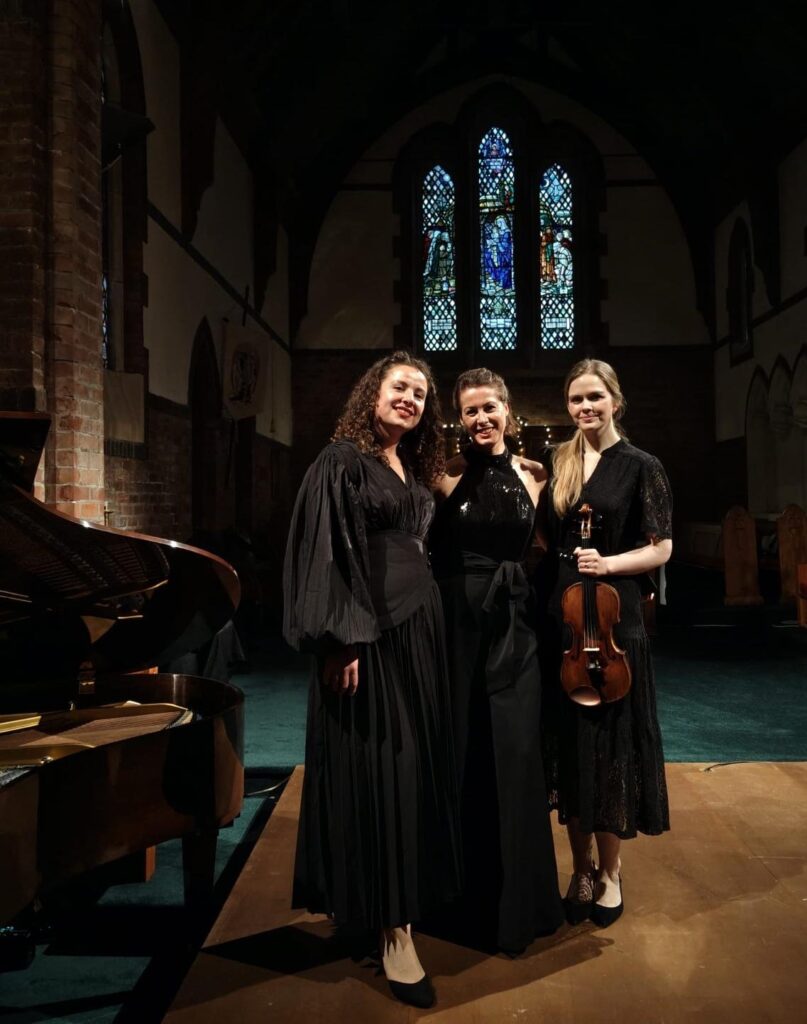 Gabriela Glapska (piano), Carleen Ebbs (soprano), Jessica Oddie (violin),
St.Michael’s Church, Upland Road, Kelburn, Wellington
Monday 9th March 2026
Review by Peter Mechen (Middle C)
The last time I heard Benjamin Britten’s haunting song-cycle “Les Illuminations” make an appearance in a Wellington concert programme was in 2009, featuring tenor Benjamin Fifita Makisi , with Marc Taddei conducting the Orchestra Wellington Strings. So, already feeling in “overdue mode” regarding this work “live”, I suddenly found my interest in this particular 50th anniversary tribute to its composer compounded all the more by the prospect of hearing the work from a trio of soprano, violin and piano.
Britten had originally written the work for soprano and string orchestra, though it came to be strongly associated with his long-time partner, tenor Peter Pears, via a famous composer-directed recording! But rather than inhibiting further divergence, “Les Illuminations” has enjoyed almost more interpreters that one could count, and with each that I’ve heard imparting a singular kind of pleasure in bringing out a particular aspect of this music’s many-faceted character.
The opening declamations proclaimed a magnificent unity of purpose from all three musicians – Gabriela Glapska’s piano sounding the fanfares whose exhilarating insistence brought forth soprano Carleen Ebbs’ wonderfully stentorian declaration of confidence –“I alone hold the key to this savage parade”, to which violinist Jessica Oddie’s highlighting of certain of the instrumental lines made a perfect foil in places for both voice and piano, enriching the instrumental texturing, and deepening and diversifying a character of exchange between the voice and its accompanying phrases on both instruments. In places the “ensemble” between the vocal tones and its accomplices recalled the richness of a chamber group rejoicing alike in an alternation of unity and divergence.
The second verse, “Villes” captures and revels in all kinds of excitable physicalities and profane imaginings – “Des cortèges de Mabs” generates from voice and players a positive whirlwind of propulsion, while “Les sauvages danset sans cesse” (the savages dance unceasingly) until body and mind remove themselves and us to calm confusion.
Then what a change comes with the following “Phrase”, the eeriness fully captured by violin and piano, as Ebbs’ voice transports us to tremulously ecstatic heights from which we serenely fall without a moment’s discomfort at the end. Her serenade “Antique” has a kind of adoring idolatry, whose longing is betrayed by the loveliness of the descending vocal line, beautifully filled out, here; while the following “Royaute” depicts a kind of commoner’s gentility in a fanciful world of heroic, quixotic music.
I enjoyed Ebbs’ courting impulses of abandonment and confidence in riding the syncopations in “Marine”, just as I relished her different treatment of the ”savage parade” motif in the following “interlude, sounding “entranced” rather than savage and determined, and imparting poise and feigned indifference at first to the subject of her “Being Beauteous” – a mood that turns to urgency as ecstasy and its darker side crystallise our responses to beauty – piano and violin similarly “play” with the singer’s anxieties.
No time was wasted with “Parade”, with singer, pianist and violinist busily cooking up the sloughs of misery and malcontent, depicting the “cruel procession of tawdry finery” and Ebbs’ voice and characterisation enjoying the deliciousness of the descriptions, the whole scenario put in perspective by the singer’s authoritative “I alone hold the key to this savage parade”. How beauteous, after all of this, was the end, with Ebbs’ voice serenely rising and falling with the instrumental lines, and partly heartbreakingly, partly stoically leaving the instruments to allow the silences to surge softly backwards at the end – all as satisfying as it was harrowing.
On the strength of this I would readily encourage groups performing this work without an orchestra to consider employing at least a violinist to join with the singer and pianist – would a cellist joining such a group work? – Though I found the violin’s addition amply satisfying, one might try, perhaps even with a string quartet! – however, this present trio of musicians made moments of real magic in St. Michael’s with this work – Britten himself could well have been amazed and possibly even delighted with it all!
There were other things on the programme as well, two works in arrangements by Britten and two adorable pieces by Elgar preceding the main work – and afterwards, we heard the trio perform an excerpt from Handel’s opera, from “Theodora – the ravishing – “O Sleep, why dost thou leave me”; and Reynaldo Hahn’s “A Chloris”, the latter a beautiful setting remarked on by one commentator as “beyond doubt the summit of Reynaldo Hahn’s art as a pasticheur”, so readily does it reflect the Classical world.
The Britten settings, firstly of the folk-song “Down by the Sally Gardens”, followed by an arrangement of Purcell’s “If Music be the Food of Love”, set a delicate, nostalgic folkish sweetness against Purcell’s wonderfully elaborate concoction, both songs given appropriate vocal colour and elegant “turnings of phrase” to bring out their respective characters, as well as enabling us to enjoy the sound and vocal artistry of Carleen Ebbs’ voice, further anticipating the major Britten work on the programme.
From another time and place came the two works for violin and piano by Edward Elgar, neither of which I’d heard before as solo violin and piano arrangements. Jessica Oddie and Gabriela Glapska deliciously charmed us with both of these pieces, performed with just the right amount of simplicity and subtlety of nuance that left one hanging upon each note as a kind of object to be savoured – very much a a listener’s delight in small pleasures.
Just as significantly, these introductory items also gave us ample opportunity to enjoy the glorious sound of the human voice as captured by St,Michael’s Church, whose existence as a concert venue I hadn’t discovered until relatively recently, and whose qualities I would certainly enjoy exploring again in the near future. In sum, a delightful and memorable concert experience