The creative spirit continues to work wonders in Te Whanganui-a-Tara, Aotearoa – (“Kei te ora tonu te wairua auaha ki Te Whanganui-a-Tara o Aotearoa”)
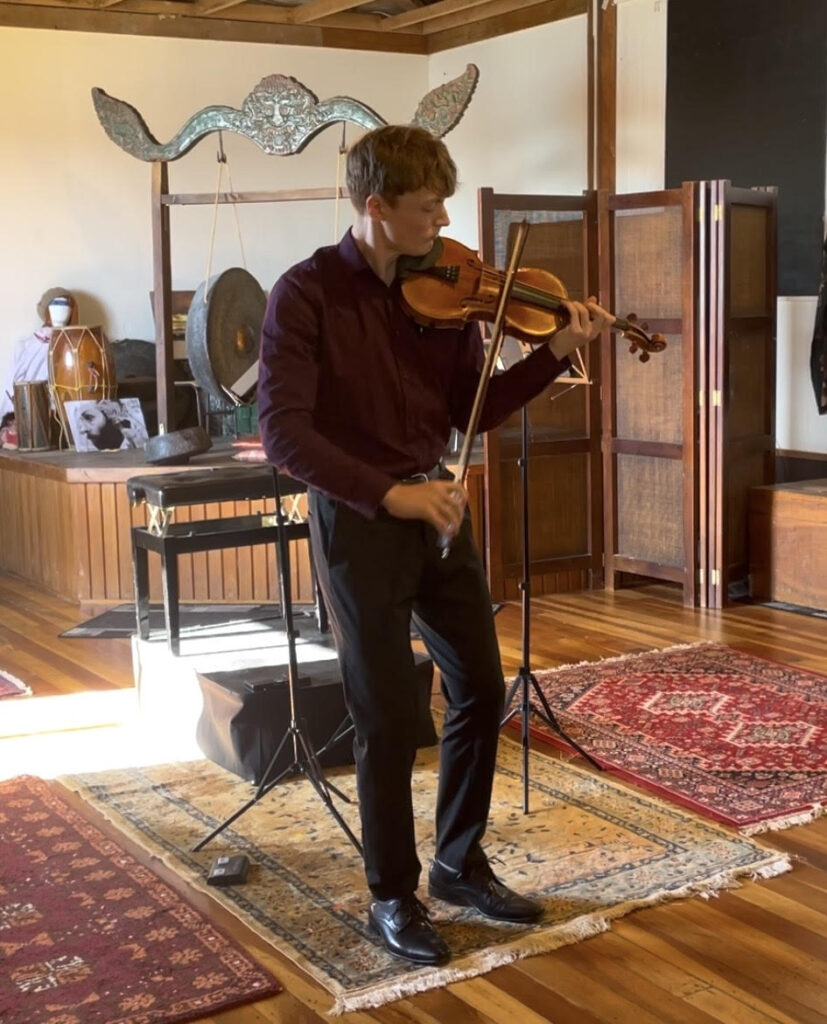 Peter Gjelsten tackles a Bach Violin Sonata (No. 2 in A Minor BWV 1003) at The Long Hall, Roseneath
The Chamber Pot-Pourri Ensemble
A Kaibosh Food Rescue Benefit Concert
ROSS HARRIS – 2 Micro-Trios (2020)
Helene Pohl, Peter Gjelsten (violins), Rolf Gjelsten (‘cello)
NICCOLO PAGANINI – Caprice No. 9 for solo violin
JS BACH – Sonata for solo violin in A Minor BWV 1003
Peter Gjelsten (violin)
CRAIG UTTING – Four Wellington Dances for violin and cello
Helene Pohl (violin), Rolf Gjelsten (‘cello)
FRANZ JOSEF HAYDN – String Quartet in G Major Op.33 No. 5
Helene Pohl, Peter Gjelsten (violins)
Sophia Acheson (viola), Rolf Gjelsten (‘cello)
The Long Hall, Point Jerningham, Roseneath
Saturday 21st March, 2026
Fresh from attending my first St.Andrew’s-on-The-Terrace lunchtime concert earlier in the week, I had the good fortune to catch another. not dissimilar kind of musical happening – this one a 2026 “first” for the capital of a series instigated a year ago by violinist Helene Pohl at Roseneath’s “The Long Hall”, situated on the Point Jerningham lookout reserve next to Roseneath Primary School. The concerts are designed to alternatively support the Kaibosh Food Rescue charity, and the Arohanui Strings, the Sistema-inspired early intervention music education programme. The Kaibosh charity makes a significant difference to food and energy waste and carbon emissions, enabling thousands of kilos of food to be redistributed to community groups, resulting in renewed efforts by the same musicians over the present in continuing and supporting an eminently worthwhile venture.
Thanks to the inspiration, skills and capacity for hard work of Helene Pohl and ‘cellist Rolf Gjelsten, the 2025 concert series was a great success. The two musicians, aided by various colleagues, were able to simultaneously commemorate and take advantage of composer Dmitri Shostakovich’s 50th death anniversary, performing a number of the composer’s chamber works in tandem with a wide range of other pieces, including a couple of contemporary works written specifically for these concerts (and therefore both world premieres!) by composers currently both on-and off-shore, Ross Harris and Gao Ping, respectively.
Now, to begin the 2026 series the Long Hall’s opening Kaibosh Food Rescue programme paid appropriate homage to some of the previous year’s delights, including works by “resident” composers (two of whom were present today!), as well as instrumental solos which illustrated the power of a single voice’s communication, and a string quartet by the composer who effectively defined the form and whose efforts provided all kinds of “springboards’ for those others who followed suit.
First up was music representing a kind of timely antidote to Aotearoa New Zealand’s present version of Trumpish madness, two Micro-Trios by Ross Harris, written during the much-discussed lockdown period of 2020 for the Pohl/Gjelsten family members present today. The two works, as if conceived with different personalities in mind, displayed contrasting characters, the first beginning in a restless, slightly anxious 5/4 which developed more forthright impulses befitting a kind of “confused turmoil of being” in response to the isolated circumstances. The second work took a more lyrical approach, with long-linked lines attracting all kinds of impulses which attached themselves to the lines before dropping off the pace and wandering quizzically through unfamiliar vistas (like an ageing process, perhaps – with apologies to the composer!).
Violinist Peter Gjelsten followed up his 2025 performance of Eugène Ysaÿe’s Third Sonata (“Ballade”) for Solo Violin with another work by a virtuoso violinist-composer, perhaps the doyen of them all, Niccolo Paganini – The Ninth of his 24 Caprices for solo violin was given here with plenty of confidence and elan, the opening “hunting calls” resounding their thirds with spirited effect in dynamically-contrasted episodes readily suggesting the shouts of purpose and encouragement from the riders relishing the chase. The “sport”was given plenty of incident by the violinist’s confident throwing-off a middle-section’s skitterish runs broken by stentorian phrases, suggesting both mishap and success in the pursuit!
Sterner stuff followed these hi-jinks, with Peter Gjelsten giving us JS Bach’s wonderful A Minor Sonata for solo violin, one of three Sonatas for the solo instrument, all of which are often coupled as a performing edition with three Partitas for the same instrument. An all-purpose differentiation between the two titles “Sonata” and “Partita” is that the former is traditionally a four-movement structure which often features linked slow-fast sections and a fugue, whereas a Partita consists of different types of Renaissance/ Baroque dance movements. True to type this Sonata includes a fugue as the second movement.
First impressions of this work emphasised seriousness over gaiety, the solemn, declamatory opening commanding our attention with the player’s presence of intonation and command of nuance giving his listeners an engaging sense of exploration right to the movement’s final questioning note. The Fugue’s elegance and poise at the outset opens out, Gjelsten finding plenty of room for variations of tone and presenting an astonishing array of different voices – the music’s trajectories buildup and carry us along with wonderful ”heads of steam”, so that the phrases and statements really resonate.
Gjelsten’s control of the Andante’s pulse enabled both melody and rhythm to coexist, often in little more than whisperings, but with an underlying strength of overall purpose. We felt taken to another world by the second half of the movement, with the composer seeming to allow us a lingering glimpse of his serenity of outlook and purpose of faith – I could imagine a young player in future years delving even further into the music’s timelessness that allow these sounds to linger long after the player ceases. The concluding Allegro is here excitingly launched and teasingly sustained with the antiphonal alternating phrases made here to dance through our sensibilities’ spaces. The rapidly-executed impulses have an exhilarating ring to them, and we’re “teased” with what seems like the approach of a final cadence, but with geyser-like irruptions that suddenly push the boundaries out further – tantalizing playing that keeps us on our toes and enables us to relish the music all the more.
We had been promised a quick, “straight-through” concert at the beginning, so our kaleidoscopic musical journey suddenly whirled us homewards via local composer Craig Utting’s engaging “Four Wellington Dances”, for violin and ‘cello (written in 2025 for Helene and Rolf.) The work began with an entirely apposite “Wind Dance”, a nagging 7/8 perpetuo-molto rhythm by turns driving, teasing and cajoling the notes into sound-impulses whose insistence any Wellingtonians would recognise, and with alternating instruments adding a moaning-sighing figure over the agitations, catching their constant unpredictabilities. Next was the strangely mesmeric “Whale Song”, introduced by spectral “con sordino” violin tones (which set the scene for strangeness) and galvanised further by hauntingly-charged “vocalisings”, firstly in the lower and then upper registers of the ‘cello – an incredible soundscape, tapping into a “natural world” communication, with the instruments conveying a real sense of ambient surroundings and language essentially removed from human interaction.
“Seagulls”, the third dance, has an introduction flecked with further atmospheric touches, such as the ‘cello playing eerie glissandi to the violin’s arpeggiations and rather touching “seafarer’s song”, first played, incidentally, lower than the ‘cello’s accompaniments, though the instruments exchange their roles at certain points – the melody is a real charmer, replete with nostalgia! Finally, the “Habanada” imbues a well-known operatic rhythm with a mischievous spirit during short sequences of dance-tunes and illicit collaborations with ostensibly unlikely partners such as Saint-Saens’s “The Swan” and Rimsky-Korsakov’s “Bumble Bee”, with even Mendelssohn’s “Wedding March” making a brief appearance before falling down the stairs and (thankfully) coming to its concluding senses!
After all of this, what better finale than to be given a masterwork from a composer whose music paralleled the conditions that produced each of the concert’s preceding works – isolation, compositional mastery, instrumental fluency, and a need for entertainment? All these things come together in the string quartets of Franz Joseph Haydn, whose Op.33 set of six string quartets were written in 1781, and became known as the “Russian” Quartets, due to the dedication to the Grand Duke Paul of Russia. Another nickname given to these works is Gli Scherzi (The Jokes) referring to the replacement of the older style Minuet with a quicker, more dynamic movement.
Here, then was the fifth of the Quartets from this Op.39 set, a work which itself has been nicknamed with the English sobriquet phrase “How do you do?”, drawing attention to the Quartet’s very beginning, a pianissimo galant cadence which actually returns to conclude the movement with which it started. the opening “How do you do?” cadence is only a prelude to the ensuing Molto Allegro, which seizes hold of the argument and propels it excitingly forwards. The mood lightens for the lyrical second subject, only to unexpectedly plunge into the almost “groaning downwards” chromatic modulation towards the end of the exposition. The volatile development dances, swoops and plunges as the music unfolds, releasing almost operatic surges of energy in places, with the “how do you do” cadence realigning the music’s focus for a recapitulation – we are, by this time, agog at the music’s volatilities, and marvel at how quickly the music races to its concluding cadences without missing a beat!
Our heartstrings are tugged immediately by the slow movement’s intensities, most strenuously propelled forwards with almost unrelenting energy, to which one simply has to surrender and allow oneself to be borne aloft and taken somewhere. What a contrast, therefore, with the impishly impulsive Scherzo, filled with all kinds of hesitancies and impulses! The Trio brings a steadier, more genteel character, as if wishing to reform such excesses, though to no avail when the opening returns, as quirky and ornery as ever, though with a touch, perhaps, of guilt via its almost evanescent ending!
After this, the finale’s music is almost prim and proper, in what seems like variation form, with the first violin decorating and elaborating on the melodic line in both subsequent variation movements, and then, the viola and cello taking turns to decorate the dance steps for a subsequent movement. Finally, there’s a Presto which scampers to a satisfyingly breathless conclusion!
Such a lot packed into a relatively short time! Nevertheless, we were replete – delighted by the music and the playing, and honoured by the good and prestigious company – a truly memorable occasion!