Resonances from the New Zealand Symphony Orchestra – suggestive Ravel, effusive Dessner and harrowing Shostakovich

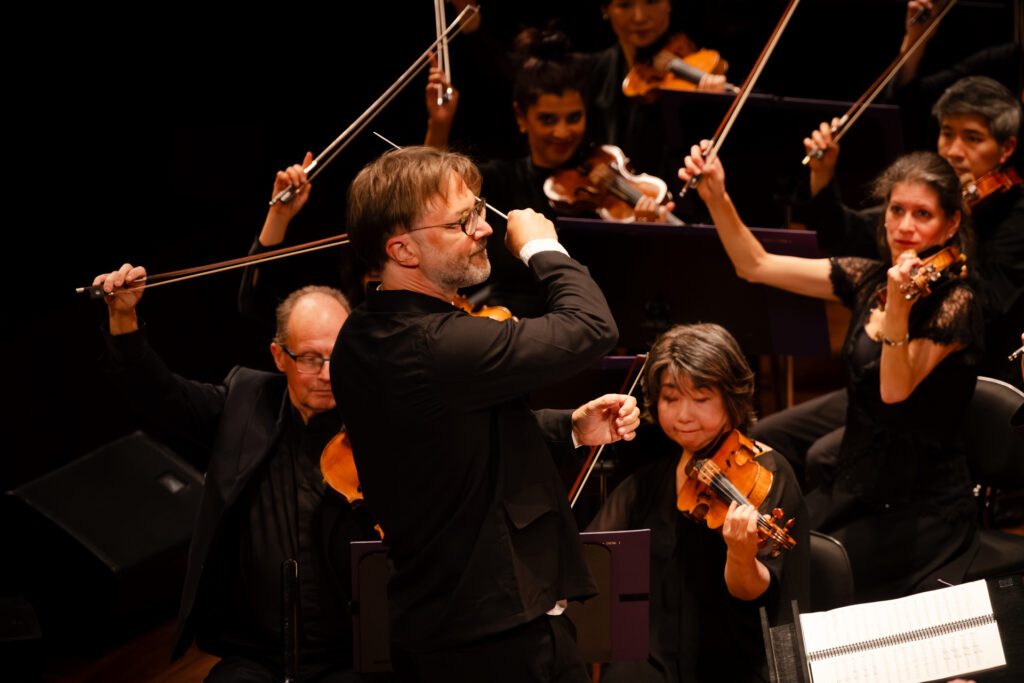
André de Ridder conducting the NZSO – image Latitude Creative/NZSO

RAVEL – Pavane pour une Infante Défunte / BRYCE DESSNER  Trombone Concerto
SHOSTAKOVICH – Symphony No. 8 in C Minor Op.65

David Bremner (trombone) New Zealand Symphony Orchestra / André de Ridder (conductor)
Michael Fowler Centre, Wellington
Thursday, April 9th, 2026

The New Zealand Symphony Orchestra’s latest concert brought together three disparate works under the generic title ”Resonance”, demonstrating orchestral music’s well-nigh infinite variety of evocation in drawing from both specific and integral sources.

The most directly effusive of these was American guitarist and composer Bryce Dessner’s trombone concerto, one substituting for  a similarly-conceived work (Slip: Concerto for Trombone and Orchestra) by American composer Andrew Norman, one intended as a premiere! – disappointinngly, the original  soloist, Dutch virtuoso Jörgen van Rijen (who’s principal trombonist with Amsterdam’s Royal Concertgebouw Orchestra), was prevented by injury from presenting the work. However, the NZSO’s own principal trombonist, the deservedly popular David Bremner, gave at short notice the inspired substitute choice of Dessner’s work with a truly sparkling performance that merited an enthusiastic “local hero” audience ovation.

At the orchestral helm for this presentation was André de Ridder, the NZSO’s Music Director Designate for 2027, due to take over from Gemma New at the conclusion of her five-year tenure in the position. De Ridder began the concert with the orchestra in fine fettle for Maurice Ravel’s sheerly beautiful Pavane pour une Infanta défunte, procuring winsome solo lines from firstly a horn (a shade late, I thought, in sounding its opening note, but flawless thereafter), and winds and strings, each counterbalancing the music’s meticulous symmetries, until the whole orchestra lustrously returned to the piece’s opening melody, the harp as before gently caressing the piece’s breath-catching luftpauses. Conductor de Ridder’s ear seemed as fastidious as the composer’s in realising the music’s beguiling textures throughout.

Bryce Dessner’s Trombone Concerto certainly put player and instrument through their respective paces, even if the end result seemed for much of the work’s duration a kind of compendium of capabilities on the part of a skilled player of a distinctive-sounding instrument rather than an expression of distinctive pictorial, emotional or philosophical content. Perhaps the slow movement focused more directly on the solo instrument’s attempts to cohere with its sonic surroundings, a kind of metaphor for modern life’s isolation – with orchestral backdrops in places withdrawn and spectral- sounding, and in others contesting the ambient spaces with the soloist. And the third movement broke into different “dance” trajectories in places, seeming to invite (or perhaps “dare”) the trombone to join in (with trombone and trumpet actually sharing a few slinky measures of roguish alliance). I thought the work more entertainment than anything else, as befitted the traditional role of a concerto, Davd Bremner and his instrument well-nigh inseparable in their shared ownership of the work’s capabilities!

No two works could have made more of a contrast with Dmitri Shostakovich’s Eighth Symphony which took up the concert’s second half. Written in 1943 and following the enormous success of the composer’s Seventh Symphony as a wartime statement of patriotic resistance, the Eighth was straightaway a different kettle of fish. This work completely and utterly turned its back on the Seventh’s triumphal aspect and its glorification of the Russian people’s resolve in the face of the Nazi invasion – instead Shostakovich called the new Symphony “a poem of suffering”, and  “an attempt to reflect the terrible tragedy of war”.

Consequently, its Moscow premiere in November that same year, by the work’s dedicatee, Evgeny Mravinsky, though acclaimed by the audience, brought only tepid critical reviews, and savage official disapproval, which resulted in the work being withdrawn until its second-only Moscow performance in 1956! Since then, it’s gradually clambered towards a position of near pre-eminence among the composer’s symphonic works, as much for its historical range of ambiguities as its overall singularity of purpose. To a violinist in one of the early performances who remarked to Shostakovich on the wonders of the C Major passage that began the finale, the composer replied, “My dear friend, if only you knew how much blood that C Major cost me!”

This presentation from the NZSO was one to resound in the memory – André de Ridder briefly introduced the work to his audience, relating the music’s intents and purposes to the prevailing misery and hardship faced by people in the world’s present-day troublespots, and then plunging the orchestral strings into the dark-browed ambiences of the work’s at once sonorous and incisive beginning. Under his continued direction the sounds coalesced slowly and purposefully, the strings leading the way for similarly-wrought wind-playing, gradually building the tensions up to the movement’s series of utterly cataclysmic crescendi with their overwhelming evocations of widespread suffering caused by war and oppression. These were acknowledged eloquently by the extended cor anglais solo (here superbly delivered) which followed the orchestral maelstroms, and in tandem with the strings whose sounds seemed to us to emanate from the very souls of all who thus suffered. A brief brass fanfare attested to the human spirit’s refusal to accept defeat before returning to the lament, whose wrung-out intensities occasioned, at the end, the feeling of a  huge but guarded exhalation of breath!

Such an evocation brought forth not just one scherzo-like response, but two diametrically different reactions – the first, an Allegretto, was given amazing sweep and grandiloquence dressed up as grotesquerie, the irony savage in its futility, here brilliantly depicted by the winds, especially the piccolo and bassoon, and later joined in the onslaught by the percussion, with strings and brass gleeful collaborators. Then came the third movement Allegro non troppo, a savagely insistent orchestral toccata, here given the most trenchant performance I’d ever encountered since hearing Russian conductor Kyril Kondrashin’s 1960s Moscow recording – this was a fiercely relentless assault punctuated by a macabre circus-like sequence for solo trumpet and side-drum (brilliant, burlesque-like playing!), the energies veering in effect between wild exhilaration and fraught anxiety, and with de Ridder encouraging his players to occasionally push the intensities further forwards. It was a sequence culminating in some almost destabilising timpani-playing driving the needle into the red at the music’s climax while simultaneously giving birth to a sombre fourth-movement Passacaglia.

Here, the music’s previous agonies were echoed in a new and terrible kind of tranquility, called by one commentator “an expression of timeless grief”, and leading up to the  numinous impact of that C major chord which brought a ray of hope . De Ridder and his players performed as if inspired, here, with the sounds lifting us from out of the slough, reinvigorating energies and teasing out sensibilities as well as plunging us once more into a brief reiteration of those hellish first movement depictions of destruction and terror wrought by war and brutal dictatorship. After this we were dazedly brought back to our senses by a trio of instrumental voices whose superbly-wrought equivocal interactions and powerfully muted orchestral responses seemed to suggest that life for each one of us, despite its vicissitudes, would nevertheless go on.

Pianist Otis Prescott-Mason – an unexpected but precious gift for us of Schubert’s heavenly G-Major Sonata D.894.

FRANZ SCHUBERT – Piano Sonata in G Major D.894

Otis Prescott-Mason (piano)
St.Andrews’-on-The-Terrace, Wellington
Wednesday, 8th April, 2026

Firstly, a bit of background, which I gleaned from the concert’s programme leaflet  – pianist Otis Prescott-Mason has recently completed his undergraduate studies with Dr.Jian Liu at the New Zealand School of Music here in Wellington. During this time, he’s taken part in several competitions throughout the country, winning firstly the 2020 New Zealand Junior Piano Competition and then both the 2022 PACANZ National Piano Competition, and the Lewis Eady National Piano Competition in Auckland that same year. More recently, in  2025 he won Third Prize at the National Concerto Competition in Christchurch with Prokofiev’s Third Piano Concerto, and has performed with various regional orchestras such as the Christchurch Symphony, Orchestra Wellington, and the Auckland Philharmonia.

Now having completed his undergraduate studies, Prescott-Mason is looking forward to his next step on the pianistic ladder, taking him to a course of study further afield at the prestigious Yale School, of Music in New Haven, Connecticut, USA during the 2026-27 academic year, and working towards a Master of Music with the great Boris Berman, a Professor at the school, and a pianistic “hero” for the young musician. He joins a prestigious group  of past keyboard-achievers from these shores who have similarly  ventured outwards to seek further artistic and musical fulfilment.

I had seen and heard Otis play before on occasions which included a memorable 2020 St. Andrews’ solo recital (review at https://middle-c.org/2021/11/firstly-sparks-and-then-a-conflagration-pianist-otis-prescott-mason-in-recital/), as well as a “shared” recital with other solo pianists (actually a ”preparation”  concert for the aforementioned 2020 NZ Junior Piano Competition, which Prescott-Mason won!), and a sparkling lunchtime concert duo recital (four hands) with Sunny Cheng in 2021. In all, my expectations had been suitably primed by the above to regard this concert as something not to be missed!.

Upon making his appearance, the pianist explained to us that, rather than fronting up with his originally-planned programme of predominantly virtuoso pieces (which I was expecting to hear) he’d felt of late much more like spending time with an audience in the company of a composer like Schubert – so to my special delight (and partly also because I had already heard him play a couple of the originally-scheduled items, and this was something very different!) he’d decided to play the Schubert Sonata in G Major D.894, a work I’d become particularly fond of in recent times thanks to Russian pianist Sviatoslav Richter’s daringly leisurely (and, for me, utterly mesmerising!) performance, especially in the case of the work’s first movement.

Though Prescott-Mason didn’t attempt to emulate Richter’s “near-timeless traversal”
of the first movement’s oceanic-like expanses, he caught at the very outset the music’s unique blend of surety and resonant utterance which the slightest hint of any haste or impatience or anything mechanical in a performance can deaden and neutralise. In fact, at the work’s very beginning the pianist “set the scene” for all of us so very beautifully by adopting the once-fashionable opening gesture of playing a series of gently-modulating figures (sometimes chordal, sometimes arpeggiated) as a kind of “storyteller’s introduction” to what was to follow. (Those readers who know of and have heard the late, great Roumanian pianist Dinu Lipatti’s legendary “farewell” recital, recorded “live” as long ago as1950, will be familiar with this enchanting and heartwarming practice!).

Schubert’s own opening chords were then gorgeously-voiced, the whole introduction entirely and disarmingly spontaneous in effect – even more elfin-like were the sounds of the following contrasting sequence, both hushed and beautifully darkened by the deeper bass notes. The music then “opened up”, gloriously amplified through its newly- burgeoning joy and intensity. Though Prescott-Mason seemed to allow the ensuing flowing trajectories of movement at first “play themselves”, he made the following filigree right-hand decorations dancing above the music’s gentle progress utterly captivating. And the timing of these decorations’ sudden downward movement was superb, generating just enough sense of momentum, strength and spontaneity to underline the sense of a kind of “arrival” at the exposition’s end, though with things remaining yet to be fully understood.

Throughout the repeat we found ourselves as entranced by the pianist’s concentration as before, the music unfolding as delightfully and spontaneously, with the descent into those declamatory chords leading to an enchanting postlude resonating with even greater gravitas and resonance this time round. Of course, the development’s sudden pitiless onset of dark-toned attack opened up a new world of frightening disturbance, from which the music’s furtive moments of “escape” into desperately-sought gesturings of consolation get beaten back by the composer’s own demons. We heard one or two instances of near-derailment as the pianist wrestled with these dark forces before managing by sheer effort of will to endure their grim purposes with sufficient patience – though I thought the recapitulation of the opening here could have conveyed a deeper, more spacious and exhausted sense of the “trauma of experience” the music conveyed so vividly in those throes of despair.

All was well by the time the coda was reached, with Prescott-Mason’s re-entry into the music’s trance-like world bringing out those almost archway-like “gates of heaven” utterances with what seemed like wonderment and gratitude, surely and generously taking us with him, as the descending phrases concluded this first part of the journey.

What enchanting song-like lines we then heard at the Andante’s beginning, the tones engaging and the mood almost joyous in its reiteration of full-throated lyrical phrasings – then, how dramatic a plunge into the second group of utterances we got here! Some  detailings seemed to have a couple of out-of-focus moments in the more beseeching parts, but the pianist kept his head and steered the music back on course  – along with the occasional unexpectedly “repeated” phrase, these felt like “corrections” of things originally mistimed…… (perhaps a by-product of the programme’s relatively late re-alignment for the recital?)

Far more important was Prescott-Mason’s maintaining of the music’s overall character, the reprise of the movement’s opening was again beautifully elaborated, with just enough suggestibility and insinuation for us to register the lasting impact of the various plungings into more shadowy and stressful sequences, a wonderful exposition of a relationship between well-being, conflict and eventual resolution. The dramatic Menuetto/Scherzo, too, was delivered with telling contrast between the opening’s muscular purpose and the wryly piquant responses, an interaction which largely dominated the movement – a lovely moment is the occasional quixotic reprise of the opening in more muted tones and with occasional wry grace-notes (as if the more bumptious manner of the opening can occasionally exhibit a more personable “inner” character, one which is brought out here to perfection. As for the Trio, it was pure enchantment on this occasion, almost like a “sleepwalking” sequence displaying an alternative side of the same coin, an “echt-Schubert” moment!

The finale here is surely one of the composer’s happiest creations, an utterly disarming instance of a composer “coming to terms” with the demons lurking in some of the music’s earlier recesses. Prescott-Mason beautifully captures the music’s charm and good humour of the opening, his technique having the spring and pliability that readily give these qualities an irresistible demeanour. And he has the gift of a delightful insouciance, which adds to the music’s appeal while keeping its significance in the larger scheme of things intact and resonant – his playing doesn’t erase memories of the journey but adds to the composer’s own achievement in  deepening the impact of the whole as a living entity. Implicit in this was his simple and heartfelt playing of the work’s final phrase, whose silences that followed were true resonances of memory. What a way to spend a lunchtime! – one, at the end of which we were left feeling such gratitude to both composer and performer!


Music from the memory, in the air and on the wing – all from Wellington City Orchestra’s opening 2026 concert!

Wellington City Orchestra’s 2026 concert series – a fresh and adventurous beginning!

LILI BOULANGER – D’un Matin de Printemps *
LOUISE WEBSTER – Violin Concerto (In Hollowed Bone I hear the Seas Roar)
LILI BOULANGER – D’un Soir Triste
SERGE PROKOFIEV – Ballet “Romeo and Juliet” – Suite No. 2

Helene Pohl (violin)
Justus Rozemond (conductor)
Virginie Pacheco (assistant conductor)*
Wellington City Orchestra

St Andrew’s-on-The-Terrace, Wellington
Saturday 28th March, 2026

This opening Wellington City Orchestra concert of 2026, brought to its audience a truly engaging and stimulating  programmme. Conductor Justus Rozemond and his WCO musicians here followed up their enterprising 2025 concert of works by Nicolai, Rachmaninov and Berlioz with an even more exploratory selection – two compositions by the tragically short-lived French composer Lili Boulanger (the first of which was directed by the WCO’s Assistant Conductor. Virginie Pacheco and which opened the concert), followed by a Violin Concerto from Auckland composer Louise Webster, here played by the work’s first performer in 2016, Helene Pohl – and with the composer in the audience! – and finally, a Suite of dances from one of the most beloved of twentieth-century ballets, Serge Prokofiev’s “Romeo and Juliet”.

Assistant Conductor, Virginie Pacheco (who had made such a positive first impression in last year’s concert series), took the rostrum for the concert’s beginning and launched her players enthusiastically into the opening wide-eyed spring-like strains of Lili Boulanger’s D’un Matin de Printemps, (A Spring Morning). This was one of the last works the composer completed before her untimely death in 1918 at the age of twenty-four – she had written several chamber versions of the piece for different instruments, but wanted its “full-orchestra” expression as the piece’s last word.

The music’s remarkably verdant textures were conveyed here throughout the “spring morning” opening section with a judicious amalgam of elan and delicacy – a more sombre set of sequences followed, featuring strings and wings in forest-murmur-like “nature-exchanges’, which built up through a splendid crescendo, becoming at the end a kind of exultant processional exuberantly capped by a splendid harp flourish – wonderful, atmospheric playing!

The front violin-desks were then moved back to make room for the concerto soloist – this was Helene Pohl, who had given the premiere performance of Louise Webster’s Violin Concerto as long ago as  2016 with Auckland’s St.Matthews’ Chamber Orchestra. The composer was originally going to write an “overture-like” piece for the concert with passages for a solo violinist, but when she discovered who the violinist was going to be, the present concerto simply “growed”, inspired by Webster’s regard for Pohl as a musician. Incidentally, Webster subtitled the work with the quotation from Ruth Dallas’s poem about the  sea – “In hollowed bone I hear the seas roar” – AFTER the music had been written, a truly organic, rather than “made-to-order” gestation!

The following year, Pohl was due to reperform the work with the NZSO as part of the SOUNZ readings of music by New Zealand composers, but conflicting schedules meant that NZSO violinist Yuka Eguchi had to step in to perform the work instead. Now, ten years after that first SMCO performance Pohl was delighted to have the chance to revisit the concerto in concert – she recalled being particularly struck by the work’s fusion of emotional expression with colourful pictorial detail, making the concerto all the more pleasurable a prospect to go back to.

The work’s beginning instantly arrested one’s attention – over a low orchestral pedal-point the solo violin entered with an ascending theme, the orchestra repeating the theme at a quicker pace. The violin’s “similar but different” wandering, soulful theme, joined by the flutes, gradually energised things, elaborating on certain phrases, rising to stratospheric heights – a beautiful sequence!  From there on the movement played host to sequences alternating tensions and exaltations, all joined in a kind of accord which  featured the soloist reacting to and interacting with both single/smaller groups and with larger orchestral forces – however, a brief confrontation sequence with the orchestra brought forth echoed phrases, sharp pizzicati, percussive “slaps”, and piled-up-note patterns, cautioning against easy conquest!

In other places the interactions of the violinist with smaller groups had an intimacy and candour that suggested something of a “friend in the wilderness” relationship – the soloist frequently parleyed with winds such as the flutes or piccolo, or tenderly mused with the clarinet, or larger groups of sostenuto strings, as well as gentle wind chorales with pizzicato accompaniment – the violinist soared above the winds’ ostinato -like figures in a beautiful passages reminiscent of Holst, sometimes echoing, and at other times supporting each of the soloists phrases and “frontings up” with similarly-derived figures. Another gorgeous “wind chorale” sequence encouraged the soloist to break into a kind of dance, joined in with by the orchestra – something which seemed for a few treasurable moments to unify the music’s questing spirit.

It came across to me as much as a kind of re-exploration or reassessment of deeply-felt experience and feeling.  various both tension and exultation.  The writing for the orchestra in places spare and uncompromising, seemed still  to respond to the soloist with things she already knew, echoing or elaborating phrases and impulses from the solo instrument’s own plethora of realities.  At the end  even the strings gave the soloist moments of reassurance in return to her oputpourings, however brief the rhythmic impulses and guarded sighings, leaving a solo ‘cello and then a viola to offer the soloist concluding impulses of companionship.

Conductor Justus Rozemond got the second movement to grasp the trajectories and flex plenty of orchestral muscle, bringing out a swinging theme that was punctuated by various wind, brass and percussion irruptions. The violin danced at first, then after letting the orchestra echo the dance, re-entered, soaring and swooning beguilingly as the winds amicably chattered away. Eventually the orchestra decided to join in with the violin, grasping the mettle with force and energy, trajectories riding upon surges of almost joyous collegial abandonment. Honour satisfied, the momentums sank to rest – so that when the violin tried to revitalise the dance the orchestra abruptly called a halt!

The third movement, written for soloist and strings alone, drifted into being like a half-realised dream, solo violin harmonics floating into and out of the bleak sostenuto orchestral string textures. The orchestral strings remained glacial as they built an impassioned climax (reminiscent in places of the slow movement of Sibelius’s Fourth Symphony). The solo violin toyed with other solo lines, all wanting to fill the ambient soundscapes, all trying in places to break through a kind of expressive stranglehold, but constantly being brought back to order by the sheer intensity of the orchestra’s impassive response.  The solo violin returned briefly to its world of spectral, half-lit tones and muted impulse, so that the work proverbially ended “not with a bang but with a whimper”. Whew!

A delighted composer came onto the platform at the end to congratulate the musicians and acknowledge our applause – what a work, and what a committed performance! And what an inspiration Helene Pohl’s incredible mastery of the solo instrumental writing would have obviously been in terms of enabling the music to work its spell – all due credit to all concerned!

We needed an interval to take it all in sufficiently, of course, and especially in view of having another of Lili Boulanger’s heartfelt final compositions to give our attention to in the concert’s second half. I was wondering whether we would get Virginie Pacheco back to conduct the second Boulanger piece, D’un Soir Triste but it was Justus Rozemond’s turn as conductor to guide the players through the second of the composer’s pieces. It proved to be the diametrical opposite of the joyous “Spring Morning” piece we had enjoyed – though its title gave us some warning of what was to follow, the music unequivocally takes the word “Triste” in the title to near-unbearable depths of despair.

The piece began with a faint heartbeat rhythm whose trajectories awoke the senses with firstly the winds and then along with the strings beginning what seemed like a death-struggle with oncoming darkness. Each of the music’s upward-thrusting agitations took us towards a remorselessly grinding climax, in which percussion and brass savagely intoned their despairing message. The haunting throbbing of drums and a cello solo clothed in mourning delivered a scenario of intense sorrow, given tongue by the strings and winds. A harp and piano added to whatever consolation the music seemed capable of giving, though the brass and percussion didn’t hesitate to imbue the same themes with sterner, more fateful and sharper-edged accents. The strings aided by the winds continued their threnody of consolation, though the increased intensities led to tragic outcomes and eventual darkness.

The piece’s ending here seemed an incredible evocation of bravery and raw courage from a composer in the midst of the gathering darkness of impending death. Adding to the poignancy of it all was music-making from conductor and players which responded to the work’s heartfelt emotion with focus and commitment that was itself moving to experience at first hand.

Even so, after such rawly-unmitigated emotion, one was almost grateful for the relative distance and paradigmatic tragedy of the “Romeo and Juliet” story, as expressed by the variety of feeling, colour and action in Serge Prokofiev’s music for his famous eponymously-named 1935 ballet. Renowned as much for its initial neglect when first completed, the ballet had to wait until a 1938 production in Brno, Czechoslovakia, for its first public staging, and until 1940 for its first presentation on Russian soil by the Kirov Ballet. The composer meantime had resorted to compiling suites of dances from the complete work to be played in symphonic concerts, as well as extracting ten pieces arranged for solo piano, as a means of getting the music known.

We were given the composer’s arrangement of a second suite of dances from the work, beginning with the portentous “Montagues and Capulets” sequence of orchestral crescendi which serves as a prelude to the “Dance of the Knights” from the ballet’s first act. These famous crescendi were delivered with tremendous gusto by the brass and percussion here, with the sudden hushed ambiences leaving the string tones floating beautifully. Justus Rosamond took a wonderfully portentously tempo for the “Dance”, conveying the arrogance and brutality of the Capulet Knights and the contrasting minuet-like sequences depicting the disguised Montagues at the ball. And how wonderful to briefly hear the timbres of the saxophone taking up the resumption of the Knight’s Dance music towards the end.

The strings made an outstandingly nimble and winsome job of Juliet’s music, Rozamund allowing the clarinet no respite in the alternate sequence (beautifully played!), but relaxed expansively for the touching flute-and-solo-cello portrayals later. In his music Friar Lawrence was a younger, more vigorous priest than I’d been accustomed to, a refreshing alternative – the portrayal got lovely bassoon work, and was ably supported by the horn and the strings. A whimsical favourite of mine has been the “Dance of the Five Couples”, one in which the various players scampered about to great effect.

More expansive was the “Romeo and Juliet before Parting”, with gorgeous, lump-in-the-throat flute playing at the start, and beautiful replying strings, before the horn splendidly made its presence felt, along with the various winds, each “launching” the lines with real presence, such as with the viola solo, nicely animated and properly demonstrative.
The more concerted reprise of the “farewell” music was properly full-blooded, with the occasional “bloop” adding to the desperate, heartfelt nature of the scenario, setting in poignant relief the ostinato-like accompanying lines from the winds and strings as the lower instruments growled an ominous foretaste of the tragedy to come in the bass registers – a splendidly-wrought scenario!

More poignance was to be had with the old-fashioned-sounding “Dance of the Maids from the Antille”, here touchingly characterised by both solo and concerted violins, and contrasting clarinet and saxophone contributions. Came the  inevitable “Death of Romeo and Juliet”, the players digging into the rawly-wrought lines, and the brasses making a properly anguished array of tones, and the cellos and violins throwing out the lovers’ ill-fated theme with heart-wrenching resonance – the whole orchestra’s delivery of the “funeral procession” sequence made for a highlight of the afternoon’s presentation. All that was left at the end were the bleak, comfortless tones of the strings and piccolo, sounding without words the refrain – “for never was a tale of such woe/than that of Juliet and her Romeo”….

All in all, the concert made a truly memorable start to a year’s eagerly-awaited music-making, with every item representing and delivering “moments per minute”, rather than the other way round! A touching “extra” occasion-moment was the marking of Rowena Cullen’s retirement from ten years’ Presidency of the Wellington City Orchestra with a presentation and a warm-hearted ovation. But the afternoon’s music was splendid and special in many ways, not least of all due to composer Louise Webster and violinist Helene Pohl. And, to conductor Justus Rozemond, and his concert assistant conductor Virginie Pacheco, and to all the players, well done for a great beginning to 2026!