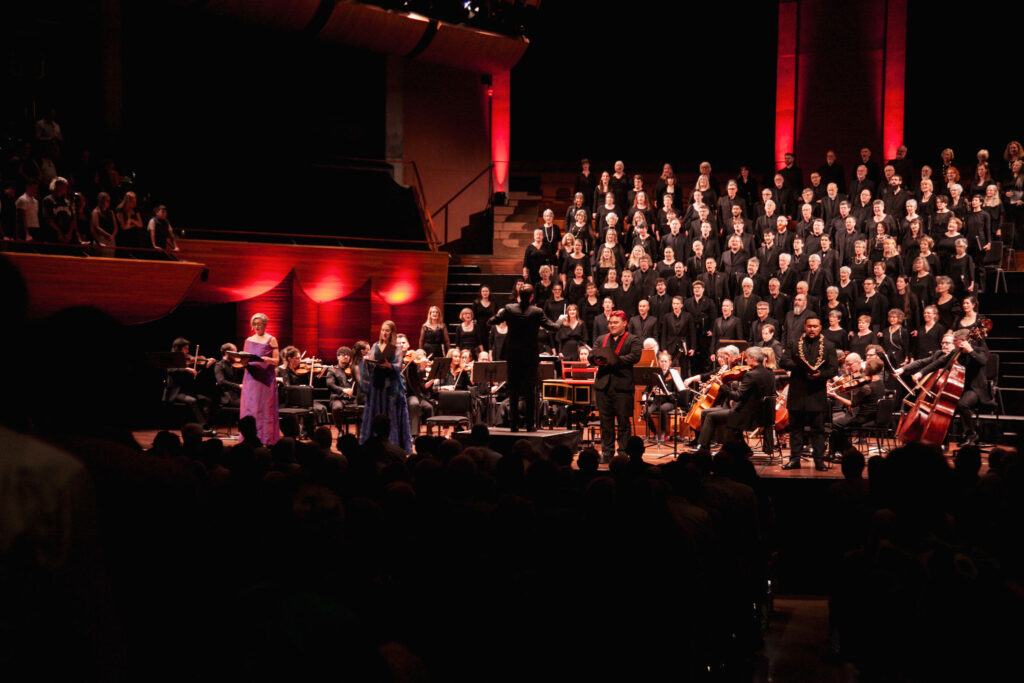
 Orpheus Choir and soloists with Brent Stewart in Handel’s “Messiah” at the MFC
George Frideric Handel – MESSIAH
Emma Pearson (soprano)
Maaike Christie-Beekman (alto)
LJ Crichton (tenor)
Joel Amosa (bass)
Orpheus Choir of Wellington
Orchestra Wellington
Brent Stewart (conductor)
Michael Fowler Centre, Wellington
Saturday, 13th December, 2025
Walking into a concert hall foyer a good half-hour before the performance’s starting time and encountering a veritable sea of faces and conglomerate of bodies all exuding a kind of excitement and anticipation tells you that you’re somehow onto a good thing for the evening!
Such an osmotic buzz of expectation spreads like a forcefield throughout the shared spaces to the performers, creating a “charged” environment through which the ordinary is metamorphosed into the fabulous even before a note is sounded.
Through some kind of alchemy, Handel’s “Messiah”, no matter how many times it gets performed, never loses its appeal. I’ve practically lost count of the ones I’ve attended, and the details have a habit of running together when I try to fetch up specific memories of a presentation with this conductor and that singer, and especially in tandem with dates – but it has for me developed the aura of a ritual in which I feel something of an unexplained compulsion to repeatedly take part.
Of course a major consideration for many people is that “Messiah” is almost never the same work on each occasion it’s presented – and I don’t mean merely in terms of differences of interpretation of the same score, because there is no single “same score” – no single “definitive” version. A statistic I encountered recently which took my breath away was that Handel had produced forty-three versions of the work’s fifteen solo numbers, the composer making numerous adjustments to suit the needs of the different singers he used at various times. Different versions of the whole work also appeared, beginning with the Dublin version in 1742, then a London version the following year, followed in 1750 at the London Foundling Hospital and a revision in 1754, featuring different music and alternate version of numbers.
This near-profligacy of difference makes each performance of this work something of an adventure for the listener – and it’s definitely a factor in the music’s never-ending joy and fascination. Naturally interpretation plays a part in this on-going process, with different conductors and soloists (and choirs and orchestras, for that matter) bringing to each occasion singular characteristics and qualities. While I can remember with great pleasure certain aspects of past performances involving both individual and concerted efforts, it’s a particular joy to encounter, as here, something of a shared benchmark of achievement on the part of all the performers. In fact I can put my hand on my heart and declare that I thought this a splendid and great-hearted “Messiah” which set out from the very beginning to “engage” with us, drawing us increasingly and unsparingly into the story’s intense wonder, drama and fulfilment regarding Christ’s sojourn on Earth.
Under conductor Brent Stewart’s focused direction, orchestra, soloists and choir were able to touch realms that seemed almost transcendent in places – of course every listener will cherish certain singular “moments” and mark them out for “legendary” status in times to come (as I’ve done now and then with past hearings of this work,as an essential component of the process). Tonight’s soloists rose to the occasion in various instances – tenor LJ Chrichton pleased with his attractively airy “Evry Valley” at the work’s beginning, even if his opening phrase of “Comfort Ye” seemed more like a “test run” than the real thing – but his subsequent longer-held phrases made sonorous amends! At the other end of the expressive scale was his more-assured Part Two set of recitatives and ariosi, concluding with the vigorous “Thou shalt break them”, which featured some confident ascents to the demanding top notes of “thou shalt dash them in pieces” – sterling, true-toned efforts!
His bass counterpart, Joel Amosa, impressed throughout with his virility and flexibility, pinning our ears back with his “Thus saith the Lord” and rolling his voice up and down his runs on the word “Shake” in fine style. Even more thrilling was his partnership with the orchestra in “Why do the Nations?” , a high-energy combination of rushing orchestral figures and melismatic vocal lines, the singer’s triplet figures riding the orchestra’s impetuous common-time trajectories with breathtaking adroitness! However, it was Amosa’s partnership with trumpeter Lewis Grey in “The Trumpet Shall Sound” which carried the day, the singer’s prescient introductory story-telling tones paving the way for the splendid combination of voice and brilliantly-sounded instrument that we were then treated to.
I’ve always thought the alto in “Messiah” had fewer opportunities to really “shine” in this work compared with the other singers, with the exception of the great aria “He was despised”. Here, Maaike Christie-Beekman movingly took us right into the hollowed-out chamber of sorrow and rejection suffered by the beleagued Christ, almost as if it were a great and private universal “confession of sorrow”. I’m nearly always disappointed when a performance neglects to include the tempestuous middle section “He gave his back” because of the dramatic contrast it sets up – a real “trial” for everybody concerned, though, when it happens!
Soprano Emma Pearson’s first recitative entry, of course, was preceded by the sublime sweetness of the “Pifa” (the Pastoral Symphony characterising the shepherds), after which she sang the 4/4 version of “Rejoice greatly” (my first hearing of this was Handel’s first gigue-like 12/8 version) – the coloratura passages were terrific, really capturing a “joyous” effect! Pearson’s lovely voice also came into its own in the second half of “He shall feed his flock”, following the alto’s opening verse with another, “Come unto him”. Where Pearson’s singing, however, for me “touched” that transcendence I’ve mentioned beforehand was in “I know that my Redeemer liveth”, her clear-as-a-bell rendering still giving the line affecting nuances while fully proclaiming the emotion of belief and surety – something about the unaffected simplicity of her “And though worms destroy this body” I found ineffably touching without knowing really why, but it was a moment that has stayed with me as one of those memories which will endure – a salutary experience for an unbeliever!
As for the “Mighty Orpheus” (as the choir has been known for decades) the voices were at one with their conductor/director Brent Stewart right from the outset, with a vigorous and stirring response to “And the Glory of the Lord”, with the sopranos particularly radiant in their soaring, largely single-note lines. I felt at times that the rapid tempi for a couple of the choruses missed a certain “deliciousness of utterance” (“And He shall purify” was one and “His yoke is easy” was another), but I could register the enjoyment of a compensatory “effervescence” in the overall effect (for example, in “All we like sheep” the voices scintillated like bubbling and cascading springs!). Though not at all related to THIS performance, I still can’t help repeating for enjoyment’s sakes a reasonably well-known anecdote attributed to the famous conductor Sir Thomas Beecham, who was heard to remark at one point in a “Messiah” rehearsal. “Ladies and gentlemen of the chorus, when you sing “All we like sheep have gone astray”, could we please have a little more regret and a little less satisfaction?” ).
At the other end of the expressive scale the chorus work projected tremendous potency – in “Surely He hath borne our griefs”, for example, whose opening word was like a hammer-blow – then, in both “He trusted in God” (the most thrillingly incisive performance I can remember ever hearing of this!) and “Let us break their bonds asunder” with similarly biting lines, allied to fantastic energy, making the words come alive – and making the most of dramatic contrast in “Since by man came death”, bursting out from its positively sepulchral opening in grandly theatrical style. I especially relished, too, the varied treatment of the final “Amen” Chorus, which featured sequences of solo and paired string-playing alternating with the voices – a scalp-prickling effect, then rounded off with plenty of suitably sonorous orchestral tones in support of the voices – wonderful!
With stirring support from the Orchestra Wellington players (a scaled-down band to more readily reflect a Handelian sound-world) aided by the mellifluous strains of both Bethany Angus’s harpsichord and Jonathan Berkahn’s chamber organ, Brent Stewart and his performers gave Handel’s work a solidly-based sonority from which the details readily sprang, always interestingly, and often excitingly to the ear. The “buzz” that had begun earlier that evening in the foyer had certainly done its job on this occasion, and in the best seasonal “Christmas tree” tradition!
Thank you for this review. It very much accorded with my experience, as a first time attender!
Fantastic review, thank you. Sadly I couldn’t travel from Hamilton to attend.
I first sang Messiah with Orpheus when your founder Malcolm Rickard retired in December 1983. I hope we can get a Messiah organised here in Hamilton while I am still singing!
Well done Mighty Orpheus.
This performance well deserved the standing ovation it received. Glorious, uplifting, perfect.