RADIANCE, from the NZSO in Wellington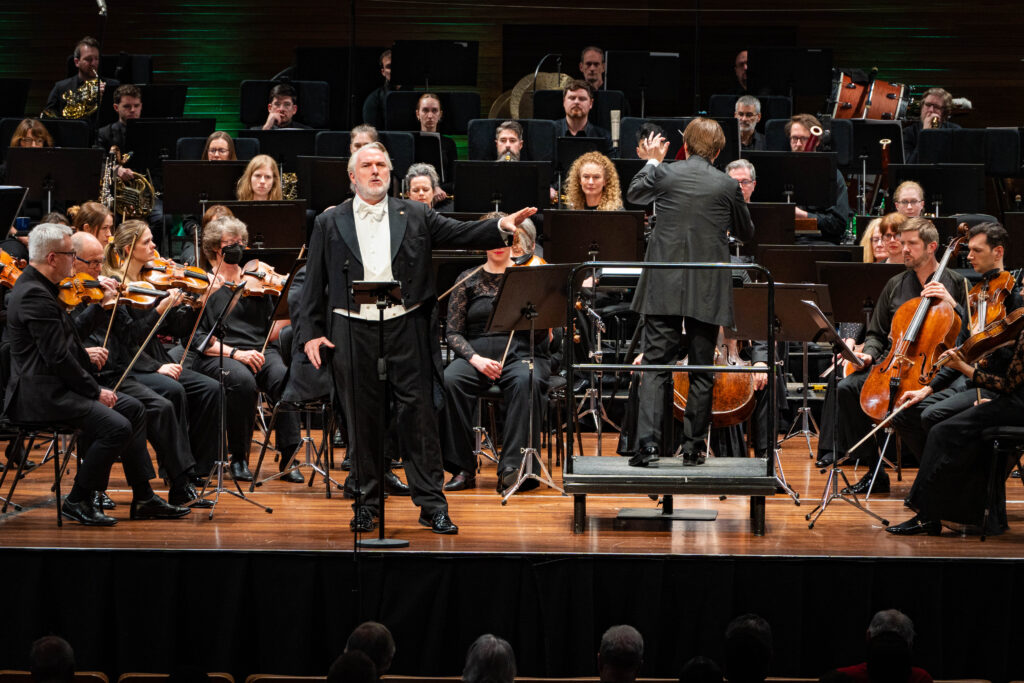
Simon O’Neill (tenor) with Pietari Inkinen (conductor) and the NZSO
Photo credit: Phoebe Cassidy, NZSO
RICHARD WAGNER (1813-1883)
TANNHÄUSER – Act I – Overture
Act II – Scene IV “Weh! Weh, mir Unglücksel’gem!”
ACT III – Overture
Scene III “Ich hörte Harfenschlag…..”
“Zurück von mir! Die Stätte wo ich raste ist verflucht!”……
“Hör an, Wolfram. hör an!”
PARSIFAL – Act I – Prelude
Act ii – Prelude
“Amfortas! Die Wunde! – Die Wunde!”
“Ja, diese Stimme! So rief sie Ihm!”
”Mit diesen Zeichen bann’ ich deinen Zauber!”
“Du weisst. Wo du mich wiederfinden kannst!”
Act III – Prelude and Good Friday Music
“Nur eine Waffe taugt”….
O! – Welchen Wunders höchtes Glück!”……
Simon O’Neill (tenor)
Pietari Inkinen (conductor)
New Zealand Symphony Orchestra
Michael Fowler Centre, Wellington
Friday 14th August 2026
Two significant players in recent worldwide Wagner presentations returned to Wellington last week with the NZSO – tenor Simon O’Neill and conductor Pietari Inkinen. Together they presented an innovative programme with the generic title “Radiance” featuring excerpts from two iconic works, Tannhäuser and Parsifal, at opposite ends of Richard Wagner’s creative career as the nineteenth century’s most influential music dramatist. In each case we were given a part-portrayal of the work’s titular hero via significant utterances which reflected Wagner’s own incessant search for redemption and fulfilment in his music as an artist and human being.
Each of the artists involved in this concert has recently earned international recognition in his particular discipline Tenor Simon O’Neill has enjoying success in practically every major opera house world-wide, particularly in the great Wagner heldentenor roles, while Pietari Inkinen has earned international critical acclaim for his conducting of Wagner, leading productions of Der Ring des Nibelungen at Bayreuth and for Opera Australia, as well as productions of Die Walkure and Das Rheingold elsewhere.
Putting these two artists with an NZSO that has since gone from strength to strength following Inkinen’s nine-year tenure with the orchestra made for an inspired piece of “showcase programming” which brought out the abilities of the participants and their respective advancements and ripenings. The confidence and surety of interchange between conductor and orchestra at the concert’s beginning with Wagner’s Overture to Tannhäuser grew with the music, from a plain and pure opening of the Pilgrim’s Theme on the horns, through more warmly-nuanced chromatic string passages and wind ensembles’ gathering of the tones towards the brass’s gloriously rich and rounded full delivery. As the wind’s reprise of the same softly receded, the glittering Venusberg music began, dancing, cajoling and insinuating its way into the soundscape, with Pietari Inkinen’s control of the music’s tones and trajectories building to bacchanale-like irruptions of energy and colour, eventually tamed by the return of the Pilgrim Chorus’s insistently resounding strains – splendid stuff!
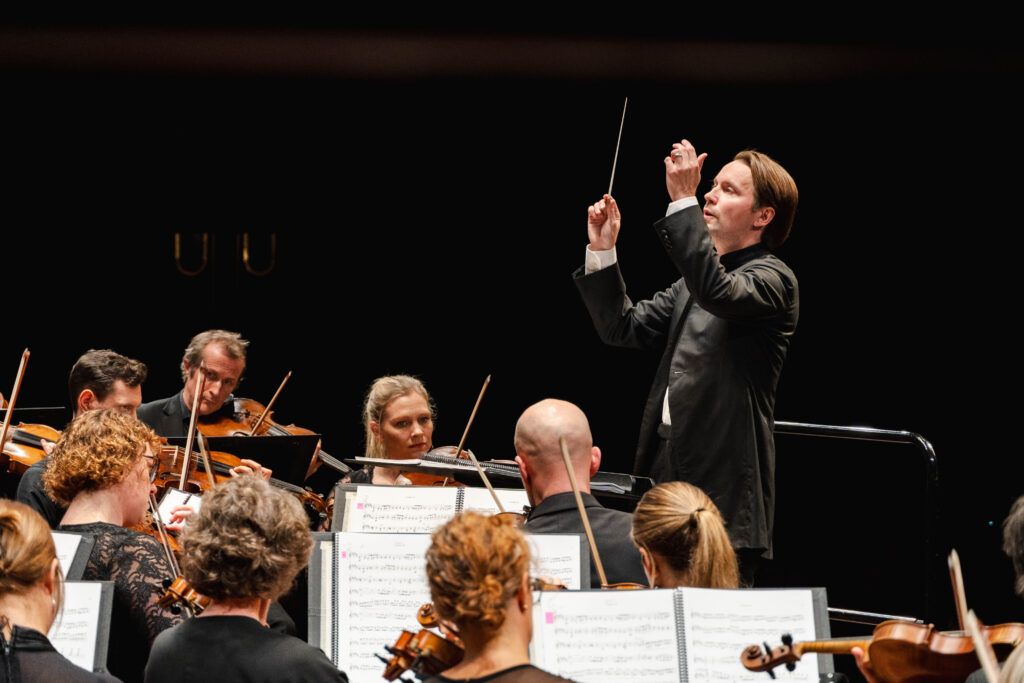 Pietari Inkinen conducting the NZSO in “Radiance”
Photo: Phoebe Cassidy, NZSO
Tannhäuser’s story, set in medieval Germany, appealed strongly to nineteenth-century tastes in its dichotomy between delight in pleasures of the senses and a higher, spiritual quest for redemption. We had heard in the Overture this conflict unashamedly expressed, with the Pilgrims’ song of praise interrupted by the strains of music from the court of Venus, to which the troubadour Tannhäuser had been drawn in his travels – but then, having grown tired of Venus’s charms, the knight had returned to his former home to seek redemption and solace in the form of the chaste Elisabeth. However, in a proposed singing contest the troubadour scandalised the company in a spontaneous outburst of praise of the “goddess of love”. Defended by the ever-loyal Elisabeth he was then filled with shame at his intemperate outburst, vowing to take the pilgrimage to Rome to seek forgiveness from the Holy See – Simon O’Neill appeared at this point in the orchestral discourse with his impassioned “Weh! Weh, mir Unglücksel’gem!” (Woe, woe is me, unhappy mortal!), his voice thrillingly riding over the orchestra, striding from the stage with the words “Nach Rom!” (To Rome!) at the end of the excerpt.
The orchestra then told the next part of the story, sounding the music of Tannhauser’s friend Wolfram (including the well-known “O du mein holder Abendstern” (known popularly as “O, Star of Eve”), and of Elisabeth, both waiting for Tannhauser’s return with the Pilgrims from Rome. They return, but to Elisabeth’s sorrow, Tannhauser is not with them. She leaves and Wolfram’s harp is then heard along with the “Abendstern” melody, bringing Simon O’Neill back onto the platform with the words “Ich hörte Harfenschlag” (I hear the strains of a harp). In distressed tones, Tannhäuser tells Wolfram not to come close to him as he is accursed – “Zurück von mir! Die Staat, wo ich raste, ist verflucht!” Then follows the Troubadour’s woeful tale of going to Rome with the Pilgrims, but declining to share any of their comforts along the way, hoping it would alleviate the penance due for his sins! “Ich Tat’s – denn in Zerknirschung wollt ich büssen, um meines Engels Tränen zu versüssen” (I did it because, filled with remorse, I wished to sweeten my angel’s tears!). However, all was to no avail, as the Pope pronounced eternal damnation on Tannhäuser as long as the staff in the pontiff’s hand “no longer bedecks itself in fresh green” (“nie mehr sie schmuckt mit frischen Grün”). In response to the Pope’s rebuffal, Tannhauser has reaffirmed his desire to return to the Venusberg and to the charms of Venus, to the horror of Wolfram who tries to stop him. Suddenly, Elizabeth’s name is heard, and the Venusberg and its goddess vanishes! (In the opera a chorus of Pilgrims bring the news that the Pope’s staff has sprouted with green foliage, so that Tannhauser’s soul has been saved.)
I’ve written this somewhat “pocketbook version” description of the action to try and convey something of the vividness of the performance of the singer, conductor and orchestra – overwhelming in its power of engagement (everybody playing and singing with extraordinary commitment, every emotion resonating, from hushed whispers through golden-toned exclamations of joy and hope to forceful urgencies and desperate cries of despair and pain!) It was, in effect, Wagner at his most effusive in his career’s early stages, grappling with his hero’s issues as if they were his own regarding earthly delight and spiritual illumination, a process which was to be a lifelong quest in his art. Simon O’Neill’s absorption and delivery of his character’s utterances flowed with the orchestra’s every nuance under Pietari Inkinen’s many-faceted direction, so that we were ourselves taken up in it all, and left at the end thrilled by the journey’s intoxications.
After the interval we encountered a same-but-different Wagner with his final major work “Parsifal”, one certainly better-known in general terms to many Wellingtonians who, like myself, had seen the first complete performance of the opera in the country’s 2006 International Arts Festival here in the capital – with a major feature of tonight’s performance being Simon O’Neill’s singing of excerpts from the title role he had given complete in that 2006 production! Here were excerpts from Acts Two and Three, the first being Parsifal’s encounters with the embittered ex-Grail Knight-cum-enchanter Klingsor, and his enslaved sorceress Kundry; and then in the Third and final act Parsifal’s return to the Grail-Knights’ wounded leader Amfortas with the Holy Spear that Klingsor had stolen many years before, and which heals Amfortas’s wound.
We first heard what I’ve always regarded as some of Wagner’s greatest music in the Prelude to Act One of the opera – a performance from Inkinen and the players here that seemed to fulfil Wagner’s own words sung by the Grail-Knight Gurnemanz to Parsifal in Act One – “Du siest, mein Sohn, zum Raum wird hier die Zeit” (You see, my Son, here, Time becomes space”) – and still after so many hearings of this music I found myself “taken over” by a sense of being in a unique and precious space, a feeling that brings an inexplicable kind of longing……it was an enchantment that rang through the precincts of the MFC, seeming to dissolve time for the music’s duration – a treasurable experience, made more so by all concerned with the heartfelt music-making! The only slight quibble I had was at the very end of the Prelude, where a kind of “concert-ending” was tacked onto the music – I thought it was a pity that Inkinen didn’t employ the open-ended stage version, which I thought invited a sense of continuity with what was to come…..
Rather than “broken”, the spell was then refocused to Act Two and Klingsor’s realm, the orchestral playing suffused with sulphurous menace and evil intent – here we dispensed with both Parsifal’s heroic deeds in dispersing the fortress’s hapless guardians, and his encounter with both the alluring Flower-maidens, and the charms of the seductive Kundry up to the moment of her first and only kiss with the hero! – At this point we were plunged into the very heart of Parsifal’s quest as he cried out with anguish the name of Amfortas, the wounded King of the Grail-Knights who had succumbed to Kundry’s charms and was wounded with his own spear by the treacherous Klingsor. O’Neill’s opening words as Parsifal here were “Amfortas! Die Wunde!” (The Wound!), at the climax of the music for Kundry’s kiss, the intensities as heart-rending as I remembered from his stage performance, as was his impassioned self-reproach, all mirrored by Inkinen’s and the orchestra’s meticulous support. After naming her and her “kiss” as the bringer of Amfortas’s torment he rejected Kundry’s further advances with “Ha! Dieser Kuss! – Verderberin! – Weiche von mir! Ewig, ewig von mir!” (Ah, this kiss! – Corrupter! – Get away from me! – Forever, forever away from me!). The orchestra thundered Klingsor’s theme as the enchanter entered with the spear to kill Parsifal, but with the words “Mit diesem Zeichen bann’ ich deinen Zauber” (With this sign I rout your enchantment!) he disarmed Klingsor and, brandishing the spear, brought the walls tumbling down in disarray. As Parsifal left, he turned to the distraught Kundry telling her “Du weisst, wo du mich wiederfinden kannst!” (You know where you can find me!).Devastating stuff!
What happened next was like an inverse of this remarkable work’s opening with those incredibly intense, heart-rending tones and textures of the opening Prelude – Wagner brings those intensities to a kind of fruition in sequences popularly known as the “Good Friday Music” as the music returned to the place where the opera began, the castle of Montsalvat in northern Spain. Here, the Grail Knights have fallen upon hard times, with their leader, Amfortas still ailing from the effects of his wound, and the community of knights lacking leadership and purpose. With the return of Parsifal, the old Knight Gurnemanz expresses joy and hope, and he reminds Parsifal that nature responds to the Saviour’s sacrifice on Good Friday for all humankind by “Holm und Blume auf den Auen” (….the Grasses and Flowers in the Meadow) blooming as “all Creation gives thanks” (“Das dankt dann alle Kreatur” ) with the winds (oboe and clarinet), and then the full orchestra allowing the themes to richly and fully bloom and sing – wonderful moments, in places not unlike Delius in some of the falling chromatic harmonies. This preludes the sombre entrance of the Grail Knights with Amfortas, their ailing King, by this time refusing to perform his office and uncovering the Holy Grail. Unnoticed until this moment. Parsifal steps forward holding the Spear, and, singing the words “Nur eine Waffe taugt – die Wunde schliesst das Speer nur, der sie schlug.” (But one weapon serves: only the Spear that smote you can heal your wound) touches Amfortas’s wound with the point of the Spear. It’s left to Parsifal to proclaim the miracle – “O! Welchen Wunders Hochstes Gluck!” (O supreme joy of this miracle!), and the music drifts to its sublime conclusion.
While Wagnerians would prefer to experience complete performances of each of these works, it’s nevertheless difficult to imagine concert excerpts such as these better done than here – and simultaneously fascinating and rewarding to witness Simon O’Neill”s portrayals of each of the title characters, distilling in the chosen sequences their essences with surety (interesting how the juxtapositioning of the two works in a single evening brought out their similarities in terms of the composer’s overall preoccupation with his heroes’ quest for redemption and enlightenment!) The voice was superbly employed, equal to all Wagner’s demands, and alive to the singularities of expression in each case – that I responded slightly more freely to O”Neill’s Parsifal surely reflected my hearing him sing the complete role – but the evening also whetted my appetite for a Tannhäuser under similar circumstances.
As for Pietari Inkinen and the NZSO players, I dips me lid! I had last heard Inkinen conduct Wagner’s music as long ago as 2012 when he conducted a splendidly-performed Die Walkure here in Wellington, also with Simon O’Neill in the cast as Siegmund on that occasion. Here, together, the two distilled the essences of the evening’s characters magnificently, encompassing all their different aspects and further whetting our appetites for more – presently, still in our dreams, but with our up-and-coming singers demonstrating their abilities in other repertoires, and an orchestra as capable as any in the world, might we not set our sights on Aotearoa’s first complete Ring Cycle, and stimulate some much-needed Trans-Tasman Wagnerian flow in this direction?