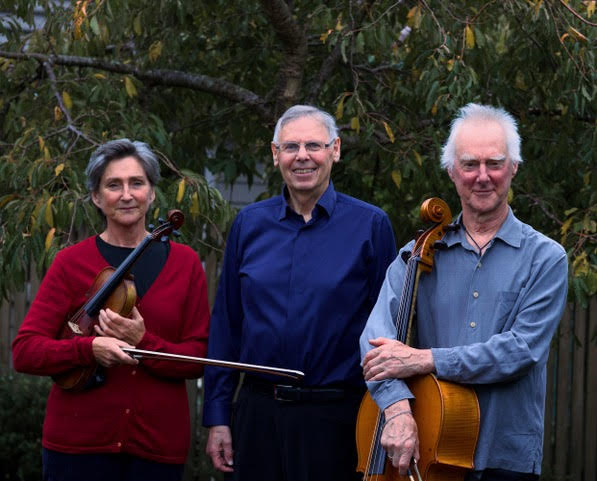
Papaioea Piano Trio offers exotic out-of-town flavourings for St.Andrew’s lunchtime fare

FRANZ JOSEF HAYDN – Piano Trio No.45 in E-flat Major Hob.XV;29
PYOTR TCHAIKOVSKY (arr. Alexander Goedicke) Six pieces from “The Seasons” Op.37a
ELENA KATZ-CHERNIN – Calliope Dreaming (2009)

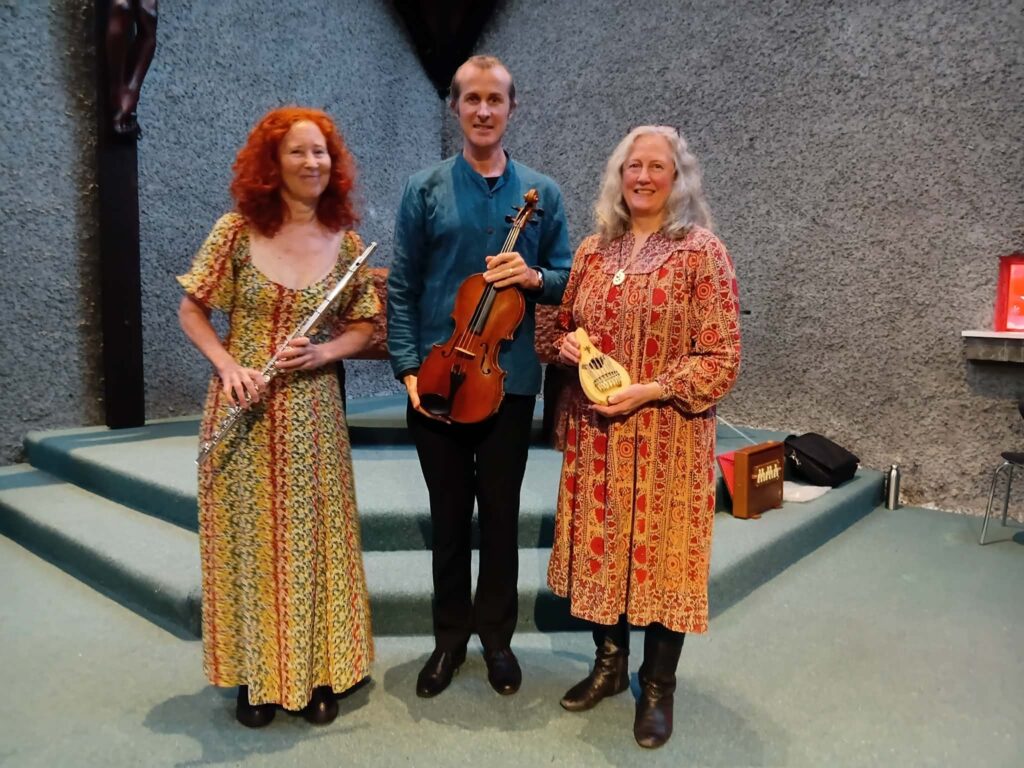
The Papaioea Trio
Elizabeth Patchett (violin), Robert Ibell (‘cello), Guy Donaldson (piano)

St.Andrew’s-on-The-Terrace, Wellington
Wednesday Ist July 2026

For those Wellingtonians and others who may not know, the name Papaioea refers to a particular location in the city of Palmerston North – in fact I grew up there being told that it was a Maori name for the city’s once-beautiful but now sadly-besmirched Square, situated right in the centre of things. Translated, the name was popularly rendered as  “How beautiful it is”, and I was given to understand at first that it was the name for a clearing in the original bush which had covered the area. Later, my understanding of the situation’s history had evolved to relocating the name Papaioea as a description of a lagoon-like lake in the Hokowhitu area of the city, a long way from the actual Square, and that same name bringing with it colourful and even sightly macabre associations with warlike activities of the local Rangitane people. Whatever the actuality of the case – and who can resist a good story?! – the name itself obviously resounded sufficiently in its own right to be considered an appropriate title for a trio of Palmerston North-associated musicians, who have thereupon proudly called themselves “The Papaioea Trio”.

Hearing that this ensemble was Wellington-bound I eagerly took myself to St Andrew’s-on-The-Terrace on the appointed day for what promised to be yet another from a series of remarkable lunchtime concerts whose quality has reaped musical riches and fostered agreeable companionship for countless people. And given that the venue is regularly used by local music groups for their own prestigious concert series (often involving fully professional musicians), there’s obviously no diminution in the quality of the sonics enjoyed by these lunchtime performers.

Of the three musicians who made up the Trio, I’d most frequently heard ‘cellist Robert Ibell as a member variously of the NZSO and of the Aroha String Quartet. While I had encountered Guy Donaldson as a collaborative pianist on several occasions I’d had as much experience of him as a conductor while I played for a few precious and enjoyable  seasons some years ago in the Manawatu Sinfonia. And, as well, I can recall hearing violinist Elizabeth Patchett on a number of occasions as a member of the vibrant Nevine String Quartet. Buoyed by such previous encounters I was greatly looking forward to the group’s coming together, and to the delights of the proposed programme.

While Haydn was perhaps an obvious choice in this repertoire I’d long since been converted to the inexhaustible pleasures given by the composer’s inventiveness in this music, every moment warmly relished by the Trio in this performance – though commentators tend to emphasise the dominance of the piano in these works, there was plenty of stimulating interaction in evidence today, as witness the violin and ‘cello counterpoints to the piano’s lines, often in Svengali-like hide-and-seek guises colouring the mood in the first movement’s development. After this one couldn’t help feeling the recapitulation had an almost Beechamesque amalgam of “regret and safisfaction” evident in the playing, with those determinedly characterful variants in the themes – but the subsequent Beethoven-like plunge into “other realms” leading to the coda was especially evocative and delightful.

The Andante opened for us a different harmonic world, almost Schumannesque in its whimsy – again the players deftly fashioned whole orbits out of simple gesturings, sudden dynamic contrasts, marvellously deep pedal points  and, after a couple of “expect the unexpected” modulations, fresh-as-daisies returnings to the sunshine, with the trajectories of the finale’s entry whirling our spirits aloft, with stimulating touches of trenchant phrasing vying with delicacies of impish delight! A minor-key development sequence again pre-echoed Haydn’s pupil Beethoven with great gusto, all three instruments  bending their backs to the task as the music vaulted all around and over the vistas, the composer seemingly enjoying the improvisatory-like helter-skelter before returning us to recognisable harmonic territories via a coda whose exhilarating upward rush lifted our spirits skyward at the end.

Having enjoyed various of Tchaikovsky’s pieces for solo piano, written for each separate month of the year, I was intrigued to learn of the existence of a version of the work arranged for Piano Trio by a later Russian composer, Alexander Goedicke (born, incidentally AFTER Tchaikovsky had written his original solo pieces!) – I found myself wondering while listening to these beautiful arrangements why it was that Tchaikovsky hadn’t used the Piano Trio format himself for this absolutely charming music as presented here – I soon discovered that the composer actually had a strong early dislike for the trio combination, telling his patroness, Nadezhda Von Meck, that it had “no tonal blend” as the instruments were “incompatible”; and yet when his friend Nikolai Rubinstein died the following year in 1881 his tribute to his late friend was a spectacularly-wrought Piano Trio! (As well, of course, he had already tried his hand at the combination with the celebrated “piano trio” section of his Second Piano Concerto, written the year before! – curiouser and curiouser!)

Still. all of this seemed beside the point at the time of listening – the Papaioea Trio presented six of Goedicke’s arrangements, publishing for our edification a translation of the poetic epigraphs that had accompanied the original solo piano versions. The opening April Snowdrop was a bitter-sweet waltz earnestly expressing a longing for the spring, while the June Barcarolle, a well-known melody, brought out the string players’ different characteristics, with Elizabeth Pachett’s violin’s phrasings precise and contained, compared with Robert Ibell’s ‘cello’s, more flowing and expansive gestures, and with pianist Guy Donaldson the fulcrum around which the different personalities interacted, making for ear-catching results! The October Autumn song was a more melancholy affair, violin and ‘cello by turns quietly expressive and eloquent, while the pianist made every note resonate with purpose in a beautiful solo reprise, echoed by the strings in both imitation and descant, and in a way which compelled us to await every turn of phrase with warm expectation.

The November Troika, a favourite recital item of pianist Sergei Rachmaninov’s, gave us the piece’s heart-warming melody at the start, at first simply, then flowing more expansively and descriptively, followed by a central section brimful with mischief and gaiety, and combining song and dance as the fun and laughter faded into the distance. The December Christmas sequence was a suave waltz, more Viennese drawing-room than Russian, though with moments of longing, almost aching rubato in between the Tempo I dance sequences. For the final February Carnival, all the festive stops were pulled out for the opening with not a moment’s gaiety wasted! – a rather more quixotic middle section could have depicted some kind of party game, one which spilled back over and into the return of the opening music – at the end, after a brief moment of reflection, of inwardness, the Carnival itself delivered the final “Come on!” gesture.  I remember wondering at that point how I would feel about going back to the solo piano version for a listen after such an enjoyable ensembled musical experience!

The programme’s final item was new to me ,and probably to most other people in the hall – its composer, Elena Katz-Chernin  was Uzbekistan-born (1957) and Moscow-educated, but, when still a teenager emigrated to Australia, continuing her musical studies at the Sydney Conservatorium. After her graduation, she moved to Germany for further study before returning to Australia in 1994, since then pursuing an active and successful composing career.  Her 2009 piece presented today, Calliope Dreaming, was written as part of a D2H (dedicated to Haydn) festival marking the latter’s death bicentenary – she was one of eighteen composers worldwide commissioned to write a work for the festival, and which was accordingly premiered that same year in Eisenstadt, Austria, by the Haydn Esterhazy Trio.

The concert’s informative programme notes told us some of the story – Katz-Chernin was inspired by a biographical detail concerning Haydn’s own reported wish that the slow movement of his own Symphony No. 44 (“Trauer”) be played at his funeral, though she was compelled by the symphony’s overall beauty to draw from other parts of the work as well when composing her own tribute. And, in a kind of Haydnesque way, she conceived the idea of giving the piece more of an “upbeat” than a mournful flavour, by writing the music as if it were to be played by a Calliope, a keyboard instrument constructed to activate the sounds of steam whistles! (truly, how more Haydnesque could you get?) – the fact that Calliope was also one of the Nine Muses in Greek mythology, whose credentials included  being “the Muse of epic poetry and eloquence, and the mother of Orpheus” to boot seemed naturally to somewhat mitigate the “circus” aspect of the actual instrument and give the “Haydn connection” irrefutable status.

After we in situ listeners-to-be had digested these delightfully incontrovertible vagaries of detail (admittedly with a few added afterthoughts!), the Trio plunged into “Calliope Dreaming”, Katz-Chernin’s wondrous caprice-fantasy upon themes by a composer given himself to such occasional flights of fancy! – the “dreaming” aspect of the title was given ample notice by what the composer called “calmer moments” amid the more “edgy rhythmic material”, though, as  Katz-Chernin herself acknowledged, the end result of her own fantasisings seemed “more in line with the finale of the symphony”. Which was fair enough, as it was HER piece, really, and not actually Haydn’s!

The end result was invigorating, the sleeve note suggesting for listeners an experience similar to that of “a rapidly-moving steam train”, with moments of calm, but also with singing lines in places soaring over the motoric rhythms. I confess that, as an out-and-out train-buff, the “ride” was for me something of an escapist joy! – though of course every listener would have had their own story to tell, after the “exhilarating downhill ride” of the concluding sequence of “Calliope Dreaming” had brought us all home!

Perhaps a local composer – from anywhere along the way! – might enlist the services of these engaging musicians to be the flagbearers of a work celebrating our own present “Capital Connection” rail-link between Papaioea  (Palmerston North) and  Pōneke (Wellington). It would be by way of strengthening and properly institutionalising what has been a somewhat haphazard recent history of a much-loved and -needed connection for people – one  showing the way between the two cities!  Having already set “Calliope Dreaming” in motion, the Papaioea Trio has demonstrated it can truly go places!


Virtuosi – Orchestra Wellington’s celebration of the capital’s individual and interactive instrumental brilliance

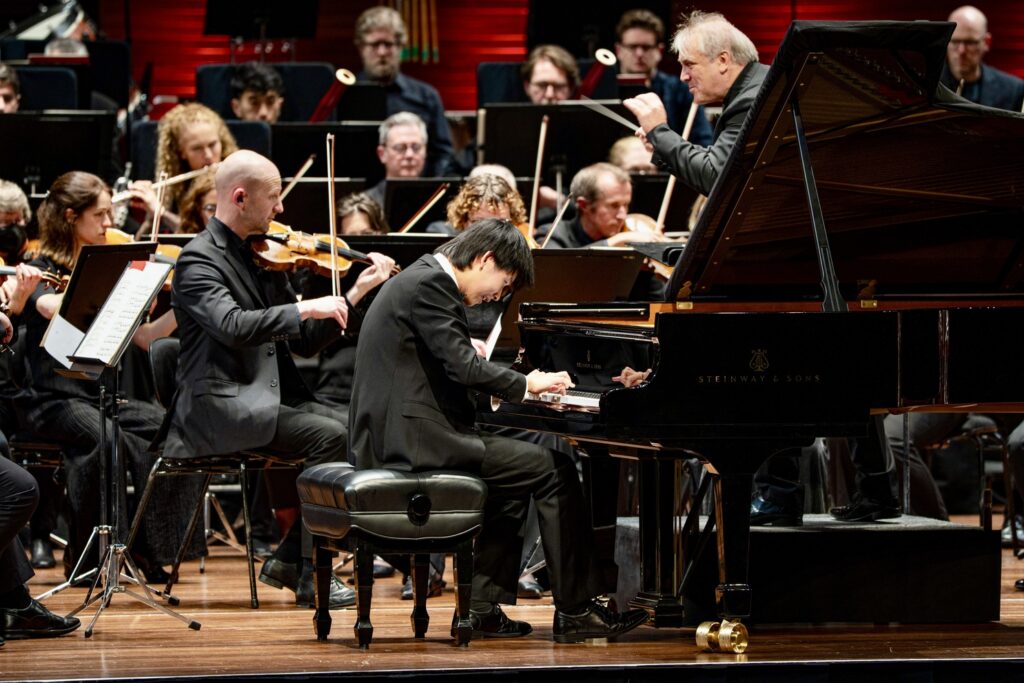
VIRTUOSI – Orchestra Wellington

ELGAR – Introduction and Allegro for String Quartet and String Orchestra Op.47
ELGAR – Concerto for ‘Cello and Orchestra in E Minor Op.85
BARTÓK – Concerto for Orchestra Sz116

New Zealand String Quartet : Peter Clark, Martin Riseley (guest player), violins;
Gillian Ansell, viola; Martin Smith, ‘cello
Inbal Megiddo, ‘cello
Orchestra Wellington
Marc Taddei, conductor

Michael Fowler Centre, Wellington

Saturday, 27th June 2026

This concert was replete with memories of formative music-listening experiences which have sung and danced throughout my musical life for almost fifty years – so the reader must forgive what seems like a self-indulgent bias regarding these works, and especially in the wake of such committed, heart-warming performances!

Originally a borrowed word from the Italian virtuoso (referring to both “virtue” and “skill”) the term “virtuosi” has “taken flight” in common usage, and is regularly used to denote skill and proficiency of the highest order in practically any human activity, and not just the performing arts. Here, it’s less fulsomely and more appositely applied to both individual and group distinction in musical performance, happily and resoundingly borne out by tonight’s stellar presentations.

One could go further and suggest that the term applied as readily to the creative and technical skills of each of the two “similar-but-different” composers whose music featured in tonight’s concert – on the face of things the “Englishness” of Edward Elgar (1857-1934) and the Hungarian “folkishness” of Béla Bartók (1881-1945) would seem to have little in common, even if their lifetimes partly coincided. Unlike his younger native contemporaries Holst and Vaughan Williams, Elgar showed little interest in ethnomusicology, whereas Bartók eagerly immersed himself in the folk-music of his native soil, both in his studies of comparative musical folklore in Hungary and his fusion of these elements with his own personal style of expression. Both composers were “countrymen” in their inclinations towards the “great outdoors” but it would seem the Malvern Hills near Worcester, beloved of Elgar, were probably somewhat removed in spirit from the isolated Carpathian Mountains of Hungary which Bartók explored, finding his most “authentic” Magyar folk music amongst those isolated communities.

Where Elgar and Bartók meet, I feel, is in the uniqueness and strength of each composer’s distinctive musical “character” – most of Elgar’s work has that instantly recognisable combination of nobility and introspectiveness which looks simultaneously outwards and inwards, in the manner of an artist at once confident and insecure, forthright and nostalgic, expressing a dichotomy that would reach its peak in the composer’s  ‘Cello Concerto played this evening. By contrast, Bartók’s music is characterised by asymmetrical themes and rhythms, modal scales, drones, and energetic folk-dance trajectories – as with Elgar, there are opposites at work, the “classical” structures expressed by “folk” music, the tonalities that contain dissonances, and the polarities of emotion which frequent the musical journey.

Coincidentally,  both Elgar pieces in tonight’s programme, though far-removed from one another in time,  began with similarly vigorous and trenchant opening  minor-key chords. First up was the composer’s earlier “Introduction and Allegro for String Quartet and String Orchestra”, its opening straightaway proclaiming an almost Baroque-like splendour and severity of utterance, one that meant business right from the outset! How appropriate, then, that kicking off the evening’s “virtuosi” scenario in this music were members of the New Zealand String Quartet, taking the concertante role of the music’s solo quartet of strings. This ensemble has steadfastly continued  its activities with various guest players, following the departure early in 2025 of two of its long-time members – happily, one of the vacancies has been filled by recently-appointed  ‘cellist Martin Smith, while the second violinist role for this concert featured a distinguished guest, Martin Riseley, a member of the celebrated Te Koki Trio. Violinist Peter Clark did the honours as leader this evening, while, happily, the mainstay of the ensemble, violist Gillian Ansell continued as the rock-like fulcrum around which the group’s comings and goings have been deftly managed over the past two years.

Both the quartet and the accompanying Orchestra Wellington strings under conductor Marc Taddei brought off the  resonantly muscular opening of the work with great elan, leading into tantalising interchanges, baroque style, between solo strings and the ripieno (larger ensemble), with pre-echoes of the themes given ear-catching contrasts of emphasis and colour. Then came the famous “Welsh tune” (the composer reported as hearing this sung by a distant voice while on holiday in Wales) played here firstly by Gillian Ansell’s viola – so tenderly and heart-stoppingly – before being given the full-blooded ensemble treatment.

This sense of wonderment continued right up to the beginning of the Allegro (at Fig.7 in my Novello score), with a quietly-stated, flowing version of the theme first heard hinted at by the solo quartet just after the opening flourish – here, begun as simply and as straightforwardly as the first few steps of a momentous journey. This took us most excitingly to the work’s resplendent major-key all-together central statement of the opening theme, marked with Elgar’s favourite “Nobilmente” direction, and given plenty of ceremonial swagger, and vigorous energy.

After a tremulous reappearance of the “Welsh tune”  Marc Taddei took the players into what Elgar famously described as “a devil of a fugue”, one whose initial composure seemed to suddenly take fright halfway through its course and “spook” its own trajectories – fantastic playing, here, from the band, with hair, gut and resin given no quarter!  The eventual recapitulation of the Allegro led this time to a full-throated version of the “Welsh tune”, with solo strings and ripieno tossing parts of the reprised themes back and forth, before the coda bound up all the players in a compulsive concerted dash towards a resounding final pizzicato chord – great excitement!

The 1919 ‘Cello Concerto which followed inhabited a different world, the older Elgar having to lay bare his feelings regarding the ravages of the Great War (1914-18), while at the same time tormented with growing self-doubts as a composer as his music was gradually and increasingly regarded by critics as “old-fashioned”. As a consequence, the concerto took a long time to establish itself in the repertoire, especially after a disastrous premiere helped put paid to any of Elgar’s own hopes for the work as giving an impression of being “good and alive”. It turned out to be the last major work he created – a direct and honest statement of feelings regarding his place in a world forever changed, both in a public and private sense.

‘Cellist Inbal Megiddo had the measure of the work’s sombre mood right from the outset, her tones and phrasings circumspectly coloured, enough to convey the emotion without excess throughout the movement, though the orchestral tones in the first tutti were lovely, as was the soloist’s rhapsodic response. She allowed herself  greater warmth in the major key exchanges that followed, and rose to match the intensities of the orchestra’s subsequent climax, though falling away as quickly back into introspection for the pizzicato chords that heralded her accompanied recitative – here her ‘cello even cajoled the orchestra in places before initiating the scampering scherzo with its wry “catch me if you can” exchanges exhibiting a droll kind of mischief. With her all the way was Marc Taddei’s suitably reactive echoing of the solo instruments’s quixotic moods in the myriad orchestral detailings, earnest and intense in the opening movement and playful in the second (the slightly untidy final chord at the latter’s conclusion of little consequence….)

The third movement seemed at first almost reverential – here, from Megiddo and her fellow-participants, it was a superbly-controlled outpouring of nostalgic beauty, capturing both the music’s audible rapture and its central stillness – so much so, that I was surprised by the performers’ “bookending” this exquisite movement rather than letting its open-ended conclusion drift into ineffable space at the end and “give rise” to the finale as a matter of course – there’s no “attacca” instruction in the score, but we could have done without all the “next movement” rustling and re-adjusting (my only misgiving regarding the performance!)

The finale’s “swing” soon restored all through-lines, real or imagined, with this performance’s rumbustious girth, playful “hide-and-seek” routines and wry interchanges between the soloist and the groups putting  me in mind in places of the composer’s “Falstaff” to a never-before extent – particularly so in the almost tavern-like scene of inebriated jollity when the soloist joins the orchestral cellos for a mock-serious choral-like unison sequence, brief, but good-humoured! All the more heart-rending, then, was the “drifting -away” of this mood, as the composer emulated his Shakespearean alter ego, lamenting the passing of the “good times” with upward-thrusting phrases that descended, weeping unashamedly, on both ‘cello and strings….

A brief episode re-evoked a distant memory of the Adagio’s loveliness, before the soloist seized the mettle and, after the work’s heartbreak accepted the inevitable with a stirring and courageous gesture of grim acceptance! A sterling performance!

A different world awaited us after the interval, with Bela Bartók’s Concerto for Orchestra, written by the composer in 1943 in the United States at the invitation of the renowned conductor of the Boston Symphony, Serge Koussevitsky. Bartok was seriously ill by this time, and in exile from his homeland due to the Nazi threat throughout Europe, so the commission came as a much needed boost to his waning creative energies – he was able to write several other works  as well as the Concerto (its title referring to the “concerto grosso” aspect of the music, similar to Elgar’s work, but much larger in scale and across the whole orchestral spectrum.)

My introduction to this work was through Hungarian conductor Antal Dorati, who was actually a pupil of Bartók’s in Budapest, and who recorded the Concerto several times, besides coming to New Zealand in 1973 and conducting the work with the NZSO in Wellington (for me an unforgettable concert experience!). Still, in line with my memory of Orchestra Wellington’s outstanding Shostakovich series from last year I was eager to hear what Marc Taddei would inspire his players to achieve with Bartók’s masterpiece – and I wasn’t disappointed. Again, as with the Elgar works of the first half, the most compelling quality of the music-making was the bringing out of the character of the work’s sound-world right from the beginning – the mysterious opening proclaimed kinship to the composer’s characteristic “night” pieces, the lower strings enunciating a series of fourths in response to which the upper strings and winds sounded similarly atmospheric undulating figures. Throughout the first movement these leaping fourths and their immediate inversions played an important thematic role, both in exciting fugal sequences for strings and stirring brass passages, as did gentler moments like the oboe’s lullabic mid-movement figure which echoed throughout the more lyrical sections. Everything was given the space it needed to proclaim its significance to the moment as well as to the whole.

The Concerto’s two Allegretto movements are the best-known to audiences and most readily remembered. Both were spectacularly presented here, the second being the famous Giuoco delle coppie (Game of Couples) with its sequence of folk-oriented melodies for pairs of instruments, each playing in finely-wrought parallel with its partner at different intervals; and the fourth a somewhat notorious Intermezzo interotto, whose fame rests on Bartok’s “lampooning” of a theme of Dmitri Shostakovich’s in his wartime “Leningrad” Symphony, a simple marching tune drawing forth cackling trills from woodwinds and vulgar sliding raspberries from the brass (on this occasion, from the trombones, easily the most gloriously blatant and visceral spoofings I’ve ever heard in concert or on record!), before being sent packing, with little more than a whimper!

The work’s two remaining movements were no less spell-binding – and I was simply and truly blown away by the orchestral response Taddei got from his players in the central palindromic Elegia, right from the ”night-music” ambiences of the opening (in which we seemed lifted up through the darkness and into extra-terrestrial regions), and through a coruscating series of searing cries from a string section playing well above its weight  and reinforced by full-blooded wind-descents  and biting brass chords with timpani – incredibly intense string-playing along with extraordinary timbral ambiences (and with lovely work from the violas at one point). But the intensities summoned up by the string-playing here in particular brought back to me something of what Dorati got from his NZSO players all those years ago – as then, with an extraordinary amalgam of incisiveness and eloquence!

After all of this, the finale represented something of a release, with plenty of ebullience from all the players, Taddei creating a veritable ferment of excitement  from all sections, the winds also enjoying their fugato-like passage before introducing a new theme which went like wildfire through the rest of the orchestra – such an infectious mood of exhilaration with the brass and timpani capping it off splendidly! The tongue-in-cheek string fugato got a querulous response from the winds, who took the argument into subaqueous regions, until what sounded like an orchestral dishwasher on rinse-cycle was suddenly thrown open and everything and everybody tumbled out, picked themselves up and skedaddled towards something of a well-deserved grandstand finish – a younger audience would have perhaps leapt to its feet after such a comprehensive orchestral display, but the ovation was still suitably warm-hearted and appreciative. I had a feeling that, in the midst of all the excitement Marc Taddei might have forgotten to acknowledge his horn section at the end – or perhaps its members simply missed their cue! Whatever the case, all the musicians were heroes – and my previous cheek-by-jowl memories of hearing this work performed will now have to be updated in the most positive and enduring way!