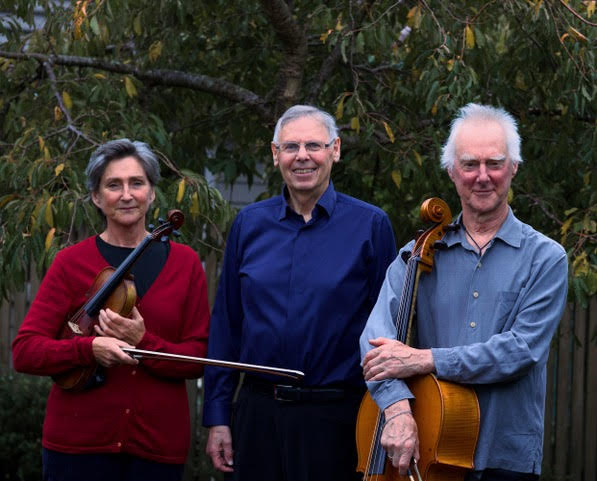
 The Papaioea Trio – Elizabeth Patchett (violin), Guy Donaldson (piano), Robert Ibell (‘cello)
FRANZ JOSEF HAYDN – Piano Trio No.45 in E-flat Major Hob.XV;29
PYOTR TCHAIKOVSKY (arr. Alexander Goedicke) Six pieces from “The Seasons” Op.37a
ELENA KATZ-CHERNIN – Calliope Dreaming (2009)
The Papaioea Trio
Elizabeth Patchett (violin), Robert Ibell (‘cello), Guy Donaldson (piano)
St.Andrew’s-on-The-Terrace, Wellington
Wednesday Ist July 2026
For those Wellingtonians and others who may not know, the name Papaioea refers to a particular location in the city of Palmerston North – in fact I grew up there being told that it was a Maori name for the city’s once-beautiful but now sadly-besmirched Square, situated right in the centre of things. Translated, the name was popularly rendered as “How beautiful it is”, and I was given to understand at first that it was the name for a clearing in the original bush which had covered the area. Later, my understanding of the situation’s history had evolved to relocating the name Papaioea as a description of a lagoon-like lake in the Hokowhitu area of the city, a long way from the actual Square, and that same name bringing with it colourful and even sightly macabre associations with warlike activities of the local Rangitane people. Whatever the actuality of the case – and who can resist a good story?! – the name itself obviously resounded sufficiently in its own right to be considered an appropriate title for a trio of Palmerston North-associated musicians, who have thereupon proudly called themselves “The Papaioea Trio”.
Hearing that this ensemble was Wellington-bound I eagerly took myself to St Andrew’s-on-The-Terrace on the appointed day for what promised to be yet another from a series of remarkable lunchtime concerts whose quality has reaped musical riches and fostered agreeable companionship for countless people. And given that the venue is regularly used by local music groups for their own prestigious concert series (often involving fully professional musicians), there’s obviously no diminution in the quality of the sonics enjoyed by these lunchtime performers.
Of the three musicians who made up the Trio, I’d most frequently heard ‘cellist Robert Ibell as a member variously of the NZSO and of the Aroha String Quartet. While I had encountered Guy Donaldson as a collaborative pianist on several occasions I’d had as much experience of him as a conductor while I played for a few precious and enjoyable seasons some years ago in the Manawatu Sinfonia. And, as well, I can recall hearing violinist Elizabeth Patchett on a number of occasions as a member of the vibrant Nevine String Quartet. Buoyed by such previous encounters I was greatly looking forward to the group’s coming together, and to the delights of the proposed programme.
While Haydn was perhaps an obvious choice in this repertoire I’d long since been converted to the inexhaustible pleasures given by the composer’s inventiveness in this music, every moment warmly relished by the Trio in this performance – though commentators tend to emphasise the dominance of the piano in these works, there was plenty of stimulating interaction in evidence today, as witness the violin and ‘cello counterpoints to the piano’s lines, often in Svengali-like hide-and-seek guises colouring the mood in the first movement’s development. After this one couldn’t help feeling the recapitulation had an almost Beechamesque amalgam of “regret and safisfaction” evident in the playing, with those determinedly characterful variants in the themes – but the subsequent Beethoven-like plunge into “other realms” leading to the coda was especially evocative and delightful.
The Andante opened for us a different harmonic world, almost Schumannesque in its whimsy – again the players deftly fashioned whole orbits out of simple gesturings, sudden dynamic contrasts, marvellously deep pedal points and, after a couple of “expect the unexpected” modulations, fresh-as-daisies returnings to the sunshine, with the trajectories of the finale’s entry whirling our spirits aloft, with stimulating touches of trenchant phrasing vying with delicacies of impish delight! A minor-key development sequence again pre-echoed Haydn’s pupil Beethoven with great gusto, all three instruments bending their backs to the task as the music vaulted all around and over the vistas, the composer seemingly enjoying the improvisatory-like helter-skelter before returning us to recognisable harmonic territories via a coda whose exhilarating upward rush lifted our spirits skyward at the end.
Having enjoyed various of Tchaikovsky’s pieces for solo piano, written for each separate month of the year, I was intrigued to learn of the existence of a version of the work arranged for Piano Trio by a later Russian composer, Alexander Goedicke (born, incidentally AFTER Tchaikovsky had written his original solo pieces!) – I found myself wondering while listening to these beautiful arrangements why it was that Tchaikovsky hadn’t used the Piano Trio format himself for this absolutely charming music as presented here – I soon discovered that the composer actually had a strong early dislike for the trio combination, telling his patroness, Nadezhda Von Meck, that it had “no tonal blend” as the instruments were “incompatible”; and yet when his friend Nikolai Rubinstein died the following year in 1881 his tribute to his late friend was a spectacularly-wrought Piano Trio! (As well, of course, he had already tried his hand at the combination with the celebrated “piano trio” section of his Second Piano Concerto, written the year before! – curiouser and curiouser!)
Still. all of this seemed beside the point at the time of listening – the Papaioea Trio presented six of Goedicke’s arrangements, publishing for our edification a translation of the poetic epigraphs that had accompanied the original solo piano versions. The opening April Snowdrop was a bitter-sweet waltz earnestly expressing a longing for the spring, while the June Barcarolle, a well-known melody, brought out the string players’ different characteristics, with Elizabeth Pachett’s violin’s phrasings precise and contained, compared with Robert Ibell’s ‘cello’s, more flowing and expansive gestures, and with pianist Guy Donaldson the fulcrum around which the different personalities interacted, making for ear-catching results! The October Autumn song was a more melancholy affair, violin and ‘cello by turns quietly expressive and eloquent, while the pianist made every note resonate with purpose in a beautiful solo reprise, echoed by the strings in both imitation and descant, and in a way which compelled us to await every turn of phrase with warm expectation.
The November Troika, a favourite recital item of pianist Sergei Rachmaninov’s, gave us the piece’s heart-warming melody at the start, at first simply, then flowing more expansively and descriptively, followed by a central section brimful with mischief and gaiety, and combining song and dance as the fun and laughter faded into the distance. The December Christmas sequence was a suave waltz, more Viennese drawing-room than Russian, though with moments of longing, almost aching rubato in between the Tempo I dance sequences. For the final February Carnival, all the festive stops were pulled out for the opening with not a moment’s gaiety wasted! – a rather more quixotic middle section could have depicted some kind of party game, one which spilled back over and into the return of the opening music – at the end, after a brief moment of reflection, of inwardness, the Carnival itself delivered the final “Come on!” gesture. I remember wondering at that point how I would feel about going back to the solo piano version for a listen after such an enjoyable ensembled musical experience!
The programme’s final item was new to me ,and probably to most other people in the hall – its composer, Elena Katz-Chernin was Uzbekistan-born (1957) and Moscow-educated, but, when still a teenager emigrated to Australia, continuing her musical studies at the Sydney Conservatorium. After her graduation, she moved to Germany for further study before returning to Australia in 1994, since then pursuing an active and successful composing career. Her 2009 piece presented today, Calliope Dreaming, was written as part of a D2H (dedicated to Haydn) festival marking the latter’s death bicentenary – she was one of eighteen composers worldwide commissioned to write a work for the festival, and which was accordingly premiered that same year in Eisenstadt, Austria, by the Haydn Esterhazy Trio.
The concert’s informative programme notes told us some of the story – Katz-Chernin was inspired by a biographical detail concerning Haydn’s own reported wish that the slow movement of his own Symphony No. 44 (“Trauer”) be played at his funeral, though she was compelled by the symphony’s overall beauty to draw from other parts of the work as well when composing her own tribute. And, in a kind of Haydnesque way, she conceived the idea of giving the piece more of an “upbeat” than a mournful flavour, by writing the music as if it were to be played by a Calliope, a keyboard instrument constructed to activate the sounds of steam whistles! (truly, how more Haydnesque could you get?) – the fact that Calliope was also one of the Nine Muses in Greek mythology, whose credentials included being “the Muse of epic poetry and eloquence, and the mother of Orpheus” to boot seemed naturally to somewhat mitigate the “circus” aspect of the actual instrument and give the “Haydn connection” irrefutable status.
After we in situ listeners-to-be had digested these delightfully incontrovertible vagaries of detail (admittedly with a few added afterthoughts!), the Trio plunged into “Calliope Dreaming”, Katz-Chernin’s wondrous caprice-fantasy upon themes by a composer given himself to such occasional flights of fancy! – the “dreaming” aspect of the title was given ample notice by what the composer called “calmer moments” amid the more “edgy rhythmic material”, though, as Katz-Chernin herself acknowledged, the end result of her own fantasisings seemed “more in line with the finale of the symphony”. Which was fair enough, as it was HER piece, really, and not actually Haydn’s!
The end result was invigorating, the sleeve note suggesting for listeners an experience similar to that of “a rapidly-moving steam train”, with moments of calm, but also with singing lines in places soaring over the motoric rhythms. I confess that, as an out-and-out train-buff, the “ride” was for me something of an escapist joy! – though of course every listener would have had their own story to tell, after the “exhilarating downhill ride” of the concluding sequence of “Calliope Dreaming” had brought us all home!
Perhaps a local composer – from anywhere along the way! – might enlist the services of these engaging musicians to be the flagbearers of a work celebrating our own present “Capital Connection” rail-link between Papaioea (Palmerston North) and Pōneke (Wellington). It would be by way of strengthening and properly institutionalising what has been a somewhat haphazard recent history of a much-loved and -needed connection for people – one showing the way between the two cities! Having already set “Calliope Dreaming” in motion, the Papaioea Trio has demonstrated it can truly go places!