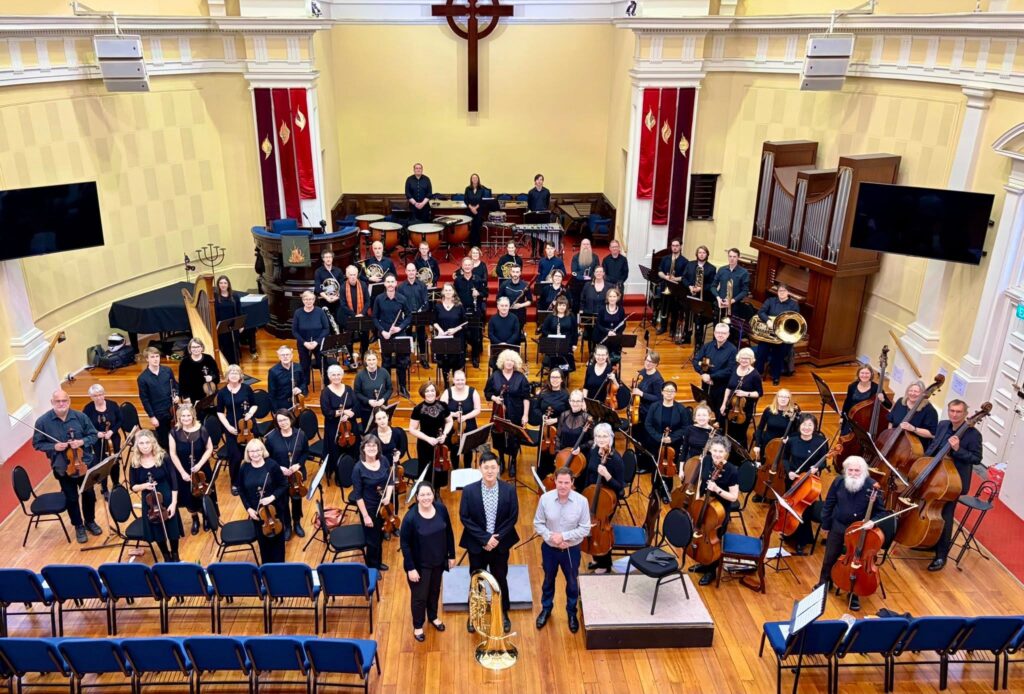
A world-encircling winter solstice concert compendium – from the Wellington City Orchestra

Wellington City Orchestra with Virginie Pacheco, Sam Zhu and Ewan Clark

CLAIRE COWAN* ( Aotearoa New Zealand) – Legend of the Trojan Bird (2008)
EDWARD GREGSON (England) – Concerto for Tuba (1978)
AMY BEACH (United States) – Symphony in E Minor “Gaelic” (1896)

Sam Zhu (tuba)
Virginie Pacheco* (assistant conductor)
Ewan Clark (conductor)
Wellington City Orchestra

St.Andrew’s-on-The-Terrace, Wellington
Sunday, 21st June 2026

Winter Solstice day in Wellington! and with it a venturesome programme of music from the Wellington City Orchestra! True, there was little or no ostensible relationship as regards the pieces’ content to the Solstice date and its marking of the venue’s furthermost separation from the sun – but as the concert featured three pieces new to the orchestra’s schedules, the musical territories we were taken to today seemed to have an appropriate sense of something out of the ordinary. This was further underlined by the cosmopolitean nature of the works and their origins, almost as if the music-making was putting a kind of Shakespearean girdle about the earth, beginning very properly with homegrown sounds and straightaway circumventing the globe before returning to our south seas via the Americas!

I thought it all fell excitingly in line with the general adventurousness of the orchestra’s recent repertoire, in terms of the programme’s relative unfamiliarity, and its attendant technical and interpretative challenges. Each WCO concert over the last couple of seasons has sparked interest in what has seemed to me like an encouraging rejuvenation of Wellington’s concert-going scene – with an increased proportion of both new and less familiar works in concerts a stimulating feature

This concert was no exception, with a trio of works notable for its diversity as such, besides representing different eras of musical history, and a variety of genres, in this case a miniature version of an orchestral tone-poem (Claire Cowan’s 2008 ”Legend of the Trojan Bird”), a 1978 concerto for tuba and orchestra (from Englishman Edward Gregson) and a fully-fledged romantic symphony (1896) by the American composer Amy Cheney Beach. I’ve not been able to find any other instance of this latter work being performed in this country, which possibly gives the occasion the additional distinction of being an Aotearoa New Zealand premiere – though I would have thought the organisers would have made mentioned of such a circumstance had it been the case.

As with previous recent concerts, one of the items was assigned to the orchestra’s Assistant Conductor, Virginie Pacheco, in this case Claire Cowan’s concise and evocative work “Legend of the Trojan Bird”, one dating from Cowan’s student years, during which she wrote the piece for the Auckland Youth Orchestra in 2008. Though not printed in the programme, a poem, presumably written by the composer, outlines the music’s trajectories, the music in effect elaborating what the poem’s words describe – the coming of the bird to “the ancient city” bringing a “moving shadow” of darkness along with the visitor’s  “dangerous beauty”. The music by turns depicted both the bird’s obvious mechanical attributes  – “wooden wings flapping, squeaking, lurching and shuddering”  along with more transformative modes, resulting in trajectories of soaring flight. Here, the rhythmic mechanical aspects become more vertiginous as the sounds “swoop, hover, soar”, before achieving, in its song a lovely “conversation with the neighbourhood of stars”- after which it disappeared as mysteriously as it had arrived. In every sense the scoring was magically ambient and ear-catching, holding one’s attention right to the mystical “stellar conversation” at the piece’s end. Conductor and orchestra achieved, I thought, miracles of evocation throughout every moment of the piece – a wondrous experience.

A different, more down-to-earth encounter was enacted by the performers in the next item, bringing both tuba soloist Sam Zhu and conductor Ewan Clark to the platform.  This was English composer Edward Gregson’s 1978 concerto for tuba, a piece obviously indebted to the latter’s historic compatriot Ralph Vaughan Williams with his similarly-wrought work for the instrument – Gregson at one point in the first movement unashamedly quotes the earlier work in an appropriate act of tongue-in-cheek homage, bringing a smile to the faces of those “in the know”, though there were many more felicities to be enjoyed, such as the wondrously cavernous notes Sam Zhu coaxed out of the ambient depths slumbering within his instrument!

A second movement demonstrated in places the expressive range of the instrument, its lyrical, and, in places, somewhat anguished tones far removed from the humour and rumbustions of the opening, partnered by some haunting wind playing sequences, and featuring a great percussion-capped climax at one point before the music drew up its folds of sound and returned to its dark silences. We were given a “return to life” by the finale, with marching pizzicato at the outset accompanying some jolly “tuba-triplets” and which then morphed into a festive dance! Sam Zhu’s instrument then gave us an almost lullabic moment with some pendulous winds as well as a briefly-philosophical like cadenza, before being marched off triumphantly at the end by the band as if “spoils from a day’s successful tuba-watching” – a great success!

So to the concert’s much-awaited second half and a symphony by the remarkable Amy Beach,a work which, at the time caused quite a stir with its first performance in Boston in1896, as it was the first symphony composed by an American woman to be performed by a major orchestra. Beach  had begun her musical career primarily as a pianist, and had already appeared as a soloist with the Boston Symphony when just seventeen years of age. However her marriage shortly afterwards resulted in her giving up her performing career for a number of years and concentrating upon composition. Largely self-taught, she drew her inspiration from both the “classics” and from the music that was still new in the 1880s, Brahms, Wagner. Liszt and Dvorak. Her compositions beside the Symphony included a Piano Concerto, a Mass and many chamber works and songs, which, after a period of neglect, are finding their way back into recent concert schedules everywhere.

Beach was a member of a group of composers from New England whose goal was to develop a uniquely “American” style of composition through combining traditional classical structures and forms with indigenous melodies and rhythms (such as Afro-American spirituals and folk melodies (Antonin Dvorak, who lived and worked for a period in New York was a passionate advocate of this principle in his composition teaching at the American National Music Conservatory).  Beach’s contemporaries included George Whitfield Chadwick,  Horatio Parker, John Knowles Paine, Arthur Foote and Edward MacDowell  – despite the esteem she was held in, she still had to overcome prevailing attitudes towards her “women composer” status, even when positively expressed – it was Chadwick who, when congratulating Beach on the success of her Symphony, described his “thrill of pride” that such a fine work had been produced by someone whom he considered had become “one of the boys”! However, Beach was determined also to advance women’s composition activities, helping to establish a Society of American Women Composers in 1925 and supporting the compositional careers of several who became known and admired, among them Margaret Ruthven Lang, and  Mabel W. Daniels, as well as the French-born Cecile Chaminade.

Beach’s Symphony in E-flat was given the name “Gaelic” because of her use of the technique of using “music of the people” for thematic and rhythmic inspiration as advocated by Dvorak, though with a significant difference – her “indigenous” affinities were with the folk-song and-dance material brought to America by her English, Scottish and Irish forbears, and the predominately ”irish” origins of the songs and dances quoted in the Symphony resulted in the work’s subtitle. She quoted the idea of the folk-themes expressing “the laments of a primitive people – their hopes and their dreams”.

Written between 1894 and 1896 this was Beach’s only Symphony, and fully expresses her determination to capture the flavour of the “music of the people” she knew best – the “Allegro con fuoco” opening of the work immediately expresses a rich, dark chromatic Romanticism, reminiscent of some of Liszt’s and Wagner’s music, mysterious swirlings punctuated by great calls and declamatory gestures. Solo winds then quoted from both Beach’s own music, a song “Dark is the Night” and from a Gaelic dance-tune, with solo clarinet, oboe, flute and horn splendidly doing the thematic honours, their traditional exposition, development and recapitulation roles coming to the fore throughout the movement, and with remarkably assured support from strings, brass and percussion in various sequences.

The second movement charmingly began “Alla Siciliana” before transforming itself into an Allegro vivace – lovely work at the outset from the solo horn, followed by the oboe quoting a beguiling Irish tune “The little field of barley” (along with other winds), after which the strings magically ushered in dancing, scampering and rumbusting textures to captivating effect! – a sudden  luftpause then brought horn, clarinet and flute as harbingers of a gorgeous cor anglais rendition of the “Little field” melody, to which the strings and brass addeed their voices, and the various winds “paired up” with fragments of the melody, until the scampering strings returned to round off the movement’s fairytale enchantment!!

The brasses announced the opening of the third movement’s “Lento”, which the winds carried on, before the solo violin presented a kind of recitative, joined by the solo cello – we then got an evocative  melody called “Cushlamachree” led by the ‘cello and joined by the oboe, and strings. This led to an epic, almost “Smetana/Ma Vlast-like” section featuring a series of “great views” from the whole orchestra, the solo horn leading the way in a series of wind and brass solos cycled about the orchestra! soundscape, with beautiful solos aplenty! The solo violin adroitly introduced a major-key melody – presumably one called “Which way did she go?” –  which built up to an almost angst-flavoured climax, before restating the first melody, Beach here displaying her compositional mastery with variants of the themes in major and minor, and with the interchanges brought to a particularly piquant conclusion.

I had found the symphony’s finale something of a protracted puzzle on first hearing a recording, but this performance held the structure together steadfastly and seemed to make everything work, right from its vigorous and declamatory “ready! – set!” introduction, indicating the onset of an adventurous journey – after this vigorous opening came a lyrical counter-subject in a major key, not unlike that in the finale of Sergei Rachmaninov’s E Minor Symphony, written a decade or so later. A strange, moodily restless passage followed, which took some time to build back the energies of the opening, the players keeping their heads and fiercely concentrating upon the music’s “search for redemption” which came with the horns sounding the alarm and rousing the brass and the rest of the orchestra to readiness! With that, and the major-key second subject’s return, the skies suddenly cleared, and the music raced to its close as jubilantly and decisively as might have been expected.

I thought, at the end of the work, that Ewan Clark and the WCO players had completed something of a major achievement, here   – such an enthusiastic and spankingly capable performance! We were left to all babble our way homewards at the joy of such a discovery, and of experiencing a whole afternoon’s feisty and absorbing listening!
At Last!  NZ Opera’s 2021 “take” on Mozart’s “The Marriage of Figaro makes it to Wellington

New Zealand Opera presents Mozart’s “The Marriage of Figaro”

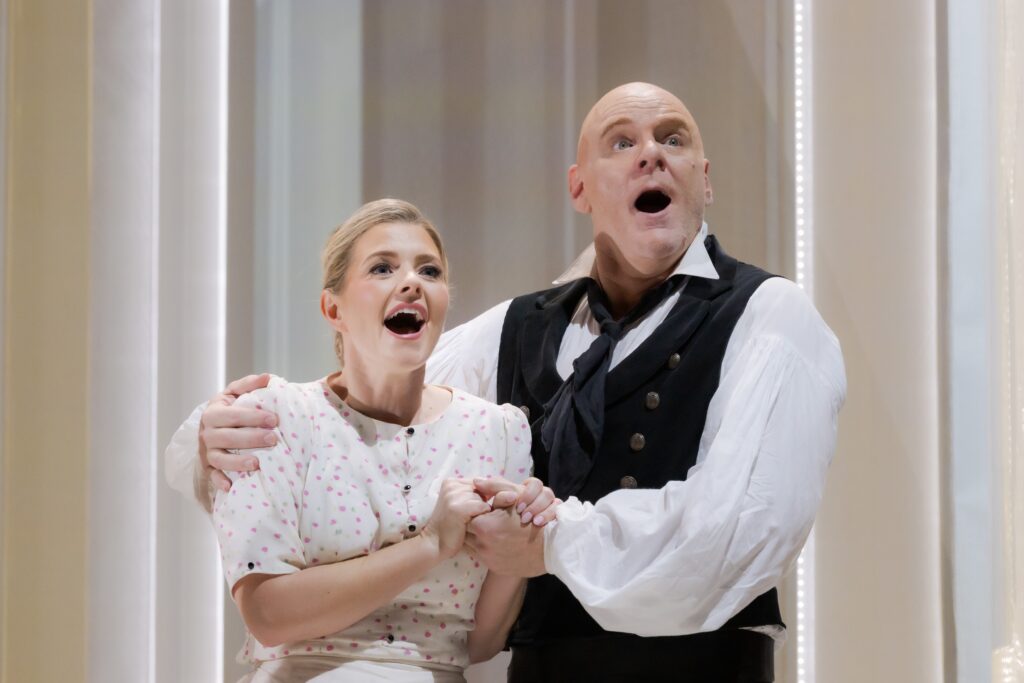
Sophie Sparrow as Susanna and James Clayton as Figaro – Photo: Stephen A’Court
Composer: Wolfgang Amadeus Mozart / Librettist: Lorenzo da Ponte
Based on Pierre-Augustin de Beaumarchais’ 1778 play “Le Nozze di Figaro”

Cast: Figaro – James Clayton
Susanna – Sophie Sparrow
Count Almaviva – Julien Van Mellaerts
Countess Almaviva – Felicity Tomkins
Cherubino – Cecilia Zhang
Marcellina – Kristin Darragh
Bartolo – Andrew Collis
Don Basilio / Don Curzio – Andrew Grenon
Barbarina – Sarah Mileham
Antonio – Joel Amosa
Bridesmaids – Barbara Graham, Charlotte Secker

Freemason Foundation New Zealand Opera Chorus
Orchestra Wellington
Conductor – James Judd

Chorusmaster Laureate – Michael Vinten
Principal Repetiteur and Continuo – David Kelly
Chorus Repetiteur – Bruce Greenfield
Director – Lindy Hume
Assistant Director – Eleanor Bishop
Set and Costume Design – Tracy Grant Lord
Lighting Designer – Matthew Marshall
Choreographer – Taiaroa Royal

St James Theatre, Wellington
Wednesday 17th June 2026

This was an opera audience that bubbled with pleasurable satisfaction long after the bringing down of the curtain at Wellington’s St.James Theatre on Wednesday evening earlier this week. NZ Opera’s eagerly-awaited (and at that time glowingly-received) 2021 production of Mozart’s “Le Nozze di Figaro” was meant to come on to Wellington following its season in Auckland that year – however, Covid intervened, forcing a last-minute Level 2 lockdown directive which put paid to Figaro’s performances in the capital ( Christchurch, which got three subsequent performances, was luckier than Wellington on that occasion).

Now, it was at last Wellington’s turn to enjoy director Lindy Hume’s and designer Tracy Grant Lord’s  much-acclaimed “take” of Mozart’s classic work, with the intervening years up to 2026 having inevitably “honed” 2021’s presentation, most obviously in terms of having a different cast bringing its own singular talents to the revival and recreating in the ever-grateful St James’ scenario a uniqueness of its own! I wasn’t able to see the 2021 “live-streamed” final Christchurch performance which NZ Opera had thoughtfully provided for its thwarted Wellington patrons, so (like many of the audience would have done) was able to come entirely freshly and all the more eagerly to this production!

I’d previously enjoyed a number of NZ Opera presentations directed by Lindy Hume, beginning with a stunningly visceral, almost “too-close-for-comfort” presentation of “Rigoletto”, as far back as 2012; and most recently – rather closer to the ethos of this evening’s subject – a “Cosi fan tutte” in 2023 which unsparingly brought out the ambiguities of human relationships between the leading characters with disconcertingly unease! So I was looking forward immensely to what insights Hume (and her inspirational designer for “Cosi”, Tracy Grant Lord) would uncover for us with this work – one that still resounds in my own memory as a precious “formative opera experience” from as long ago as 1971!

From the outset I was enchanted by the set and its all-encompassing “lit from within” qualities, the constant fluidity and variegation of both parameters and illumination taking us through as much a “journey of the imagination” as a series of spaces wrought with the work’s constant flux of both wilful interaction and judicious concealment in mind. Hume described the spaces created by readily moveable walls and doorways as suggestive of on-going change, as the opera’s action (a single day) unfolds its course from early morning until late at night and the characters move from scenario to scenario, firstly inside and later, outside the house, and in the garden. Tracy Grant Lord’s set and costume designs and Matthew Marshall’s lighting together simply enfolded us in a kind of timelessness about it all, recognisably as much a scenario from 200 years ago as in a large and modern country house, leaving us in the audience to “flesh out” whatever era from that time we could imagine through our own reactions.

What came across as forcefully here as in the 2023 “Cosi” production was the depiction of emotional disruption to societal order which both Mozart and his librettist Lorenzo da Ponte took pains to depict and examine – and while in both cases a semblance of that “order” was restored to the lives of the characters, much deeper undercurrents had been irreversibly plumbed by all the parties. And as Lindy Hume points out in her insightful notes in the programme, the women were the ones who instigated the changes in “Figaro”, presenting in no uncertain terms a new vision of a society being “remade”. Perhaps if Mozart had lived for longer, might he and da Ponte might have further pursued an operatic version of the original author Beaumarchais’s third play “La Mère coupable” (The Guilty Mother)? We will never know…..

Here in 2026 we were given everything envisaged by composer and librettist – there was comedy, intrigue, anger and pathos in this presentation, with all of the characters at one stage or another revealing or disporting strong and varied émotions, subject in places to rapid change, and instigating a kind of volatility associated with societal disturbance and disruption, either of authority or of deep feeling. Whether in a kind of soliloquy, or accompanied by interaction, these different expressions were wholeheartedly conveyed, in recitative or in set pieces, solo or concerted, with every character suitably “enlarging” her or his personality in the process.

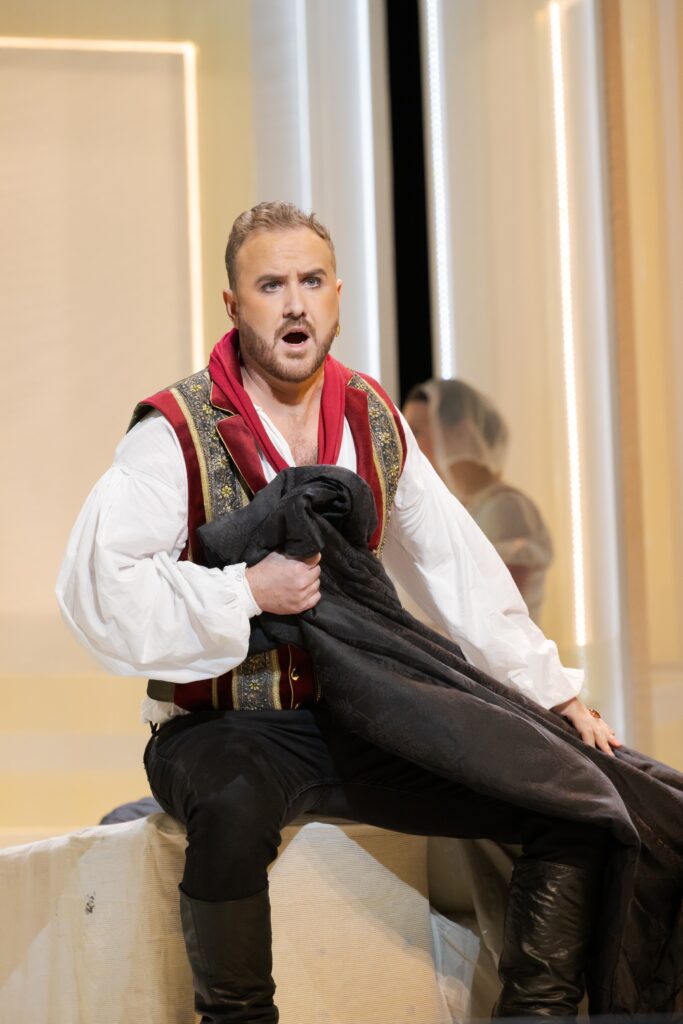
Julien Van Mellaerts as the Count  – Photo: Stephen A’Court
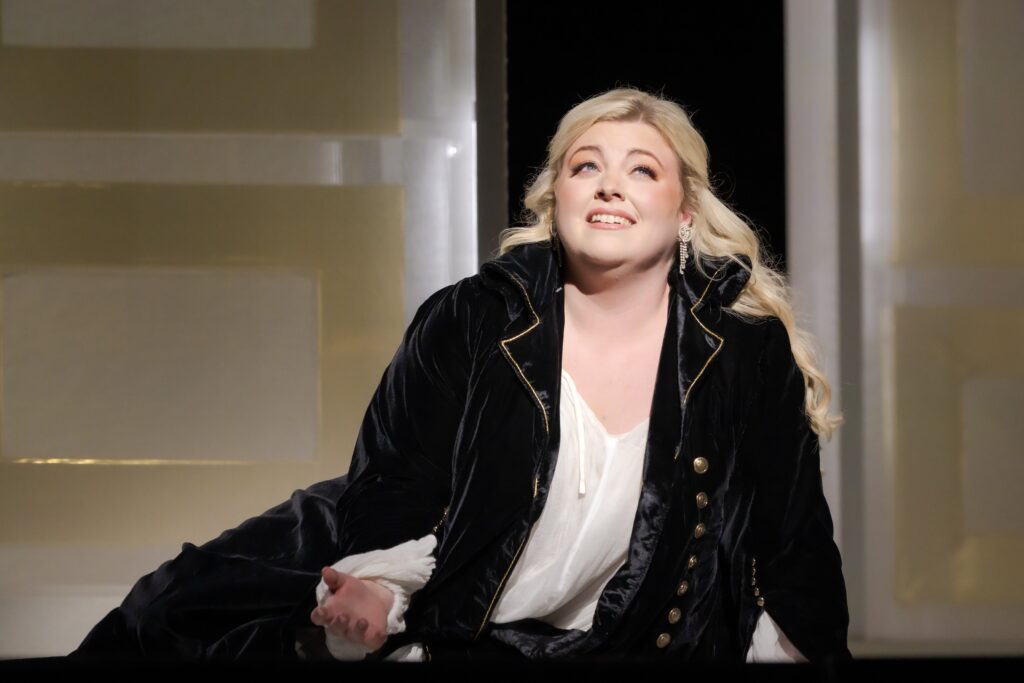
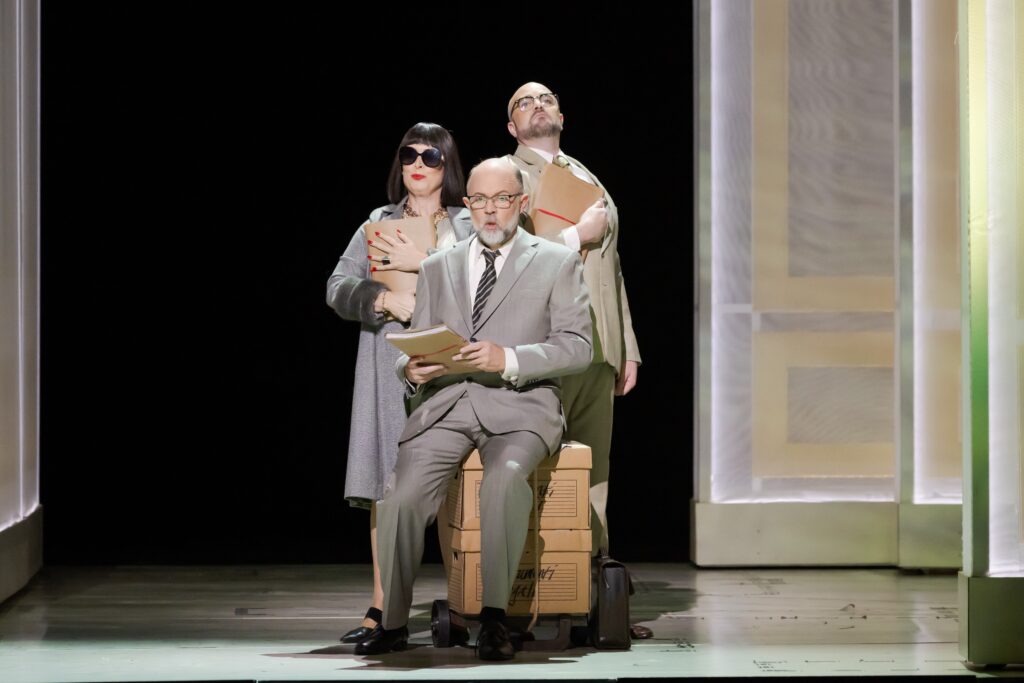

Felicity Tomkins as the Countess – Photo: Stephen A’Court

In that sense, the work was a perfect “ensemble” piece, whose dramatic coherence rested upon upon teamwork, with timing and balance adroitly kept on the rails by conductor James Judd, with every portrayal, including the lesser characters, prospering in partnership with others.  As Figaro, James Clayton’s robust baritone, and Sophie Sparrow’s ever-mellifluous soprano as Susanna brilliantly encompassed their pairing’s ebb-and-flow dynamics besides keeping on the boil their various parallel relationships with co-conspirators and adversaries – everything had an inventiveness and volatility which kept the audience guessing as to “how”, regardless of knowing “what”. Figaro’s and Susanna’s upper-class equivalents, the lascivious Count Almaviva (Julien Van Mellaerts)  and his long-suffering Countess (Felicity Tomkins) were dynamic adversaries/eager collaborators in terms of their own relationship, Van Mellaerts with his quick, flexible baritone the perfect foil here for Tomkins’ sympathetic and warmly-appealing soprano.

Kristin Darragh (Marcellina), Andrew Collis – front (Bartolo), and Andrew Grenon (Don Basilio/Don Curzio) – photo:  Stephen A’Court
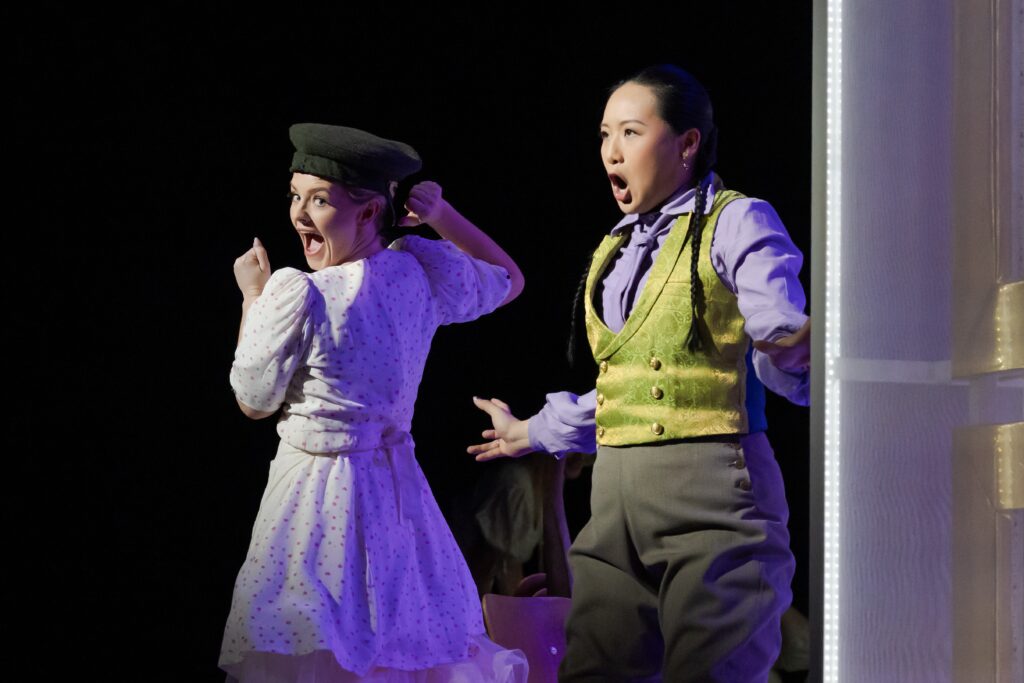
Into this quartet of conflict came the vengeful pairing of Marcellina and Bartolo, each with an axe to grind regarding the luckless Figaro – Kristin Darragh was a gorgeous, fulsomely acquisitive Marcellina, here in tandem with the initially less dynamic Bartolo of Andrew Collis, whose decidedly oldish portrayal did, however, manage to gather some momentum during his “La vendetta” aria – and together the pair’s subsequent Act Three rediscovery of their own parentage of Figaro himself got the biggest laugh of the evening – in a production already replete with humour, a great moment!


Sophie Sparrow (Susanna) and Cecilia Zhang (Cherubino) – photo: Stephen A’Court

Diverting opposites were mezzo-soprano Cecilia Zhang’s quicksilverish, testosterone-ridden pageboy Cherubino, her voice and presence replete with pubescent urgings (in one instance graphically suggestive via an item of the countess’s clothing!), and Andrew Grenon’s delightfully first-up artless Don Basilio, whose drollery effectively (if only temporarily) masked his character’s true oily nature, bent on mischief and mayhem at whomever he’d been primed to target. Grenon here did an adroit double-act as Don Curzio, the Judge summonsed by Marcellina to formalise the intended marriage between her and Figaro. There was also Sarah Mileham’s Barbarina (a servant-girl) played innocently and sweetly in her defence of Cherubino against the Count, and adroitly-voiced in her “notepin” aria, alongside two effective cameos from bass-baritone Joel Amosa as the slightly drunken and suitably affronted gardner, Antonio.

The chorus’s brief but deftly-timed festive entrances overlaid the Count’s scheming with suitably rustic-sounding innocence and charm, besides providing an atmospheric backdrop of « daily task » activity just outside and around most of each acting area – an inspired production touch! All of this was buoyantly propelled by James Judd’s variegated direction of some superb orchestral playing by the Orchestra Wellington players – from the stirring strains of Cherubino’s “off to the battle” military pomp and vigour, through the gaiety of the rustic celebrations to the tenderness of the music for the Countess’s heart-rending moments of amatory sorrow, and, at the end, relishing and delivering wholeheartedly the opera’s rejuvenating message of hope for the human condition in the best universal sense via Mozart’s glorious music.


.

Aotearoa and China – a musical dialogue presented by Jian Liu

Wellington Chamber Music Concert Series 2026

Jian Liu (piano) presents “Aotearoa and China – a musical  dialogue”
Works for solo piano  by New Zealand and Chinese composers
– the first of four concerts as part of a CMNZ tour)

St Andrews on the Terrace, Wellington
Sunday, 14 th June 2026

Review for Middle C by Gary Wilby

What a thoughtfully curated concert by Associate Professor Jian Liu of Te Koki New Zealand School of Music Victoria University of Wellington. This was a brilliant piano journey through both the place and the culture of New Zealand and China. The programme – Aotearoa & China: A Musical Dialogue  –  cleverly paired piano solos by composers from the two places which are Jian Liu’s home.

In his introductory comments he mentioned that the programme was not the big works from the romantic period – which he had recently been playing as
member of a Quintet at the Chamber Music section of the Michael Hill International Violin Competition Semi Finals in Auckland – but rather smaller piano works from the two countries which complement and contrast place, land, and its inhabitants.

Jian Liu, who has lived in NZ for some 16 years spoke of live performance as having an energy and connection  which he wished to share with us. The programme began with Lilburn’s 1951 “From the Port Hills” one of Five Bagatelles. This  the most evocative and embedded of piano works relating to the landscape of NZ – the vista, the walking, cycling, running, the backdrop to every Cantabrians day – was played with spacious crafted phrases and dynamic range, the bass notes played with a heft to perhaps even suggest the crater’s volcanic origins.

This was immediately followed without a break by “Pictures from Bashu” by Huang Hu Wei,  referencing the cultural richness of Sichuan in a selection of four pieces from that work. Immediately the delicacy of morning, the lyricism, the dynamic virtuosity, the festivity, the sound with Chinese characteristics was
apparent.

“Three Short Pieces” by Salina Fisher, who was present in the audience, moved us to a more abstract view – amazing for a work by a school student at the time – of “Raindrops on a Misty Pond”, “Moths in the light” and then “Galaxy”, giving us a sense of vastness. Each of these Jian gave us with great clarity – delicate echoes, where every note had its place creating an almost different piano sound. And, we were made aware of that by the performer.

Salina was paired with probably the most well-known Chinese composer to New Zealanders in this programme – Tan Dun. If not for the film “Crouching Tiger, Hidden Dragon” maybe because of his many concertos. His “Water Concerto” has been performed in NZ as has his opera “Tea” performed at the NZ International Festival of the Arts. He also visited NZ a number of times and worked at VUW, facilitated by Jack Body and connections through the Asian Composers League Festivals. Again, only a selection of movements from this longer piece – “Eight Memories in Watercolours” – were heard  – the exciting “Staccato Beans”, the
pastoral “Herdboy”, and the evocative “Floating Clouds” almost French floating away to nothing.

Tan Dun’s work was more motivic than we had heard thus far. Dynamic with strong rhythms, tempo and beat. The “Herdboy” evoked isolation and Chinese instrumentation. I would love to have heard Jian playing the last in this suite – the very exciting “Sun Rain”

The programme then moved into love and affection – lyricism. Gareth Farr’s beautiful, sensitive “Love Songs” for three friends – subtle and beautiful melodic lines with arpeggiated left hand accompaniment. Immediately appealing but also requiring reflection. Of course, Jian played these very sensitively,  gifting us the simplicity and emotion of these pieces.

Jian then played “Three Songs from the Mountains of Southern Yunnan” by Zhang Zhao. The folk aesthetic moved though dance like activities involving children, hills, Mountain Moons and mountain Fire which sparked under Jian’s fingers and almost felt slightly dangerous.

After the Interval we had two Lullabies – “For Matthew” by Gillian Whitehead and a work by He Lu Ting. The intimacy of interacting with a child, the soothing of a child – Gillian’s rocking motion with Jian bringing out the bass part and then a work with a Chinese taste where the pianist “rang out” the melodic line. A universal act.

The children are presumably slightly older in Anthony Ritchie’s “Carolina Bay Suite” and Ding Shan De’s “Children Suite – Happy Holidays”. The former evokes a sunrise then children excitedly playing and running on one of the South Island’s most well-known beaches and carnivals. Having fun in the sun at the beach. The Chinese child getting out of the city, skipping with ropes and playing hide and seek. The perfect day for children – here and there.

The programme concluded with two early works by senior composers of the two countries’ earlier times – more formal and traditionally structured.  David Farquhar’s “Sonatina” is a work which should be played more as it reflects on and is part of a time when NZ composers were finding their own feet as part of this country, as part of this land. The programme finished with Wang Li San’s “Sonatina”. Unlike Farquhar’s typical music tempo markings (eg .Andante) for each movement, the latter has the more typical Chinese “titles” describing nature’s sunshine, new rain and “Dance of the Mountain Men” evoking dance and nature.

What an interesting programme –  so well curated and so well presented to the large audience by the performer and by Wellington Chamber Music. As one woman said leaving the venue “That was so exciting –  I didn’t know any of the pieces”. But she was converted and enthralled. Jian Liu’s playing is in its self worth hearing but in this concert he did more by creating links and dialogue for us. He brought us to the lands and the people of two countries’ cultures – especially the children.

It is worth noting that the music is available through Sounz Centre for NZ Music and also through the NZ Music Trust who published “Chinese Piano Music for Children” and also “NZ Piano Works in Two Volumes”. Jian Liu is, during the next week, presenting the programme through Chamber Music NZ to Whanganui, Upper Hutt and New Plymouth

Orchestra Wellington in full “swing” with escapist New York jazz

ORCHESTRA WELLINGTON -2026 Collaborations
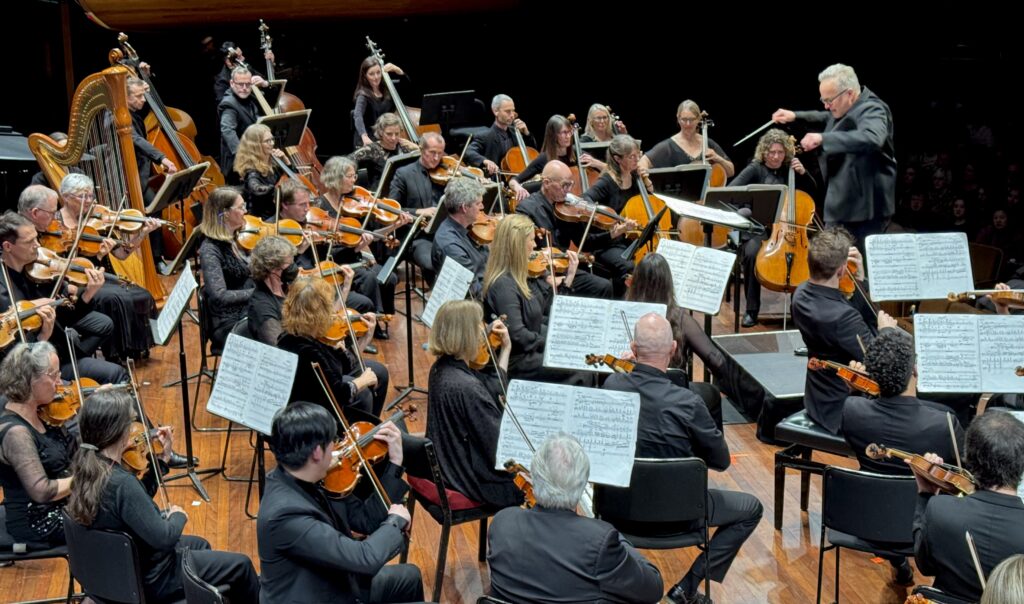
W:ELLINGTONMarc  Taddei with Orchestra Wellington  – Photo Credit : Andy Best
LEONARD BERNSTEIN – Chichester Psalms
– Tudor Consort / Joshua Derbyshire-Foale (boy soprano)
GEORGE GERSHWIN – Piano Concerto in F
– David Fung (piano)
ROLF LIEBERMANN – Concerto for Jazz Band and Orchestra
– Te Koki Jazz Band
DUKE ELLINGTON – Harlem

Orchestra Wellington
Marc Taddei (conductor)

Michael Fowler Centre, Wellington
Saturday 30th May 2026

Reviewed by Leila Lois
for MIddle C

What a treat to experience Roaring Twenties New York, replete with a jazz-inflected orchestra and virtuoso soloists, on an early winter evening in Wellington. This edition of Orchestra Wellington’s ‘Collaborations’ series transported audiences to the streets and speakeasies of a bygone Manhattan. The evening exuded classical jazz sophistication, with a pleasing
programme loosely fitted to the jazz era theme: Leonard Bernstein, George Gershwin, Rolf Liebermann, and Duke Ellington.

The evening began with a gorgeous rendition of Bernstein’s Chichester Psalms, featuring the Tudor Consort and boy soprano Joshua Derbyshire-Foale. The chorus roused the piece with “Behold how good”, the cello foreshadowing the beauty to come. The work sat perfectly within
the Michael Fowler Centre’s acoustics, maintaining its ecclesiastical air while finding warmth in the venue’s wooden architecture.

Next came Gershwin’s Piano Concerto in F, with pianist David Fung bringing a syrupy fluidity to the keys. Honed by training with the Cleveland Orchestra and Los Angeles Philharmonic, he proved a wonderful collaborator throughout. There was a playful call and response between trumpet, timpani, and piano, melting into the swoony strings under the expert direction of
conductor Marc Taddei. The helter-skelter rondo evoked Roaring Twenties Manhattan so vividly it could practically be felt — the muted trumpets a particular standout, alongside the desultory pizzicato violin and the balmy calm of flute and piano.

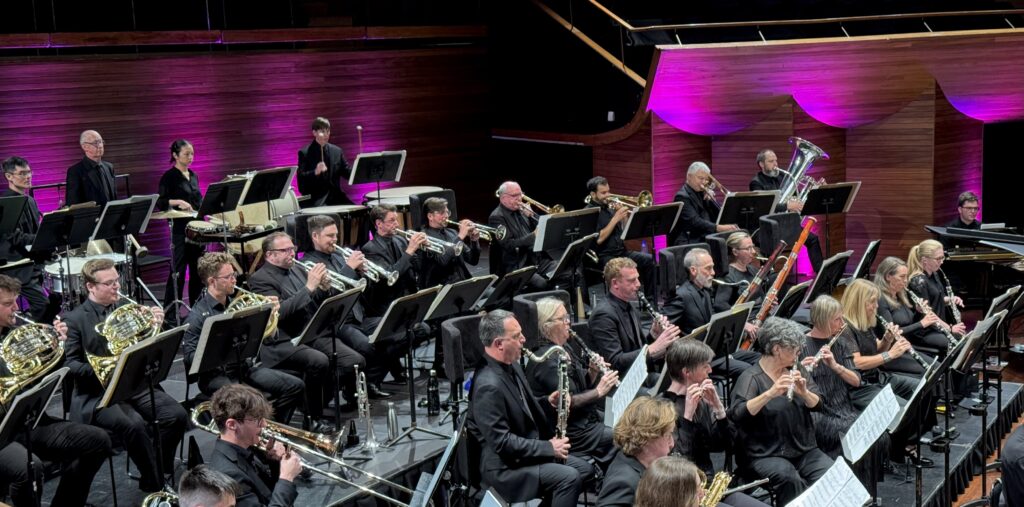
Liebermann’s Concerto for Jazz Band and Orchestra, accompanied by the Te Koki Jazz Band, delivered a vibrant dance-hall sound. The pacy cymbals and trombone (the latter led by Jakob Elijas) had the audience toe-tapping and shoulder-shimmying within moments. A playful turn into bossa nova, complete with cowbell and Afro-Cuban instrumentation, added a welcome frisson.

Winds, brass and percussion – Orchestra Wellington – Collaborations 2026 :  Photo Credit: Andy Best

The final piece, Duke Ellington’s much-admired Harlem, perhaps transported audiences furthest of all. Ellington once quipped that “you can’t write music right unless you know how the man who’ll play it plays poker” — and this work fully embodies that spirit, maximising the plush textures of the full orchestra to conjure a vivid, colour-drenched Harlem of the early-to-midtwentieth century.

A beautiful showcase of escapist New York jazz, this edition of Orchestra Wellington’s ‘Collaborations’ series was a real hit, and at the onset of winter, it brought welcome colour and delight.

Nota Bene brings people in for some mellifluous music-making at St.Andrew’s

Four Hands, Two Grands and a Choir (striking a modern chord)

Gabriela Glapska / Catherine Norton (pianos)
Nota Bene Choir
directed by Maiike Christie-Beekman

St.Andrew’s-on-The-Terrace, Wellington

Sunday 31st May, 2026

What an inspirational title for a concert! – words obviously intended to  quicken the interest and activate any curiosity! And it all seemed to have worked a treat, as St.Andrew’s-on-The-Terrace Church proceeded to fill up with people almost to bursting-point! What was more, all of us were told on entry by the organisers to “fill up the seating gaps” – in other words, to “bunch up” today and ignore that good old Kiwi inclination to “leave a space” if one is next to somebody one doesn’t know. We all did our best, and were able to start up many an unsolicited conversation with our neighbours as part of the acclimatisation experience! Naturally there were a number of “sisters , cousins and aunts” present, to support friends and relations among the Nota Bene performers, so that everybody soon jelled as a responsively homogenous audience.

For choir performers perhaps the name René Clausen (b.1953) is a familiar one, though this was my first encounter with the composer’s music. I found a note describing him as “one of America’s most popular choral composers, creating music suited to all levels of expertise”. His music, though obviously challenging for performers doesn’t ever startle or berate the listener with dissonant or over-angular tones. The opening Prayer, a setting of words by Mother Teresa of Calcutta, uses very open harmonies that give the work a lovely spaciousness. The individual lines successfully explore both freedom of individuality and a sense of belonging to something greater – lovely cluster-tones in places contrast with the sopranos’ free, stratospheric lines elsewhere, while conductor Maaike Christie-Beekman gets pleasing unanimity and gorgeous tones from her voices throughout.

A setting of Psalm 100’s “Make a joyful noise” certainly achieved the words’ desired effect, with catchy syncopations tossing varieties of tone, timbre and colour at us, while the accompanying pianists, Catherine Norton and  Gabriela Glapska brought out the dance-like qualities of the work to perfection with adroit, incisive playing, the antiphonal effect on two pianos nicely ear-catching! With the Song of Solomon setting of Verses 5-8, ”Set Me as a Seal” the choir regrouped as a kind of wisely-spaced “circle” around the church’s outer aisles, with Christie-Beekman in the centre aisle as conductor. The result was captivating, the flowing lines and resonating harmonies capturing the “strength from tragedy” context of the work, composed in the aftermath of the tragic death of the composer’s unborn child – a detail only vaguely hinted at in the programme, and which I discovered while researching material for this review, making the music’s response to such a devastating loss all the more poignant upon rehearing.

In the wake of such touching sounds we were treated to the completely different experience of hearing two pianos in a performance of a set of variations by Roumanian composer George Enescu (1881-1955). Amazingly the work was written when Enescu was just seventeen, at that stage as proficient a pianist as a violinist (the work is dedicated to fellow-pianists Édouard Risler and Alfred Cortot), and also undertaking composition studies at the Paris Conservatoire. Gabriela Glapska and Catherine Norton threw themselves into the fray with the music’s majesterial and ceremonial opening sparking off a series of imaginatively-wrought contrasts of mood and response, from the delicate and decorative first variation, through delights such as the triplet-rhythmed third variation, and the stylish “promenade” trajectories of the fifth“ episode – not unexpectedly the final variation was a fugue which grew out of some florid exchanges, resolutely intertwining the  lines towards a satisfyingly grand three-chord conclusion!

Another composer whose work is known to the few rather than the many was Josef Rheinberger (1839-1901), perhaps best known for his works for solo organ, which were highly regarded as “the most valuable addition to organ music since Mendelssohn”, though his choral music “pops up” every now and then – I have just one of his choral works on a lovely recording, a Christmas cantata “The Star of Bethlehem”, for soprano, chorus and orchestra), but didn’t know the beautiful six-part Abendlied which we heard next – a kind of “Abide with me” in effect, the voices achieving throughout under Maaike Christie-Beekman’s direction a gorgeously-sounded seamless flow.

We then had another work I didn’t know, Johannes Brahms’s Nänie, written in 1880-81 as a memorial tribute to a friend, the painter Anselm Beuerbach. The words are Friedrich Schiller’s, which draw from three well-known myths , Orpheus and Eurydice, Aphrodite and Adonis, and the death of Achilles,  each illustrating the transience of youth and beauty through death. Written originally for choir and orchestra, Brahms made a version for four-hands piano accompaniment to allow the work to be performed when an orchestra wasn’t available.

A longish piano introduction began the work before the voices entered, proclaiming the poet’s overall idea that “even beauty must die”, The intensities rose and fell as the singers described the efforts of Orpheus to win back Euridice, fatefully intoning the message that “only once did love melt the Lord of Shadows”, and how, at the last moment, all was lost. Then, rather than elaborating greatly on the tragic deaths of both the beautiful Adonis and the heroic Achilles, Brahms instead expressed an empathetically-controlled sense of the mourners’ bereavement, saving any great outpouring pf emotion for the description of Achilles’ mother Thetis, rising from the sea in the company of the sea-nymphs and weeping for her son, the voices conveying resounding tones of lament before the beatific conclusion  here expressing the idea of mourning transfiguring and truly celebrating a life.

The concert’s second half began with another rarity, Igor Stravinsky’s 1926 work “Otche Nash” (Pater Noster) – with the setting in “Old Slavonic” – Stravinsky, whose years (1882-1975) traversed whole eras of musical expression, characterised this work as belonging to his “most earnest period of Christian Orthodoxy” – slow and atmospheric, I enjoyed its SOUND immensely, and partly because the words could only be Russian – they reminded me so much of my listening to Rachmaninov’s wonderful “Vespers” (and, naturally enough, I knew exactly what the words meant!) Incidentally, the singers took their places “around” the church for this item, similarly to the first half’s “Set Me as a Seal” performance, and just as effective as a surround-sound” experience! For the 4-part work by Arvo Part (b.1935), “Da Pacem Domine”, which followed, Maaike Christie-Beekman got her singers to move to a “front-and-back” antiphonal exchange position, each group the corner of a rectangle. This 2004 work came to be associated with a tragic train-bombing in the city of Madrid that same year, and is still often performed in Spain. Typically for the composer, the music is slow-moving, giving an impression of great stillness, absolutely mesmeric in effect, as if captured “out of the air” – we heard a kind of “declamation then echo” pattern of utterance which over time created an incredible timeless kind of effect – the “improvisatory” nature of the sounds meant that any slight imprecisions between the groups had a spontaneity which seemed entirely natural, making for a true sense of meditation and connection between sound and emotion.

For the second time that evening the two-piano ensemble came, in a sense, to our rescue from the music’s quiet sense of tragedy, and catapaulted us into a world of colour, movement and excitement. Composer Darius Milhaud (1892-1974) had written some incidental music for two separate productions which he had afterwards worked into a “suite” called “Scaramouche” for saxophone and piano. At that point (1937) the famous French pianist Marguerite Long requested of Milhaud a work for two pianos, which gave him the idea of using the “Scaramouche” music, and which quickly established itself as a concert item. And, along with the composer’s famous orchestral piece  “Le Boef sur le Toit” (The Bull on the Roof), the two-piano version of “Scaramouche” became his most well-known work.

Catherine Norton’s and Gabriela Glapska’s pianistic energies and scintillations were fully on display here, as the first of the three movements. “Vif” hit the ground running, with irrepressible movement and cheeky syncopations, before the players switched mode to a whimsical children’s chant section, reminding one of the old English count-down tune “Ten green bottles hanging on the wall” – after which the helter-skelter opening returned, unabated! The second movement sounded part lullaby, part reverie, with different voices echoing between the instruments, and with a nostalgic Ravel-like sense of children’s bedtime games capturing a child-like world. The last movement revitalised us once again, our pianists enticing the catchiest of rhythms from their instruments with a well-known rhumba-like dance whose vivacity, through various kaleidoscopic key-changes was exhilarating to keep up with – such great fun!

Nobody could complain of a lack of variety in this splendid concert, and especially as the Stravinsky work which concluded the afternoon was quite unlike anything else on the programme. Composed in 1930, the Symphony of Psalms was commissioned to mark the 50th anniversary of the formation of the Boston Symphony Orchestra by its famous then-conductor Serge Koussevitsky – however the conductor fell ill and the Boston performance had to be postponed, allowing the Swiss conductor Ernest Ansermet to give the work’s premiere in Brussels early in December 1930, Koussevitsky in Boston following a week later.

The work has a four-part chorus and a large orchestra – Stravinsky, however, eschewed the usual large-scale orchestra sound, choosing to write in what became known as the composer’s “neoclassical” manner, and using Latin psalm texts. For this performance conductor Maiike Christie-Beekman had the use of a famous adaptation of the work’s orchestration for four hands /two pianos by Russian composer Dmitri Shostakovich, who greatly admired Stravinsky’s work. There were three movements, the first a setting of the closing verses of Psalm 38, the second of the opening verses of Psalm 39, and the finale the whole of Psalm 150, all in the latin text of the Vulgate, the late 4thCentury translation of the Bible which used “vulgar” or “everyday” Latin, spoken by the common people.

Beginning with bare, uncoloured piano figurations the work’s vocal line followed suit with lines similarly bare and astringent – the opening “Exaudi orationam meam” (Hear my prayer) sung almost hypnotically, but with the emotion rising, beginning at “Quoniam advena ego sum” (for I am a stranger) and reaching desperation levels with “Sicut omnes patres mei” (as all my fathers were” and with the cries of “Remitte mihi” (Spare Me!  towards the end. The second movement was more agitated, the fugue beginning with angular piano lines, and carried on by the choir with “Expectans expectavi Dominum” (I waited patiently for the Lord)  growing in complexity as the music proceeded. A heartfelt outburst from the voices at “Et immisit in os meum canticum novrum” (And he hath put a  new song in my mouth) affirmed faith and trust, as the music died away into silence.

An impulse of joy lit up the church with the third movement’s opening “Alleluia” giving the music an austere beauty. At first  the voices sounded quietly-confident impulses of praise, initiated by piano chords, and with repeated murmurings of “Laudate Dominum” – when suddenly the pianos suddenly galvanised the ensemble with driving rhythmic trajectories, over which the voices floated their continued “Laudate” phrase. These broke off for a brief luftpause of praise with an “Alleluia”, before returning to the driving piano rhythms and floating choral phrases. We were spellbound as the choir and pianists brought the work to a close with a quiet but determined “Laudate Dominum” – these focused distillations of worship and awe from the singers and quietly steadfast support from the pianists, were all held tremulously in place through Maiike Christie-Beekman’s  beautifully-judged sense of culmination – finis pulchra!