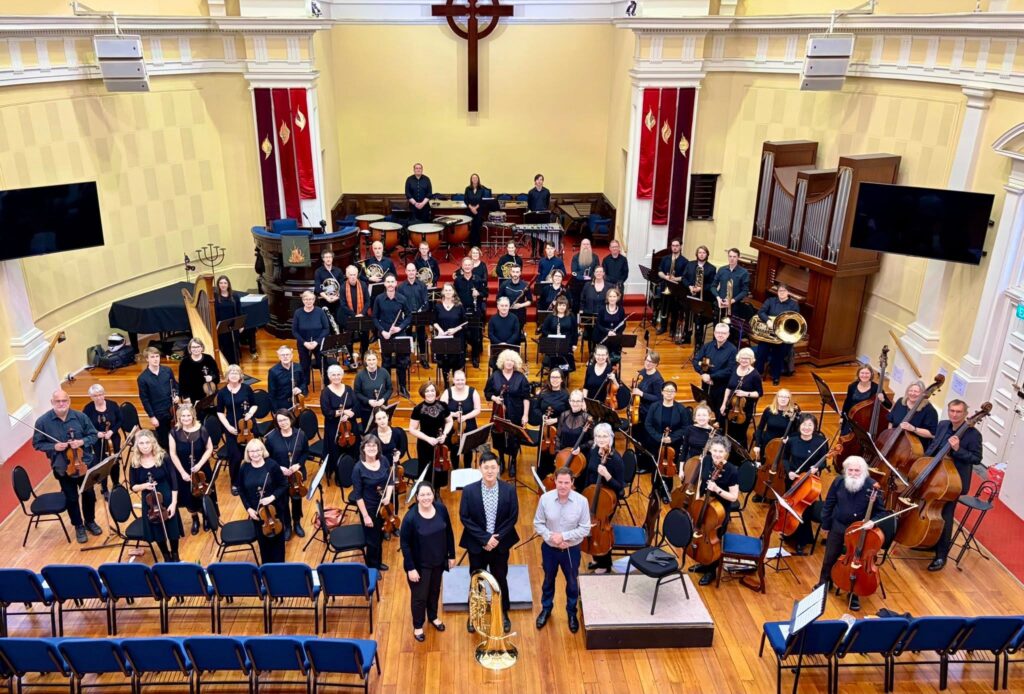
A world-encircling winter solstice concert compendium – from the Wellington City Orchestra

Wellington City Orchestra with Virginie Pacheco, Sam Zhu and Ewan Clark

CLAIRE COWAN* ( Aotearoa New Zealand) – Legend of the Trojan Bird (2008)
EDWARD GREGSON (England) – Concerto for Tuba (1978)
AMY BEACH (United States) – Symphony in E Minor “Gaelic” (1896)

Sam Zhu (tuba)
Virginie Pacheco* (assistant conductor)
Ewan Clark (conductor)
Wellington City Orchestra

St.Andrew’s-on-The-Terrace, Wellington
Sunday, 21st June 2026

Winter Solstice day in Wellington! and with it a venturesome programme of music from the Wellington City Orchestra! True, there was little or no ostensible relationship as regards the pieces’ content to the Solstice date and its marking of the venue’s furthermost separation from the sun – but as the concert featured three pieces new to the orchestra’s schedules, the musical territories we were taken to today seemed to have an appropriate sense of something out of the ordinary. This was further underlined by the cosmopolitean nature of the works and their origins, almost as if the music-making was putting a kind of Shakespearean girdle about the earth, beginning very properly with homegrown sounds and straightaway circumventing the globe before returning to our south seas via the Americas!

I thought it all fell excitingly in line with the general adventurousness of the orchestra’s recent repertoire, in terms of the programme’s relative unfamiliarity, and its attendant technical and interpretative challenges. Each WCO concert over the last couple of seasons has sparked interest in what has seemed to me like an encouraging rejuvenation of Wellington’s concert-going scene – with an increased proportion of both new and less familiar works in concerts a stimulating feature

This concert was no exception, with a trio of works notable for its diversity as such, besides representing different eras of musical history, and a variety of genres, in this case a miniature version of an orchestral tone-poem (Claire Cowan’s 2008 ”Legend of the Trojan Bird”), a 1978 concerto for tuba and orchestra (from Englishman Edward Gregson) and a fully-fledged romantic symphony (1896) by the American composer Amy Cheney Beach. I’ve not been able to find any other instance of this latter work being performed in this country, which possibly gives the occasion the additional distinction of being an Aotearoa New Zealand premiere – though I would have thought the organisers would have made mentioned of such a circumstance had it been the case.

As with previous recent concerts, one of the items was assigned to the orchestra’s Assistant Conductor, Virginie Pacheco, in this case Claire Cowan’s concise and evocative work “Legend of the Trojan Bird”, one dating from Cowan’s student years, during which she wrote the piece for the Auckland Youth Orchestra in 2008. Though not printed in the programme, a poem, presumably written by the composer, outlines the music’s trajectories, the music in effect elaborating what the poem’s words describe – the coming of the bird to “the ancient city” bringing a “moving shadow” of darkness along with the visitor’s  “dangerous beauty”. The music by turns depicted both the bird’s obvious mechanical attributes  – “wooden wings flapping, squeaking, lurching and shuddering”  along with more transformative modes, resulting in trajectories of soaring flight. Here, the rhythmic mechanical aspects become more vertiginous as the sounds “swoop, hover, soar”, before achieving, in its song a lovely “conversation with the neighbourhood of stars”- after which it disappeared as mysteriously as it had arrived. In every sense the scoring was magically ambient and ear-catching, holding one’s attention right to the mystical “stellar conversation” at the piece’s end. Conductor and orchestra achieved, I thought, miracles of evocation throughout every moment of the piece – a wondrous experience.

A different, more down-to-earth encounter was enacted by the performers in the next item, bringing both tuba soloist Sam Zhu and conductor Ewan Clark to the platform.  This was English composer Edward Gregson’s 1978 concerto for tuba, a piece obviously indebted to the latter’s historic compatriot Ralph Vaughan Williams with his similarly-wrought work for the instrument – Gregson at one point in the first movement unashamedly quotes the earlier work in an appropriate act of tongue-in-cheek homage, bringing a smile to the faces of those “in the know”, though there were many more felicities to be enjoyed, such as the wondrously cavernous notes Sam Zhu coaxed out of the ambient depths slumbering within his instrument!

A second movement demonstrated in places the expressive range of the instrument, its lyrical, and, in places, somewhat anguished tones far removed from the humour and rumbustions of the opening, partnered by some haunting wind playing sequences, and featuring a great percussion-capped climax at one point before the music drew up its folds of sound and returned to its dark silences. We were given a “return to life” by the finale, with marching pizzicato at the outset accompanying some jolly “tuba-triplets” and which then morphed into a festive dance! Sam Zhu’s instrument then gave us an almost lullabic moment with some pendulous winds as well as a briefly-philosophical like cadenza, before being marched off triumphantly at the end by the band as if “spoils from a day’s successful tuba-watching” – a great success!

So to the concert’s much-awaited second half and a symphony by the remarkable Amy Beach,a work which, at the time caused quite a stir with its first performance in Boston in1896, as it was the first symphony composed by an American woman to be performed by a major orchestra. Beach  had begun her musical career primarily as a pianist, and had already appeared as a soloist with the Boston Symphony when just seventeen years of age. However her marriage shortly afterwards resulted in her giving up her performing career for a number of years and concentrating upon composition. Largely self-taught, she drew her inspiration from both the “classics” and from the music that was still new in the 1880s, Brahms, Wagner. Liszt and Dvorak. Her compositions beside the Symphony included a Piano Concerto, a Mass and many chamber works and songs, which, after a period of neglect, are finding their way back into recent concert schedules everywhere.

Beach was a member of a group of composers from New England whose goal was to develop a uniquely “American” style of composition through combining traditional classical structures and forms with indigenous melodies and rhythms (such as Afro-American spirituals and folk melodies (Antonin Dvorak, who lived and worked for a period in New York was a passionate advocate of this principle in his composition teaching at the American National Music Conservatory).  Beach’s contemporaries included George Whitfield Chadwick,  Horatio Parker, John Knowles Paine, Arthur Foote and Edward MacDowell  – despite the esteem she was held in, she still had to overcome prevailing attitudes towards her “women composer” status, even when positively expressed – it was Chadwick who, when congratulating Beach on the success of her Symphony, described his “thrill of pride” that such a fine work had been produced by someone whom he considered had become “one of the boys”! However, Beach was determined also to advance women’s composition activities, helping to establish a Society of American Women Composers in 1925 and supporting the compositional careers of several who became known and admired, among them Margaret Ruthven Lang, and  Mabel W. Daniels, as well as the French-born Cecile Chaminade.

Beach’s Symphony in E-flat was given the name “Gaelic” because of her use of the technique of using “music of the people” for thematic and rhythmic inspiration as advocated by Dvorak, though with a significant difference – her “indigenous” affinities were with the folk-song and-dance material brought to America by her English, Scottish and Irish forbears, and the predominately ”irish” origins of the songs and dances quoted in the Symphony resulted in the work’s subtitle. She quoted the idea of the folk-themes expressing “the laments of a primitive people – their hopes and their dreams”.

Written between 1894 and 1896 this was Beach’s only Symphony, and fully expresses her determination to capture the flavour of the “music of the people” she knew best – the “Allegro con fuoco” opening of the work immediately expresses a rich, dark chromatic Romanticism, reminiscent of some of Liszt’s and Wagner’s music, mysterious swirlings punctuated by great calls and declamatory gestures. Solo winds then quoted from both Beach’s own music, a song “Dark is the Night” and from a Gaelic dance-tune, with solo clarinet, oboe, flute and horn splendidly doing the thematic honours, their traditional exposition, development and recapitulation roles coming to the fore throughout the movement, and with remarkably assured support from strings, brass and percussion in various sequences.

The second movement charmingly began “Alla Siciliana” before transforming itself into an Allegro vivace – lovely work at the outset from the solo horn, followed by the oboe quoting a beguiling Irish tune “The little field of barley” (along with other winds), after which the strings magically ushered in dancing, scampering and rumbusting textures to captivating effect! – a sudden  luftpause then brought horn, clarinet and flute as harbingers of a gorgeous cor anglais rendition of the “Little field” melody, to which the strings and brass addeed their voices, and the various winds “paired up” with fragments of the melody, until the scampering strings returned to round off the movement’s fairytale enchantment!!

The brasses announced the opening of the third movement’s “Lento”, which the winds carried on, before the solo violin presented a kind of recitative, joined by the solo cello – we then got an evocative  melody called “Cushlamachree” led by the ‘cello and joined by the oboe, and strings. This led to an epic, almost “Smetana/Ma Vlast-like” section featuring a series of “great views” from the whole orchestra, the solo horn leading the way in a series of wind and brass solos cycled about the orchestra! soundscape, with beautiful solos aplenty! The solo violin adroitly introduced a major-key melody – presumably one called “Which way did she go?” –  which built up to an almost angst-flavoured climax, before restating the first melody, Beach here displaying her compositional mastery with variants of the themes in major and minor, and with the interchanges brought to a particularly piquant conclusion.

I had found the symphony’s finale something of a protracted puzzle on first hearing a recording, but this performance held the structure together steadfastly and seemed to make everything work, right from its vigorous and declamatory “ready! – set!” introduction, indicating the onset of an adventurous journey – after this vigorous opening came a lyrical counter-subject in a major key, not unlike that in the finale of Sergei Rachmaninov’s E Minor Symphony, written a decade or so later. A strange, moodily restless passage followed, which took some time to build back the energies of the opening, the players keeping their heads and fiercely concentrating upon the music’s “search for redemption” which came with the horns sounding the alarm and rousing the brass and the rest of the orchestra to readiness! With that, and the major-key second subject’s return, the skies suddenly cleared, and the music raced to its close as jubilantly and decisively as might have been expected.

I thought, at the end of the work, that Ewan Clark and the WCO players had completed something of a major achievement, here   – such an enthusiastic and spankingly capable performance! We were left to all babble our way homewards at the joy of such a discovery, and of experiencing a whole afternoon’s feisty and absorbing listening!

Breathtaking NZSM wind and brass at St.Andrew’s

St. Andrews Lunchtime Concert Series
NZSM Wind and Brass Solo Recital

Flute: Keeson Perkins Treacher
Oboe: Amy Clough
Piano: Ziqian Xu
Tuba: Sam Zhu

Eugene Bozza – Image
Jacques Ibert – Deux Interludes I. Andante Espressivo, II. Allegro Vivo
W.A. Mozart – Oboe Concerto in C Major (K. 314) II. Adagio ma non troppo
Madeline Dring – Trio for Flute, Oboe, and Piano. I. Allegro con brio, II. Andante Semplice, III. Allegro Giocoso
Roland Szentpali – Variations on a Children’s Hungarian Song

St Andrew’s on the Terrace, Wellington

Wednesday, 29th May, 2024

It’s not often I get to share my lunchtime concert routine with others, but this week I was joined by my friend (and flatmate). Thankfully, she’s a flutist, and was very generous in helping me with my terminology. As someone with a background in strings, it was very useful to have her point out parts that I may have missed otherwise.

Prior to the concert, I was already impressed by every wind or brass player simply because of their breathing skills. I think I was short changed at some point with my lungs, because I could never achieve their level of breath technique .

The beginning of the concert had a last-minute change from Gabriel Faure’s ‘Fantasie for Flute and Piano’ to Eugene Bozza’s ‘Image.’ Last-minute implies rush, perhaps some panic, but there was none of that in St Andrew’s. Keeson Perkins-Treacher’s performance was a wonderful start to the concert, with lovely phrasing and incredibly smooth trills. My friend made sure that I noticed that the runs were especially smooth.

‘Image’ was followed by Jacques Ibert’s ‘Deux Interludes,’ for the flute, oboe, and piano. The first movement was gorgeous, with a mournful, beautiful melody. It had a great sense of movement. The second movement was fun, but still melancholic, so there was a wonderful tension and energy to it. To be honest, I enjoyed this piece so much that I forgot to take notes.

Amy Clough then took over, with the second movement from Mozart’s Oboe Concerto in C Major (K. 314). From the jump, Amy was brilliant. She has such a smooth, even tone, and a real poise. It all just flowed seamlessly, she essentially sings with the oboe. I could listen to her for hours. Sadly, the concert was only an hour.

Continuing with another piece for a trio, this time by Madeline Dring. The first movement started in full unison, which can be tricky to get right, but they did it perfectly. It’s a fun movement that surprises you, but still feels seamless, with some really nice call and response. The second movement started with Ziqian Xu on the piano, which was just gorgeous. Then the flute came in, and then the oboe. The layering of these parts was so beautiful, and showed great ensemble skills, even in a solo recital. The third movement had slight dissonance, which made the piece all the more exciting. Again, lovely call and response throughout, plus a really great moment where just the flute and oboe played, and then merged into the piano. A great job from all three musicians.

We then switched over to the tuba, which was very exciting. I feel like you rarely get tuba solos, so I was eager to see what it would be like. My first impressions of the tuba was the stereotypical “womp womp” of marching band tubas, but Sam Zhu proved this impression very wrong. He had such smooth and fast runs, which was very impressive. At one point, he sang while playing, which I didn’t even know you could do. I think my jaw may have dropped slightly when my friend explained what he was doing. Everyone in St Andrews were incredibly impressed with his performance, and rightly so.

I left St Andrews in total admiration. The immense skill of these musicians is just breathtaking. Pardon the slight pun, but I genuinely can’t find a better word, or at least, one that I haven’t already used throughout my review.

Welllington Chamber Orchestra – significant, important, moving……

Wellington Chamber Orchestra presents:
LILBURN AND VAUGHAN WILLIAMS

LILBURN – A Song of Islands / Symphony No.1 (1949)
VAUGHAN WILLIAMS – Concerto for Tuba in F Minor / Norfolk Rhapsody No. 1

Naomi Christensen (tuba)
Ian Ridgewell (conductor)
Wellington Chamber Orchestra

St Andrew’s on-the-Terrace, Wellington

Sunday, 20th September, 2015

A significant, important and moving concert. Significant? – with two works by Douglas Lilburn included, the orchestra splendidly commemorated the composer’s 100th birthday year. Important? – the concert included in the programme Lilburn’s First Symphony, one that ought to be in our main-centre orchestras’ regular concert repertoire, but is hardly ever played – see “Stop Press” below, however. Moving? – the concert was dedicated by the orchestra to the memory of one of its members who had recently died, the well-known luthier and ‘cellist, Ian Lyons.

Besides the actual concert, two of Ian Lyons’ close friends, Chris and Anna Van Der Zee, together with the NZSO’s Alan Molina and former principal ‘cellist of the same orchestra, David Chickering, played, at the beginning of the second half, the slow movement from Haydn’s String Quartet in D Major Op.20 No.4. – a beautiful and appropriate gesture.

Conducting the orchestra for the concert proper was Ian Ridgewell, English-born with a background in tuba-playing, composition (he studied with with Sir Malcolm Arnold) and conducting, both of brass bands and symphony orchestras, currently living and working in the Wellington region as a teacher of music. And, to add to the concert’s interest, one of the items was none other than a Tuba Concerto by Vaughan Williams, played by Naomi Christensen, who was awarded “Brass Player of the Year” for 2014 at Te Kōkī New Zealand School of Music here in Wellington. We were told, in a brief biographical note in the program, that her “journey with the Tuba” began at aged ten, “from atop a pile of ‘phone books (allowing her to reach the mouthpiece)” – presumably not just the telephone’s, judging by the skill and ease with which she handled her instrument.

For the orchestra it seemed no easy task to tackle not merely one, but TWO challenging pieces by Lilburn. Though the Symphony is the later work, it seemed to me that the “Song” was in some ways just as difficult a nut to crack, both technically (it contained some extremely difficult string-writing) and interpretatively (needing a strong and secure “overview”, without which the music would have simply wandered and become shapeless and confused). To both the players’ and the conductor’s credit these things were well-attended to, the playing focused and detailed, the overall view purposeful and clearly laid out as the piece progressed.

The music opened strongly and emphatically, given enough space to allow the rolling phrases plenty of room and the brass plenty of time to expand. I enjoyed the prominence given to the finely-crafted appearances of those warm, golden harmonies which seemed to impart a glow over the vast oceanic spaces and the ruggedness of the terrain. Importantly the conductor maintained tight rhythmic control, designed to keep the music’s underlying pulses alive, while capturing detailings like the oceanic swells and the contours of the freshly-discovered landscapes.

Throughout the strings and winds had a somewhat volatile interaction, each having a turn at being either thematic or rhythmic – in some places the debt by Lilburn to Sibelius was palpably demonstrated,  but invariably with a South Seas accent. These exchanges were punctuated by moments of great splendour on the brasses, sounding the composer’s “song” while the rest of the orchestral textures kaleidoscopically energized and interacted with great volatility. The ecstasy of fulfillment at the end as strings and then brass “humanized” the orchestral textures brought out some great playing from all concerned.

Something completely different was the Vaughan Williams Tuba Concerto, a work which has provoked divided responses among listeners and critics ever since its composition in 1954, but which has steadily increased its following and popularity, having since been recorded over a dozen times. It’s a fine, jovial work, rumbustious in the outer movements and surprisingly expressive in the central Romanza movement. What a performance here from this young musician! With on-the-spot support from conductor and orchestra, Naomi Christensen and her alter ego of an instrument brought out all of the music’s character, to begin with bluff good humour, and then plenty of swagger and wry rhythmic agility both in the second subject section, and throughout the jaw-dropping cadenza.

That legendary tuba-playing raconteur Gerard Hoffnung would have , I’m sure, enjoyed her playing immensely, both here, and in the nostalgia-tinted central movement, where the soloist “partnered” the string melodies at the outset, later adding occasional piquant touches, rather like what an observer would do while walking through the midst of a glorious landscape. As for the last movement, the solo instrument was hardly silent, leading the bucolic romp with great élan, the orchestra allowed only a tiny moment of self-contained glory just before the final cadenza – again, masterly playing from the soloist, wryly-expressed rhetorical gestures with wonderful trills, and a cataclysmic “all fall down” finish. Glorious and memorable!

And what a lovely contrast the same composer’s Norfolk Rhapsody No.1 made in the concerto’s wake – At first the single lines of the opening (oboe and strings) sounded a little raw, but with the clarinet’s entry and the string harmonies warming the textures, the sound sweetened and began to glow – the principal viola, Stephanie van Dyk, deservedly singled out afterwards for a beautiful bit of solo playing, with the clarinet closely in support. I thought the ambient vistas were captured most effectively by the winds, both solos and concerted work with the strings, the oboe especially coming into its own here and delivering some lovely lines. An almost Delian sweep was achieved, the tutti delivering the rhapsodic aspect of the music splendidly and richly.

The maritime-like tunes which launched the allegro section came together after a slightly ragged start, establishing a characteristic gait and building, with brass and percussion, to a stirring climax, before the sounds began taking their leave of us, gradually returning to the solitary ambiences of the opening, winds giving us a valedictory version of the opening melody and the brasses softly chiming in with a slower haunting reminiscence of the central dance. At the end the oboe and strings, now thoroughly acclimatised, gently and sensitively sounded those opening strains as if it had all been a dream.

After the interval it was to the business of the Lilburn Symphony that we all turned. It began most promisingly, a bright, breezy trumpet call activated the echoes and ambiences, allowing a lovely Copland-esque feeling (I had, I confess, the previous evening, heard the NZSO play the Four Rodeo Dance Episodes!), with the dancing rhythms kept steadily on the rails. There’s such great brass writing in this work and the players here did so well, even if the St.Andrew’s ambience made them sound too uncomfortably close in places. The movement abounded in tricky dovetailings which conductor Ian Ridgewell and his players brought off so well, some sticky moments apart. The brass and winds were mostly right “on”, the wind lines in particular very tangy and earthy, while the strings strove mightily, recreating those characteristic tightly-knit tensions that make up the Lilburn sound.

So I was disappointed that, after maintaining such strong and secure trajectories for his players throughout and up to this point, the conductor then, I thought, pushed the slow movement along too quickly – the players seemed unable to settle, to properly hook into that obsessive rhythmic pattern, with the slight lack of synchronization producing a somewhat raucous result in places. Fortunately, once the brass were given their heads the rhythm seemed to steady – the horns were particularly steadfast, here, and things seemed to come together – how bleak at its centre some of this music is! And why don’t our orchestras play it more often?

The finale excitingly and abruptly unfurled, like a vast curtain being thrown suddenly open! – dark, almost Tapiola-like statements from the strings created a brooding, expectant atmosphere, the winds and brass soundinging particular “northern”, with moments of sunlight breaking through the clouds and just as quickly disappearing. When the rhythmic explosion suddenly drove detail into a frenzy, with warning shouts from the wind and brass, I was afraid that, again, the tempi would be too quick for these players – and indeed, some of the articulation was a blur at this speed – but mixed with the scrambling aspect was a certain edge-of-seat excitement, which saw the music through. Everything was excitingly capped by the brass and timpani, even if I felt the strings in particular were put under a lot of pressure in places.

The music’s sudden plunge back into the void of the movement’s opening was splendidly done – strings were angsting and winds were skirling in fine style – and those great building-blocks of sound which grew out of the built-up energies were here most satisfyingly sounded by the brass and timpani, a mighty and well-deserved sense of arrival, one which we in the audience truly relished. So, in all, warmest congratulations to conductor Ian Ridgewelll and his band of sterling musicians!

STOP PRESS: I’ve beaten my breast a couple of times in this review as to the relative neglect of this music over the years, but am equally excited to report that the Te Tōkī NZSM Orchestra’s planned Lilburn concert on Thursday October 1st at the Basilica in Hill Street, ALSO features this same First Symphony (as well, incidentally, as – you’ve guessed it! – Vaughan Williams’ Norfolk Rhapsody No.1!) So, as a change from famine conditions, it’s good to be able to enjoy, in the case of this remarkable symphony, a feast!