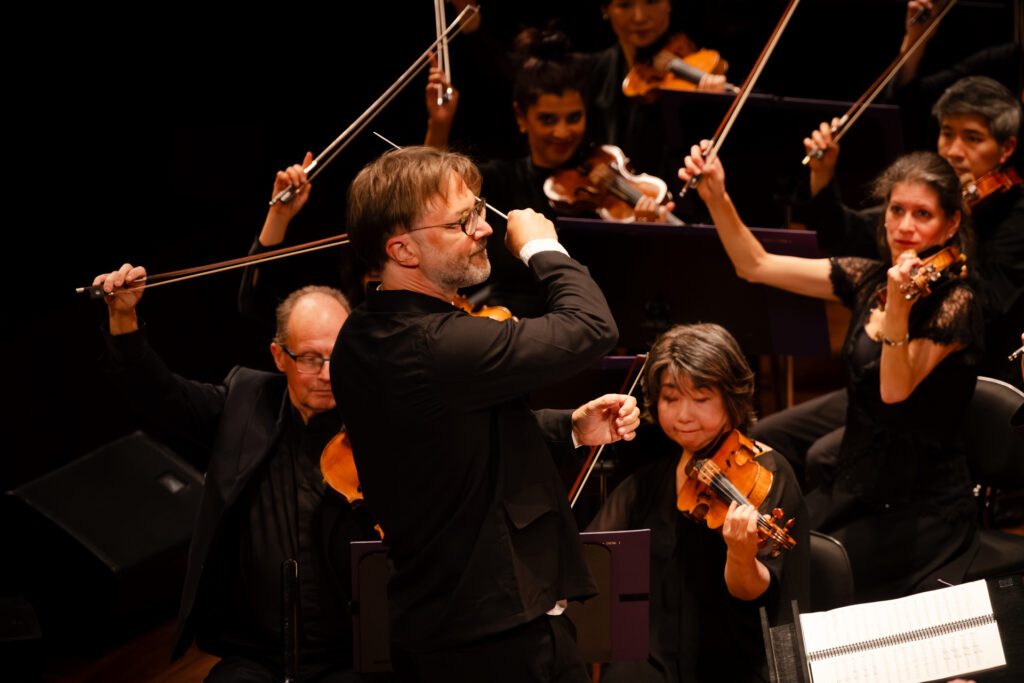
 André de Ridder conducting the NZSO – image Latitude Creative/NZSO
RAVEL – Pavane pour une Infante Défunte / BRYCE DESSNER Trombone Concerto
SHOSTAKOVICH – Symphony No. 8 in C Minor Op.65
David Bremner (trombone) New Zealand Symphony Orchestra / André de Ridder (conductor)
Michael Fowler Centre, Wellington
Thursday, April 9th, 2026
The New Zealand Symphony Orchestra’s latest concert brought together three disparate works under the generic title ”Resonance”, demonstrating orchestral music’s well-nigh infinite variety of evocation in drawing from both specific and integral sources.
The most directly effusive of these was American guitarist and composer Bryce Dessner’s trombone concerto, one substituting for a similarly-conceived work (Slip: Concerto for Trombone and Orchestra) by American composer Andrew Norman, one intended as a premiere! – disappointinngly, the original soloist, Dutch virtuoso Jörgen van Rijen (who’s principal trombonist with Amsterdam’s Royal Concertgebouw Orchestra), was prevented by injury from presenting the work. However, the NZSO’s own principal trombonist, the deservedly popular David Bremner, gave at short notice the inspired substitute choice of Dessner’s work with a truly sparkling performance that merited an enthusiastic “local hero” audience ovation.
At the orchestral helm for this presentation was André de Ridder, the NZSO’s Music Director Designate for 2027, due to take over from Gemma New at the conclusion of her five-year tenure in the position. De Ridder began the concert with the orchestra in fine fettle for Maurice Ravel’s sheerly beautiful Pavane pour une Infanta défunte, procuring winsome solo lines from firstly a horn (a shade late, I thought, in sounding its opening note, but flawless thereafter), and winds and strings, each counterbalancing the music’s meticulous symmetries, until the whole orchestra lustrously returned to the piece’s opening melody, the harp as before gently caressing the piece’s breath-catching luftpauses. Conductor de Ridder’s ear seemed as fastidious as the composer’s in realising the music’s beguiling textures throughout.
Bryce Dessner’s Trombone Concerto certainly put player and instrument through their respective paces, even if the end result seemed for much of the work’s duration a kind of compendium of capabilities on the part of a skilled player of a distinctive-sounding instrument rather than an expression of distinctive pictorial, emotional or philosophical content. Perhaps the slow movement focused more directly on the solo instrument’s attempts to cohere with its sonic surroundings, a kind of metaphor for modern life’s isolation – with orchestral backdrops in places withdrawn and spectral- sounding, and in others contesting the ambient spaces with the soloist. And the third movement broke into different “dance” trajectories in places, seeming to invite (or perhaps “dare”) the trombone to join in (with trombone and trumpet actually sharing a few slinky measures of roguish alliance). I thought the work more entertainment than anything else, as befitted the traditional role of a concerto, Davd Bremner and his instrument well-nigh inseparable in their shared ownership of the work’s capabilities!
No two works could have made more of a contrast with Dmitri Shostakovich’s Eighth Symphony which took up the concert’s second half. Written in 1943 and following the enormous success of the composer’s Seventh Symphony as a wartime statement of patriotic resistance, the Eighth was straightaway a different kettle of fish. This work completely and utterly turned its back on the Seventh’s triumphal aspect and its glorification of the Russian people’s resolve in the face of the Nazi invasion – instead Shostakovich called the new Symphony “a poem of suffering”, and “an attempt to reflect the terrible tragedy of war”.
Consequently, its Moscow premiere in November that same year, by the work’s dedicatee, Evgeny Mravinsky, though acclaimed by the audience, brought only tepid critical reviews, and savage official disapproval, which resulted in the work being withdrawn until its second-only Moscow performance in 1956! Since then, it’s gradually clambered towards a position of near pre-eminence among the composer’s symphonic works, as much for its historical range of ambiguities as its overall singularity of purpose. To a violinist in one of the early performances who remarked to Shostakovich on the wonders of the C Major passage that began the finale, the composer replied, “My dear friend, if only you knew how much blood that C Major cost me!”
This presentation from the NZSO was one to resound in the memory – André de Ridder briefly introduced the work to his audience, relating the music’s intents and purposes to the prevailing misery and hardship faced by people in the world’s present-day troublespots, and then plunging the orchestral strings into the dark-browed ambiences of the work’s at once sonorous and incisive beginning. Under his continued direction the sounds coalesced slowly and purposefully, the strings leading the way for similarly-wrought wind-playing, gradually building the tensions up to the movement’s series of utterly cataclysmic crescendi with their overwhelming evocations of widespread suffering caused by war and oppression. These were acknowledged eloquently by the extended cor anglais solo (here superbly delivered) which followed the orchestral maelstroms, and in tandem with the strings whose sounds seemed to us to emanate from the very souls of all who thus suffered. A brief brass fanfare attested to the human spirit’s refusal to accept defeat before returning to the lament, whose wrung-out intensities occasioned, at the end, the feeling of a huge but guarded exhalation of breath!
Such an evocation brought forth not just one scherzo-like response, but two diametrically different reactions – the first, an Allegretto, was given amazing sweep and grandiloquence dressed up as grotesquerie, the irony savage in its futility, here brilliantly depicted by the winds, especially the piccolo and bassoon, and later joined in the onslaught by the percussion, with strings and brass gleeful collaborators. Then came the third movement Allegro non troppo, a savagely insistent orchestral toccata, here given the most trenchant performance I’d ever encountered since hearing Russian conductor Kyril Kondrashin’s 1960s Moscow recording – this was a fiercely relentless assault punctuated by a macabre circus-like sequence for solo trumpet and side-drum (brilliant, burlesque-like playing!), the energies veering in effect between wild exhilaration and fraught anxiety, and with de Ridder encouraging his players to occasionally push the intensities further forwards. It was a sequence culminating in some almost destabilising timpani-playing driving the needle into the red at the music’s climax while simultaneously giving birth to a sombre fourth-movement Passacaglia.
Here, the music’s previous agonies were echoed in a new and terrible kind of tranquility, called by one commentator “an expression of timeless grief”, and leading up to the numinous impact of that C major chord which brought a ray of hope . De Ridder and his players performed as if inspired, here, with the sounds lifting us from out of the slough, reinvigorating energies and teasing out sensibilities as well as plunging us once more into a brief reiteration of those hellish first movement depictions of destruction and terror wrought by war and brutal dictatorship. After this we were dazedly brought back to our senses by a trio of instrumental voices whose superbly-wrought equivocal interactions and powerfully muted orchestral responses seemed to suggest that life for each one of us, despite its vicissitudes, would nevertheless go on.