Trio Obscura – singular tones and timbres bringing to life old and new music with verve and sensitivity


TRIO OBSCURA
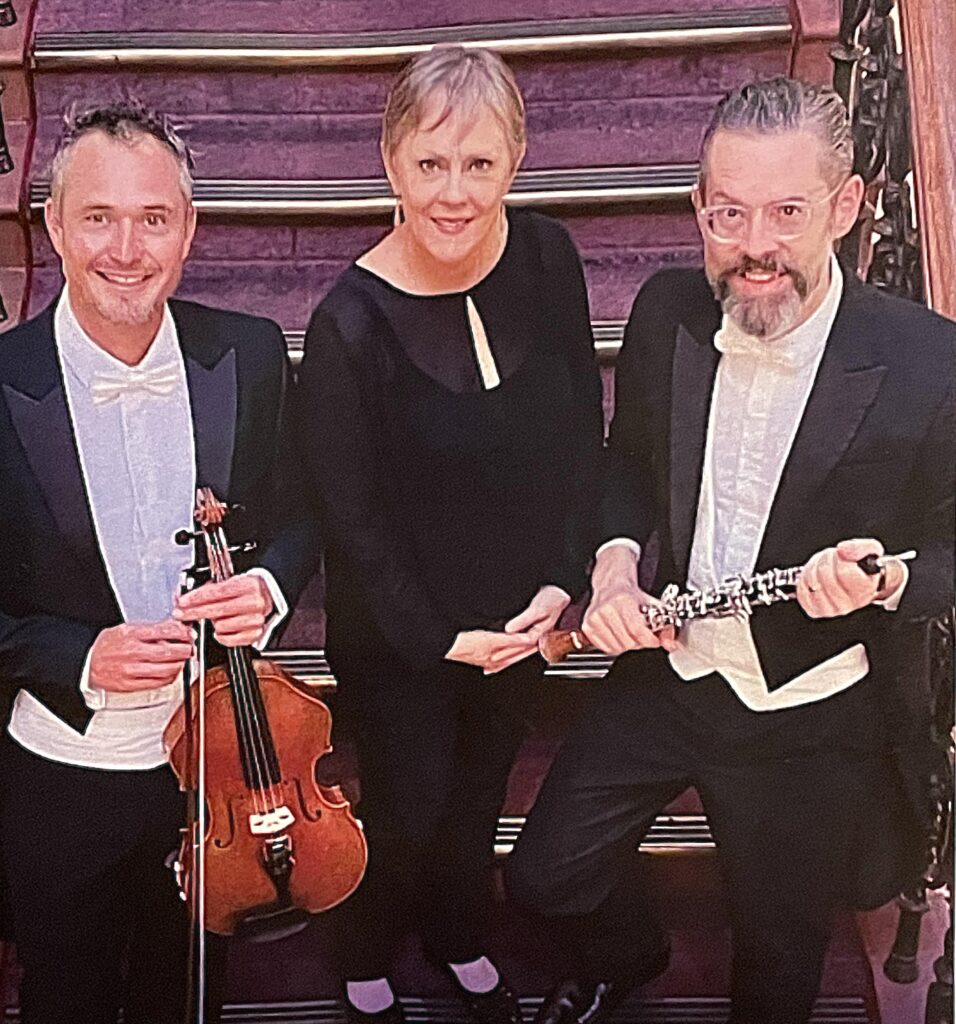
Bede Hanley (oboe), Robert Ashworth (viola), Sarah Watkins (piano)

AUGUST KLUGHARDT (1849-1902)
“Schilflieder” (Songs of the Reeds) – Five Fantasy Pieces   (1872)

ALYSSA MORRIS (1984- )
“The Big Questions” (2024)
1. Who am I?  2. What is this Crazy Thing called Life? 3. How is it Possible?  4. What Comes Next?

CHARLES MARTIN LOEFFLER (1861-1935)
Two Rhapsodies for Oboe, Viola and Piano (1901)
1. Lento (un poco andante ) – L’etang (“The Pool”)
2, Un poco maestoso  (Andante) – La Cornemuse (“The Bagpipe”)

JANET JENNINGS  (1957- )
Five Emotional States (2025)
1.Anxiety   2.Melancholy   3.Anger  4.Relief  5.Exhilaration

Wellington Chamber Music Sunday Concerts
St.Andrew’s-on-The-Terrace, Wellington
Sunday 10th May, 2026

Trio Obscura’s name reminded me somewhat of TS Eliot’s wonderfully idiosyncratic poem “The Naming of Cats”, in which the poet describes a cat’s reverie when contemplating “…his ineffable, effable, effanineffable, deep and inscrutable, singular name”.  Of course, there’s no such comparable mystery regarding “The Naming of The Trio” (its title is sufficiently and resonantly suggestive!), but there’s certainly a kind of singularity in the actual combination of “sounds” here, one which was sported blithely and cheerily by this combination of musicians!

I’d not heard of two of the four composers on today’s programme, the first of whom was August Klughardt, born in Köthen, Germany, in 1849, and who grew up during a time of turmoil in music between conservatives who held to classicism and its traditions and the progressives who wanted to explore new modes of expression. From an early age he worked at developing his performing as well as composing skills, first as a pianist and then as a conductor, in which capacity when working at the Ducal Court in Weimar he encountered Franz Liszt, who exerted a profound impression upon him, introducing him to Richard Wagner and the “New German School” of creativity (Klughardt was to conduct Wagner’s Der Ring des Nibelungen at the court in Dessau in later years). His own compositions, however, reflected a kind of eclectic attitude to the music of the times, taking elements from both traditional and progressive influences. Today his music – symphonies, concertos, operas, vocal and chamber music – is hardly known, though his chamber music is beginning to receive increased attention –  an obvious influence in his work we heard today was that of Schumann  (as it was in Klughardt’s own 1884 Piano Quintet, the appearance of which suggested an act of homage made by one composer to another!)

Today’s work “Schilflieder” (Song of the Reeds) took the form of five “Fantasy Pieces”, inspired by the poetry of Nikolaus Lenau (1802-50), whose work also inspired music by Franz Liszt and Richard Strauss. This particular set of verses devotes a separate stanza to the different moods of a wanderer’s day and evening in a forest and by a pond.  “Schilflkieder” was written in 1872 and dedicated by Klughardt to Liszt himself – and actually achieved well-deserved attention for the remainder of the composer’s lifetime.  Interestingly, Klughardt noted in the score that the oboe part could be played if necessary by the violin, a starkly practical, if somewhat radical-sounding adjustment to a sound-world!

The first piece, titled “The sun is sinking over there”, was begun by Sarah Watkins’ piano solo as a sombre preparatory.  The music continued its melancholy course on Bede Hanley’s oboe, until Robert Ashworth’s viola’s entry brought a contrastingly flowing, more expressive character to the mood, seeming to have cheered the oboe up considerably when it re-entered. In this mood of appeasement the instruments ended the piece quietly together. With the following “Darkness falls, the clouds are flying”, I was straightaway taken into what seemed a Schumannesque world = the music had that same earnestly-toned sense of striving (the music marked “impassioned”), with, of course the viola’s sombre tones adding to that so-distinctive ambience! With the following, and so delectably, in places, Brahmsian  “Along a secret path”  I found myself straining to hear the viola at first, against the piano, (the composer’s rather than the player’s fault, here!) wanting more body of tone to make the lines sing. The oboe had no difficulty in this regard, even despite the florid nature of the piano writing, but the viola’s line I thought too subdued in places for the material.,

As for the fiery “Sunset” which followed, it sounded as if we were on board Wagner’s Dutchman’s ship battling the tempests – Sarah Watkins’ piano-playing conjured up a veritable storm through which the oboe piped strenuously and heroically, except that the viola was for the most part, to my ears, lost, swamped in the torrents of sound! Most thankfully, with the “sehr ruhig” of the final piece “On the pond, the motionless one”, we heard both exquisite solo lines and beautiful duetting between oboe and viola, suggesting perhaps moonlight on the tranquil waters after the storm, the viola spaciously raising its voice and singing its melodic traceries. The piano still generated energies aplenty with triumphant-sounding chords in places, but was content to accompany its companions over the work’s serenely lyrical close.

Another name new to me was Alyssa Morris (b.1984), an American composer whose style was described in the programme as “approachable, flashy and beautiful” – the title of her 2024 work “The Big Questions” poses the idea of confronting our very existence, pondering imponderables such as “Who am I?” / “What is this crazy thing called Life?”/ “How is it Possible?” / “What comes next?”.  Reasoning that there are as many potentialities and possibilities as there are humans on this planet capable of flooding one’s sensibilities with uniquely-conceived minutae potentially delivering as much confusion as enlightenment (that sentence will do for a starter!), I strained forwards in my seat hoping to discern via the infintinesimal/infinite action of sound-impulses upon my primed sensibilities a true sense of awareness illuminating my inner being. I wasn’t sure whether the result would be any different to my listening to a favourite piece of music at any given moment of out-of-the-ordinary receptivity – but I counted myself at that particular moment as “ready for anything”.

It struck me that the composer was indulging in a kind of “sleight-of-hand” in giving us the existential titles I’ve already quoted, their “idea” actually containing the seeds of execution more than the actual sounds that followed. “Who am I?”, for example, began with a viola’s single note over which oboe and piano elaborated, recitative-style in a series of “statements” – the piano floridly invited the oboe and viola to similarly elaborate their lines. The music became very “Big American Musical” or “Big Screen”,r even “Big Country”, encouraged by fulsome instrumental tones. A by-product of these fulsome amplifications was that I felt “engaged “ with ideas while losing any specific sense of any uniquely distinctive and definitive state – was it me in this “Who am I?” moment, or was I actually experiencing with this “the craziness of the thing called Life?”

There were “clues” as to what was happening – conversational exchanges between the three instruments punctuated by crazily sassy detailings such as the viola’s sudden downward-plunging glissando, followed by pizzicato-like excuses for such off-the-wall spontaneities! Then there’s a waltz-rhythm, with the three players “bending the trajectories” in Salvador-Dali-like ways, until the famously flaccid structures raised themselves up with an effort and brought off a surprisingly “cutsie” gesture of farewell!

By this time, the question of “What comes next?” that we felt “ready for” had been gazumphed in itself so many times by the music itself we felt ready for anything! A piano solo, gesturing and ruminative, answered by the viola and echoed by the oboe (where he/she goes, we go! was almost sentimentally refrained by the ensemble) – until there was definitely a sense of something impending – was this, perhaps “The Next?” – the piano plunged into  a running, surging accompaniment-like figure which had left its soloists at the starting post by accident! – but which oboe and viola catch up hurriedly! The music became a full-scale song, almost Negro-spiritual-like in manner! The instruments fulsomely decorated their lines as if approaching a kind of climax! Suddenly, everything stopped! – could this be “an end”?  Was there actually such a thing?  I remember when a small boy thinking “When the spaceship reaches the so-called “end of space”, what’s behind that end-wall? – there’s still more space!” Similarly, was this an ending? – or was there simply no end? Was this “What comes Next?” – will there be “no end” of “What comes next?”… except continued (and gorgeous!) soft playing?  The music drifts into space – the oboe and violin hold their notes……the piano softly elaborates…..and finishes!

We needed a half-time! – the sense of “Where am I?” needed some familiar, reassuring sign-posting  – also, I was uncomfortably aware of having perhaps too readily indulged in fancy throughout Alyssa Morris’s essentially “escapist” piece. I needed something more earthily “real” once again, upon which to plant my feet. Interestingly,  the composer Charles Martin Loeffler (1861-1935) whose music was next on the programme  was to supply me with a soupcon of empathy in this respect – Loeffler was described by violist Robert Ashworth in his introduction as “a German man trying to be French”! This was a reference to the composer’s reluctance to acknowledge his actual birthplace (Schonëberg, Berlin), and his somewhat “displaced” sense of upbringing, as he spent most of his life claiming his birthplace was in the Alsace region, which famously borders France, Germany and Switzerland! – (in fact a number of references I checked continue to maintain his claim that he was born in the French Alsacs region!)

Embarking on a career that took him from his birthplace in Germany to the United States via France, Russia, Hungary and Switzerland, the young Loeffler studied the violin in Berlin with Joseph Joachim and then composition with Ernest Giuiraud in Paris, playing in various French orchestras. After his move to the United States in 1881 he joined the Boston Symphony, with whom he performed as assistant concertmaster until resigning from the orchestra to devote his energies to composition. He’s known today as a skilled, highly fastidious and self-critical composer, belonging to no “school”, but combining his earlier French influences and sensibilities with his later “New World” experiences . In February 1931 Olin Downes, Music Critic of the New York Times, wrote in a seventieth birthday tribute to the composer, that Loeffler was “one of the representative musicians of an age”, but concluded that “his expression of that age has come from within, and not, as an imitation of fads and shibboleths of the hour, from outside.”

This work was originally planned as a set of Three Rhapsodies in 1898, but was extensively revised by Loeffler after the tragic death of the dedicatee – one of the pieces was shelved, and the two remaining works were rescored during 1901 for oboe, with viola and piano The first of these Rhapsodies became a memorial for the composer’s deceased colleague. Consequently, the piece began darkly, with the viola answering the piano’s first sombre notes strongly and whole-heartedly, more than matching the oboe’s plaintive tones, the viola here far more assertively-voiced than was the case with the Klughardt work. The style recalled the late-Romanticism of Ernest Chausson, evident in the “longing” nature of the phrases for all of the instruments, the oboe delivering a particularly beautiful solo episode at one point over the piano’s rippling phrases. A darker passage for both instruments resulted in recitative-like passages suddenly seeming to break into a dance , almost like the “friss” which follows a “lassu” in the Hungarian Rhapsodies of Liszt, the music readily ebbing and flowing across the instrumental timbres, until the sombre mood suddenly returned, the viola again richly-and darkly-toned against the plaintive oboe and  piano, with the music hauntingly drifting between minor and major harmonies as the voices died away.

The Second Rhapsody (subtitled “The Bagpipe”) actually began as if it were a Liszt Rhapsody, with a florid piano passage, but then wistfully morphed into a kind of plaintive Bartokian folk-song – perhaps the bagpiper’s tune? Its repetition was suitably lump-in-the throat in its wistfulness – oboe and viola responded most rhapsodically, the “bagpipe” theme by turns lively and ruminative, either goading its listeners into dancing-mode or regaling listeners with a story. We felt regaled by story-telling tones and gestures from each of the instruments, feeling as if the listeners had “heard this tale before” and were reliving its characterisations and narrative lines! And what a particular joy it was to hear the viola sing so sonorously, next to its companions!  After oboe and viola had finished their near-operatic “duet” with the piano’s sterling guidance, the three instruments engaged in a brief, gestural “are we all here, still?” exchange before letting the tones of the discursive tales find their rest.

For those who felt that the Loeffler work was much too earnest a response to those “Big Questions” posed by Alyssa Morris earlier in the afternoon, an alternative, “thistledown-on-the-wind”-like  rejoiner to “Life And Its Problems” was posed by Waikato composer Janet Jennings (whose work “Voices of Women” I’ve previously reviewed on “Middle C” – see https://middle-c.org/2020/09/16161/ )  This work – “Five Emotional States”  – is described in a programme note by its composer as “not to be taken seriously”, a comment that on a certain level of engagement makes plenty of good sense, but may simultaneously “beg the question” of emotional health in general for those who look beyond the work’s wondrously rollicking capacities for entertainment and into the real world of 2026 New Zealand, where people of all ages and circumstances are often forced against their will into situations where these states are all too palpably experienced. I’m not saying the work shouldn’t have been written – rather the opposite! Perhaps, though, it needs, in my opinion, not to be trivialised.

Having gotten that concern “off my chest”, may I say that the experience itself was for me an absolute riot, a palpable and resonating amalgam of delight and disturbance whose sequences I could all too readily recognise as having a degree of self-ownership of feelings generated by both inward and outer tensions – it also made me aware of the vital role that hope has to play amidst such experiences, given expression here in the section called “Relief”, and without which for me would have been akin to a horrifying, inwardly Faustian prospect of eternal damnation! Am I myself thus guilty of doing what the composer urged her audiences not to do?  I was, all above concerns considered, ultimately delighted by the experience – and, to the performers, Sarah Watkins, Robert Ashworth and Bede Hanley, I dips my lid in boundless appreciation!

Tales of the New Zealand String Quartet 2026

New Zealand String Quartet presents
“STORYTELLERS”  – the 2026 Season

Part One: ORIGINS

MIKA CORNELIUS – Universal Veil
FRANZ SCHUBERT – String Quartet No. 10 in E-flat Major D.87
GARETH FARR – String Quartet No. 2 “Mondo Rondo”
MISSY MAZZOLI – Death Valley Junction
BENJAMIN BRITTEN – String Quartet No. 1 in D Major, Op.25

New Zealand String Quartet
Peter  Clark, Manu Berkeljon, violins
Gillian Ansell, viola
Lavinia Rae, ‘cello

Prefab Hall, Jessie St, Mt Cook, Wellington
Wednesday 6th May, 2026

Concerts never cease to amaze! – even when the music is familiar, performers can illuminate what one thought was familiar territory and revitalise one’s responses with freshly-wrought approaches and energies. But there’s nothing like hearing live performances of unfamiliar or completely “new” music to one’s own ears, which was my experience at the New Zealand String Quartet’s first “Storytellers” Concert of 2026.  It was one that would have given a heart-warming dollop of interest and pleasure to a wide range of concert-going people in Wellington, pushing out the boundaries and widening the vistas normally associated with chamber music and string-quartet-playing to revelatory degrees while still remaining recognisably familiar and viable as an art-form.

I thought it was a pity that Auckland-born and Melbourne-based composer Mika Cornelius could not be with us tonight, here in Wellington, for their work which opened the Quartet’s season of concerts -this was a journey we were taken upon through an absorbing, almost William-Blake-like world of delineation involving the osmotic growth of fungi! – in a phrase, a single mushroom! The exercise of re-enactment of this singular “force-of-nature” process had itself a fascinating kind of multi-media identity in terms of expression and conveyance – beginning with our receptivities as an audience having been appropriately engaged and stimulated by the actual words of the composer about the piece, here spoken by the NZSQ’s General Manager Aslinn Ryan who had welcomed us to the concert, and then introduced the musicians and their four stringed acoustic instruments. It was, in general terms, a scenario whose inescapably “public” ambience seemed, most fascinatingly, to be somewhat at odds initially with what seemed like the essentially miniature, almost microscopic processes required to bring about fruition!

Mika’s words succinctly characterised their work’s depictions, descriptions and delineations of the subject’s components and the latters’ processes for us, movement by movement – firstly there were the “hyphae” – these were “delicate threads that form the foundation of fungi”. How distant, primitive, primordial and raw seemed the sounds made by the players’ instruments, singular and insubstantial, spontaneous by default in their existence, unresponsive to the presence or movement of others. Whatever the scale of things, microscopic, nanoscopic and sub-atomic, or of magnitudes thicker, longer, wider, taller and deeper than one could imagine, these “hyphae” at some point were stimulated by bearers of stimulus which could be described as magical, and given here the universal symbol of “autumn rain”.

The sounds made by the players began to coalesce in almost spontaneous and seemingly random ways – some of the interactions were rhythmic, while others were slow and linear; some connected readily to neighbours, while others were more independent – all rather like a process of adolescence, with  variously-growing foci, but somehow these impregnated, coalescent organisms couldn’t help but express a destiny, expressed here by a burst of rhythmic unanimity, a shock to systems whether active or passive! – they became products, results, outcomes!

This newness of identity began to coalesce as spores! – they appeared, whether randomely or purposefully, and with enough self awareness to perform a graceful dance! Tending to pizzicato at first, the sounds gradually “grew into” arco, instrument by instrument, entering a realm of what the composer called “silent eruptions of energy”, with spiralling tones whirling as they took flight!  “Is this world our oyster?” became a “Tower-of-Babel-catch-cry”, a buzzing, chattering, babbling refrain as the energies sought their destiny.

A heartfelt, winsome, sighing kind of dance slowly crystallised as the “mycellum”, the “Mecca” of the world of fungi, formed an intricate web – more recitative than melody, and interweaving the individual lines of expression, tremulously draping its sounds all about the textures  as the mycellum infiltrated all around and over the earth, forming what the composer called “a Universal Veil”, and validifying at one and the same time the idea of individuality having a collective essence – we ourselves are, like ants, or termites – or, ultimately, fungi! – connected!  The music’s lines ended quietly and reflectively, its course showing the way for its infinite progeny to follow….

After this musical version of our somewhat “Magic Schoolbus” adventure we were able to resize, and refocus our existential parameters on a youthful Franz  Schubert’s Quartet No.10 in E-flat Major, written when just sixteen years old, and intended for performance by members of the composer’s family – consequently, the work’s become known in some quarters as the “Haushaltung”,  (“Household” or “Family”  Quartet). The many hours the young musician spent in the “family” quartet gave him a working insight into what each instrument could do. While the individual parts in this quartet (which has the date “1813” on the autograph manuscript) certainly don’t match the excellence or difficulty found in the composer’s later, “great” masterpieces, they are by no means negligible – Schubert would probably have conceived these early works less as aspects of a “personal testament” and more as “things to be effectively performed” – with several notable touches immediately apparent in the NZSQ’s fresh-sounding reading.

The warm initial tones of the work’s opening phrase, with its three conclusive staccato notes brought out, in a single phrase a sense of both balance and humour, with lovely lines and deftly-touched impulses, a young composer’s sense of equilibrium at work, here and in the interplay between lyricism and playfulness as the exposition unfolded. The development and recapitulation sections followed traditional sonata-form practice, maintaining the E-flat major key this time in the latter right through to the movement’s concluding chords – conventional but still impressive!

I straightaway recognised from a previous encounter the perky, leaping-octave opening of the scherzo with its dancing reply – here put second, instead of third, as on my recording  (optional?) which followed with its leaping octave briefly taking on the clamour of a concerted chorus at one point, and also cheekily inserting a “false start” grace note on occasions! – and what a beautiful and redolently flowing minor-key“ trio interlude the players delighted us with!

The slow movement’s opening began with forte/piano phrases, here, beautifully and simply delivered, the songful themes then continuing, here-and-there further decorated by repeated-note sequences both together and separately – all serene and unclouded and lullabic. As for the finale, I loved the music’s opening  Keystone Cops-like scampering rhythmic trajectories, the players hardly missing a beat when reverting to triplets, and, then, even more cheekily, to the insouciant walking rhythms of the second subject – with  Schubert all the while indulging in his already-burgeoning melodic gift of producing hummable tunes!  Naturally, with unalloyed glee the players again “pounced” on the “running” rhythms at the reprise of the opening, whirling us through the trajectories to the work’s coda!  The final ensembled gestures of the piece here had all the conviviality of a family occasion with a burst of devil-may-care energy just to round things off at the end – so very enjoyable!

I was looking forward immensely to the programme’s next scheduled item, Gareth Farr’s String Quartet No. 2 Mondo Rondo, which I’d heard once before in concert but had much earlier (1999, in fact!) reviewed the work’s first recording by the NZSQ of that time for the Morrison Music Trust. We were amused greatly when the players this evening told us of an occasion somewhere when they’d asked audience members to record and send to the group their reactions to Gareth Farr’s music! – subsequent responses included  reports of “accelerated heart rates” and images of “disturbed ants’ nests” – though the zaniest was of “sped-up scenes of a New York train station interspersed with images from a sausage factory!”….whether any further such hallucinatory impressions would emanate from this evening’s audience as a result of tonight’s performance will remain to be seen!

I found myself sufficiently “challenged” by the players’ invitation to audience members to contribute their own impressions of what thoughts and images the music generated, though I remembered at the end of the first movement (subtitled “Mondo Rondo”) that I was supposed to be reviewing the Quartet’s performance, rather than my own recreative reactions to it!  Nevertheless, by that movement’s end I had firmly fixed in my mind the pathetic struggles of a puppet on a stage in a half-dressed state trying at once to pull the rest of its clothes on properly while acting out and dancing a story, and getting in a terrible tangle as a result!

It just wouldn’t have done to continue in this vein – so I returned to my “critic” guise for the rest of the work, registering the second “Mumbo Jumbo” movement as a kind of rhythmic-texture loop-cycle, sounds ensnared in the workings of a machine, the tones and timbres characterised by dry pizzicati and instrument-tapping which almost without warning changes completely in character to arco-bowed cries of distress and despair, as if the sounds had suddenly acquired a distinguishable “voice” and were crying to be heard, saved, released, helped to escape – arco, pizzicato and “struck” timbres jostled and tumbled together until the voices gradually relinquished their tones and were distantly silenced, leaving what seemed like a kind of void of impulse and emotion – a feeling no longer able to feel……

Like a kick-started machine bursting into life after a few vain attempts, the rhythm of the third movement “Mambo Rambo” got under way, the ostinato rhythms supporting an exotic, Middle-eastern-like theme with both languid and more energised forms alternated by violin and viola over the incessant trajectories of the second violin and ‘cello, in places rhythmically “crunchy”, in others beset by syncopated “groans” and eerily wandering lines, before the exotic melody returned, enjoying a full throated reprise on all the instruments and then abruptly flung to the winds and disappearing! I couldn’t remember enjoying the piece more than I did here – all so engaging and persuasive, even my very own half-dressed pathetic puppet at the beginning!

After an interval enabled us to get our breath back, we were enjoined to steel ourselves for a visit to “Death Valley Junction”, which was the name of a piece by the American composer Missy Mazzoli, a ten-minute work for string quartet which recreates the ambiences of one of the most renowned places of desolation on Earth – Death Valley, in California’s Mojave Desert. The Junction was “discovered” by Mazzoli on a road trip with her husband in 2004, finding a building that, almost forty years before, in 1967, had been converted from some kind of recreation hall into a hotel-cum-opera house through the efforts of Marta Becket, a former ballet dancer who, inspired by the location of the building developed the idea of establishing a performing arts centre – she herself presented weekly one-woman shows there as well! Mazzoli was, in turn, inspired by the whole concept of what Marta Becket had done, and in  2010 wrote her piece Death Valley Junction, dedicated to Marta Becket herself (the latter died in 2017, aged 92, but her spirit lives on in this music).

In her programme note for the work the composer described the piece as beginning “with a sparse, edgy texture – the harsh desert landscape” and then transforming the ambiences with “a wild and buoyant dance”. From the outset we were made aware of the environment’s notorious heat and aridity by the bleakness and dryness of the instruments sostenuto lines, augmented by the viola’s vivid, and almost in places sinister glissandi, as if representing swooping birds of prey. Gradually the tones took on increased movement and rhythm, glissandi and note-patternings coming together, as if life was signalling its presence, and with movement and energies even suggesting the spirit of song and dance. We were borne, dream-like, through a soundscape suggesting a fusion of co-existence, not through heavy-handed subjugation, but more by determined adaptation of the human spirit to what seemed like a particularly intractable instance of the natural world’s harsh environment. This was particularly characterised by the ‘cello’s on-going dynamic activity, its “human” component in the soundscapes achieving the sense of a small but nevertheless significant instance of survival and achievement.

The programme’s final work was Benjamin Britten’s String Quartet No.1, part of the NZSQ’s tribute to the composer to mark his fiftieth anniversary year. Whether purposed or merely coincidental, the work gave me the impression of seeming to naturally “grow out of” the various soundscapes the NZSQ had already presented us with in the concert –  Britten’s writing had elements of the microcosmic growth impulses of Mika Cornelius’s vision, the youthful exuberances of Schubert’s quartet, the madcap energies in places of Gareth Farr’s pulsations and the distinctive feeling for particular “ambiences” demonstrated by Missy Mazzoli’s work. It was the first of his three numbered String Quartets (Britten had written various others as student efforts), and written in 1941 in the United States, the composer and his partner Peter Pears, both pacifists and conscientious objectors, having fled the strictures of the war in Europe. The work was the direct result of a commission by arts patron Elizabeth Sprague Coolidge, and received its premiere in Los Angeles from the Coolidge Quartet, to grateful acclaim from the composer.

In four movements Britten combines elements of classic forms and instances of freer, more spontaneous expression, with marked contrasts of mood both between and in the course of some of the movements. The first movement began quite wondrously with unearthly, top-of-the-range, sostenuto tone-clusters from the upper strings, leaving the ‘cello as if earthbound, looking up and succinctly commenting upon the wonders all about what seemed like the upper reaches of the music’s firmament. Halfway through the movement these sounds died away and the stillness of the visionary mood was suddenly set upon by all the instruments, playing a vigorously-racing, exhilarating, almost “disturbed” kind of triplet-rhythmed, “flailing -in-all-directions” episode, before the pace of things slowed and the music seemed to want to climb back up to the stratospheric heights from whence it began. This process echoed in varied guises until a final “star-cluster, like glow-worms suddenly disturbed in a dark cavern, peremptorily extinguished their light-lines! – superbly-managed musical theatricalities here from the players!

The second movement was a cheekily rhythmic Allegretto, punctuated by abrupt triplet exclamations, and running passages, the mood spontaneous and volatile, almost a kind of danse macabre featuring spasms of energy which dissipated as quickly as they appeared. Not so with the third Andante calmo movement, here as good as its word, with the music seeming in places almost to anticipate the “Moonlight” orchestral interlude in Britten’s yet-to-be-written opera “Peter Grimes”. This was the sequence that ostensibly impressed the American critics who attended the premiere most profoundly, one likening the movement to a kind of “Memorial for a lost world” – the steadily played-out 5/4 rhythms enabled individual instruments to gently rhapsodise in different keys through moments reflecting quiet intensities of both stillness and motion.

The first of a series of scampering arch-like gestures began the final movement, individually and haltingly at first, and then coalescing into partnership in a kind of joyous ferment! Again, the upper string and the ‘cello undertook different pathways through the same scenarios, interchanging turns at intoning soaring lines set next to vigorously dancing figurations, the players achieving exquisite balancings of different themes and counter-rhythms, and delighting us with the tonal, textural and rhythmic differences! And, what a wonderful concerted declamation the ensemble achieved at the end, with trajectories spiralling downwards so heart-stoppingly and spectacularly into the gestures leading to the final chord! Tremendous and resonating stuff for me, as it was also for a number of people I talked with afterwards – a new leaf of exploration turned over for me regarding the fascinating compositional world of Benjamin Britten, but a definite feather in the collective cap of the New Zealand  String Quartet!

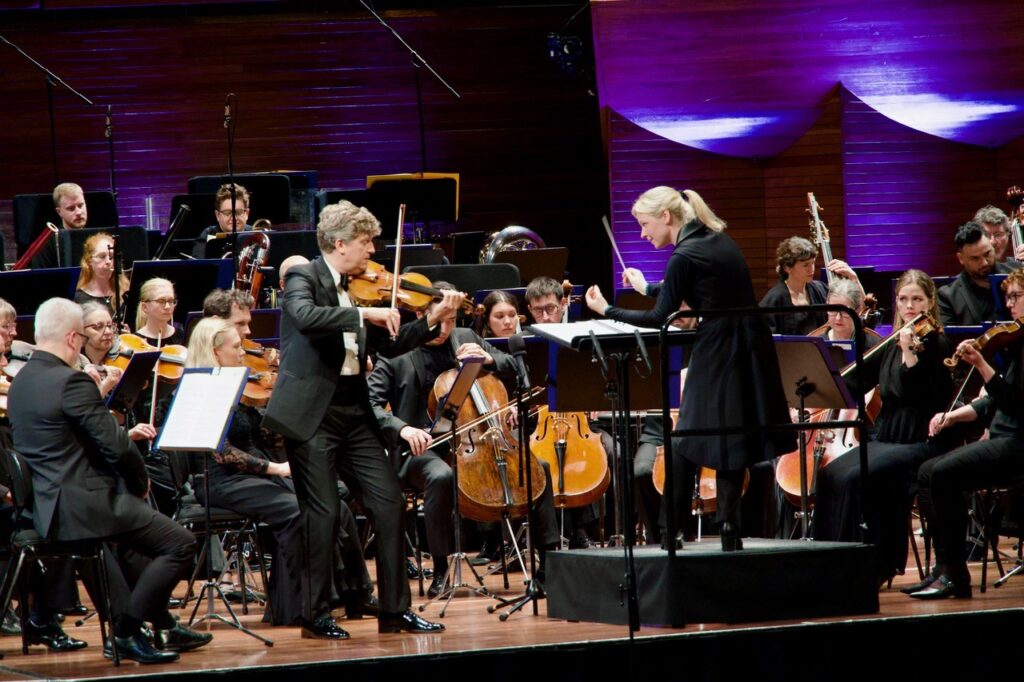
Wellington Youth Orchestra with Mark Carter serves up an orchestral feast.

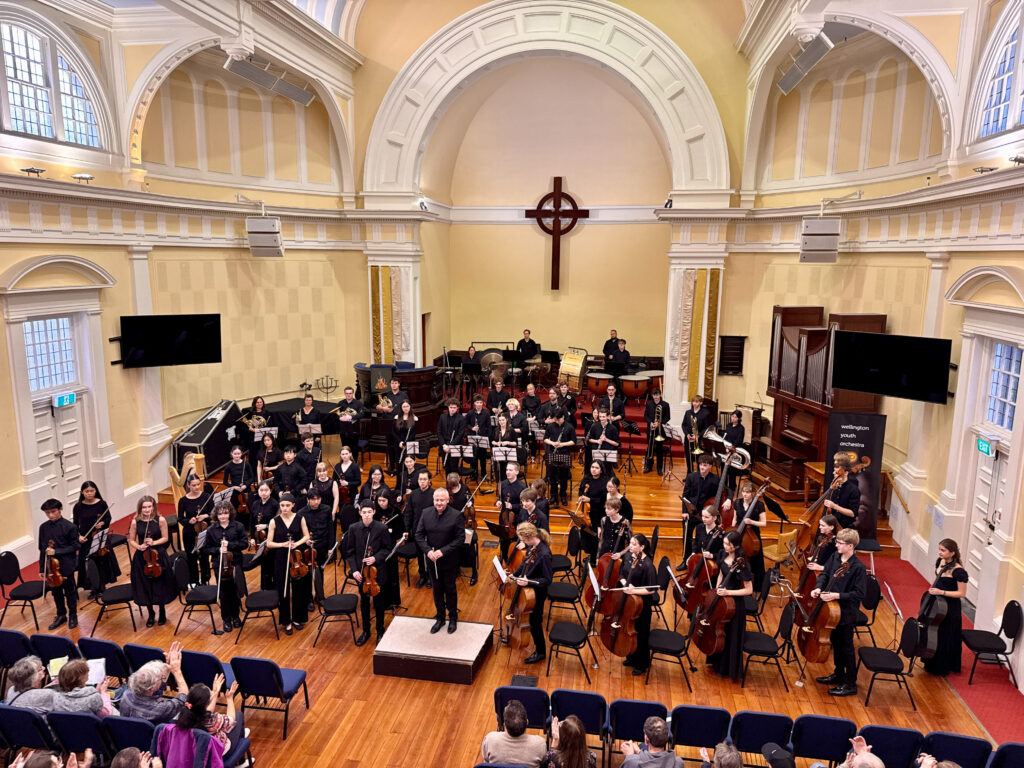
Wellington Youth Orchestra with Mark Carter at St.Andrews-on-The-Terrace  –  photo credit:  Cindy Young Waldron
SIBELIUS – Finlandia
ELGAR – Suite No. 2 from “The Wand of Youth”
VAUGHAN WILLIAMS – A London Symphony

Wellington Youth Orchestra
Mark Carter, conductor

St.Andrew’s-on-The-Terrace, Wellington
Sunday, May 3rd, 2026

“Pines to Pastures” was the Wellington Youth Orchestra’s programme-title for its first 2026 concert – it succinctly described the book-ends containing the action-packed musical journey we were taken upon by the orchestra and its inspirational conductor Marc Carter throughout an eventful Sunday afternoon. The programme featured the music of three composers whose names often appear on the lists of “master orchestrators” –  Sibelius, Elgar and Vaughan Williams – with each of the pieces’ very different evocations bringing its own particular technical and interpretative set of challenges for the players to grapple with. The end result was a triumph – throughout the concert the playing regaled us with wall-to-wall instances of ear-catching detailings, characterfully-wrought vignettes and larger scale scenarios of beauty, drama and excitement. Every note sounded was accorded, to my ears, a kind of living, pulsating quality, with the players’ concentration seeming never to flag  nor the energies falter.

Opening with Finnish composer Jean Sibelius’s “Finlandia”, the big, dark-browed brasses at the start straightaway  focused our attention, contrasting sharply with the plangent pastoral sounds of the winds, and then the passionately insistent strings, and with the winds and strings building the urgencies towards the brass’s sharp-edged calls – the wonderfully “grinding” lower strings conveyed a sense of a force about to be unleashed as the rest of the strings and the brass traded outbursts of pent-up energies. All of this led into the precipitous allegro, with tumultuous percussion heralding the driving orchestral forces, joyously and vigorously responding to the great horn calls, and surging excitingly into and through the climaxes! That done, and the exhausted forces having given their all, the way was open for, firstly the winds, and then the strings to sonorously intone the famous ”tune” that has subsequently found its way into all kinds of celebratory and worshipful scenarios world-wide. It was fitting that, having regained their composure, the more combatative sections of the orchestra were then able to rouse themselves for a return to the allegro in its most celebratory tones, capped off by a splendidly conclusive, and full-blooded “Amen-like” coup de grace!

Stirring though the Sibelius performance was, I subsequently felt that it was during the playing of the various dances comprising the next item (an adorable suite of dances by Edward Elgar called “The Wand of Youth”), that the orchestra seemed more relaxed and assured, having “played themselves in” during the Sibelius for the concert’s remainder.  While “Finlandia” was exciting, it felt very “tightly-wound” throughout – with the Elgar, however, conductor and players seemed to “expand” further, and fill parts of the music up with a different kind of relaxed exuberance. I particularly noticed how both “The Little Bells” and “The Wild Bears” pieces exuded such great warmth, whole-heartedness and unbuttoned “swagger” in places. While “The Little Bells” has always been a favourite of mine, due to its heart-wrenching echt-Elgarian “second” theme (such a beautiful counter-theme on the lower strings the second time through! – and I was especially taken by the excellent playing of the glockenspiel by a nimble, if unsighted percussionist), I did so enjoy the orchestra’s spectacularly exuberant playing of “The Wild Bears” –  it was wonderful stuff (though I had to strain to make out that very first and well-remembered triangle “ping!”)!  These dances were from two orchestral suites based on some of the composer’s childhood musical sketches he had made when aged eleven, for a kind of “fantasy play” which he and his siblings were to perform, and which were miraculously relocated much later, and reworked for our pleasure!).  A small point here – I realised after the concert that I had NO memory of the orchestra playing the enchanting “Fountain Dance” listed in the programme – was the spell cast by the music so great that I actually took leave of my senses for a few minutes during the proceedings? – or did Mark Carter and the orchestra simply omit the dance?

No matter – there were even greater landmarks looming on the musical horizon for the players, in the form of a four-movement symphony that’s become almost as iconic as anything written by Elgar – this was his younger English contemporary Ralph Vaughan Williams’ “A London Symphony”, first completed and then extensively revised by its composer after its first performance in 1914 (this ‘original version” still exists, found nowadays in a revelatory Chandos recording made by the late, lamented conductor Richard Hickox).  The symphony continued to be revised (and even occasionally performed in “newer” manifestations) until a final authorized performing version appeared, published in 1936 (Wikipedia has an absorbing account of the genesis and various appearances of different versions of this work!). Richard Hickox’s fascinating reading of the “original” gives the work’s supporters cause for both lamentation (that so many passages in the original were removed) and relief (that the work displays increased coherence and stature with those same passages excised)!

One doubts whether the “original” 1914 version will ever outstrip the 1936 “finished” work in popularity, but it certainly adds to the fascination of the work in particular and the trajectories of the composing process in general. Vaughan Williams was certainly no Bruckner regarding the latter’s woeful lack of confidence in his own, composing abilities, but he did listen to advice from friends, including interpreters of his music who occasionally might suggest the occasional change or an edit here or there. He certainly retained a great affection for this work, and is on record as declaring, later in life, that it was perhaps still “the favourite” of all his symphonic offspring!

The work gives a confident impression from the outset as indeed being a “Symphony by a Londoner” (as the composer later mused over what he thought should perhaps have been the work’s “proper title”). The opening Lento, here. with lower strings and murmuring winds sounding atmospheric chords and lines was an evocation of a city before dawn magically emerging from the darkness, the instruments gradually opening up the vistas as the ambiences lightened and everything gradually came alive – the Westminster chimes sounded, and amid fanfare calls the sun’s rays seemed to suddenly break through and reveal the pulsating heartbeat of a city! We got plenty of activity from the strings in response to the joyously percussive fanfares, and the jaunty “walking movement”, firstly from the winds, then the strings, and then the brass carried the exuberant rhythms onwards towards a return of the great introductory fanfare of the city’s awakening! The  players enjoyed the folk-dance-like ditties and the exuberant shouts alike as the city boisterously flexed its human muscles, then took us to quieter, more subdued vistas where the melancholy strains from the cor anglais initiated moments of reflection, leading then to a ‘cello solo joined by other strings – a poignant episode, practically chamber-music! – and beautifully sounded by the players, obviously revelling in such gorgeous string-writing!  The fanfares sounded again in the distance and the energies reawakened, gradually rebuilding and redoubling the previous excitements and working up to a last, protracted fanfare resonating through to the end of a long-held final chord.

“Bloomsbury Square on a November afternoon” was the composer’s description of the slow movement’s opening – a beautiful solo from the cor anglais rose out of quiet string passages, the strings repeating the melody and extending the tranquil mood – a gentle horn and trumpet passages, and the strings returned more impassioned than before – altogether a heartfelt evocation – a solo viola fluently began a series of atmospheric street-call-like phrases, answered by other instruments and punctuated by the percussion’s gentle jingling of cab harnesses passing by, and drawing forth a rapturous burst of nostalgic tones from the whole orchestra – it was scalp-pricking stuff! – all beautifully evoked! It was left to the cor anglais, horn and solo cello to re-establish the prevailing atmospheres, giving the movement’s last few sounds to the solo viola once again.

The scherzo was a lively nocturne, with specific instructions from the composer to the listener, to “imagine himself standing on Westminster Embankment at night, surrounded by the distant sounds of the Strand….with its crowded streets and flaring lights….” Conductor Mark Carter encouraged a delightfully insoucient swagger from his players throughout this engaging music relying on accent and nuance rather than speed to invest the music with plenty of characterful “bounce” – this music always reminds me of certain books I read when young about English childhood adventures, such as “The Otterbury Incident” and “Stig of the Dump”, with their somewhat rollicking, devil-may-care attitudes adopted by the protagonists! I particularly enjoyed the orchestra’s detailing throughout, (including an especially spectacular piece of horn-playing of the main theme at one point!) – and the winds and percussion also had great fun with the trio-like interlude featuring the sounds of a busker’s wheezing accordion! And conductor and players “coaxed” the dying strains of the day from out of the movement’s end so very sensitively.

Every time I hear this work’s finale, with its “cry of pain” at the very opening, I find myself wondering just what Vaughan Williams was meaning – it’s almost Mahlerian in its unexpected angst and darkness of aspect! Not unlike Mahler’s Fifth Symphony’s opening, it has an explosive beginning, then settles into a march-like episode of grim, dark-browed intent! – was this REALLY VW’s view of London? I remember reading somewhere very early on that VW was here expressing the city’s darker, more tragic side – the march-like rhythms hinting at the misery of those down on their luck, hungry, unemployed, and even homeless. Other commentators have referred to the city’s traditional pomp and ceremonial gravitas over centuries, which are expressed here in tones of sombre grandeur. Typically, the composer kept his thoughts largely to himself regarding much of his music, though in this particular movement’s case he famously referred to H.G. Wells’s 1908 novel Tono-Bungay, which contains a passage describing the novel’s narrator sailing down the River Thames and seeming “to be passing all England in review”, as influencing the work’s elegiac closing pages, beginning with a reiteration of the first movement’s “Westminster Chimes” and then simply drifting unhurriedly to a close……the concluding words in the novel are – “The river passes…..London passes….England passes.”

I hope I’m forgiven for dwelling on this aspect of the music besides writing about its performance – these references to aspects of the composer’s inspiration for the work can’t help but further inform my opinion of the excellence of the Youth Orchestra’s performance and the surety of the guiding hand of conductor Mark Carter throughout. It’s precisely that tragic and  lament-like aspect that hovers over this music which was what these players brought out so movingly – the silence at the piece’s end in this performance was indicative of the effect it all had on its audience – we had been witness to something extraordinary, something that deserved its moment of contemplation as well as acclaim at the very end. I’ve refrained from describing anything specific at this point in the work – it all seemed integrated and inevitable, just as night follows day, with the players’ energies and concentration seemingly unflagging! And afterwards, who could blame them for wanting to conclude the afternoon with something a bit more festive and rousing! – especially since it was the return of  “The Wild Bears” which came to the rescue of the symphony’s “stricken” conclusion with even more panache than in the first-half performance – and THIS time I definitely and unequivocally heard that wonderful, nostalgic tintinnabulation of the triangle first time round! I went home after hearing all of that as happily as any concertgoer had a right to be – no affirmation could be more appropriate or deserved!


Echoes of woodland scenes rubbing shoulders with companionable coffee-houses! – an echt-Viennese musical lunchtime experience for Wellingtonians at St. Andrew’s-on-the-Terrace!

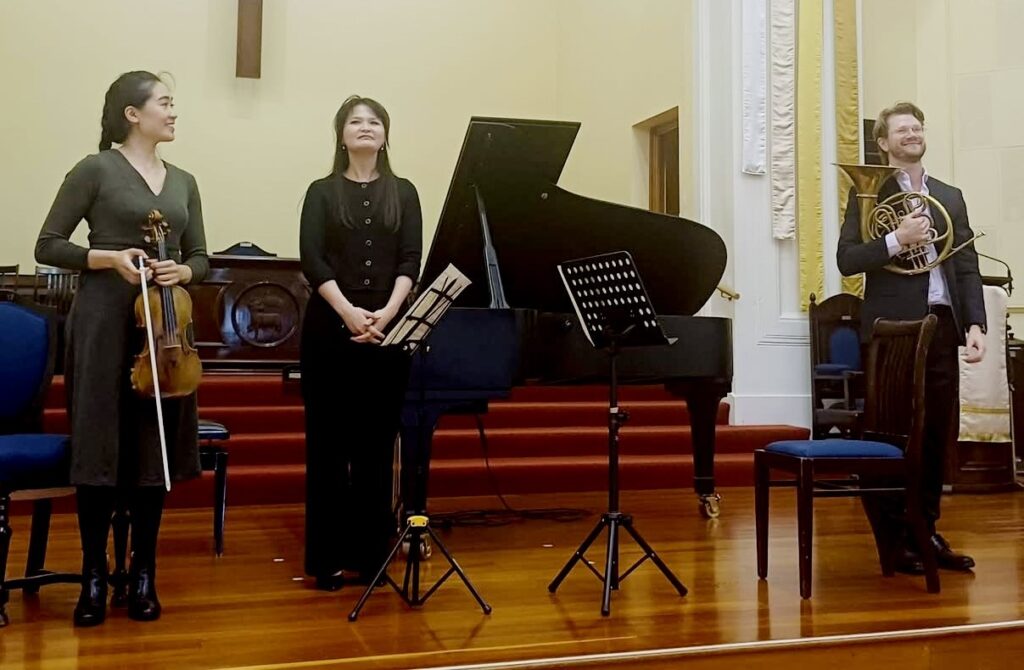
Christine Wang (violin), Beth Chen (piano), and Sebastian Dunn (horn)

EUGÈNE BOZZA (1905-1991) – En Forêt (In the Forest) Op.40
Sebastian Dunn (horn), Beth Chen (piano)

FRITZ KREISLER (1875-1962) – Schön Rosmarin (Old Viennese Dance No. 3)
Christine Wang (violin), Beth Chen (piano)

JOHANNES BRAHMS  (1833-1897) – Trio for Horn, Violin and Piano in E-flat Major Op.40
Christine Wang (violin), Sebastian Dunn (horn), Beth Chen (piano)

St Andrew’s-on-The-Terrace, Wellington
Wednesday, April 29th, 2026

Every now and then in a concert one encounters music one has never before heard, or even heard of, and sometimes even whose composer has a name one doesn’t know. On certain occasions audiences sit primly and attentively and at the end applaud, congratulating the composer(s) and the musicians, and of course, one another upon according the piece or pieces due attention. But on once-in-a-blue-moon occasions such hitherto unknown music can unexpectedly generate an instant impact akin to a real frisson of excitement, one which lingers on in the memory for ages afterwards. It’s happened to me a few times over my years of concert-going experience – the latest being my attendance at a recent St Andrew’s-on-The Terrace concert featuring three outstanding musicians – Sebastian Dunn, horn, Christine Wang, violin, and Beth Chen, piano.

To be accurate, the truly “instant combustion” fireworks took place most markedly during the concert’s first item, featuring horn player Sebastian Dunn and pianist Beth Chen in a vivid presentation of an ear-opening horn-and-piano piece by French composer, Eugène Bozza (1905-1991). This was En forêt  (In the Forest), a piece written in 1941 as an entrance exam piece for the Conservatoire de Paris, and one regarded ever since as embodying the entire technical and expressive capabilities of the French horn. The piece depicted a hunting party in a forest, the writing combining different horn-playing techniques with an impressionistic piano accompaniment. Both  Sebastian Dunn and Beth Chen revelled in their concerted evocations of the hunt and their individual depictions of various scenes and moods throughout – a particularly atmospheric feature was the horn’s magical use of call and distanced (or muted) respondings. The visceral impact of the piece and its performance almost literally “brought the house down” at the conclusion, so evocative was the playing of both musicians throughout in terms of recreating presence and distance, activity and reflection.

After these somewhat “larger-than-life” exertions, violinist Christine Wang next took the platform with Beth Chen to give us “something completely different” – a most charming and nostalgia-soaked piece titled Schön Rosemarin – Old Viennese Dance No.3, by Fritz Kreisler. Before the piece was even halfway though, the winsome charm and delicacy of the players’ violin and piano strains had taken us far away from the forests and the hunters, and was instead enabling us to “drink in” the ambience of the Viennese coffee-house with its traditional “Atmosphäre von Gemütlichkeit”. Fritz Kreisler, besides having been, of course, a renowned virtuoso violinist, was also a composer, but he preferred to publish some of his music under an assumed name so as to give the pieces the chance to be judged by their own merits and not by his “virtuoso violinist’s” reputation. By comparison with Sebastian Dunn’s riveting display of “virtuoso roar” with HIS instrument, violinist Christine Wang seemed to me to catch the completely different kind of “olde-worldly” ambience of the Kreisler piece perfectly, as did Beth Chen’s equally delightful pianistic identification with the spirit of the music.

These seemingly far-flung performing aureoles and contrasts in delivery then magically came together for the programme’s third item, Johannes Brahms’s Horn Trio in E-flat Major. In his introduction to the piece Sebastian Dunn talked about the composer’s preference for the “natural” (i.e. “valveless) horn over the more modern version.  Obviously the “Waldhorn” as it was known, had nostalgic connections for Brahms (his father had taught him as a child to play the instrument) besides what the composer specifically referred to as the horn’s more “natural” characteristics, its intrinsic tonal shadings and generally “softer” sound. Dunn assured us that he would do his best in this performance to compensate for his own “modern” instrument’s relative “brashness”!

This work was written in 1865, and probably inspired chiefly by the death of the composer’s mother earlier that same year. As with Brahms, its genesis wasn’t perhaps entirely straightforward, as befitted his generally enigmatic response to various influences regarding his music.  The Trio’s somewhat changeable moods across its four-movement span have prompted various other conjectures regarding sources of inspiration – besides recalling his mother singing the folksong “Dort in den Weide steht ein Haus” (There among the willows stands a house) as influencing part of the Adagio Mesto slow movement, Brahms hinted at another, more mischievous song in the work’s finale, “Es soll sich ja keiner mit der Liebe abgeben” (No-one should have anything to do with love), one which ably suited his ongoing “confirmed bachelor” status. As with any piece of music its creative motivations, whether conscious or otherwise, invariably reflect a veritable jigsaw of influences.

Brahms’s combination of violin, piano and horn was innovative at the time, but has since inspired a number of other works, most obviously (and perhaps, surprisingly) György Ligeti’s 1982 work Hommage à Brahms. Here, the performance of the “original” generously brought out all of the work’s inherent qualities, the opening Andante movement enjoying its relative freedom as the only “sonata-ish” work of Brahms’ to pay little heed to sonata form! – this was more of a rondo-patterned melancholy main theme with a livelier contrasting sequence, the two sections alternating and  subtly blending gestures from one another’s material into a beautiful coda.

The second movement was a dancing Scherzo begun by the piano, and juxtaposing a leaping opening theme with occasional syncopated shouts of consenting glee, catapaulting the trajectories through to the resonantly sombre Trio, after which the Scherzo’s return restored the music’s high spirits. Came the Adagio mesto slow movement, a funereal introduction by the piano heralding a scenario of sorrowful lament, violin and horn almost weeping, it seemed, as the piano moved the cortege forwards – there appeared no respite until the movement’s end, despite an occasional “lifting up” of the melodic line, only to be brought down to earth again under the weight of emotion and gradually dissolving into the mists of gloom….

What a transformation the music then underwent with the finale’s delicious bubbling-up of energies from within!  – with rompings and frolickings spreading like wildfire through the music’s textures! Christine Wang’s violinistic brilliance, by now fully come into its own, and Beth Chen’s vigorous “foundation-rock” piano-tones were the constant “movers and shakers” of the music throughout. Interestingly, (and ironically), I’ve always felt Brahms’ writing for the horn never fully conveyed the out-and-out exhilarations of the “Waldhorn” world, one made so manifest by the Bozza piece we heard at the concert’s beginning – though, of course Sebastian Dunn’s skilfully-reproduced rumbustions during the Brahms work were sufficiently ebullient in certain places to make the instrument’s presence felt, and especially towards the piece’s end!

A group of us, amid plenty of excited babble, managed to make our way across the Terrace to a coffee-shop afterwards, where we were able to reflect anew (and not by any means for the first time!) upon our good fortune at having a lunchtime concert series in the city to attend which featured such resoundingly memorable musical treasures delivered via absolutely first-class performances!


Bright, Capricious and Colourful – Arohanui Strings’ Benefit Concert at Roseneath, Wellington ’s “Long Hall”

MORITZ MOSZKOWSKI – Allegro Energico (from “Suite in C Minor Op. 71)
The Treble-Makers – Whitney Wu  and Izabela Ibanez, violins, (Arohanui Strings)
Amelia Liu, piano, (Queen Margaret College, Wellington)
JS BACH – Three Dances (Bouree – Loure – Courante) from French Suite in G Major BWV 816
(arr. Pohl/Gjelsten)
Helene Pohl, violin, Rolf Gjelsten, ’cello
ALBERT ROUSSEL – Trio for Flute, Viola and ‘Cello (1929)
Bridget Douglas, flute, NIcholas Hancox, viola, Rolf Gjelsten ‘cello
WOLFGANG MOZART – Quartet for Flute, Violin, Viola and ‘Cello K.298
Bridget Douglas, flute, Helene Pohl, violin, Nicholas Hancox, viola, Rolf Gjelsten, ‘cello

The Long Hall, Point Jerningham, Roseneath. Wellington
Saturday 25th April, 2026

One of the more delightful aspects of concert-going is the singular pleasure of encountering “new music” on the programme – by “new”, I mean in this instance music that one has never before encountered, rather than something “contemporary”. –  from this twenty-first century viewpoint the latter term has for many of us seen works thus described undergo the inevitable ageing process!

Not that I can remember the music of Polish/German pianist and composer Moritz Moszkowski (1854-1925) ever sounding “contemporary”, though what we heard today from the output of French composer Albert Roussel (1869-1937) was certainly rather more acerbic and  “modern-sounding ” than that of either Moszkowski or the music of Russian composer Reinhold Glière (1875-1956), the third of the trio of nineteenth/twentieth-century names accompanying that of JS Bach’s and Mozart’s on the programme I heard today at Roseneath’s “The Long Hall”.

Helene Pohl’s and Rolf Gjelsten’s continued espousal of their Pot-Pourri Chamber Ensemble activities brought together a brilliant and wholehearted array of talents for today’s concert, featuring flutist Bridget Douglas and violist Nicholas Hancox, as well as an inspiring trio of young musicians, two of whom, violinists  Whitney Wu and Izabella Ibanez play in the inspirational group Arohanui Strings, and a third, pianist Amelia Liu, a competition winner from Queen Margaret College in Wellington. The last-named occasioned the bringing out of an upright piano for the Moszkowski work, which was a “first” for this listener at the Long Hall – a rare treat! (I loved the name this Trio had concocted and made reference to in the programme, for our pleasure! – “The Treble-Makers”!)

I came to this concert largely uninitiated as far as the music by the three aforementioned era-spanning composers was concerned – in fact, the only music by Moszkowski I had previously heard was a set of “Spanish Dances Op.12” beloved by audiophiles due to a justly-famous early stereo (late 1950s) recording of the same, sporting the title “Espana”. (Elsewhere, as well, there’s definitely a highly-regarded piano concerto I’ve yet to catch up with!) Though only the first movement, Allegro  energico, of a “Suite in G Minor Op. 71” was played by the Trio, the group caught the “striving melancholy” of the violins’ firmly-centred descending phrases, in both minor and major keys, deftly supported by the piano when alternating heartfelt descending melodic lines with tumbling rhythmic surges, and creating infectious excitement by building the intensities leading to a spiritedly accelerated coda – what fun! – and what a joy to experience such youthful exuberance in triplicate!

Next came three dances taken from one of JS Bach’s keyboard works, a French Suite in G Major, and transcribed here for violin and ‘cello – Helene Pohl described the transcription of this music in the progrqmme as “working beautifully for string duo”, with counterpoints “to be savoured”! First came a spirited and joyous Boureé, the violin singing the melody and the ‘cello keeping things moving with a running counterpoint, the latter seemingly tempted at various cadences to follow the violin canonically, but after a few imitative notes skipping back into dance-mode! After this came the Loure (a languid, waltz-like dance) with its opening phrase imitative between the instruments before the ‘cello took up the rhythmic trajectories, enjoying, in the second sequence, some deliciously insouciant accompanying gestures. Finally, we heard the Courante, the music again imitative between the instruments at first, before the second part featured the ‘cello dancing in attendance of the violin, the latter picking up the cello’s figurations in response – gorgeously interactive!

We then got what was for me another rarity, four pieces from Reinhold Glière’s Eight Duets for Violin and ‘Cello, Op. 39. I’d actually heard more of Glière’s music than of Moszkowski’s or of Roussel’s, having encountered probably his most well-known piece from a Soviet-style ballet, “The Red Poppy”, a boisterous, crowd-pleasing romp called  the “Russian Sailors’ Dance”.  I’d also heard, more momentously, the most famous of his three symphonies –  an epic 80-minute work subtitled “Ilya Muromets” celebrating the adventures and death of a mythological Russian “Bogatyr” hero based on the lives of several such personae from different epochs of Russian history – strong stuff for a beginner-listener to encounter, back in my College years, but with startling sequences that still resonate in the memory, however dimly. Another notable claim to fame of Gliere’s was his tutorship of the youthful Serge Prokofiev, beginning lessons in 1902 when the latter was just ten years old and continuing until Prokofiev was accepted into the St.Petersburg Conservatory as a student at the age of thirteen.

Much of Glière’s output is unexplored, including a not inconsiderable amount of chamber and instrumental works (though he caused a posthumous ripple of interest in his music when soprano Joan Sutherland enterprisingly recorded in the 1970s a “Concerto for coloratura soprano and orchestra”). The Four Duets we heard were taken from his Op.39, written in 1909. The Prelude, beginning the set, was practically a “tuning-up” exercise, with the violin holding a single note and the ‘cello intoning a wistful, repeated phrase, before the instruments “swopped” roles – a simple, sombre, but resonantly effective piece. The Berceuse which followed featured a gorgeous violin melody in tandem with the cello’s  attendant repeated rising phrase – simply enchanting!   Then came the Intermezzo, a melancholy Schumannesque melody with a “rocking” motion, reminiscent of parts of Schumann’s Kinderscenen. Interestingly, the Gavotte that followed seemed to jump into a harmonically different dance-floor world altogether, with an engaging middle section, very “pesante” themes from the violin and drone-sounds from the ‘cello, then taking us back for something of an abrupt farewell to the dance and its mercurial world.

Our two aforementioned additional players joined the ensemble after a short break – one of them, violist Nicholas Hancox, was of course a stalwart of the ensemble at many of last year’s concerts at the hall and was thus welcomed like an old friend! But we felt especially honoured to have with us for the second half flutist Bridget Douglas, well-known for her participation in many memorable NZSO concerts as a principal section leader, and also in numerous chamber performances in the Wellington region. These players brought with them more (for me)  relatively unfamiliar music, a Trio for flute, viola and ‘cello by Albert Roussel, a name I knew only through a recording I’d purchased  long ago of a ballet of his with the name Le Festin de l’araignée (“The Spider’s Feast”), a work filled with gorgeous impressionistic sounds buoyed along by insinuating rhythms and extremely wry characterisations.

This Trio, written in 1929, I thought an extraordinary piece! – it promised something similar to the ballet at its outset, the Allegro featuring  buoyant rhythms dancing through open-air ambiences, and suggesting all nature at play, despite the occasional tinges of melancholy. The flute enjoined its companions more readily to share its bright-and-breezy manner, and viola and ‘cello did occasionally “buck themselves up”  with spirited surges of march-rhythm merriment and even a patch of  “triplet-flavoured bonhomie” towards the movement’s end that helped keep us all smiling!

But “O, mon Dieu!”  – the Andante was introduced by a sombre viola melody with an equally rueful arpeggiated ‘cello accompaniment, to which the flute added a kind of would-be-but-on-another-day-consoling melody – that done the viola and ‘cello had an exceedingly gloomy duet sequence (“those poor dears!”), one which the ‘cello tried next to “cheer up”, without success! The flute also persisted but without much joy (“What on earth could be the matter?” I wanted to ask the composer’s shade……). A sustained note seemed to be the only floating Pooh-stick the players could find to grasp and hold onto, and wait for the end!  Goodness! – the silence was golden!

And then, wonder of wonders, the music’s first-movement cheerfulness returned for the finale! The ‘cello had stepwise pizzicati, the viola a dancing figure and the flute a perky, bright-faced tune! Such was the camaraderie, the players sped up the trajectories as the blood started to flow more quickly, bringing our listeners’ hearts into our mouths with the relief of it all! – we even had a bit of unbridled stamping sailors’ dance excitement at one point! The movement’s opening returned with even more insouciance, bringing back the sailors for a bit more hi-jinks stamping – and then we heard an eerie passage featuring extraordinary harmonics-like texturings from the strings and near-lullabic tones from the flute.  However, the players seemed to then pick up on the composer’s “homeward bound” urgings, as they responded stepwise to the music’s ever-growing trajectories,  some helter-skelter, almost “silent movie’  soundtrack-scamperings with more “sailors’ dance” roisterings, leading to a concerted “knees-up-like” final flourish! Golly! – Did we dream him? –  or did Roussel dream us? – I ask myself as I write these wry remembrances of what we heard!

With the Mozart Flute Quartet K.298 (a later work than the K-number suggests) which followed, we were presented with a different kind of wryness, firstly in the form of the widespread supposition that the composer didn’t really CARE for the flute despite writing various works for the instrument, one set against a counter-argument that it was actually the person who COMMISSIONED the works for the instrument that Mozart really abhorred! This having been said, we then learned that Mozart had possibly written this particular work for himself, purely for pleasure!

Whatever the case, the music was simply divine – a lovely opening, half-hymn, half popular ditty, featured the flute carrying the melody. This was actually a ”theme and variations” movement, with Bridget Douglas “dancing”  her instrument through the ensuing moments of sheer contrapuntal enjoyment, and ringing the changes in the other variations, the second a running counterpoint for the violin against long-held flute notes, the third a florid version of the theme from the viola (just superb!) with “ambient” comments from the others, and the last a return by the flute to the theme with the ‘cello supplying the knowingly droll trajectories!

The second movement, Menuetto, jumped into D Major, with the flute leading a sprightly, upwardly  soaring opening harmonised phrase striding out confidently, then impishly dancing about in a single variation of the theme in a middle section. Back came the opening key for the last movement with gentle finality, the melody tossed about the instruments with an art-that-conceals-art kind of spontaneity, so that we got the composer’s intention of a group of friends making music for the sheer pleasure of doing so, a pleasure we in the audience felt, in such company, pleased and privileged to share and similarly enjoy.