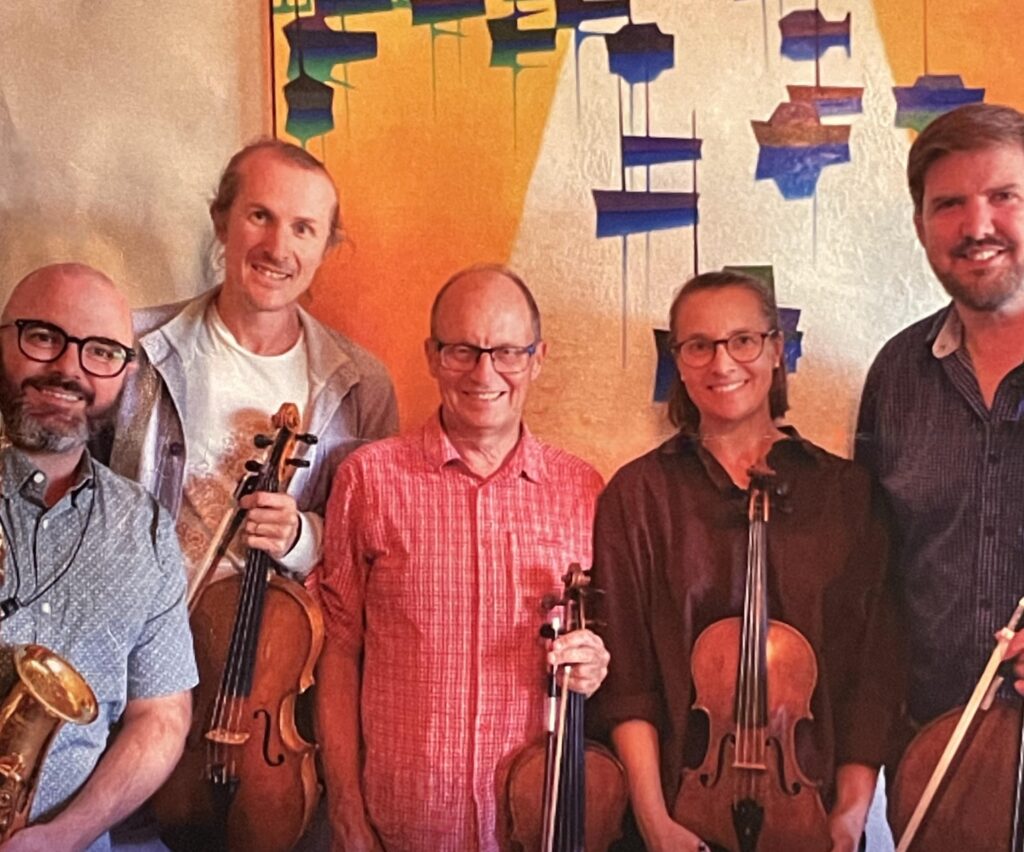
 Wellington Chamber Music Series 2026 – Simon Brew with the Amici Ensemble
RUSSELL PETERSON (b.1969) – Quintet for alto saxophone and strings 2003
MAX RICHTER (b.1966) – On the Nature of Daylight (2004)
ELLEN TAAFFE ZWILICH (b.1939) – Quintet for Saxophone and Strings
WOLFGANG AMADEUS MOZART (1756-1791) – String Quartet in F Major K.590
ASTOR PIAZZOLLA (1921-1992) Winter and Spring from The Four Seasons of Buenos Aires (arr. Mary Osborn)
Amici Ensemble (Saxophone Quintet)
Donald Armstrong (violin), Anna van der Zee (violin), Nicholas Hancox (viola), Andrew Joyce (‘cello), Simon Brew (saxophone)
St.Andrews-on-The-Terrace
Sunday, 12th April 2026
The saxophone as a musical instrument has made quite a journey – its inventor, Adolphe Sax, intended his instrument as a kind of “missing link” between winds and brass in the symphony orchestra, wanting to combine the power of brass instruments with the flexibility of woodwinds, though the earliest saxophones tended to find their way into French military bands because of their ability to project their sounds outdoors. The instrument did appear in some nineteenth-century classical compositions, mostly by composers with names unknown today (has anybody previously heard the names of Jean-Baptiste Singelée, who wrote a Premier Quatuor for Saxophones in 1857?- or Jules Demersseman, the composer of an 1860 Fantasie for Saxophone and Piano? ) but also with a number of “pioneering” examples of usage, such as in George Bizet’s incidental music for the play “L’Arlesienne” (1872), in music by Delibes (the 1876 ballet “Sylvia”) and in Massenet’s operas (“Le Roi de Lahore”, “Herodiade” and “Werther”) the earliest of these in 1877.
Of course since the turn of the century the orchestral gates have occasionally opened to admit the saxophone, with concertante works from composers such as Debussy, Glazunov and Ibert, and significant contributions from the instrument in works by Rachmaninov, Prokofiev, Strauss, Vaughan Williams, Richard Strauss and Ravel (via Mussorgsky) among others. In chamber music, too, the saxophone has noticeably figured, both in original works for the instrument and different kinds of arrangements, each of which were featured in this afternoon’s presentation by saxophonist Simon Brew and the Amici Ensemble.
Our concert began with American composer Russell Peterson’s 2003 Quintet for Alto Saxophone and Strings, the music beginning plaintively with strings only, then hauntingly continuing with the saxophone’s disarmingly dulcet tones – a sombre, processional-like exposition with gently melancholy dialogues and concerted passages – whose ambiences were then briefly but arrestingly galvanised by an impassionedly rising saxophone sequence, the music falling back to the previous subdued manner , only to again arch splendidly and disconcertingly – one was transfixed anew by the saxophone’s arresting power of utterance when at “full throttle”! – I enjoyed the movement’s following dance-like, somewhat exotic-sounding sequences, despite a “sameness” about the saxophone’s repeated “rise-and-fall” aspect to the music.
The second movement’s Bartok-like dance rhythms brought repeated-note patterms, more saxophonic declamations and running figurations, with the violin’s folkish lines echoed by the cello’s soulful responses. What appeared to be a third movement was begun by the saxophone, partnered by the ‘cello in a kind of sombre and almost canonic duet, whose musings were broken into by the viola, beginning a fugal-like sequence, and joined by the second violin, the mood remaining sombre until the first violin burst in with a more dance-like line, inspiring the ‘cello to begin a spirited, “running” kind of response to which the saxophone joined, the pace of the music quickening until the opening chords of the second movement returned. This then sent the music into a kind of “spin”, the saxophone pursuing a kind of orgiastic folk-theme, whose cries brought the strings running towards and executing as one a brilliant concluding flourish!
The contrast with Max Richter’s meditative and “slow-chapp’d” work for strings On The Nature Of Daylight, which followed couldn’t have been more profound – at first, not unlike the opening of Strauss’s “Metamorphosen” the music almost straightaway developed in a different, more esoteric direction, beginning here with three players delivering long, slow, mesmeric and suggestive chords, until a fourth enters with a melody that derives wholly from these chord progressions. The piece’s popularity has actually begun to generate a kind of reaction to its over-use by film-makers, a counterproductive kind of “bleeding the piece dry” effect, though Richter’s powerfully simple evocation will, like so many over-used pieces of music have previously done, doubtless survive its unselfconscious fecundity and remain fixed for future generations. I couldn’t imagine a more “centred”, sensitively-judged performance than we got here from our quartet of string-players.
The first half’s highlight for me was the Ellen Taafe Zwilich work, a 2008 Quintet for Saxophone and Strings, one with its opening Beethoven Grosse-Fugue-like beginning announcing its credentials and intents before setting off to a jogtrot-like journey throughout vistas of ear-catching detail. At first, the strings trod measured steps while the saxophone undertook a “whistling an air” kind of attitude, but with the group occasionally varying the trajectories, moving between a kind of lyrical wonderment, spontaneously impulsive gesturings and a droll “take it as it comes” manner.
Short, sharp impulses aplenty set the second movement on its intriguing course, in-and-out of occasional sequences which “papered over the cracks” in the music’s sustained lines (some evocative saxophone outpourings in places!). Our ears were kept engagingly activated by these wonderfully benign conniptions of expression, and highly entertained by an amusingly po-faced set of false “endings” to the movement leading up to the music’s true one!
The cello took up a nostalgic rocking rhythm at the third movement’s opening over which the saxophone sang a lullabic refrain, the strings joining in with a repeated-note accompaniment – fabulously ear-catching! As the saxophone began to energise its voice, the strings caught the mood and adroitly “syncopated” the exchanges, until the opening rocking rhythm made a sudden reappearance on the strings – saxophone and violin rhapsodised over the import of the moment, which intensified as the “chugging” rhythm also returned. The opening chord of the work then resounded, and echoed, before the players decided to have done with the past with a few terse, no-nonsense chords. I sat at the end, unexpectedly enchanted by it all!
After the interval, Mozart proved to be a perfect re-entry point to the concert with one of his “Prussian” Quartets (K.590 in F Major), albeit one of his greatest compositions, and one fraught with “might-have-beens” at the time the quartet was written – the circumstances have conspired to give this quartet a particularly distinctive flavour in a number of respects. At the time of writing this work the composer was in financial straits due to a recession in the Austrian economy caused by a drawn-out war with Turkey, resulting in fewer concerts and commissions. He had, in 1789, travelled to Berlin to meet the Prussian monarch Friedrich William II, an amateur cellist, hoping to make a good impression on the music-loving monarch, but instead had to be content with meeting the King’s Director of Chamber Music, the ‘cellist Jean-Pierre Dupont.
Afterwards he wrote to Constanze, his wife, that he had received money and commissions for six string quartets and six keyboard sonatas after performing for the Queen on a second visit. But there is no entry in the Court records for either money or commissions being made, and researchers have concluded that Mozart probably borrowed the money from friends, and invented the story regarding the visit and the commissions so he would have something to show for his efforts on his return to Vienna! He did complete three string quartets, two of them during 1790, the year following the Berlin visit, the second of which we heard today.
It’s an extraordinary work in itself, right from the beginning – two soft introductory notes and then a third louder and more insistent, followed by a scampering and unresolved unison descent – the whole then balanced by a repetition with solo violin, the dynamic contrasts softened, and the descent harmonically resolved. Mozart then uses that same three-note pattern and the scampered descent throughout the movement, the playing here of the Amici’s strings as deft and tonally varied as one might wish.
The following Andante has a hymn-like beginning, to which each instrument adds an embellished dance-like variation, leading to a stratospherically piquant ending. The Menuetto’s lively dance is characterised by an oscillating accompanying figure which passes from voice to voice throughout and in places moves up-and-down in almost vertiginous chromatic ways, while the Trio makes much of gawkily-witty grace-notes at some of the phrase-ends – charming! As for the finale it thrives on fluidity of utterance and quicksilver reactions, with several of the modulations seeming to flirt with atonality in places, while leaving our ears to actively wonder whether the lines would actually “find” one another again – such extraordinarily forward-looking juxtaposing of rhythms and harmonies! And what a delightfully po-faced concluding cadence – a wonderful sleight-of-hand ending!
Simon Brew brought his soprano saxophone with him this time, to conclude the concert with music by Astor Piazzolla, and featuring two excerpts from a work I’d not previously heard and was looking forward to – Piazzolla’s “The Four Seasons of Buenos Aires”. The composer originally wrote and scored the pieces separately between 1965 and 1970 for his own ensemble, which featured his own instrument, the bandoneon (a kind of accordion). Like much of the composer’s music they have been arranged for all kinds of combinations, including a version by Russian composer Leonid Desyatnikov for string ensemble which occasionally quotes from Antonio Vivaldi’s “The Four Seasons.
The Amici players performed two of these “seasons”, winter and spring, the first Invierno Porteño (Winter),having a gorgeous melancholic flavour, with much languishing at the piece’s beginning, and then with the saxophone tones bring out a truly exotic flavour to the textures and tones. Both pieces use the term Porteño, a word referring to a native of Buenos Aires, so that the Spring is given the name Primavera Porteña – the music’s somewhat livelier than the first piece, though the players here give even the slower middle section’s rhythms plenty of “heft” . We enjoyed the experience so much we were able to persuade the ensemble to return to the platform and give us some more Piazzolla, a characteristically sultry opening, with the strings sighing as the saxophone literally took flight, the lines soaring like a bird, before the instrument brought these impulses back to earth, joining the strings for a soulful concluding melody in luscious thirds. Gorgeous sounds! – we couldn’t have helped enjoying the ensemble’s wonderfully cosmopolitean adventurings throughout a variety of times and places – a real treat for the senses in every way!
They were fantastic and memorable