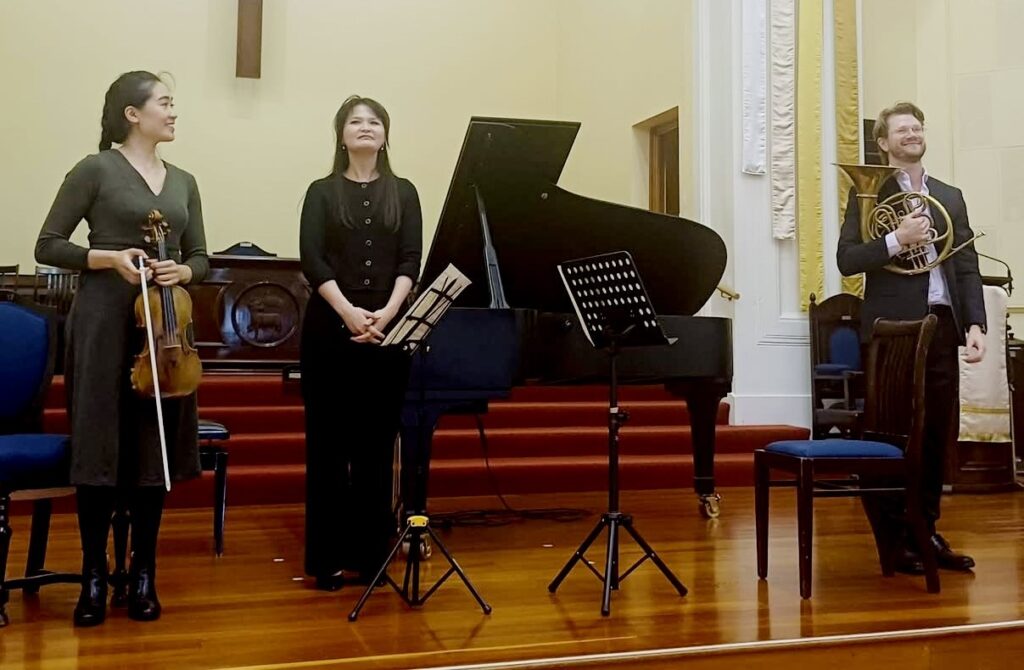
 Christine Wang (violin), Beth Chen (piano), and Sebastian Dunn (horn)
EUGÈNE BOZZA (1905-1991) – En Forêt (In the Forest) Op.40
Sebastian Dunn (horn), Beth Chen (piano)
FRITZ KREISLER (1875-1962) – Schön Rosmarin (Old Viennese Dance No. 3)
Christine Wang (violin), Beth Chen (piano)
JOHANNES BRAHMS (1833-1897) – Trio for Horn, Violin and Piano in E-flat Major Op.40
Christine Wang (violin), Sebastian Dunn (horn), Beth Chen (piano)
St Andrew’s-on-The-Terrace, Wellington
Wednesday, April 29th, 2026
Every now and then in a concert one encounters music one has never before heard, or even heard of, and sometimes even whose composer has a name one doesn’t know. On certain occasions audiences sit primly and attentively and at the end applaud, congratulating the composer(s) and the musicians, and of course, one another upon according the piece or pieces due attention. But on once-in-a-blue-moon occasions such hitherto unknown music can unexpectedly generate an instant impact akin to a real frisson of excitement, one which lingers on in the memory for ages afterwards. It’s happened to me a few times over my years of concert-going experience – the latest being my attendance at a recent St Andrew’s-on-The Terrace concert featuring three outstanding musicians – Sebastian Dunn, horn, Christine Wang, violin, and Beth Chen, piano.
To be accurate, the truly “instant combustion” fireworks took place most markedly during the concert’s first item, featuring horn player Sebastian Dunn and pianist Beth Chen in a vivid presentation of an ear-opening horn-and-piano piece by French composer, Eugène Bozza (1905-1991). This was En forêt (In the Forest), a piece written in 1941 as an entrance exam piece for the Conservatoire de Paris, and one regarded ever since as embodying the entire technical and expressive capabilities of the French horn. The piece depicted a hunting party in a forest, the writing combining different horn-playing techniques with an impressionistic piano accompaniment. Both Sebastian Dunn and Beth Chen revelled in their concerted evocations of the hunt and their individual depictions of various scenes and moods throughout – a particularly atmospheric feature was the horn’s magical use of call and distanced (or muted) respondings. The visceral impact of the piece and its performance almost literally “brought the house down” at the conclusion, so evocative was the playing of both musicians throughout in terms of recreating presence and distance, activity and reflection.
After these somewhat “larger-than-life” exertions, violinist Christine Wang next took the platform with Beth Chen to give us “something completely different” – a most charming and nostalgia-soaked piece titled Schön Rosemarin – Old Viennese Dance No.3, by Fritz Kreisler. Before the piece was even halfway though, the winsome charm and delicacy of the players’ violin and piano strains had taken us far away from the forests and the hunters, and was instead enabling us to “drink in” the ambience of the Viennese coffee-house with its traditional “Atmosphäre von Gemütlichkeit”. Fritz Kreisler, besides having been, of course, a renowned virtuoso violinist, was also a composer, but he preferred to publish some of his music under an assumed name so as to give the pieces the chance to be judged by their own merits and not by his “virtuoso violinist’s” reputation. By comparison with Sebastian Dunn’s riveting display of “virtuoso roar” with HIS instrument, violinist Christine Wang seemed to me to catch the completely different kind of “olde-worldly” ambience of the Kreisler piece perfectly, as did Beth Chen’s equally delightful pianistic identification with the spirit of the music.
These seemingly far-flung performing aureoles and contrasts in delivery then magically came together for the programme’s third item, Johannes Brahms’s Horn Trio in E-flat Major. In his introduction to the piece Sebastian Dunn talked about the composer’s preference for the “natural” (i.e. “valveless) horn over the more modern version. Obviously the “Waldhorn” as it was known, had nostalgic connections for Brahms (his father had taught him as a child to play the instrument) besides what the composer specifically referred to as the horn’s more “natural” characteristics, its intrinsic tonal shadings and generally “softer” sound. Dunn assured us that he would do his best in this performance to compensate for his own “modern” instrument’s relative “brashness”!
This work was written in 1865, and probably inspired chiefly by the death of the composer’s mother earlier that same year. As with Brahms, its genesis wasn’t perhaps entirely straightforward, as befitted his generally enigmatic response to various influences regarding his music. The Trio’s somewhat changeable moods across its four-movement span have prompted various other conjectures regarding sources of inspiration – besides recalling his mother singing the folksong “Dort in den Weide steht ein Haus” (There among the willows stands a house) as influencing part of the Adagio Mesto slow movement, Brahms hinted at another, more mischievous song in the work’s finale, “Es soll sich ja keiner mit der Liebe abgeben” (No-one should have anything to do with love), one which ably suited his ongoing “confirmed bachelor” status. As with any piece of music its creative motivations, whether conscious or otherwise, invariably reflect a veritable jigsaw of influences.
Brahms’s combination of violin, piano and horn was innovative at the time, but has since inspired a number of other works, most obviously (and perhaps, surprisingly) György Ligeti’s 1982 work Hommage à Brahms. Here, the performance of the “original” generously brought out all of the work’s inherent qualities, the opening Andante movement enjoying its relative freedom as the only “sonata-ish” work of Brahms’ to pay little heed to sonata form! – this was more of a rondo-patterned melancholy main theme with a livelier contrasting sequence, the two sections alternating and subtly blending gestures from one another’s material into a beautiful coda.
The second movement was a dancing Scherzo begun by the piano, and juxtaposing a leaping opening theme with occasional syncopated shouts of consenting glee, catapaulting the trajectories through to the resonantly sombre Trio, after which the Scherzo’s return restored the music’s high spirits. Came the Adagio mesto slow movement, a funereal introduction by the piano heralding a scenario of sorrowful lament, violin and horn almost weeping, it seemed, as the piano moved the cortege forwards – there appeared no respite until the movement’s end, despite an occasional “lifting up” of the melodic line, only to be brought down to earth again under the weight of emotion and gradually dissolving into the mists of gloom….
What a transformation the music then underwent with the finale’s delicious bubbling-up of energies from within! – with rompings and frolickings spreading like wildfire through the music’s textures! Christine Wang’s violinistic brilliance, by now fully come into its own, and Beth Chen’s vigorous “foundation-rock” piano-tones were the constant “movers and shakers” of the music throughout. Interestingly, (and ironically), I’ve always felt Brahms’ writing for the horn never fully conveyed the out-and-out exhilarations of the “Waldhorn” world, one made so manifest by the Bozza piece we heard at the concert’s beginning – though, of course Sebastian Dunn’s skilfully-reproduced rumbustions during the Brahms work were sufficiently ebullient in certain places to make the instrument’s presence felt, and especially towards the piece’s end!
A group of us, amid plenty of excited babble, managed to make our way across the Terrace to a coffee-shop afterwards, where we were able to reflect anew (and not by any means for the first time!) upon our good fortune at having a lunchtime concert series in the city to attend which featured such resoundingly memorable musical treasures delivered via absolutely first-class performances!