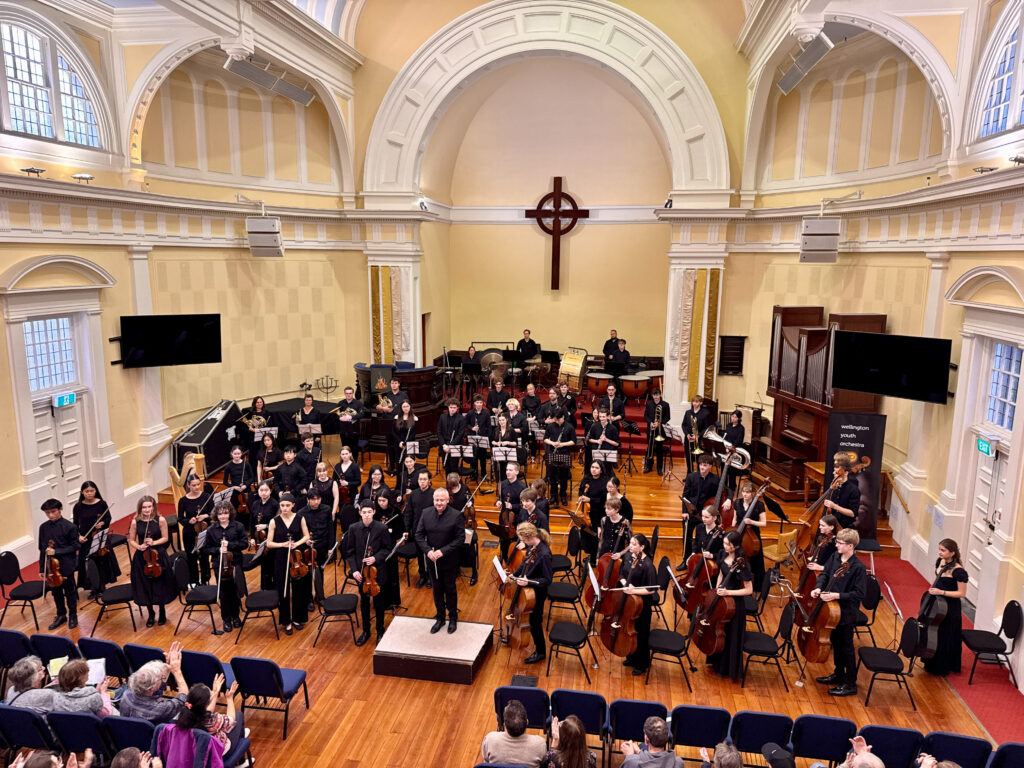
 Wellington Youth Orchestra with Mark Carter at St.Andrews-on-The-Terrace – photo credit: Cindy Young Waldron
SIBELIUS – Finlandia
ELGAR – Suite No. 2 from “The Wand of Youth”
VAUGHAN WILLIAMS – A London Symphony
Wellington Youth Orchestra
Mark Carter, conductor
St.Andrew’s-on-The-Terrace, Wellington
Sunday, May 3rd, 2026
“Pines to Pastures” was the Wellington Youth Orchestra’s programme-title for its first 2026 concert – it succinctly described the book-ends containing the action-packed musical journey we were taken upon by the orchestra and its inspirational conductor Marc Carter throughout an eventful Sunday afternoon. The programme featured the music of three composers whose names often appear on the lists of “master orchestrators” – Sibelius, Elgar and Vaughan Williams – with each of the pieces’ very different evocations bringing its own particular technical and interpretative set of challenges for the players to grapple with. The end result was a triumph – throughout the concert the playing regaled us with wall-to-wall instances of ear-catching detailings, characterfully-wrought vignettes and larger scale scenarios of beauty, drama and excitement. Every note sounded was accorded, to my ears, a kind of living, pulsating quality, with the players’ concentration seeming never to flag nor the energies falter.
Opening with Finnish composer Jean Sibelius’s “Finlandia”, the big, dark-browed brasses at the start straightaway focused our attention, contrasting sharply with the plangent pastoral sounds of the winds, and then the passionately insistent strings, and with the winds and strings building the urgencies towards the brass’s sharp-edged calls – the wonderfully “grinding” lower strings conveyed a sense of a force about to be unleashed as the rest of the strings and the brass traded outbursts of pent-up energies. All of this led into the precipitous allegro, with tumultuous percussion heralding the driving orchestral forces, joyously and vigorously responding to the great horn calls, and surging excitingly into and through the climaxes! That done, and the exhausted forces having given their all, the way was open for, firstly the winds, and then the strings to sonorously intone the famous ”tune” that has subsequently found its way into all kinds of celebratory and worshipful scenarios world-wide. It was fitting that, having regained their composure, the more combatative sections of the orchestra were then able to rouse themselves for a return to the allegro in its most celebratory tones, capped off by a splendidly conclusive, and full-blooded “Amen-like” coup de grace!
Stirring though the Sibelius performance was, I subsequently felt that it was during the playing of the various dances comprising the next item (an adorable suite of dances by Edward Elgar called “The Wand of Youth”), that the orchestra seemed more relaxed and assured, having “played themselves in” during the Sibelius for the concert’s remainder. While “Finlandia” was exciting, it felt very “tightly-wound” throughout – with the Elgar, however, conductor and players seemed to “expand” further, and fill parts of the music up with a different kind of relaxed exuberance. I particularly noticed how both “The Little Bells” and “The Wild Bears” pieces exuded such great warmth, whole-heartedness and unbuttoned “swagger” in places. While “The Little Bells” has always been a favourite of mine, due to its heart-wrenching echt-Elgarian “second” theme (such a beautiful counter-theme on the lower strings the second time through! – and I was especially taken by the excellent playing of the glockenspiel by a nimble, if unsighted percussionist), I did so enjoy the orchestra’s spectacularly exuberant playing of “The Wild Bears” – it was wonderful stuff (though I had to strain to make out that very first and well-remembered triangle “ping!”)! These dances were from two orchestral suites based on some of the composer’s childhood musical sketches he had made when aged eleven, for a kind of “fantasy play” which he and his siblings were to perform, and which were miraculously relocated much later, and reworked for our pleasure!). A small point here – I realised after the concert that I had NO memory of the orchestra playing the enchanting “Fountain Dance” listed in the programme – was the spell cast by the music so great that I actually took leave of my senses for a few minutes during the proceedings? – or did Mark Carter and the orchestra simply omit the dance?
No matter – there were even greater landmarks looming on the musical horizon for the players, in the form of a four-movement symphony that’s become almost as iconic as anything written by Elgar – this was his younger English contemporary Ralph Vaughan Williams’ “A London Symphony”, first completed and then extensively revised by its composer after its first performance in 1914 (this ‘original version” still exists, found nowadays in a revelatory Chandos recording made by the late, lamented conductor Richard Hickox). The symphony continued to be revised (and even occasionally performed in “newer” manifestations) until a final authorized performing version appeared, published in 1936 (Wikipedia has an absorbing account of the genesis and various appearances of different versions of this work!). Richard Hickox’s fascinating reading of the “original” gives the work’s supporters cause for both lamentation (that so many passages in the original were removed) and relief (that the work displays increased coherence and stature with those same passages excised)!
One doubts whether the “original” 1914 version will ever outstrip the 1936 “finished” work in popularity, but it certainly adds to the fascination of the work in particular and the trajectories of the composing process in general. Vaughan Williams was certainly no Bruckner regarding the latter’s woeful lack of confidence in his own, composing abilities, but he did listen to advice from friends, including interpreters of his music who occasionally might suggest the occasional change or an edit here or there. He certainly retained a great affection for this work, and is on record as declaring, later in life, that it was perhaps still “the favourite” of all his symphonic offspring!
The work gives a confident impression from the outset as indeed being a “Symphony by a Londoner” (as the composer later mused over what he thought should perhaps have been the work’s “proper title”). The opening Lento, here. with lower strings and murmuring winds sounding atmospheric chords and lines was an evocation of a city before dawn magically emerging from the darkness, the instruments gradually opening up the vistas as the ambiences lightened and everything gradually came alive – the Westminster chimes sounded, and amid fanfare calls the sun’s rays seemed to suddenly break through and reveal the pulsating heartbeat of a city! We got plenty of activity from the strings in response to the joyously percussive fanfares, and the jaunty “walking movement”, firstly from the winds, then the strings, and then the brass carried the exuberant rhythms onwards towards a return of the great introductory fanfare of the city’s awakening! The players enjoyed the folk-dance-like ditties and the exuberant shouts alike as the city boisterously flexed its human muscles, then took us to quieter, more subdued vistas where the melancholy strains from the cor anglais initiated moments of reflection, leading then to a ‘cello solo joined by other strings – a poignant episode, practically chamber-music! – and beautifully sounded by the players, obviously revelling in such gorgeous string-writing! The fanfares sounded again in the distance and the energies reawakened, gradually rebuilding and redoubling the previous excitements and working up to a last, protracted fanfare resonating through to the end of a long-held final chord.
“Bloomsbury Square on a November afternoon” was the composer’s description of the slow movement’s opening – a beautiful solo from the cor anglais rose out of quiet string passages, the strings repeating the melody and extending the tranquil mood – a gentle horn and trumpet passages, and the strings returned more impassioned than before – altogether a heartfelt evocation – a solo viola fluently began a series of atmospheric street-call-like phrases, answered by other instruments and punctuated by the percussion’s gentle jingling of cab harnesses passing by, and drawing forth a rapturous burst of nostalgic tones from the whole orchestra – it was scalp-pricking stuff! – all beautifully evoked! It was left to the cor anglais, horn and solo cello to re-establish the prevailing atmospheres, giving the movement’s last few sounds to the solo viola once again.
The scherzo was a lively nocturne, with specific instructions from the composer to the listener, to “imagine himself standing on Westminster Embankment at night, surrounded by the distant sounds of the Strand….with its crowded streets and flaring lights….” Conductor Mark Carter encouraged a delightfully insoucient swagger from his players throughout this engaging music relying on accent and nuance rather than speed to invest the music with plenty of characterful “bounce” – this music always reminds me of certain books I read when young about English childhood adventures, such as “The Otterbury Incident” and “Stig of the Dump”, with their somewhat rollicking, devil-may-care attitudes adopted by the protagonists! I particularly enjoyed the orchestra’s detailing throughout, (including an especially spectacular piece of horn-playing of the main theme at one point!) – and the winds and percussion also had great fun with the trio-like interlude featuring the sounds of a busker’s wheezing accordion! And conductor and players “coaxed” the dying strains of the day from out of the movement’s end so very sensitively.
Every time I hear this work’s finale, with its “cry of pain” at the very opening, I find myself wondering just what Vaughan Williams was meaning – it’s almost Mahlerian in its unexpected angst and darkness of aspect! Not unlike Mahler’s Fifth Symphony’s opening, it has an explosive beginning, then settles into a march-like episode of grim, dark-browed intent! – was this REALLY VW’s view of London? I remember reading somewhere very early on that VW was here expressing the city’s darker, more tragic side – the march-like rhythms hinting at the misery of those down on their luck, hungry, unemployed, and even homeless. Other commentators have referred to the city’s traditional pomp and ceremonial gravitas over centuries, which are expressed here in tones of sombre grandeur. Typically, the composer kept his thoughts largely to himself regarding much of his music, though in this particular movement’s case he famously referred to H.G. Wells’s 1908 novel Tono-Bungay, which contains a passage describing the novel’s narrator sailing down the River Thames and seeming “to be passing all England in review”, as influencing the work’s elegiac closing pages, beginning with a reiteration of the first movement’s “Westminster Chimes” and then simply drifting unhurriedly to a close……the concluding words in the novel are – “The river passes…..London passes….England passes.”
I hope I’m forgiven for dwelling on this aspect of the music besides writing about its performance – these references to aspects of the composer’s inspiration for the work can’t help but further inform my opinion of the excellence of the Youth Orchestra’s performance and the surety of the guiding hand of conductor Mark Carter throughout. It’s precisely that tragic and lament-like aspect that hovers over this music which was what these players brought out so movingly – the silence at the piece’s end in this performance was indicative of the effect it all had on its audience – we had been witness to something extraordinary, something that deserved its moment of contemplation as well as acclaim at the very end. I’ve refrained from describing anything specific at this point in the work – it all seemed integrated and inevitable, just as night follows day, with the players’ energies and concentration seemingly unflagging! And afterwards, who could blame them for wanting to conclude the afternoon with something a bit more festive and rousing! – especially since it was the return of “The Wild Bears” which came to the rescue of the symphony’s “stricken” conclusion with even more panache than in the first-half performance – and THIS time I definitely and unequivocally heard that wonderful, nostalgic tintinnabulation of the triangle first time round! I went home after hearing all of that as happily as any concertgoer had a right to be – no affirmation could be more appropriate or deserved!