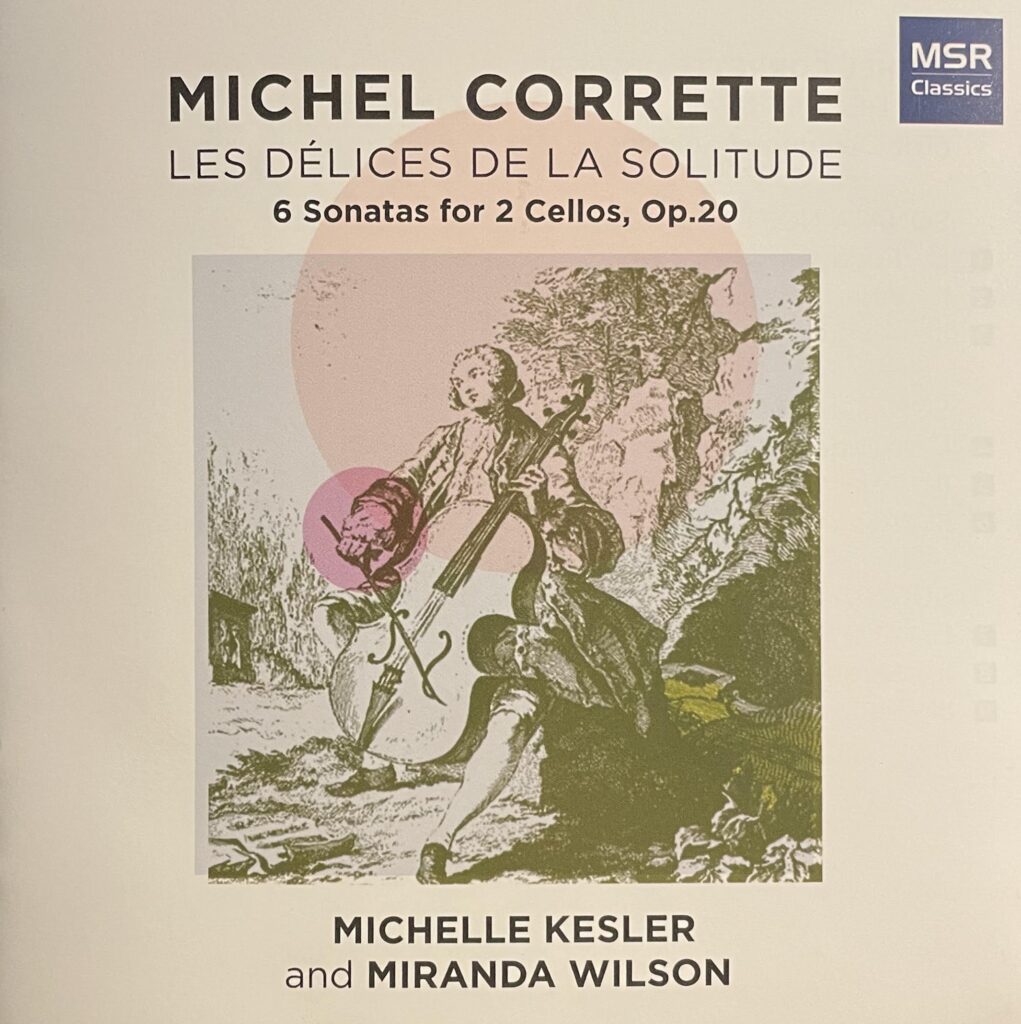
MICHEL CORRETTE (1707-1795) France
LES DELICES DE LA SOLITUDE – Sonatas Op. 20 Nos.1-6
Michelle Kesler – ‘Cello I Sonatas 2, 4 & 6 / Cello II
Miranda Wilson – ‘Cello I Sonatas 1, 3 & 5 / Cello II
MSR Classics MS 1832
Recorded November 2024 in the Recital Hall at Brigham Young University, Provo, Utah, USA
“In the spirit of friendship between ‘cellists, we hope listeners will enjoy this lively conversation between instruments” writes ‘cellist Miranda Wilson in her notes accompanying a delightful recording that has come my way, of music by a composer whose name I did not know, one Michel Corrette, born in Rouen, France in 1707. In this case, it’s amusing to associate the ready camaraderie between the two musicians featured on this recording with a work whose six sonatas have the collective subtitle Les délices de la solitude (The Delights of Solitude) – however, although it would seem that Corrette’s set of six sonatas were originally for solo ‘cello plus basso continuo, they’re here assigned to two ‘cellos, whose demonstrably equal share of the lines makes for great satisfaction, as much obviously in performing as in our listening!
Cellists Michelle Kesler and Miranda Wilson are the players on this recording, made in November 2024 at Brigham Young University in Provo, Utah – at the time both were Professors of ‘Cello at their respective teaching places, Kesler at the aforementioned Brigham Young University, and Wilson in the neighbouring state of Idaho at the eponymously-named State University in Moscow, Idaho. We’re given detailed guidance as to which player is “Cello I” in each of the sonatas, Kesler conveniently taking the “lead” in Sonatas 2, 4, and 6, and Wilson in the other three. The presentation nicely completes the collaborative nature of the whole by presenting the works in numerical order.
My first listening impression (Sonata No. 1 in F Major) was of a slightly more spacious acoustic for the two instruments that I thought I was going to fully enjoy, but, as with any concert or recording one encounters, one’s ears can take a little while to, in Michael Flanders’ immortal words on his and Donald Swann’s “At the Drop of A Hat” live recording, “get the pitch of the hall” – and by the first movement’s end the sounds had found and “inhabited” their places for me with music which had by this time amiably teased, cajoled and enlivened my spirits!
Miranda Wilson entertainingly draws attention to Corrette’s music corresponding with the rise of the ‘cello as a solo instrument at the expense of the viola da gamba in popularity at this time, one taken advantage of by, firstly, the publication of these sonatas at around 1739, and the composer’s 1741 treatise Theoretical and Practical Method for Learning the ‘Cello to Perfection in a Short Time. Something of the ferment of the controversy is excitingly suggested by a pamphlet circulated in 1740 by a French lawyer and amateur viola da gamba player Hubert Le Blanc, one which bore the contentious title Defence of the Bass Viol against the Enterprises of the Violin and the Pretensions of the ‘Cello! – wot larks! Le Blanc’s somewhat intemperate rationale regarding his instrument’s superiority has since seen its consignment to the realm of the specialist, by no means obliterated, but put in its place by history!
Here, we are invited to indulge in the composer’s obvious enthusiasm for the then still new-fangled instrument (Corrette’s aforementioned treatise was the first French publication of “a theoretical and practical method” for aspiring cellists) – and the sonatas as recorded here feature a kind of “coming together” of solitudinous delights, with each ‘cellist by turns blending their instruments’ solo lines with their partners’ roles as contrapuntal voices, the modes somewhat antithetical in these pairings but, in situ, delightful.
Sonata No. 1 straightaway dances into a Fuga, marked Allegro, the counterpoints unselfconsciously switching from first to second voice in non-hierarchical exchange, its composer obviously allowing his originally-wrought basso continuo a satisfyingly comparable response to the soloist here, and also in the Affetuoso Aria that followed – and the Allegro finale makes for as “companionable” a solitude as could be imagined!
The D Minor Sonata No. 2 begins with a more driving Allegro, with lots of “fizz” to some of the exchanges, and the ensuing Affetuoso, with its contrasting Arias I and II underlining a poignant operatic-like interaction, not unexpectedly calling for some resolution – a CPE Bach-like Allegro staccato did the trick, those brusque, attention-grabbing initial notes making for a splendid “what’s all this, then!” kind of denoument!
I loved the easy, loping stride of the C Major No 3’s Allemande – a kind of relaxed “bustle” of an Allegro, and then with both this and the equally bucolic concluding Fuga da capella third movement enclosing an unexpectedly concentrated middle-movement Sarabande. More concentrated intensities came with both players’ deep-diving into the following E-flat Major Fourth Sonata’s opening Adagio, one that conveyed a more-than-usual sense of solitude on the music’s part. This dramatically tipped over and into a Corrente, an exhilarating running-sequence leaving one breathless but energised enough to take on board the music’s almost hymn-like Aria which followed – little did we realise we were being primed for a “call-to-arms” with the succeeding “Brut de chasse” here rousing and enthralling our sensibilities with sounds and sensations of an army on the march!
Further excitement came with the galvanic Presto Prelude to the Fifth Sonata in G Major, in which one imagined our two cellists enjoying an “Anything you can do” exchange, with hair and resin flying! The following Allemande, though more leisurely an Allegro took us on a reasonably aerobic stroll, a mood which was at once echoed and calmed by a graceful Sarabande – here, a winsome and exploratory partnership that brought peace to one’s soul. As well for such respite, with the sharply-etched Presto finale that followed mischievously breaking the mood, snapping playfully at dancers’ heels.
Glorious and celebratory were the Handelian flourishes which opened the final sonata of the set, the 6th in a joyous D Major. Here, strangely, it seems the MSR Classics booklet prints the incorrect names and tempi for the movements – the opening Preludio has a grand, ritualistic character which should be Allegro Moderato, not Presto. And this suits the solemn, ceremonial gait of the second movement Aria, not Allemande – Allegro as listed here. Finally, the players skip merrily into a concluding Gigue (not in the least bit like a Sarabande!). It all made for a bit pf a puzzle on a first listen, but one well worth solving, and which Michel Corrette himself might possibly have regarded with amusement rather than annoyance – after all, among his prodigious output were no less than twenty-five “Concerti Comiques”, pieces for vocal and instrumental ensembles which were often “fun” settings of popular tunes and well-known opera themes, and written largely to be used as “entractes” during performances of comic theatre.
This was revelatory stuff for me – listening to the disc right through was like being taken on some kind of “tour” of a specific time and place in European musical history – though he lived in the same era as his fellow countrymen Rameau, Leclair, Boismortier and Mondonville, and at the same time as Handel, CPE Bach, Gluck and Pergolesi, Corrette’s music survives comparison with these more famous figures due to its craftsmanship and its composer’s penchant for capturing elements of different styles and blending them in singular ways. The voices of his influences are in places unmistakable but he manages to make the results of their synthesis his own. The only comment I wanted to make of a questioning nature concerned repeats in the various movements, so many of which seemed to finish before I wanted them to! – and moments such as those made me wonder what the scores of these works indicated were the options for the players who perform this music. I would be interested to find out more regarding this subject. For the rest, to the composer and performers, simply “Bravo! C’est magnifique!”