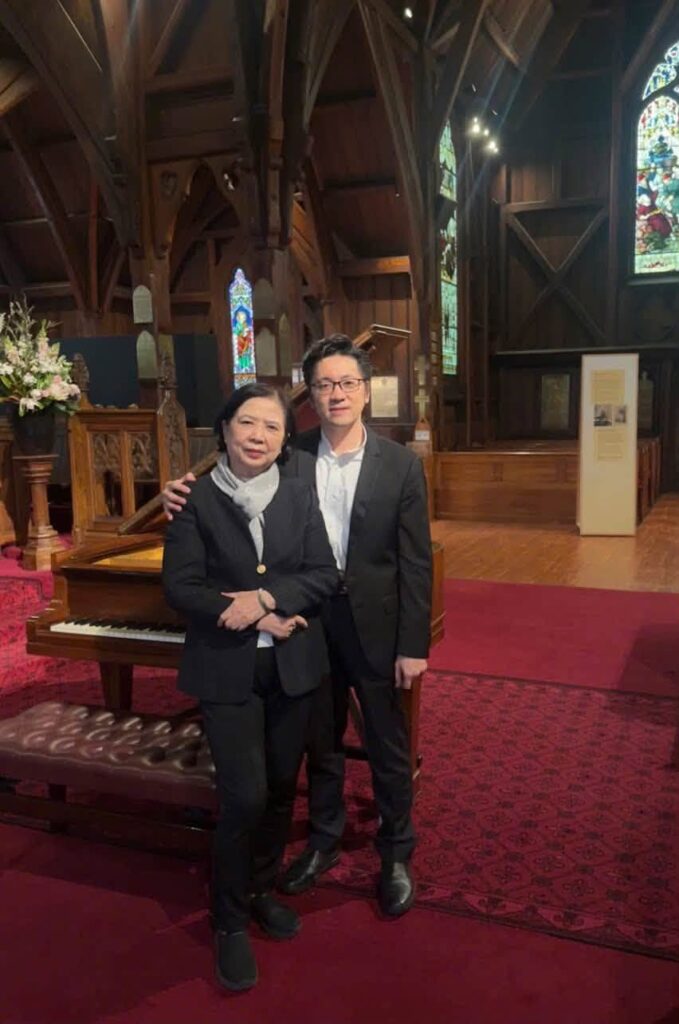
 Quang Hong Luu, with Phan Hồng Châu, at Old St.Paul’s, Wellington
FRANZ LISZT – Anneés de pelerinage – Troisieme (Third Year of Pilgrimage) S.163
Angelus – “Prayer to the Guardian Angels”
Aux Cyprès de la Villa d’Este No.1 & 2
Les jeux d’eaux à la Villa d’Este
Sunt Lachrymae Rerum E mode Hongroise
Marche Funebre
Sursum Corda
Quang Hong Luu (piano)
Cathedral of St. Paul (“Old St. Paul’s”), Mulgrave St., Thorndon, Wellington
Thursday, 10th September, 2026
Vietnamese-born pianist Quang Hong Luu made a welcome “return to life” on behalf of Wellington’s concert-goers in an Old St.Paul’s “lunchtime concert” presentation, after an earlier indisposition prevented him from giving a promised recital for Wellington Chamber Music’s Sunday concert series on August 16th. Quang had originally intended to present music by Chopin, Beethoven and Liszt, including in the recital the last-named composer’s rarely-performed set of pieces from his later years, written while in residence in Tivoli, Rome, at the Villa d’Este, famous for its spectacular gardens and fountains. These seven pieces were published as the third book of an extensive collection of works which the composer collectively called “Annees de Pelerinage” (Years of Pilgrimage).
Three of these pieces draw their direct inspiration from the Villa d’Este, two of them meditations evoking feelings concerning the magnificent cypress trees in the villa’s gardens, and one inspired by the inspirational fountains, the latter work resonating in various other composers’ music in the years to come. Liszt’s sojourns at these Tivoli gardens provided solace to a composer feeling himself increasingly at odds with existence in general, and beset by occasional depression and sadness, much of which is expressed in the darker moments of some of these pieces.
The “lunchtime concert” format of this occasion perfectly suited the detachment of these pieces by Liszt from the original recital intended by the pianist, the music’s markedly spiritual, and in places esoteric character finding a fitting ambience in the Old St.Paul’s outstandingly beautiful “old-world” environment. The piano, too, in this case a hundred-plus year-old instrument, seemed to unashamedly proclaim its venerable experience in a way that felt and sounded entirely appropriate to the music and to Quang’s playing. Only the dismal weather outside refused to take note of the significance of the occasion, the rain probably accounting for a smaller-than-usual lunchtime audience.
Opening the collection was Angelus (Prayer to the Guardian Angels), its opening tintinnabulations suggesting the traditional bells – as befitted this piece’s dedication (to Liszt’s grand-daughter Daniela) the music at first seemed innocently child-like in tone and aspect, though gradually taking on deeper, grander tones before again returning to the child-like simplicities of the opening. The ballade-like melody pressed forward with engaging youthful vigour, “playing” inquisitively with the three-note staccato figure and its modulations, and with the melody itself, before gathering itself for a grand presentation of the theme, the pianist raising his hands high as if symbolising the blessings of the return to the repeated figuration passage with which the work began, and blissfully intoning an “uplifted” meditative repetition of those same notes whose gentle earthward descent returned us to a fleeting reminiscence of the ballade-like melody’s opening strains.
By comparison, the first of the two Aux Cyprès de la Villa d’Este made a big, black-browed, imposing, even fearful impression – the repeated tolling bells in the bass amplify and brutalise the opening tintinnabulations of the first piece, the music moving forward deliberately and majestically, then reinforcing the music’s forward movement, plunging us headlong into a kind of maelstrom of agitated sound whose tones lift us up and plunge us downwards in the manner of some oceanic wave, leaving us at the mercy of the ambiences surrounding the places to which the music has delivered us – as if we are in awed dialogue with the cypress trees, a kind of confrontation with nature, with creation in a larger sense and with our place in it, one of awed humility at their symbolic permanence and essential “character” (these trees being symbols of death in classical tradition…..)
Again, the music at the outset of the second Cyprès de la Villa d’Este was gaunt, black-browed and imposing, though not as unremittingly fearful or threatening in aspect as in the previous piece – a repeated downward-leaping fifth rose partially upwards in a gesture of part defiance, part despair, followed by several tersely muttered chords. The exchange wass repeated, and a new theme, determined and rising appeared, followed by a fanfare-like passage that rose and fell with some certainty – the downward-leaping fifth and its partly-upward “balance” reappeared, followed by, firstly, a forward-looking chromatically-harmonised passage, and a luminous-sounding chorale-like major-key section, suddenly sounding like the Liszt of a previous time, as if a melodic resurgence of a idea from the composer’s 1850 Consolations or from his 1852 Harmonies Poetiques et religieuses had come to mind. It seemed almost as if the composer had penetrated the outwardly forbidding aspect of the cypresses to express deeper, more ambivalent existential truths suggested by their customary associations – working towards a more transcendent expression that shed light upon darkness in unforeseen ways. Certainly, there was as much peaceful resignation in the repetitions of the luminous- sounding chorale as there was an occasional indication of a troubled spirit elsewhere.
Les jeux d’eaux à la Villa d’Este, the most famous of the set, came next, introduced by an upwardly-thrusting impulse of light and energy and substance whose joyous outpourings symbolisd what its composer described via his quote from the Gospel of John (4:14) as “a well of water springing up into eternal life”, and which was to prove inspirational for a whole new generation of Impressionist composers such as Debussy and Ravel. I wanted Quang Hong Luu to savour for a few more resonant milliseconds the truly transcendental moments of Liszt’s quoting of Wagner from the opera “Das Rheingold” – here, the alluring Rhinemaidens’ twice-voiced lament was, for me, dispatched a shade too quickly – fortunately, the rest, under Quang’s fingers was sheer magic through his playing’s crystalline brilliance, and, towards the end, his complete and exhilarating physical realisation of the flow of water’s all-engulfing cumulative effect, leaving at the end a deep, richly-intoned summation in the piano tones of something sacramental and life-changing!
The next piece, Sunt lacrymae rerum – en mode hongrois, returned to the darkness of the first “Cypress” piece. The title “Sunt lacrymae rerum” means “There are tears for things”, and is a quote from Virgil’s “Aeneid” made in reference to the fall of Troy, though Liszt would have been referring here to the Hungarian War of Independence of 1848-49, a theme he had already explored in his piano piece Funerailles, and the symphonic poem “Hungaria”. The air of mourning was apparent, expressed on both a personal and a national level, Liszt employing all kinds of sonorities to express different levels of sorrow, the piano writing unique in terms of its vision and inventiveness.
No let-up was possible with the following Marche funebre (the earliest piece in the collection, written in 1867), written to mark the death by execution of the unfortunate Maximilian I, the Emperor of Mexico, and containing the inscription on the score “To have wished for great things is an accomplishment in itself “. Perhaps the introduction to this work contained the set’s darkest music – Wagner called this music “an old man’s delirium” – the central section was bleak and ruminative, while the final section was extraordinary, a huge crescendo, atonal harmonies amid tremolandi passages, before a final section which paid homage to the unfortunate monarch in the most fulsome pianistic “clarion call” terms!
Finally came the pianist’s ultimate act of faith, the chorale-like Sursum Corda (Lift up your hearts!) an irresistible and heartfelt statement of faith which the pianist here threw himself into with amazing gusto, at times lifting his whole body from the piano seat in aid of putting every fibre of his being behind the delivery of this music’s message, a performance which fulfilled to a unique, overwhelming degree a “blood-sweat-and-tears” kind of fervour on the part of the composer, so that here, it was as if performer and composer had become one.
We made up for lack of audience numbers at the end with what we hoped were sounds and gesturings of enthusiastic appreciation of the pianist’s superhuman efforts! Quang assured me he would be in Wellington next year for another concert, as yet undisclosed as to content. At such an interpretative level as we had been privileged to experience on this occasion I felt inclined to happily and eagerly undertake with him whatever musical journey he might propose! What a treat to have such an experience to look forward to!