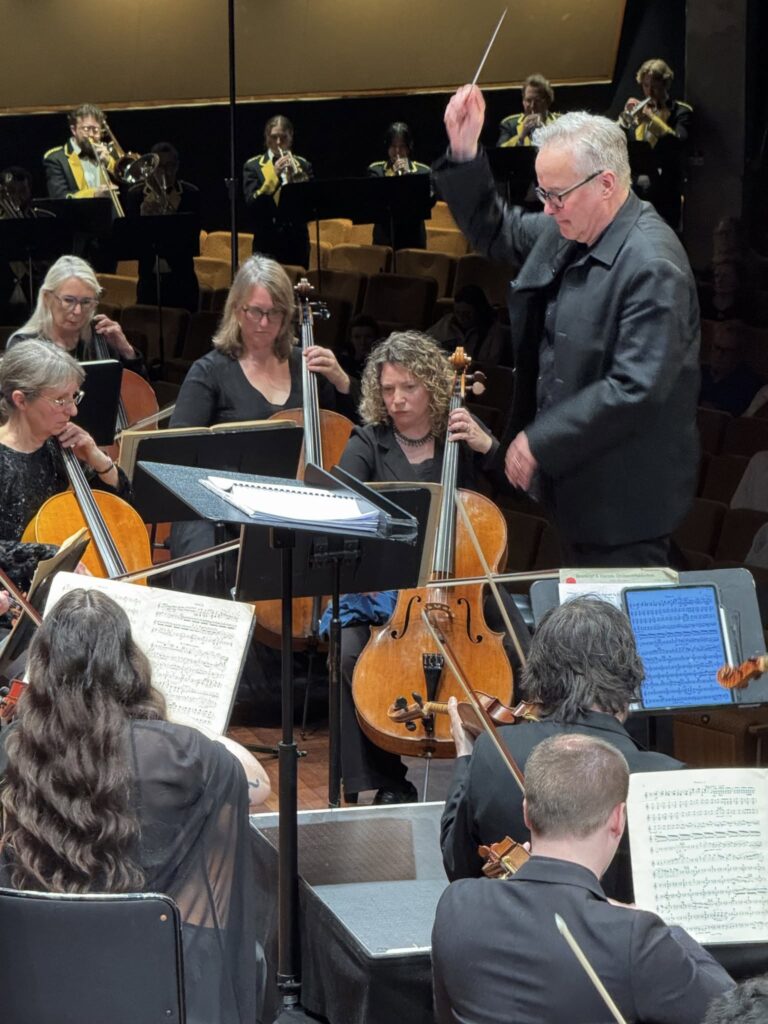
 Marc Taddei with Orchestra Wellington and Wellington District Brass Ensemblepresents “Colossal”
JOSHUA PEARSON – Digital Fenua: Fakatili Te Kiloga Fau (world premiere)
HECTOR BERLIOZ – Requiem: Grand Messe des Morts
Kyle Stegall (tenor)
Orpheus Choir, Wellington (Brent Stewart, director)
Te Kōkī Orchestra / Wellington Brass Band / Trust Porirua City Brass
Hutt City Brass / Levin and Districts Brass
Orchestra Wellington
Marc Taddei (conductor)
Michael Fowler Centre, Wellington
Saturday, September 12th, 2026
Review for Middle C by Peter Mechen
With the confidence, surety and irrepressible flair that has characterised his work with Orchestra Wellington over the past few years, conductor Marc Taddei brilliantly succeeded in both masterminding and spearheading an event which bounteously fulfilled the ineffably effable title “Colossal” for the concert itself. In every way it was an appropriate description of an event that in my experience has perhaps been recently matched for grandeur here in Wellington only by the performance of Gustav Mahler’s “Symphony of a Thousand” in 2010 when Vladimir Ashkenazy conducted the New Zealand Symphony Orchestra, together with a team of vocal soloists, the Orpheus Choir and various other choral groups in a similarly unforgettable occasion.
Of course pride of place in respect to the concert’s title was inevitably accorded French composer Hector Berlioz’s intrinsically prodigious “Grand Messe des Morts”, or “Requiem”, and borne out by the extent of musical forces employed by the composer. Such large-scale events were not uncommon in France of the composer’s time and before, being an expression of La Gloire, that source of pride, honour and distinction associated with one’s nation. From the era of Louis XIV (“the Sun King”) French composers would seek to emphasise and reflect in their music the earthly and divinely-appointed virtues of the monarch, bringing to the public spectacular musical depictions by such as Jean-Baptiste Lully, Marc-Antoine Charpentier and Jean-Philippe Rameau – and not forgetting, in more revolutionary times, the famous La Marseillaise of Claude Joseph Rouget de Lisle.
Berlioz’s music was to serve a ceremonial, rather than a liturgical function, a reflection of the changed, post-Revolution place of the Church in French society (as was the use of the composer’s own setting of the words instead of the traditional “Dies Irae” Catholic liturgical setting, in use since the fourteenth century). The Requiem was in fact a commission from the French Government in 1837 for a work of remembrance honouring soldiers who fell in the July 1830 revolution – but due to the disapproval of various anti-revolutionary interests, the dedication was then changed to honour a hero (General Damrémont, the French Army’s commander-in-chief, killed during the country’s recent war efforts aimed at colonising parts of North Africa).
Though Berlioz’s music in general displays occasional touches of La Gloire his Requiem here paid singular attention to a number of varied influences, both musical and social, reflecting his individual feelings towards a “new Romanticism” in art and culture. The work’s large and diverse forces produced a remarkable range of musical and aural responses, in particular a sensitivity and restraint in certain places, which of course made the almost seismic upheavals of parts of the Dies Irae all the more overwhelming in their effect. The composer described his initial enthusiasm for the text of the work in characteristically excitable tones – “I fell upon it with a kind of fury – my brain felt as though it would explode with the pressure of ideas!” – given these declarations of such creative ferment (here reproduced in the concert’s excellent programme notes), it continued to surprise with how much of the work was so introspective, delicate and ethereal. Here was a composer-sensibility capable of generating intensities at practically every place along such a spectrum, a kind of compendium of emotional response whose spontaneously-wrought effect compelled constant attention.
Along with this “Grande Messe des Morts” and its historical and cultural associations, the concert brought to us the very great pleasure of an additional work, moreover, one from this part of the globe which nicely balanced things with the Berlioz work – this was the world premiere of a work by young Aotearoa New Zealand-born Samoan composer, Joshua Pearson, one whose title Digital Fenua: Fakatili Te Kiloga Fou concerned the Pacific island nation of Tuvalu, and translated from the Tuvaluan language as “Navigating the changing Environment”. The issues facing Tuvalu have been exacerbated by climate change over recent years – they concern rising sea levels, coastal erosion, drinking water shortages and extreme weather patterns. Joshua Pearson’s astonishing and instantly impactful orchestrations plunged all of us into a series of swirling turbulences, with insistent chimes heralding the onset of currents and counter-currents of watery impulses, coloured by megaphonic vocalisations from different parts of the orchestra as strings sounded eerie harmonics and a solo violin floated a stratospheric solo line. Players alternated between conventional instrumental sounds and creative rustlings and crinklings from crumpling cellophane clusters (how onomatopoeic these description words themselves sound!) .
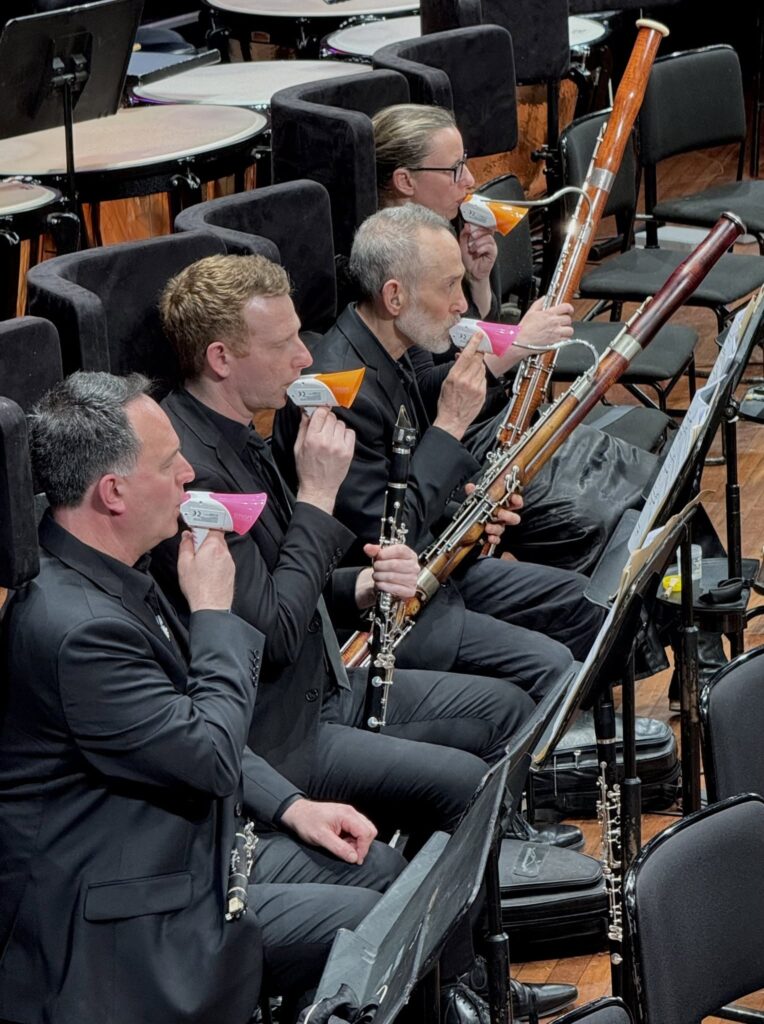 What could be taken on surface value for a magical fairytale sound-world of course had darker, bleaker and more ruinous implications, with Pearson’s evocative instrumentations graphically illustrating both the destabilising action and effects of increasingly confrontational weather-patterns and resulting conditions threatening present living environments with eventually uninhabitable conditions. Hand-in-hand with the ”thriil” of these near-virtuosic orchestrations came, of course, the realisation for us that these spectacular evocations were portents of doom in a sobering, “for whom the bell tolls” kind of way – all the more credit to the composer, therefore, in sounding so graphic a warning to humanity at large. The conclusion of the piece underlined its grim message with the players gradually enveloped in darkness as the sounds faded to silence. As befitted the piece, its presentation and performance, the reception at the end was overwhelming, with the composer making a warmly-acclaimed appearance!
There was no interval, but a kind of changeover process during which the Orpheus choir and brass band personnel filed respectively into their places, while Marc Taddei gave a brief outline of the freshly-published 2027 Orchestra Wellington concert prospectus – an exciting and stimulating season based upon “Dance” and affording all of us many a delightful listening prospect. That done, and a goodly proportion of the composer’s requirements regarding voices and instrumentalists having been brought into the performing arena, the stage was set for the “Requiem” to be set in its “leviathanic” motion.
The work’s mournfully-phrased opening gave notice of its proverbial “depths”, with lower and higher voices in tandem properly emphasising their “polar opposite” tones, the singing, with variously deep and pure tones combining with strings and winds to make an immense “carpet of sound”, as the cries of “Requiem” vied with the winds’ piercing, downwardly-cascading phrases After the tersely-delivered “Kyrie Eleisons” came the “Dies Irae”, introduced by black-toned double-basses, with Berlioz again using his sopranos, this time in tandem with winds, as a dramatic contrast, before bringing in the other voice-lines. Each group of verses was given its own level of purposeful intensity by agitated string passages, the “Quantus tremor” passages urgent and vigorous, leading up to the first of the work’s truly monumental passages, with brass choir antiphonally following and exchanging phrases with brass choir, two upper groups interacting with two lower groups and leading to the thunderous entrance of the percussion – a scalp-prickling moment, to which the men’s voices then added their stentorian cries of “Tuba mirum” as part of an enormous crescendo of sound, one which resorted to hushed tones for “Mors stupebit” but which then flared up excitingly once more at “Liber scriptus proferetur”. And how pathetic, energy-drained and fearfully wonderful was “Quid sum miser”, with its bleakly forlorn cor-anglais and bassoon accompaniments!
The tumultuous “Rex Tremendae Majestatis” outbursts, followed by the increasingly urgent ‘Recordare, Jesu Pie”, leading into “Confutatis maledictis” made for episodes of great and desperate excitement, the “prayer” becoming a compelling “theatre of supplication” before returning to “Rex Tremendae” amid piteous cries of “Salva Me”. The following “Quaerens Me” brought us some of the evening’s loveliest singing, the voices in unaccompanied . lyrical mode, pleading for forgiveness as was accorded Mary Magdalene and the Good Thief at Christ’s crucifixion, and a necessary respite when considering what was to follow.
This was the mighty “Lacrimosa”, the “day of tears”, Berlioz unsparingly giving the verses a harsh, jagged syncopated accompaniment from strings, winds and brass in rugged 9/8 time – two quieter passages gave some respite, but soon returned to the merciless onslaught with additional brass and percussion joining the fray as the choir wass spared nothing! The prayer rose towards its punishing finality, with every singer and player in the hall, it seemed, hanging onto those final utterances for all they were worth – a transfiguring moment, leaving at the end an exhausted, but still reverberating silence!
Into this “void left by a maelstrom” came the Offertorium, a deeply-moving work whose obsessively-repeated and anxiously unresolved vocal lines representing a kind of great anxiety, with the voices seemingly left abandoned in a wilderness, intoning a figure that oscillated between two notes without settlement or deliverance – meanwhile all around these voices the instrumental lines “wandered” as if enchanted or bewildered, the strings and winds aware of and responding to the text’s invocations of the “promise” made by God to “Abraham and his seed” – the beautiful moment at the words “promisisti et semini ejus” was here like balm for our senses, the music moving into the major key and generating a flowering of hope for deliverance into light and warmth – wonderfully and superbly-delivered! The following “Hostias”, with its hauntingly celestial key-changes generated by angelic winds (always reminding me of – and, of course, pre-dating – “Lohengrin”!) gave even further hope for salvation (but what creepily sepulchral brass-playing was sounded here at the end, affording scary glimpses into the abyss!).
Then came the equally spell-binding sequence with solo tenor Kyle Stegall, the single voice resplendently furthering Berlioz’s transfiguring fusion of the ordinary and the fabulous, backed up by celestial echoes and resonances from the choir (apart from a brief moment of strain for the sopranos in their “Gloria” utterances) – their “Hosannas” here joyously danced and exalted in response, as did the adjoining brasses at the end!
It was left for the “Agnus Dei” to usher in the drama’s final moments, with magical wind and brass chordings underpinned by strings giving the choir’s heartfelt utterances a kind of enduring luminosity, as did in contrasting ways the succeeding, entirely characteristic exchanges between the lighter strings and winds and the darker, more sinister brasses. More grounding was the return to the work’s opening, with the cries of “Requiem” punctuated once more by those well-remembered descending wind chords, but reaching a finality with the voices’ utterances resolving into “Quia pius es, in aeternum, Domine” (Because thou art forever merciful, Lord) and a series of heart-easing “Amens” with blissfully rising-and-falling string roulades underpinned by gently-throbbing timpani and string pizzicati which together concluded the work.
Such an accolade-exhausting achievement left one grasping vainly for further acclamations! To all the performers, enablers and organisers one needs must bestow very great gratitude at being presented with such a work brought off with all the elan, brilliance depth and variety that it needed to succeed. It takes its honorable place in the growing pantheon of memorable presentations by Orchestra Wellington and the Orpheus Choir, here enriched by the stellar contributions of so many local musicians who obviously relished their integral part in the proceedings. Both Marc Taddei’s and Orpheus Choir director Brent Stewart’s stewardship of this historic event will be remembered and appreciated for a long time to come.