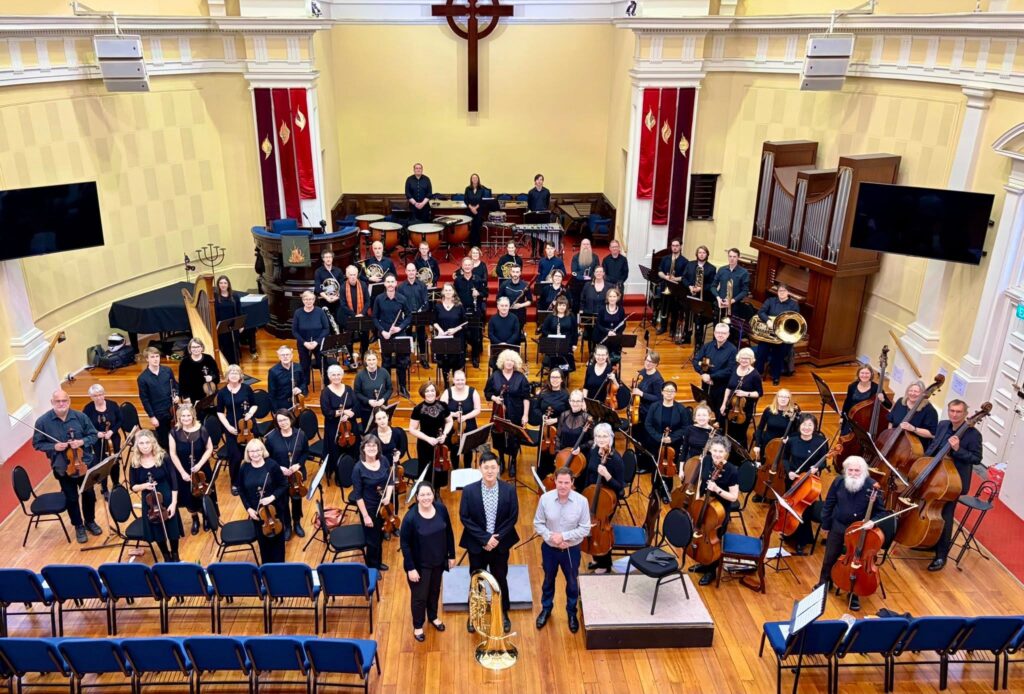
 Wellington City Orchestra with Virginie Pacheco, Sam Zhu and Ewan Clark
CLAIRE COWAN* ( Aotearoa New Zealand) – Legend of the Trojan Bird (2008)
EDWARD GREGSON (England) – Concerto for Tuba (1978)
AMY BEACH (United States) – Symphony in E Minor “Gaelic” (1896)
Sam Zhu (tuba)
Virginie Pacheco* (assistant conductor)
Ewan Clark (conductor)
Wellington City Orchestra
St.Andrew’s-on-The-Terrace, Wellington
Sunday, 21st June 2026
Winter Solstice day in Wellington! and with it a venturesome programme of music from the Wellington City Orchestra! True, there was little or no ostensible relationship as regards the pieces’ content to the Solstice date and its marking of the venue’s furthermost separation from the sun – but as the concert featured three pieces new to the orchestra’s schedules, the musical territories we were taken to today seemed to have an appropriate sense of something out of the ordinary. This was further underlined by the cosmopolitean nature of the works and their origins, almost as if the music-making was putting a kind of Shakespearean girdle about the earth, beginning very properly with homegrown sounds and straightaway circumventing the globe before returning to our south seas via the Americas!
I thought it all fell excitingly in line with the general adventurousness of the orchestra’s recent repertoire, in terms of the programme’s relative unfamiliarity, and its attendant technical and interpretative challenges. Each WCO concert over the last couple of seasons has sparked interest in what has seemed to me like an encouraging rejuvenation of Wellington’s concert-going scene – with an increased proportion of both new and less familiar works in concerts a stimulating feature
This concert was no exception, with a trio of works notable for its diversity as such, besides representing different eras of musical history, and a variety of genres, in this case a miniature version of an orchestral tone-poem (Claire Cowan’s 2008 ”Legend of the Trojan Bird”), a 1978 concerto for tuba and orchestra (from Englishman Edward Gregson) and a fully-fledged romantic symphony (1896) by the American composer Amy Cheney Beach. I’ve not been able to find any other instance of this latter work being performed in this country, which possibly gives the occasion the additional distinction of being an Aotearoa New Zealand premiere – though I would have thought the organisers would have made mentioned of such a circumstance had it been the case.
As with previous recent concerts, one of the items was assigned to the orchestra’s Assistant Conductor, Virginie Pacheco, in this case Claire Cowan’s concise and evocative work “Legend of the Trojan Bird”, one dating from Cowan’s student years, during which she wrote the piece for the Auckland Youth Orchestra in 2008. Though not printed in the programme, a poem, presumably written by the composer, outlines the music’s trajectories, the music in effect elaborating what the poem’s words describe – the coming of the bird to “the ancient city” bringing a “moving shadow” of darkness along with the visitor’s “dangerous beauty”. The music by turns depicted both the bird’s obvious mechanical attributes – “wooden wings flapping, squeaking, lurching and shuddering” along with more transformative modes, resulting in trajectories of soaring flight. Here, the rhythmic mechanical aspects become more vertiginous as the sounds “swoop, hover, soar”, before achieving, in its song a lovely “conversation with the neighbourhood of stars”- after which it disappeared as mysteriously as it had arrived. In every sense the scoring was magically ambient and ear-catching, holding one’s attention right to the mystical “stellar conversation” at the piece’s end. Conductor and orchestra achieved, I thought, miracles of evocation throughout every moment of the piece – a wondrous experience.
A different, more down-to-earth encounter was enacted by the performers in the next item, bringing both tuba soloist Sam Zhu and conductor Ewan Clark to the platform. This was English composer Edward Gregson’s 1978 concerto for tuba, a piece obviously indebted to the latter’s historic compatriot Ralph Vaughan Williams with his similarly-wrought work for the instrument – Gregson at one point in the first movement unashamedly quotes the earlier work in an appropriate act of tongue-in-cheek homage, bringing a smile to the faces of those “in the know”, though there were many more felicities to be enjoyed, such as the wondrously cavernous notes Sam Zhu coaxed out of the ambient depths slumbering within his instrument!
A second movement demonstrated in places the expressive range of the instrument, its lyrical, and, in places, somewhat anguished tones far removed from the humour and rumbustions of the opening, partnered by some haunting wind playing sequences, and featuring a great percussion-capped climax at one point before the music drew up its folds of sound and returned to its dark silences. We were given a “return to life” by the finale, with marching pizzicato at the outset accompanying some jolly “tuba-triplets” and which then morphed into a festive dance! Sam Zhu’s instrument then gave us an almost lullabic moment with some pendulous winds as well as a briefly-philosophical like cadenza, before being marched off triumphantly at the end by the band as if “spoils from a day’s successful tuba-watching” – a great success!
So to the concert’s much-awaited second half and a symphony by the remarkable Amy Beach,a work which, at the time caused quite a stir with its first performance in Boston in1896, as it was the first symphony composed by an American woman to be performed by a major orchestra. Beach had begun her musical career primarily as a pianist, and had already appeared as a soloist with the Boston Symphony when just seventeen years of age. However her marriage shortly afterwards resulted in her giving up her performing career for a number of years and concentrating upon composition. Largely self-taught, she drew her inspiration from both the “classics” and from the music that was still new in the 1880s, Brahms, Wagner. Liszt and Dvorak. Her compositions beside the Symphony included a Piano Concerto, a Mass and many chamber works and songs, which, after a period of neglect, are finding their way back into recent concert schedules everywhere.
Beach was a member of a group of composers from New England whose goal was to develop a uniquely “American” style of composition through combining traditional classical structures and forms with indigenous melodies and rhythms (such as Afro-American spirituals and folk melodies (Antonin Dvorak, who lived and worked for a period in New York was a passionate advocate of this principle in his composition teaching at the American National Music Conservatory). Beach’s contemporaries included George Whitfield Chadwick, Horatio Parker, John Knowles Paine, Arthur Foote and Edward MacDowell – despite the esteem she was held in, she still had to overcome prevailing attitudes towards her “women composer” status, even when positively expressed – it was Chadwick who, when congratulating Beach on the success of her Symphony, described his “thrill of pride” that such a fine work had been produced by someone whom he considered had become “one of the boys”! However, Beach was determined also to advance women’s composition activities, helping to establish a Society of American Women Composers in 1925 and supporting the compositional careers of several who became known and admired, among them Margaret Ruthven Lang, and Mabel W. Daniels, as well as the French-born Cecile Chaminade.
Beach’s Symphony in E-flat was given the name “Gaelic” because of her use of the technique of using “music of the people” for thematic and rhythmic inspiration as advocated by Dvorak, though with a significant difference – her “indigenous” affinities were with the folk-song and-dance material brought to America by her English, Scottish and Irish forbears, and the predominately ”irish” origins of the songs and dances quoted in the Symphony resulted in the work’s subtitle. She quoted the idea of the folk-themes expressing “the laments of a primitive people – their hopes and their dreams”.
Written between 1894 and 1896 this was Beach’s only Symphony, and fully expresses her determination to capture the flavour of the “music of the people” she knew best – the “Allegro con fuoco” opening of the work immediately expresses a rich, dark chromatic Romanticism, reminiscent of some of Liszt’s and Wagner’s music, mysterious swirlings punctuated by great calls and declamatory gestures. Solo winds then quoted from both Beach’s own music, a song “Dark is the Night” and from a Gaelic dance-tune, with solo clarinet, oboe, flute and horn splendidly doing the thematic honours, their traditional exposition, development and recapitulation roles coming to the fore throughout the movement, and with remarkably assured support from strings, brass and percussion in various sequences.
The second movement charmingly began “Alla Siciliana” before transforming itself into an Allegro vivace – lovely work at the outset from the solo horn, followed by the oboe quoting a beguiling Irish tune “The little field of barley” (along with other winds), after which the strings magically ushered in dancing, scampering and rumbusting textures to captivating effect! – a sudden luftpause then brought horn, clarinet and flute as harbingers of a gorgeous cor anglais rendition of the “Little field” melody, to which the strings and brass addeed their voices, and the various winds “paired up” with fragments of the melody, until the scampering strings returned to round off the movement’s fairytale enchantment!!
The brasses announced the opening of the third movement’s “Lento”, which the winds carried on, before the solo violin presented a kind of recitative, joined by the solo cello – we then got an evocative melody called “Cushlamachree” led by the ‘cello and joined by the oboe, and strings. This led to an epic, almost “Smetana/Ma Vlast-like” section featuring a series of “great views” from the whole orchestra, the solo horn leading the way in a series of wind and brass solos cycled about the orchestra! soundscape, with beautiful solos aplenty! The solo violin adroitly introduced a major-key melody – presumably one called “Which way did she go?” – which built up to an almost angst-flavoured climax, before restating the first melody, Beach here displaying her compositional mastery with variants of the themes in major and minor, and with the interchanges brought to a particularly piquant conclusion.
I had found the symphony’s finale something of a protracted puzzle on first hearing a recording, but this performance held the structure together steadfastly and seemed to make everything work, right from its vigorous and declamatory “ready! – set!” introduction, indicating the onset of an adventurous journey – after this vigorous opening came a lyrical counter-subject in a major key, not unlike that in the finale of Sergei Rachmaninov’s E Minor Symphony, written a decade or so later. A strange, moodily restless passage followed, which took some time to build back the energies of the opening, the players keeping their heads and fiercely concentrating upon the music’s “search for redemption” which came with the horns sounding the alarm and rousing the brass and the rest of the orchestra to readiness! With that, and the major-key second subject’s return, the skies suddenly cleared, and the music raced to its close as jubilantly and decisively as might have been expected.
I thought, at the end of the work, that Ewan Clark and the WCO players had completed something of a major achievement, here – such an enthusiastic and spankingly capable performance! We were left to all babble our way homewards at the joy of such a discovery, and of experiencing a whole afternoon’s feisty and absorbing listening!