New Zealand Opera presents Mozart’s “The Marriage of Figaro”
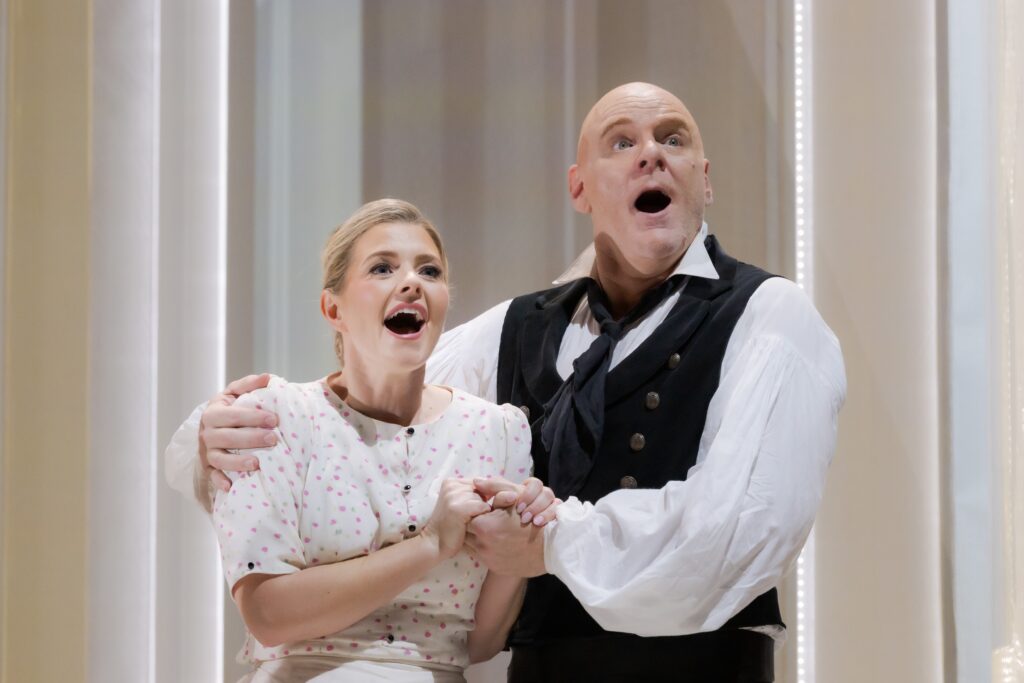 Sophie Sparrow as Susanna and James Clayton as Figaro – Photo: Stephen A’Court
Composer: Wolfgang Amadeus Mozart / Librettist: Lorenzo da Ponte
Based on Pierre-Augustin de Beaumarchais’ 1778 play “Le Nozze di Figaro”
Cast: Figaro – James Clayton
Susanna – Sophie Sparrow
Count Almaviva – Julien Van Mellaerts
Countess Almaviva – Felicity Tomkins
Cherubino – Cecilia Zhang
Marcellina – Kristin Darragh
Bartolo – Andrew Collis
Don Basilio / Don Curzio – Andrew Grenon
Barbarina – Sarah Mileham
Antonio – Joel Amosa
Bridesmaids – Barbara Graham, Charlotte Secker
Freemason Foundation New Zealand Opera Chorus
Orchestra Wellington
Conductor – James Judd
Chorusmaster Laureate – Michael Vinten
Principal Repetiteur and Continuo – David Kelly
Chorus Repetiteur – Bruce Greenfield
Director – Lindy Hume
Assistant Director – Eleanor Bishop
Set and Costume Design – Tracy Grant Lord
Lighting Designer – Matthew Marshall
Choreographer – Taiaroa Royal
St James Theatre, Wellington
Wednesday 17th June 2026
This was an opera audience that bubbled with pleasurable satisfaction long after the bringing down of the curtain at Wellington’s St.James Theatre on Wednesday evening earlier this week. NZ Opera’s eagerly-awaited (and at that time glowingly-received) 2021 production of Mozart’s “Le Nozze di Figaro” was meant to come on to Wellington following its season in Auckland that year – however, Covid intervened, forcing a last-minute Level 2 lockdown directive which put paid to Figaro’s performances in the capital ( Christchurch, which got three subsequent performances, was luckier than Wellington on that occasion).
Now, it was at last Wellington’s turn to enjoy director Lindy Hume’s and designer Tracy Grant Lord’s much-acclaimed “take” of Mozart’s classic work, with the intervening years up to 2026 having inevitably “honed” 2021’s presentation, most obviously in terms of having a different cast bringing its own singular talents to the revival and recreating in the ever-grateful St James’ scenario a uniqueness of its own! I wasn’t able to see the 2021 “live-streamed” final Christchurch performance which NZ Opera had thoughtfully provided for its thwarted Wellington patrons, so (like many of the audience would have done) was able to come entirely freshly and all the more eagerly to this production!
I’d previously enjoyed a number of NZ Opera presentations directed by Lindy Hume, beginning with a stunningly visceral, almost “too-close-for-comfort” presentation of “Rigoletto”, as far back as 2012; and most recently – rather closer to the ethos of this evening’s subject – a “Cosi fan tutte” in 2023 which unsparingly brought out the ambiguities of human relationships between the leading characters with disconcertingly unease! So I was looking forward immensely to what insights Hume (and her inspirational designer for “Cosi”, Tracy Grant Lord) would uncover for us with this work – one that still resounds in my own memory as a precious “formative opera experience” from as long ago as 1971!
From the outset I was enchanted by the set and its all-encompassing “lit from within” qualities, the constant fluidity and variegation of both parameters and illumination taking us through as much a “journey of the imagination” as a series of spaces wrought with the work’s constant flux of both wilful interaction and judicious concealment in mind. Hume described the spaces created by readily moveable walls and doorways as suggestive of on-going change, as the opera’s action (a single day) unfolds its course from early morning until late at night and the characters move from scenario to scenario, firstly inside and later, outside the house, and in the garden. Tracy Grant Lord’s set and costume designs and Matthew Marshall’s lighting together simply enfolded us in a kind of timelessness about it all, recognisably as much a scenario from 200 years ago as in a large and modern country house, leaving us in the audience to “flesh out” whatever era from that time we could imagine through our own reactions.
What came across as forcefully here as in the 2023 “Cosi” production was the depiction of emotional disruption to societal order which both Mozart and his librettist Lorenzo da Ponte took pains to depict and examine – and while in both cases a semblance of that “order” was restored to the lives of the characters, much deeper undercurrents had been irreversibly plumbed by all the parties. And as Lindy Hume points out in her insightful notes in the programme, the women were the ones who instigated the changes in “Figaro”, presenting in no uncertain terms a new vision of a society being “remade”. Perhaps if Mozart had lived for longer, might he and da Ponte might have further pursued an operatic version of the original author Beaumarchais’s third play “La Mère coupable” (The Guilty Mother)? We will never know…..
Here in 2026 we were given everything envisaged by composer and librettist – there was comedy, intrigue, anger and pathos in this presentation, with all of the characters at one stage or another revealing or disporting strong and varied émotions, subject in places to rapid change, and instigating a kind of volatility associated with societal disturbance and disruption, either of authority or of deep feeling. Whether in a kind of soliloquy, or accompanied by interaction, these different expressions were wholeheartedly conveyed, in recitative or in set pieces, solo or concerted, with every character suitably “enlarging” her or his personality in the process.
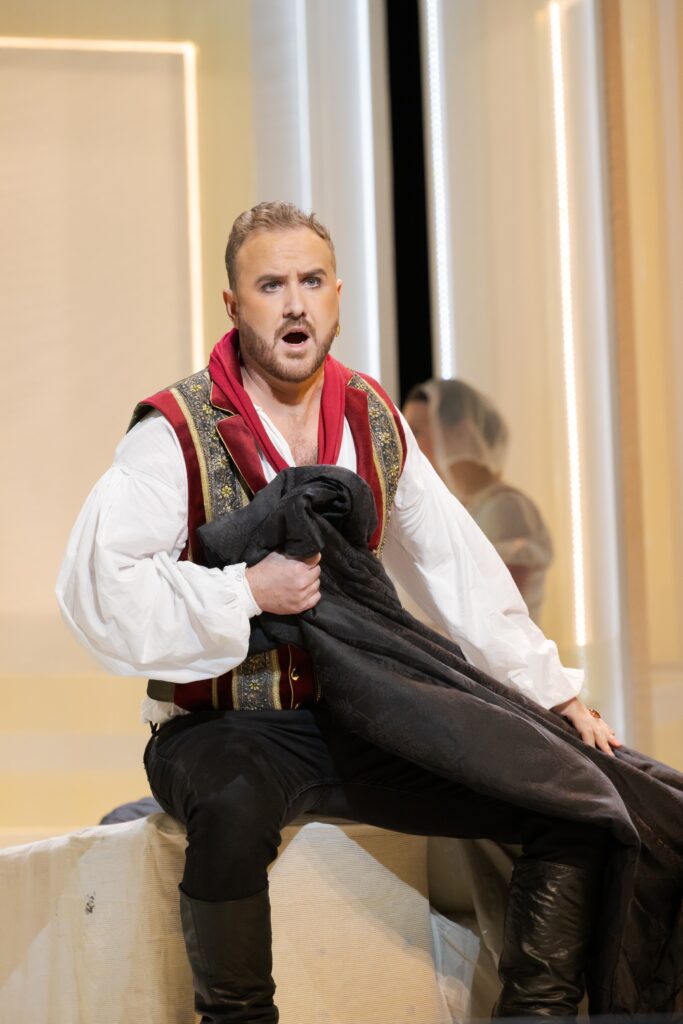 Julien Van Mellaerts as the Count – Photo: Stephen A’Court
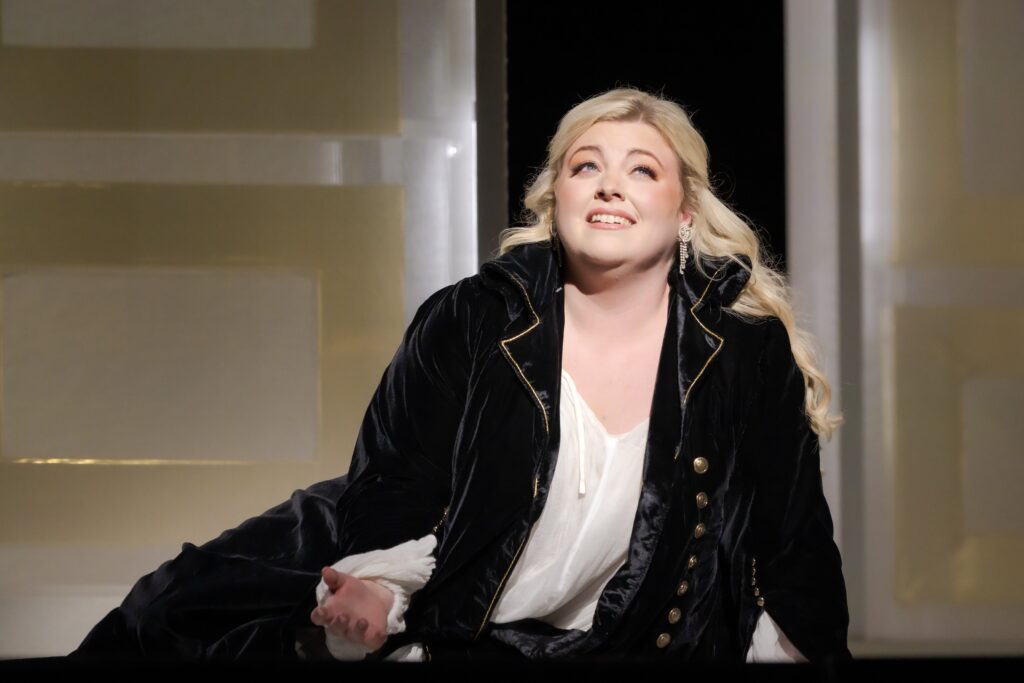
Felicity Tomkins as the Countess – Photo: Stephen A’Court
In that sense, the work was a perfect “ensemble” piece, whose dramatic coherence rested upon upon teamwork, with timing and balance adroitly kept on the rails by conductor James Judd, with every portrayal, including the lesser characters, prospering in partnership with others. As Figaro, James Clayton’s robust baritone, and Sophie Sparrow’s ever-mellifluous soprano as Susanna brilliantly encompassed their pairing’s ebb-and-flow dynamics besides keeping on the boil their various parallel relationships with co-conspirators and adversaries – everything had an inventiveness and volatility which kept the audience guessing as to “how”, regardless of knowing “what”. Figaro’s and Susanna’s upper-class equivalents, the lascivious Count Almaviva (Julien Van Mellaerts) and his long-suffering Countess (Felicity Tomkins) were dynamic adversaries/eager collaborators in terms of their own relationship, Van Mellaerts with his quick, flexible baritone the perfect foil here for Tomkins’ sympathetic and warmly-appealing soprano.
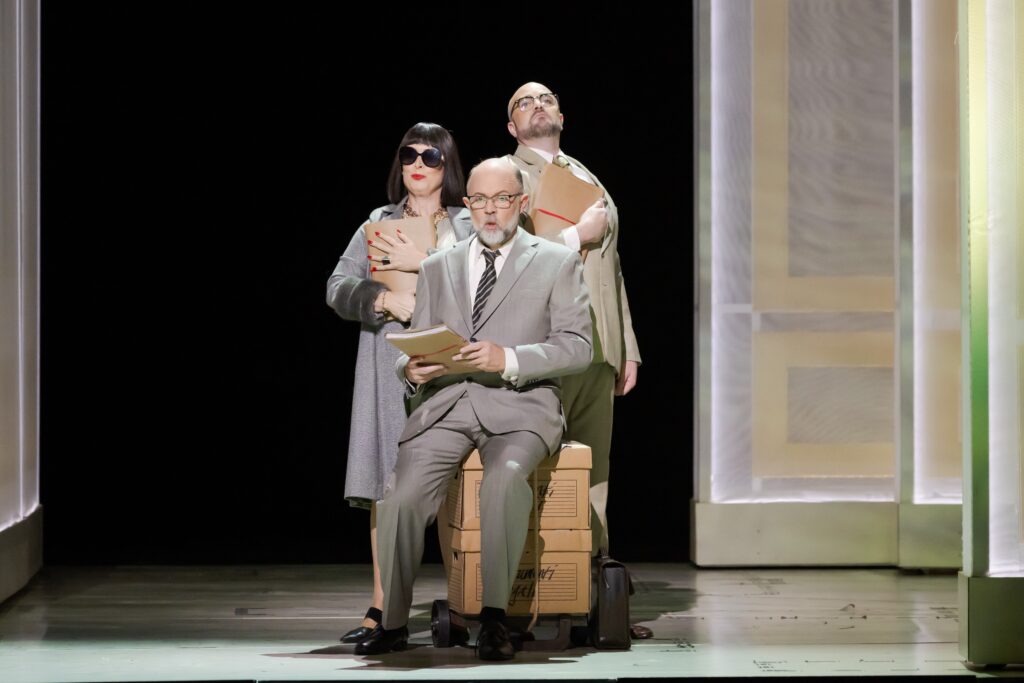 Kristin Darragh (Marcellina), Andrew Collis – front (Bartolo), and Andrew Grenon (Don Basilio/Don Curzio) – photo: Stephen A’Court
Into this quartet of conflict came the vengeful pairing of Marcellina and Bartolo, each with an axe to grind regarding the luckless Figaro – Kristin Darragh was a gorgeous, fulsomely acquisitive Marcellina, here in tandem with the initially less dynamic Bartolo of Andrew Collis, whose decidedly oldish portrayal did, however, manage to gather some momentum during his “La vendetta” aria – and together the pair’s subsequent Act Three rediscovery of their own parentage of Figaro himself got the biggest laugh of the evening – in a production already replete with humour, a great moment!
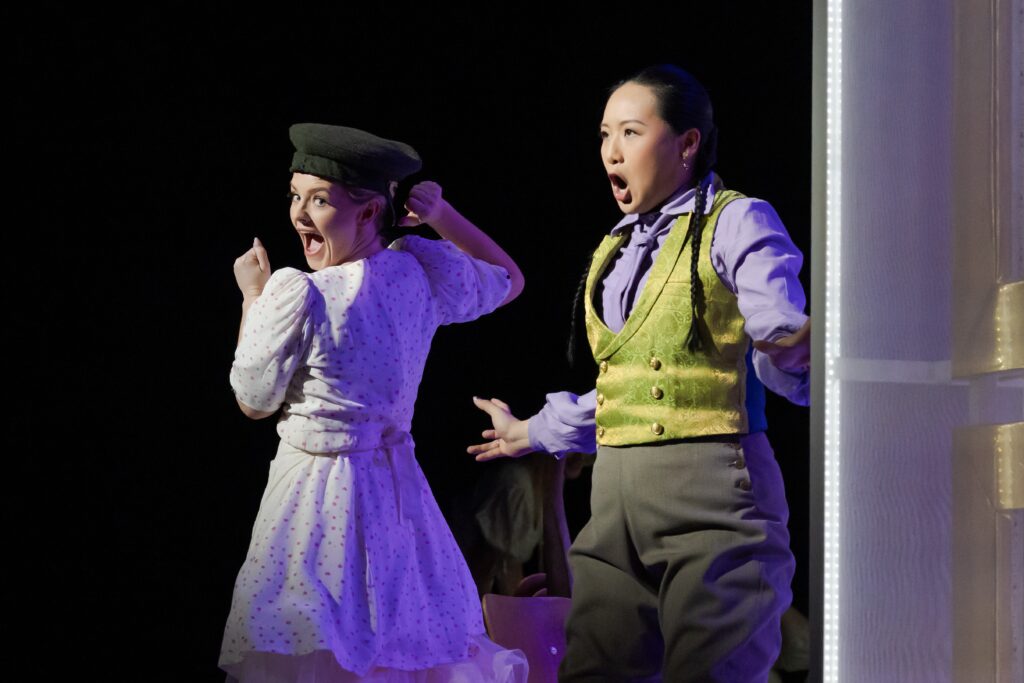
Sophie Sparrow (Susanna) and Cecilia Zhang (Cherubino) – photo: Stephen A’Court
Diverting opposites were mezzo-soprano Cecilia Zhang’s quicksilverish, testosterone-ridden pageboy Cherubino, her voice and presence replete with pubescent urgings (in one instance graphically suggestive via an item of the countess’s clothing!), and Andrew Grenon’s delightfully first-up artless Don Basilio, whose drollery effectively (if only temporarily) masked his character’s true oily nature, bent on mischief and mayhem at whomever he’d been primed to target. Grenon here did an adroit double-act as Don Curzio, the Judge summonsed by Marcellina to formalise the intended marriage between her and Figaro. There was also Sarah Mileham’s Barbarina (a servant-girl) played innocently and sweetly in her defence of Cherubino against the Count, and adroitly-voiced in her “notepin” aria, alongside two effective cameos from bass-baritone Joel Amosa as the slightly drunken and suitably affronted gardner, Antonio.
The chorus’s brief but deftly-timed festive entrances overlaid the Count’s scheming with suitably rustic-sounding innocence and charm, besides providing an atmospheric backdrop of « daily task » activity just outside and around most of each acting area – an inspired production touch! All of this was buoyantly propelled by James Judd’s variegated direction of some superb orchestral playing by the Orchestra Wellington players – from the stirring strains of Cherubino’s “off to the battle” military pomp and vigour, through the gaiety of the rustic celebrations to the tenderness of the music for the Countess’s heart-rending moments of amatory sorrow, and, at the end, relishing and delivering wholeheartedly the opera’s rejuvenating message of hope for the human condition in the best universal sense via Mozart’s glorious music.
.