“Something old, something new…” – the Elementi Trio at Futuna Chapel, July 2026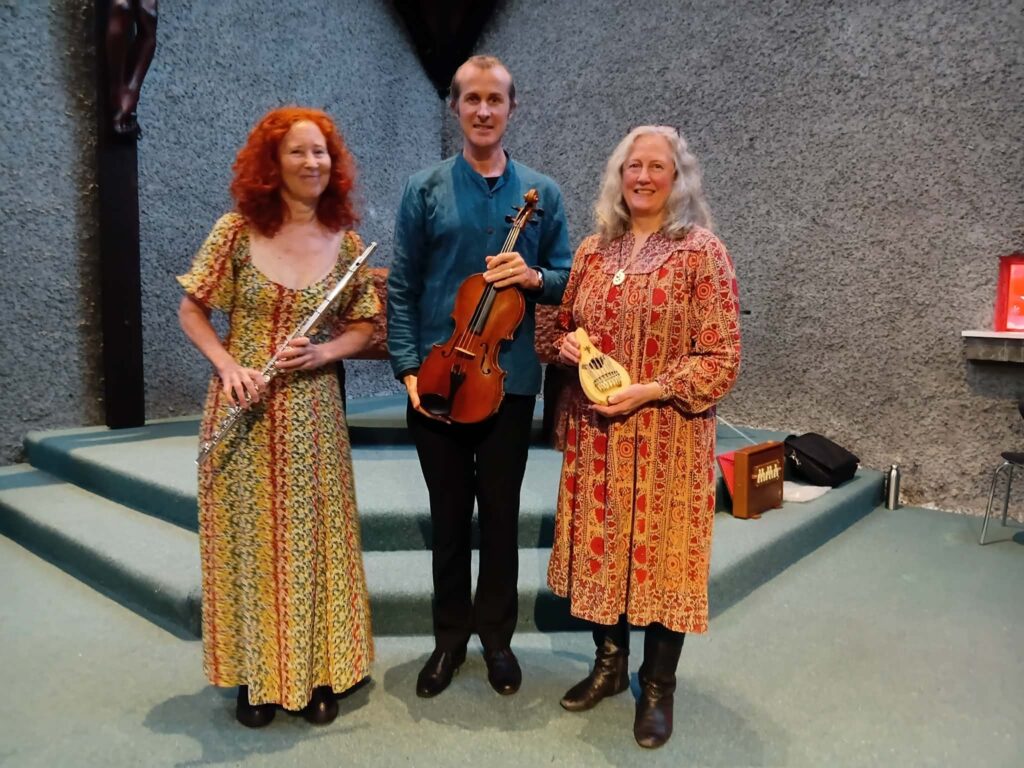 Monica Verburg, Nicholas Hancox and Pepe Becker
ELEMENTI TRIO –
Monica Verburg – flute, alto flute
Nicholas Hancox – viola
Pepe Becker – soprano, thumb piano (mbira)
Futuna Chapel, Karori, Wellington
Sunday, 5th July 2026
Sitting in Futuna Chapel, in Karori, on a recent Sunday afternoon, listening to a concert of music given by a trio of extremely talented performers (flutist, violist and soprano vocalist), I found myself thinking at various stages of the concert about the sheer beauty of the sounds being brought forth by these musicians. I’m sure that, given the singular beauty of the venue’s overall atmosphere, ambience and amalgam of design and colour, I was allowing those qualities to infuse the music’s impact beyond the realms of a simple auditory response and into a kind of totality of experience that transcended “normal” listening. Be that as it may, the effect of these different factors conspired to produce a level of enjoyment of this concert’s music-making that has stayed with me right up to this moment.
Interestingly, the very first item of the concert seemed to me as much a “test run” by the performers, almost a “getting the pitch of the hall” kind of run-through with an audience present for the musicians to be able to sound out things like the balances between the instruments and the voice, and the degree to which the sounds “come back” from the peopled ambient spaces. I did find this first item (Thomas Morley’s madrigal “Arise, get up, my dear” a trifle chaotic in its full-blooded amalgam of sounds – and yet the music is actually about incidental chaos, being Morley’s musical description of the hustle and bustle of a new bride’s wedding day. More spacious and wide-ranging was Pepe Becker’s singing of Hildegarde of Bingen’s “O Euchari” which followed, the singer enabling her voice to “ring down the ages” from Hildegard’s time, with Nicholas Hancox’s viola steadily recreating the age-old drone accompaniment. A third item completed an opening “triumvirate” of the concert’s range and scope, featuring a home-grown work, Pepe Becker’s own setting of a sixteenth-century poem “T’amo mia vita” (I love you, my life) by Giovanni Battista Guarini, originally written for three voices and mbira “thumb piano” but here recast by Becker for soprano, viola and mbira – the latter is an African instrument and was played here by Becker herself, its sound creating a kind of timeless, tonally transcendent “voice”. The words of the poem have a universality which here seemed to fit the composer’s revised setting as much as it must have her all-vocal original!
We heard three more of Pepe Becker’s by turns playful, declamatory and darkly visionary pieces placed separately throughout the concert, the delightful “Two Tui” a work for flute premiered by Bridget Douglas in 2010, and essayed here most viscerally by Monica Verburg, the music based on two separate calls associated with different places in Wellington, and brought together as a kind of dialogue, with a petulant dismissive squawk of one bird at the other’s expense at the end! Becker’s more expansive, almost ritualistic piece, “Scorpio II – From the far point of the Rising Sun” featured her soprano voice enacting a kind of ritual exchange with the solo flute. Long, sonorous lines alternating with stately roulade-like flourishes before the dialogues become intricate and earnest (though no words were provided – I presumed the singer’s phrases were in Latin), the lines occasionally mirroring one another before concluding the piece with some brief mirror-image shared phrasings. Most suggestive for me was her darkly resonant tribute to Sagittarius, a setting of William Blake’s “The Tyger” a work Becker dedicated to her father, along with her “many Sagittarius friends” – something of a “Do not go gentle into that good night” work of darkness and angst, the sombre tone set by Nicholas Hancox’s opening viola chord, though the trio fetched up more incisive and trenchant tones for the poem’s “fearful symmetries” (it was a work composed for this concert, in fact!).
Bringing her own creative talents to this cornucopian assemblage was flutist Monica Verburg, who contributed no less than two recently-completed pieces for premiering at this concert, the first one a heartwarming and environmentally topical work titled “To the Hills” (Ki ngā puke), being inspired by a recent campaign of conservation of Otago’s Dunstan Mountains. Verburg drew our attention to the piece’s influences, a certain “Celtic flavour” in accord with early European settlement of this area, and which the trio of musicians made much of in performance throughout the piece’s three sections, The other recent work of Verburg’s was “In the Slipstream” a delight for the ear in its interplay between two instruments, flute and viola (the flutist often swapping between flute and alto flute in her performances, which variation, to my shame, I seem to have neglected to draw any attention to in my notes – mea culpa!) Here, the two instrumental lines imitated, shadowed and mimicked one another constantly, with (I thought) occasionally bluesy inflections spicing the sounds ever so slightly, as the music, by turns teased and blended its two strands before drifting into a pensive ending.
Monica Verburg was as well responsible in full or in part for four other items, two of them original works and two arrangements, the first original work “Turn Your Eyes”, originally composed in 2024 for soprano and alto recorder, and then rewritten for soprano, flute and viola – the words were based on the text from Proverbs 4:25 “Let your eyes look straight ahead….” Though the combination of tones made it impossible for me to decipher any of the actual text, the sounds in tandem, though brief, were themselves glorious! We then heard a song “Ocean Breeze” (aha! – in my notes is a mention of the ALTO flute!) – here, Pepe Becker’s soprano and Monica Verburg’s instrument were wistful companions at the song’s opening, one whose melody readily caught the ear in balladic fashion! The two arrangements made by Verburg were for larger-scale forces as one might have expected in her grand setting of Giovanni Gabrieli’s “Jubilate Deo” with its splendidly ceremonial trappings, not to mention the fulsomeness of the text – “Shout joyfully to God, all of the earth!” – what attention-grabbing gesturings (suggesting, of course, antiphonal voices) and declamatory utterances, complete with brief, wistful occasional minor-key harmonic turns, just for variety! Great stuff!
Before I mention in conclusion the concert’s final item (Verburg’s second “arrangement”) I need to recap with still more “gems” which came up in passing – one was non-vocal, Jack Body’s “Aeolian Harp”, here most evocatively realised by Nicholas Hancox’s viola, capturing the piece’s extraordinary and irresistible frisson of intensities gleaned from nature’s random impulses. Then there were three medieval “pop” numbers from the fourteenth and fifteenth centuries, the earliest of which was Guillaume de Machaut’s “Douce Dame Jolie” (Sweet. Lovely lady) – performed here with the viola as the drone instrument and the flute as a companion for the voice – what an uncanny sense of time and place, here, with music making its way to us centuries later! Of the two other later works, one (“Quel fronte signorille” (That noble brow) by Guillaume Dufay) had a similar “courtly love” sentiment no less resonant and focused than de Machaut’s, while the other (a motet “Quam pulchra es” by John Dunstable) was by contrast an unashamedly erotic setting of words from the Biblical “Song of Songs”, its performance here suggesting a parallel musical “enchantment by beauty”.
By the time we reached the programme’s final item everything seemed suffused with a spirit of complete capitulation towards the music and its making, one suitably enhanced by Monica Verburg’s inspired arrangement of this concluding music. Flute and viola began the “thistledown on the wind” introduction, the former extempore and the latter holding a firm foundation line. The scene having been set, the voice then entered with the famous melody “Hine e Hine”, one written famously by Princess Te Rangi Pai (the stage-name of Fanny Rose Poata – b.1868 d.1916), composed in or around 1907. It felt like a kind of “homecoming”, one returning to something deeper than the present, and with enveloping tendrils of belonging, easier to “feel” than to explain. But in tandem with the glories of the venue in which we had enjoyed these sounds it “rounded off” for me (and for others I spoke to at the time) a most agreeable afternoon’s music-listening!
take a look at the site here [url=https://cs2-skins.net/]trade cs2 skins[/url]
https://shorturl.fm/6tW1w
читать [url=https://vd-vodkabet.com/]vodka.bet[/url]