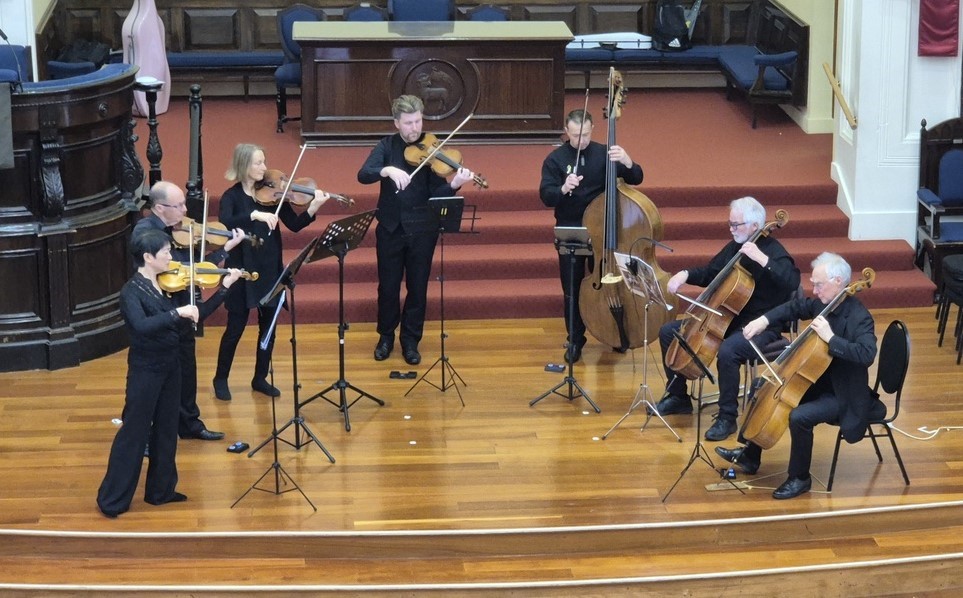
 AROHA STRING QUARTET – International Music Academy Tutors Concert
ASTOR PIAZZOLLA (1921-1992) – Tango Ballet (1956) – arrangement for string quartet by Jose Bragato
RICHARD STRAUSS (1864-1949) – Metamorphosen for 23 solo strings (1945)
– arrangement for 7 solo strings by Rudolf Leopold (1996)
Members of the Aroha String Quartet International Music Academy Tutors –
Haihong Liu, Donald Armstrong (violins) / Eli Vincent, Konstanze Artmann (violas)
Robert Ibell, David Chickering (‘cellos) / Oleksandr Gunchenko (double-bass)
St Andrew’s-on-The-Terrace, Wellington – Lunchtime Concert
Wednesday, 15th July, 2026
The Aroha String Quartet’s International Music Academy meets every year in Wellington for six days of intensive music-making, involving workshops, coaching and rehearsals, an event organised and run by the Quartet members themselves and the Academy Administrator Cathie McCallum. This year close to forty non-professional string players from around New Zealand and Australia were brought together for workshops, coaching and rehearsals, which result in various concerts involving the players and the guest tutors, and featuring works for both chamber and orchestral forces.
One of these concerts, featuring firstly the Aroha Quartet players themselves, and then in partnership with several of the Academy’s tutor-musicians brought a large lunchtime-concert audience to St.Andrews’ for what promised to be a special event – we were given repertoire out of the usual “run” of things for a string quartet – a “Tango Ballet” by the Argentinian composer Astor Piazzolla (written originally for his own ensemble, the “Octeto Buenos Aires” in 1955 – a string quartet version of this work was made by Jose Bragato, the composer’s regular “collaborator”), and then followed by a work from Richard Strauss written in 1945, originally for seven players but then recast as the “Metamorphosen for 23 solo strings” version we normally hear (this performance was of a 1996 reconstruction of the “original” by Rudolf Leopold).
Consequently, it was very much a concert of two halves, beginning with the Piazzolla work which delighted on all fronts from the outset – Piazzolla’s “Tango Ballet” sought to “expand” the traditional associations of the dance into various adaptations of mood and situation, using a narrative not dissimilar in technique to George Gershwin’s “An American in Paris”, namely, a series of impressions of city life (in Piazzolla’s music’s case, Buenos Aires, of course!). The work’s introduction features the solo violin vertically effervescing with energy, the accompanying strings at first taciturn in response, but then rolling into a swinging rhythm, the impulses sufficiently and enticingly “held back” by way of suggesting greater excitements to come…..the following “The Street” gets the rhythms walking with ever-growing excitement, the upper strings dancing over the cello’s ever-jaunty strides and eventually rushing up and down in a ferment of exhilaration, which then unexpectedly quivers to a halt, as if transfixed by a sight, a feeling, a happening – what could it be?…
The score bears the title “Encounter”, suggesting a meeting, bringing bewilderment, perhaps bashfulness, or beguilement, an awkwardly romantic moment (Eli Vincent’s viola here contributes a wonderfully-played and smokily suggestive moment of discombobulation towards the end) – when suddenly the music breaks into the mood with “Cabaret” , with the rhythms bouncing all around and about, the energies having an almost animalistic “impulse without thought”, but which then drain disconcertingly to a near-silence. It’s the work’s most profound moment, and one which the composer’s favoured instrument, the bandoneon is almost certainly suggested in this movement’s introspectiveness, as befits its title of “Solitude”. The music drifts downwards, the lower strings’ despairing tones icily accompanied by violin tremolandi, the latter then taking up a heart-wrenching melody, very harmonically “free’ and played with heartfelt focus by Haihong Liu.
And so, life goes on, as the music returns to the mood of the opening, heralding the concluding “galop” with lots of fanfare-like gesturings, and bringing the work to a close with a few flavoursome “tough” harmonies leaping off the bowstrings and into the excited resonances of the conclusion.
One couldn’t have asked for a more contrasted ambience than from the work by Richard Strauss which followed – this was a piece given here by seven string players which the composer had first sketched out in response to a commission from the famous Swiss conductor Paul Sacher in 1944. The conductor had wanted a work for string orchestra, so the sketch was amplified to a work for 23 solo strings, and given the name “Metamorphosen” by the composer, inspired by the writings of Johann Wolfgand von Goethe whose ideas had expressed, over a century beforehand a metamorphosis of living things through constant transformation and renewal.
By this time the ageing German composer had become sickened by the war’s gradual destruction of so many hallowed locations throughout Germany and Austria which he had held sacred as representative of Germany’s art and culture. He was to write in his diary, after finishing “Metamorphosen” in May 1945, “The most terrible period of human history is at an end, the twelve-year reign of bestiality, ignorance and anti-culture under the greatest criminals, during which Germany’s 2,000 years of cultural evolution met its doom” . Though the despair Strauss felt at the loss of so many cherished symbols of his country’s art and culture was palpable, his choice of a title for the piece seemed, however subconsciously (and at that time remotely), a gesture akin to planting a Goethe-like seed of renewal in the face of such destruction.
In fact Strauss’s fellow-composer Gustav Mahler had similarly expressed in his own music many years before something of the same dark despair in the concluding pages of the latter’s Sixth Symphony – and, of course, both composers were to emerge from their separate “dark nights of the soul” and go on to compose subsequent works of searing beauty, Mahler with his “Das Lied von der Erde” and his Ninth Symphony, and Strauss with his equally glorious “Four Last Songs”.
The themes Strauss crafted for “Metamorphosen” are partly his own and partly those of his idol Beethoven, directly evoking memories of the latter’s “Funeral March” from the “Eroica” Symphony. In this performance of the composer’s original septet version (reconstructed by Rudolf Leopold in 1996) the themes inevitably stand out more clearly than in the full, 23-instrument version, though the ambiences are inevitably different, and in some ways more intense for listeners, who are perhaps encouraged to “move more closely” to a smaller group, rather than settle back and revel in the lusher, fuller sound of the bigger ensemble.
I had not heard this “chamber version” before, and, not unexpectedly, found it revelatory, in as much as that “moving closer” sensation brought upon by greater intimacy with the sounds, enabled the music to “strike home” even more tellingly (ironic though it might seem when one thinks of the sonic impact of a large group of strings!), Of course there have been many great recorded performances of the work in its “full strings” version – and I also recall a superb performance from as distant a time as 2010 from the NZSO strings with Pietari Inkinen here in Wellington, all but the ‘cellos standing, and everybody playing their hearts out!
With the Aroha Quartet players and three others whose names are indelibly associated with the NZSO, Donald Armstrong (violin), David Chickering (‘cello) and Oleksandr Gunchenko (double bass), there was no question regarding the brilliance, fluency and commitment of the playing of these musicians in this work, which was thrilling! What I came to realise, shortly after the work began, was the extent to which this music quickly overflowed its expressive parameters as I listened, transcending its composer’s original intention of commemorating the destruction of a culture at a specific time and in a specific place, and prompting – no, in fact, URGING me to bring to mind the world’s present-day happenings of destruction and desecration of whole peoples and their cultures by forces whose originators and proponents one might well accuse in turn of “bestiality, ignorance and anti-culture” and as our own era’s “greatest criminals”! Strauss himself might have been obsessed with his own personalised despairings via this work, but his brilliant stroke of introducing motifs from the music of one of the world’s most oft-acknowledged sympathisers towards and spokespersons for mankind in general, here completely and utterly transcended any boundaries of time, place and circumstance relating to the original 1945 work.
Certain concerts take it upon themselves to be enshrined in the memory, especially those whose performances are enabled by the players to speak with an eloquence that transcends the ordinary – sometimes even to the point where the music-making reminds us, however uncomfortably, that we live in a world in which “Humankind cannot bear very much reality”…….this concert took me into the sobering, on-going realities of those words and the resultant sufferings of people, then and now, and everywhere…..