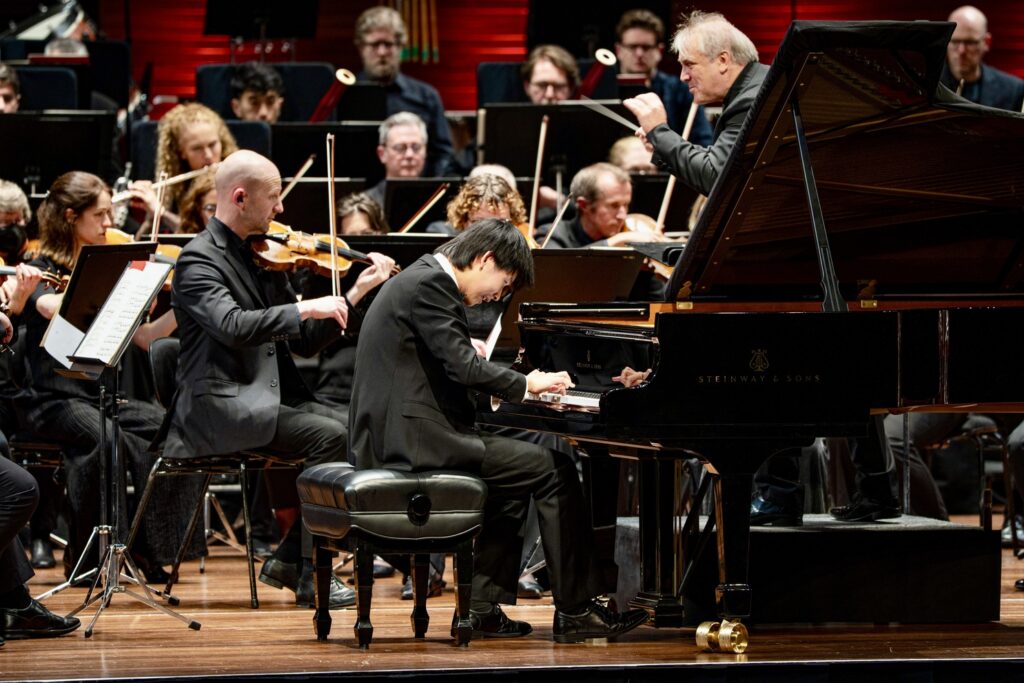
 Shan Liu (piano) with Jaime Martín and the New Zealand Symphony Orchestra – photo, New Zealand Symphony Orchestra
KALJA SAARIAHO (1952-2023) – Lumiere et Pesanteur
SERGE PROKOFIEV (1891-1953 – Piano Concerto No. 3 In C Major Op.26
PYOTR ILYICH TCHAIKOVSKY (1840-1893 – Symphony No. 4 in F Minor Op.36
Shan Liu (piano)
Jaime Martín (conductor)
New Zealand Symphony Orchestra
Michael Fowler Centre, Wellington (Te Whanganui-a-Tara)
Friday, 24th July 2026
Review by Peter Mechen (Middle C / Seen and Heard International)
This concert by the New Zealand Symphony Orchestra was given the title “Let There Be Light”, a quotation from Genesis 1:3 in the Bible, depicting the creation of light upon the earth and its division from darkness – a theme which took different manifestations in the three works given in this evening’s concert by the New Zealand Symphony Orchestra and its guest conductor Jaime Martín, along with a major contribution in one of the items from the remarkable sixteen year-old New Zealand pianist Shan Liu, here making his mainstage debut with the orchestra.
Beginning the concert was a piece by Finnish composer Kaija Saariaho. Lumière et Pesanteur (Light and Gravity) – the composer’s own notes regarding this work referred to it as a ”gift” from her to fellow Finnish composer and conductor Esa-Pekka Salonen to honour his advocacy as an interpreter of an earlier work by Saariaho, the oratorio La Passion de Simone, which was inspired by the works of 20th Century philosopher Simone Weil (1909-1943). The music of Lumière et Pesanteur was reworked by the composer from part of that same oratorio, the “Eighth Station”, described by one commentator as the piece’s “most orchestral and least-defined“ section.
Saariaho’s work here began with the merest murmur of a percussion twinkle from celeste and strings, an evocation of space into which joined a lone trumpeter, sounding a fantastical line with the utmost freedom – this gave way to various wind instruments whose floating tones spontaneously interacted, forming delightfully speculative colouristic and textural ambiences, with brasses playing ever so softly! Over the top of these iridescences piped a piccolo, a foil for the occasional subterranean growlings welling up from beneath, but countered by the continued effusions of wind tone supported by the harp and the softest and most mysterious of brass sonorities.
One could have supposed some kind of narrative at work – my feeling, being new to this music, was a fairytale-like scenario, one in what seemed in a constant state of sublime and seamless coalescence. It felt for me as if existence itself here was portrayed in the act of emitting hugely all-embracing sighs of pleasure from the various instrumental groups, occasionally led or spearheaded by specific lines.
Throughout, these tones seemed poly-harmonic, giving us hardly any consciousness of specific keys or modes – instead, opening our imaginations to scenarios of sonorities, textures and timbres engaged in some kind of cosmic interaction, and at which we were spectators mesmerised by the phenomenon’s inception, its growing to various stages of fruition and its equally enigmatic departure! – one in which the sounds didn’t cease as such but seemed to play on at the end beyond what we could actually hear……
After this came the Prokofiev Concerto, a different kind of journey, with its volatility and “take-it-as-it-comes” attitudes towards darkness and light, bestowing insights upon both players and listeners via an experience akin to something of a roller-coaster ride! Such a process seemed all the more Herculean a scenario here through the work in question being undertaken in our presence by such a youthful soloist! Of course Shan Liu had by this time demonstrated his exceptional qualities as a pianist on both the home and international pianistic arenas, even though he was here tackling repertoire that one would think was the preserve of the super-virtuosi (I had, for instance, seen none other than Martha Argerich play this concerto – so I was hedging my bets as to how this young man would in my mind fare against that memory!)…..
Anyway, what a concerto! The opening Andante featured firstly a clarinet, and a second soon joining in, with the strings then sounding that characteristic sweet-and-sour quality of Prokofiev’s in the opening melody – then in came the strings again with the Allegro – such terrific energy and momentum announcing the pianist’s first entry – could Shan Liu do it? My goodness, could he what! – straightaway, such sparkling, clear and brilliantly fluent fingerwork – and then he really opened up the pianistic throttle for the toccata-like exchanges with swirling winds and slashing strings and tremendous orchestral support in general! And so it went on – the military-like dotted march rhythms shared between the piano and mischievous instrumental detailing brought out humour aplenty – the march rhythms turned to scampering ones, with each upward-thrusting gesture eliciting cataclysmic cries from the orchestra, the last of which featured a return of the opening theme as a full-throated kind of “hymn-tune” – Shan Liu took up the cantabile mood, interacting with the waves of orchestral sound and producing a kind of ethereal, almost mystical sea-change in the music, until the return of the urgent allegro rhythms which recommenced the argument. And so it went on, through various succeeding episodes too numerous to describe, except to say that the last sortie set the seal on the movement, with the pianist’s running two handed unisons gathering up the orchestral forces in the tremendous and excitingly irresistible propulsions that took the music to a triumphal final chord – at which point the Michael Fowler audience simply exploded with delight and pent-up exhilaration, deservedly giving the musicians their due!
The slow movement was all wistfulness and charm at the outset, the soloist completely at one with conductor and orchestra in the music’s bitter-sweet lyricism, until a sudden outburst brought a wild dance, which the cellos and basses helped along, giving plenty of “hoof to the swing” – as they also did with the succeeding triplet rhythms. By contrast a sequence of pure magic then meandered into and over the sound-vistas, everybody in a kind of drifting dream -a moment of fantastic, other-worldly music-making! And how spontaneously the rhythmic impulses seemed to come to life again, with dancing impulses sprouting from all about the orchestra – those amazingly jaunty passages then fused their energies with the return of the wistful melody that began the movement – what seemed like opposites enjoying a perfect partnership!
The winds had done a superb job of introducing most of this work’s themes thus far – and the finale was no exception, with the bassoon setting a wry, insouciant opening tone for the movement’s beginning, the piano joining in the fun with big-boned dance measures and playful competition with the orchestra via several glissandi-like skirling phrases added to the “quick-march” exchanges. There was so much to enjoy, with the winds (again) initiating a plaintive, bitter-sweet melody, the piano nonchalantly replying with a “walking” theme, taken up by the winds, and a full-blooded return to the bitter-sweet theme on the strings – this was both voiced and embellished until the theme here got the gloriously “full Rachmaninov” treatment from soloist and orchestra (though I’m certain that neither composer would thank me for THAT heartfelt observation!). Those ubiquitous winds then bumptiously reintroduced the opening theme – by now sounding positively turbo-charged! – and with soloist, conductor and players working up to full stretch in alternating the music’s heightened momentums, the concerto by the end had simply overwhelmed us with its power and brilliance!
We couldn’t let Shan Liu go for a while after this! – not until conductor Jaime Martín visibly INSISTED the young pianist play an encore! – most appropriately we were given Schumann’s Traumerei from Kinderszenen, an appropriate antidote to the concerto performance’s intoxication in its simplicity and naturalness of utterance – even though it inhibited not a whit of animated discussion throughout the interval regarding what we’d heard!
Surprisingly, and as it turned out, delightfully, conductor Jaime Martín made a gracious and entertaining “guest’s speech” for us at the second half’s beginning, firstly praising Shan Liu’s remarkable performance, and then properly introducing himself, by way of amusingly recounting his first interactions upon his arrival with various New Zealanders who, upon learning that he was Spanish, acceded, to his utter amazement, fulsome congratulations upon him in relation to the recent Football World Cup Spanish victory! – “..almost as if” he said “I myself had played in the final!”. He then talked about his own impressions of the Tchaikovsky Symphony he and the orchestra were about to play, actually getting the players to sound a few of the work’s themes and motifs by way of highlighting them for us – all this was done in a perfectly straightforward and unpatronising way – a further amusing moment was when the conductor mentioned the word “fate” in his description of the symphony’s main recurring motif, and paused for dramatic effect – in the silence one of the cellists dropped their bow on the floor!
All such byplays done with, Martín began the symphony, getting truly spine-tingling brass-playing and dramatic whiplash-chordings from the full orchestra in the work’s introduction. The strings expressively and plaintively took up their own “first subject”, handing over to the winds and helping to further build up the tensions which became a kind of “pitched battle’ between the “fate” theme and the orchestra’s lamentations! It was a properly dramatic and sonorous journey throughout, the eloquent orchestral detailing in every section by turns confronting (the “fate” music and its insistent accompanying theme) and consoling (the folksy second subject theme and its major-key variant) right to the tumultuous conclusion of the first movement.)
Martín had asked his strings beforehand to play the accompaniments alone to the long oboe solo that distinguishes the second movement, encouraging his audience to “register” the simplicity and loneliness of these pizzicato passages, adding to the beauty of oboist Robert Orr’s actual performance – listening to this movement I was freshly taken aback by the qppeql of Tchaikovsky’s orchestrations, especially the many interactions between strings and winds so gorgeously and heartfeltly realised in this performance. Likewise in the famous pizzicato-led third movement the impact of the instrumental contrasts between strings, winds and brass were positively flavoursome (Johanna Gruskin’s piccolo in particular picturing a superbly loquacious “beastie”!).
Martín then introduced the finale almost as attacca (not marked in the score), conveying the music’s tremendous urgency, the playing marked by fierce exchanges and great brilliance – similarly, the conductor brought the contrasting “Birch tree” melody in almost in tempo. maintaining the music’s delicacy but enhancing the excitement! Later in the movement this melody led with increasing intensity to the final, tumultuous statement of the “fate” motif, momentarily halting the music’s headlong flow, but leading to a quiet reiteration of the festive-like music which represented the composer’s words “If you cannot discover the reasons for happiness in yourself, look to others…” The orchestral frenzy unleashed for us at the conclusion of this movement tonight embodied that fatalism with the utmost euphoria and excitement. Since then, my memory has been wandering back to my first encounter with this work via the legendary Hungarian conductor Antal Dorati, whom I saw give what seemed like a cataclysmic-sounding performance with the then NZBC Symphony Orchestra here in Wellington in 1973 – his shade would, I think, have relished tonight’s equally memorable presentation.