Bright, Capricious and Colourful – Arohanui Strings’ Benefit Concert at Roseneath, Wellington ’s “Long Hall”

MORITZ MOSZKOWSKI – Allegro Energico (from “Suite in C Minor Op. 71)
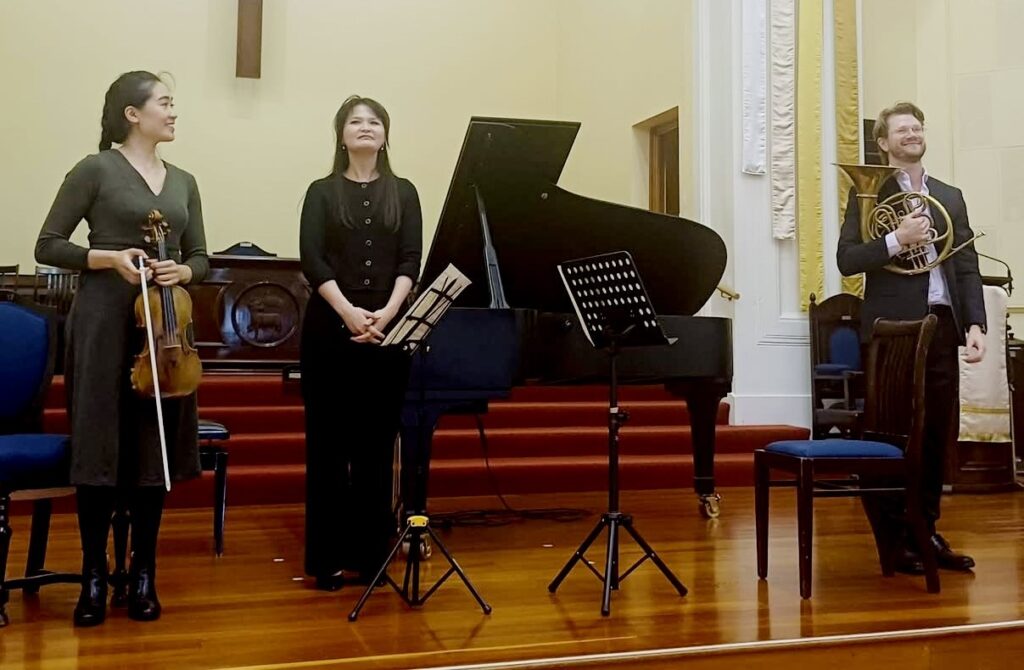
The Treble-Makers – Whitney Wu  and Izabela Ibanez, violins, (Arohanui Strings)
Amelia Liu, piano, (Queen Margaret College, Wellington)
JS BACH – Three Dances (Bouree – Loure – Courante) from French Suite in G Major BWV 816
(arr. Pohl/Gjelsten)
Helene Pohl, violin, Rolf Gjelsten, ’cello
ALBERT ROUSSEL – Trio for Flute, Viola and ‘Cello (1929)
Bridget Douglas, flute, NIcholas Hancox, viola, Rolf Gjelsten ‘cello
WOLFGANG MOZART – Quartet for Flute, Violin, Viola and ‘Cello K.298
Bridget Douglas, flute, Helene Pohl, violin, Nicholas Hancox, viola, Rolf Gjelsten, ‘cello

The Long Hall, Point Jerningham, Roseneath. Wellington
Saturday 25th April, 2026

One of the more delightful aspects of concert-going is the singular pleasure of encountering “new music” on the programme – by “new”, I mean in this instance music that one has never before encountered, rather than something “contemporary”. –  from this twenty-first century viewpoint the latter term has for many of us seen works thus described undergo the inevitable ageing process!

Not that I can remember the music of Polish/German pianist and composer Moritz Moszkowski (1854-1925) ever sounding “contemporary”, though what we heard today from the output of French composer Albert Roussel (1869-1937) was certainly rather more acerbic and  “modern-sounding ” than that of either Moszkowski or the music of Russian composer Reinhold Glière (1875-1956), the third of the trio of nineteenth/twentieth-century names accompanying that of JS Bach’s and Mozart’s on the programme I heard today at Roseneath’s “The Long Hall”.

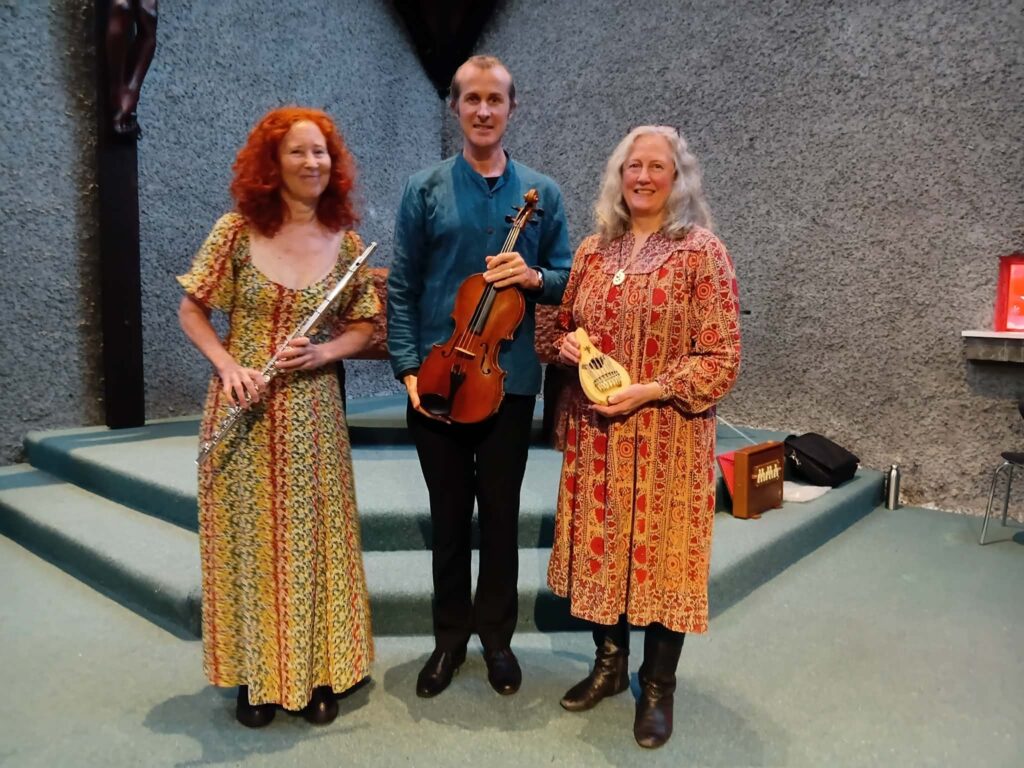
Helene Pohl’s and Rolf Gjelsten’s continued espousal of their Pot-Pourri Chamber Ensemble activities brought together a brilliant and wholehearted array of talents for today’s concert, featuring flutist Bridget Douglas and violist Nicholas Hancox, as well as an inspiring trio of young musicians, two of whom, violinists  Whitney Wu and Izabella Ibanez play in the inspirational group Arohanui Strings, and a third, pianist Amelia Liu, a competition winner from Queen Margaret College in Wellington. The last-named occasioned the bringing out of an upright piano for the Moszkowski work, which was a “first” for this listener at the Long Hall – a rare treat! (I loved the name this Trio had concocted and made reference to in the programme, for our pleasure! – “The Treble-Makers”!)

I came to this concert largely uninitiated as far as the music by the three aforementioned era-spanning composers was concerned – in fact, the only music by Moszkowski I had previously heard was a set of “Spanish Dances Op.12” beloved by audiophiles due to a justly-famous early stereo (late 1950s) recording of the same, sporting the title “Espana”. (Elsewhere, as well, there’s definitely a highly-regarded piano concerto I’ve yet to catch up with!) Though only the first movement, Allegro  energico, of a “Suite in G Minor Op. 71” was played by the Trio, the group caught the “striving melancholy” of the violins’ firmly-centred descending phrases, in both minor and major keys, deftly supported by the piano when alternating heartfelt descending melodic lines with tumbling rhythmic surges, and creating infectious excitement by building the intensities leading to a spiritedly accelerated coda – what fun! – and what a joy to experience such youthful exuberance in triplicate!

Next came three dances taken from one of JS Bach’s keyboard works, a French Suite in G Major, and transcribed here for violin and ‘cello – Helene Pohl described the transcription of this music in the progrqmme as “working beautifully for string duo”, with counterpoints “to be savoured”! First came a spirited and joyous Boureé, the violin singing the melody and the ‘cello keeping things moving with a running counterpoint, the latter seemingly tempted at various cadences to follow the violin canonically, but after a few imitative notes skipping back into dance-mode! After this came the Loure (a languid, waltz-like dance) with its opening phrase imitative between the instruments before the ‘cello took up the rhythmic trajectories, enjoying, in the second sequence, some deliciously insouciant accompanying gestures. Finally, we heard the Courante, the music again imitative between the instruments at first, before the second part featured the ‘cello dancing in attendance of the violin, the latter picking up the cello’s figurations in response – gorgeously interactive!

We then got what was for me another rarity, four pieces from Reinhold Glière’s Eight Duets for Violin and ‘Cello, Op. 39. I’d actually heard more of Glière’s music than of Moszkowski’s or of Roussel’s, having encountered probably his most well-known piece from a Soviet-style ballet, “The Red Poppy”, a boisterous, crowd-pleasing romp called  the “Russian Sailors’ Dance”.  I’d also heard, more momentously, the most famous of his three symphonies –  an epic 80-minute work subtitled “Ilya Muromets” celebrating the adventures and death of a mythological Russian “Bogatyr” hero based on the lives of several such personae from different epochs of Russian history – strong stuff for a beginner-listener to encounter, back in my College years, but with startling sequences that still resonate in the memory, however dimly. Another notable claim to fame of Gliere’s was his tutorship of the youthful Serge Prokofiev, beginning lessons in 1902 when the latter was just ten years old and continuing until Prokofiev was accepted into the St.Petersburg Conservatory as a student at the age of thirteen.

Much of Glière’s output is unexplored, including a not inconsiderable amount of chamber and instrumental works (though he caused a posthumous ripple of interest in his music when soprano Joan Sutherland enterprisingly recorded in the 1970s a “Concerto for coloratura soprano and orchestra”). The Four Duets we heard were taken from his Op.39, written in 1909. The Prelude, beginning the set, was practically a “tuning-up” exercise, with the violin holding a single note and the ‘cello intoning a wistful, repeated phrase, before the instruments “swopped” roles – a simple, sombre, but resonantly effective piece. The Berceuse which followed featured a gorgeous violin melody in tandem with the cello’s  attendant repeated rising phrase – simply enchanting!   Then came the Intermezzo, a melancholy Schumannesque melody with a “rocking” motion, reminiscent of parts of Schumann’s Kinderscenen. Interestingly, the Gavotte that followed seemed to jump into a harmonically different dance-floor world altogether, with an engaging middle section, very “pesante” themes from the violin and drone-sounds from the ‘cello, then taking us back for something of an abrupt farewell to the dance and its mercurial world.

Our two aforementioned additional players joined the ensemble after a short break – one of them, violist Nicholas Hancox, was of course a stalwart of the ensemble at many of last year’s concerts at the hall and was thus welcomed like an old friend! But we felt especially honoured to have with us for the second half flutist Bridget Douglas, well-known for her participation in many memorable NZSO concerts as a principal section leader, and also in numerous chamber performances in the Wellington region. These players brought with them more (for me)  relatively unfamiliar music, a Trio for flute, viola and ‘cello by Albert Roussel, a name I knew only through a recording I’d purchased  long ago of a ballet of his with the name Le Festin de l’araignée (“The Spider’s Feast”), a work filled with gorgeous impressionistic sounds buoyed along by insinuating rhythms and extremely wry characterisations.

This Trio, written in 1929, I thought an extraordinary piece! – it promised something similar to the ballet at its outset, the Allegro featuring  buoyant rhythms dancing through open-air ambiences, and suggesting all nature at play, despite the occasional tinges of melancholy. The flute enjoined its companions more readily to share its bright-and-breezy manner, and viola and ‘cello did occasionally “buck themselves up”  with spirited surges of march-rhythm merriment and even a patch of  “triplet-flavoured bonhomie” towards the movement’s end that helped keep us all smiling!

But “O, mon Dieu!”  – the Andante was introduced by a sombre viola melody with an equally rueful arpeggiated ‘cello accompaniment, to which the flute added a kind of would-be-but-on-another-day-consoling melody – that done the viola and ‘cello had an exceedingly gloomy duet sequence (“those poor dears!”), one which the ‘cello tried next to “cheer up”, without success! The flute also persisted but without much joy (“What on earth could be the matter?” I wanted to ask the composer’s shade……). A sustained note seemed to be the only floating Pooh-stick the players could find to grasp and hold onto, and wait for the end!  Goodness! – the silence was golden!

And then, wonder of wonders, the music’s first-movement cheerfulness returned for the finale! The ‘cello had stepwise pizzicati, the viola a dancing figure and the flute a perky, bright-faced tune! Such was the camaraderie, the players sped up the trajectories as the blood started to flow more quickly, bringing our listeners’ hearts into our mouths with the relief of it all! – we even had a bit of unbridled stamping sailors’ dance excitement at one point! The movement’s opening returned with even more insouciance, bringing back the sailors for a bit more hi-jinks stamping – and then we heard an eerie passage featuring extraordinary harmonics-like texturings from the strings and near-lullabic tones from the flute.  However, the players seemed to then pick up on the composer’s “homeward bound” urgings, as they responded stepwise to the music’s ever-growing trajectories,  some helter-skelter, almost “silent movie’  soundtrack-scamperings with more “sailors’ dance” roisterings, leading to a concerted “knees-up-like” final flourish! Golly! – Did we dream him? –  or did Roussel dream us? – I ask myself as I write these wry remembrances of what we heard!

With the Mozart Flute Quartet K.298 (a later work than the K-number suggests) which followed, we were presented with a different kind of wryness, firstly in the form of the widespread supposition that the composer didn’t really CARE for the flute despite writing various works for the instrument, one set against a counter-argument that it was actually the person who COMMISSIONED the works for the instrument that Mozart really abhorred! This having been said, we then learned that Mozart had possibly written this particular work for himself, purely for pleasure!

Whatever the case, the music was simply divine – a lovely opening, half-hymn, half popular ditty, featured the flute carrying the melody. This was actually a ”theme and variations” movement, with Bridget Douglas “dancing”  her instrument through the ensuing moments of sheer contrapuntal enjoyment, and ringing the changes in the other variations, the second a running counterpoint for the violin against long-held flute notes, the third a florid version of the theme from the viola (just superb!) with “ambient” comments from the others, and the last a return by the flute to the theme with the ‘cello supplying the knowingly droll trajectories!

The second movement, Menuetto, jumped into D Major, with the flute leading a sprightly, upwardly  soaring opening harmonised phrase striding out confidently, then impishly dancing about in a single variation of the theme in a middle section. Back came the opening key for the last movement with gentle finality, the melody tossed about the instruments with an art-that-conceals-art kind of spontaneity, so that we got the composer’s intention of a group of friends making music for the sheer pleasure of doing so, a pleasure we in the audience felt, in such company, pleased and privileged to share and similarly enjoy.

Saxophone opening up the chamber vistas – Simon Brew with the Amici Ensemble at St.Andrew’s

Wellington Chamber Music Series 2026 – Simon Brew with the Amici Ensemble
RUSSELL PETERSON (b.1969) – Quintet for alto saxophone and strings 2003
MAX RICHTER  (b.1966) – On the Nature of Daylight (2004)
ELLEN TAAFFE ZWILICH (b.1939) – Quintet for Saxophone and Strings
WOLFGANG AMADEUS MOZART (1756-1791) – String Quartet in F Major K.590
ASTOR PIAZZOLLA (1921-1992) Winter and Spring from The Four Seasons of Buenos Aires (arr. Mary Osborn)

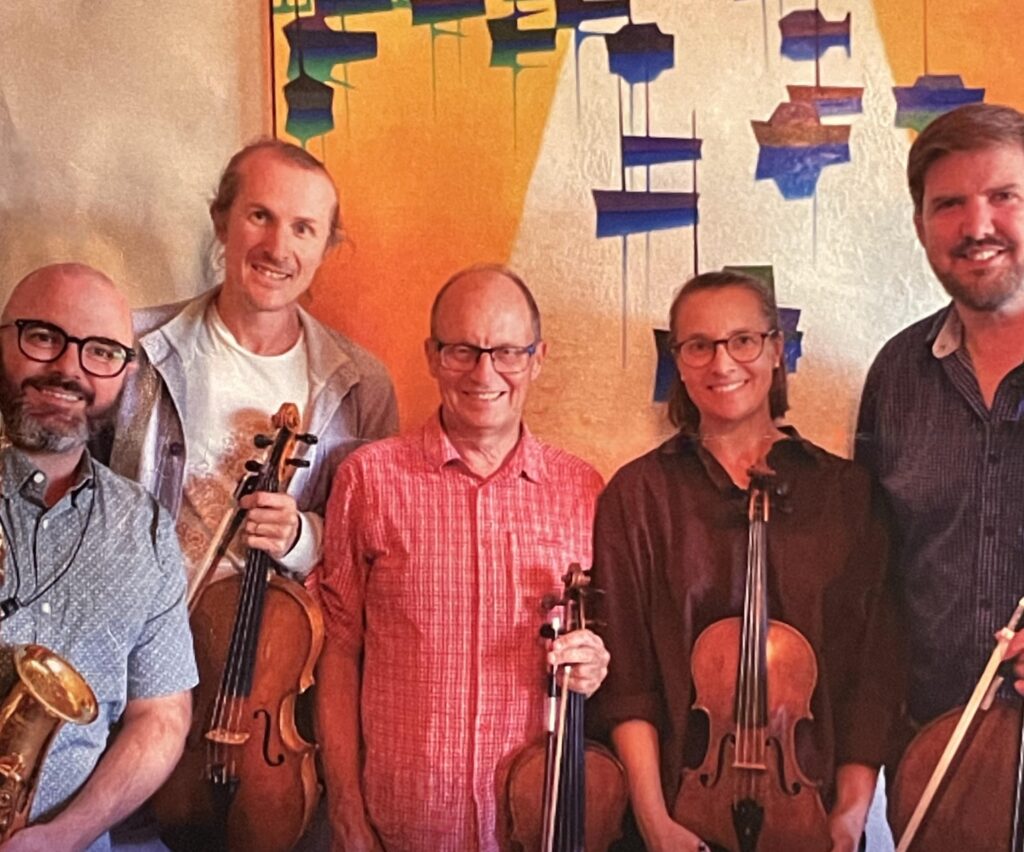
Amici Ensemble (Saxophone Quintet)
Donald Armstrong (violin), Anna van der Zee  (violin), Nicholas Hancox (viola), Andrew Joyce (‘cello), Simon Brew (saxophone)

St.Andrews-on-The-Terrace
Sunday, 12th April 2026

The saxophone as a musical instrument has made quite a journey – its inventor, Adolphe Sax, intended his instrument as a kind of “missing link” between winds and brass in the symphony orchestra, wanting  to combine the power of brass instruments with the flexibility of woodwinds, though the earliest saxophones tended to find their way into French military bands because of their ability to project their sounds outdoors. The instrument did appear in some nineteenth-century classical compositions, mostly by composers with names unknown today (has anybody previously heard the names of Jean-Baptiste Singelée, who wrote a Premier Quatuor  for Saxophones in 1857?- or Jules Demersseman, the composer of an 1860 Fantasie for Saxophone and Piano? ) but also with a number of “pioneering” examples of usage, such as in George Bizet’s incidental music for the play “L’Arlesienne” (1872), in music by Delibes (the 1876 ballet “Sylvia”) and in Massenet’s operas (“Le Roi de Lahore”, “Herodiade” and “Werther”) the earliest of these in 1877.

Of course since the turn of the century the orchestral gates have occasionally opened to admit the saxophone, with concertante works from composers such as Debussy, Glazunov and Ibert, and significant contributions from the instrument in works by Rachmaninov, Prokofiev, Strauss, Vaughan Williams, Richard Strauss and Ravel (via Mussorgsky) among others. In chamber music, too, the saxophone has noticeably figured, both in original works for the instrument and different kinds of arrangements, each of which were featured in this afternoon’s presentation by saxophonist Simon Brew and the Amici Ensemble.

Our concert began with American composer Russell Peterson’s 2003 Quintet for Alto Saxophone and Strings, the music beginning plaintively with strings only, then hauntingly continuing with the saxophone’s disarmingly dulcet tones – a sombre, processional-like exposition with gently melancholy dialogues and concerted passages – whose ambiences were then briefly but arrestingly galvanised by an impassionedly rising saxophone sequence, the music falling back to the previous subdued manner , only to again arch splendidly and disconcertingly – one was transfixed anew by the saxophone’s arresting power of utterance when at “full throttle”! –  I enjoyed the movement’s following dance-like, somewhat exotic-sounding sequences, despite a  “sameness” about the saxophone’s repeated “rise-and-fall” aspect to the music.

The second movement’s Bartok-like dance rhythms brought repeated-note patterms, more saxophonic declamations and running figurations, with the violin’s folkish lines echoed by the cello’s soulful responses. What appeared to be a third movement was begun by the saxophone, partnered by the ‘cello in a kind of  sombre and almost canonic duet, whose musings were broken into by the viola, beginning a fugal-like sequence, and joined by the second violin, the mood remaining sombre until the first violin burst in with a more dance-like line, inspiring the ‘cello to begin a spirited, “running” kind of response to which the saxophone joined, the pace of the music quickening until the opening chords of the second movement returned. This then sent the music into a kind of “spin”, the saxophone pursuing a kind of orgiastic folk-theme, whose cries brought the strings running towards and executing as one a brilliant concluding flourish!

The contrast with Max Richter’s meditative and “slow-chapp’d”  work for strings On The Nature Of Daylight,  which followed couldn’t have been more profound – at first, not unlike the opening of Strauss’s “Metamorphosen” the music almost straightaway developed in a different, more esoteric direction, beginning here with three players delivering long, slow, mesmeric and suggestive chords, until a fourth enters with a melody that derives wholly from these chord progressions. The piece’s popularity has actually begun to generate a kind of reaction to its over-use by film-makers, a counterproductive kind of  “bleeding the piece dry” effect, though Richter’s powerfully simple evocation will, like so many over-used pieces of music have previously done, doubtless survive its unselfconscious fecundity and remain fixed for future generations. I couldn’t imagine a more “centred”, sensitively-judged performance than we got here from our quartet of string-players.

The first half’s highlight for me was the Ellen Taafe Zwilich work, a 2008 Quintet for Saxophone and Strings, one with its opening Beethoven Grosse-Fugue-like beginning announcing its credentials and intents before setting off to a jogtrot-like journey throughout vistas of ear-catching detail. At first, the strings trod measured steps while the saxophone undertook a “whistling an air” kind of attitude, but with the group occasionally varying the trajectories, moving between a kind of lyrical wonderment, spontaneously impulsive gesturings and a droll “take it as it comes” manner.

Short, sharp impulses aplenty set the second movement on its intriguing course, in-and-out of occasional sequences which “papered over the cracks” in the music’s sustained lines (some evocative saxophone outpourings in places!). Our ears were kept engagingly activated by these wonderfully benign conniptions of expression, and highly entertained by an amusingly po-faced set of false “endings” to the movement leading up to the music’s true one!

The cello took up a nostalgic rocking rhythm at the third movement’s opening over which the saxophone sang a lullabic refrain, the strings joining in with a repeated-note accompaniment – fabulously ear-catching! As the saxophone began to energise its voice, the strings caught the mood and adroitly “syncopated” the exchanges, until the opening rocking rhythm made a sudden reappearance on the strings – saxophone and violin rhapsodised over the import of the moment, which intensified as the “chugging” rhythm also returned. The opening chord of the work then resounded, and echoed, before the players decided to have done with the past with a few terse, no-nonsense chords. I sat at the end, unexpectedly enchanted by it all!

After the interval, Mozart proved to be a perfect re-entry point to the concert with one of his “Prussian” Quartets (K.590 in F Major), albeit one of his greatest compositions, and one fraught with “might-have-beens” at the time the quartet was written – the circumstances have conspired to give this quartet a particularly distinctive flavour in a number of respects. At the time of writing this work the composer was in financial straits due to a recession in the Austrian economy caused by a drawn-out war with Turkey, resulting in fewer concerts and commissions. He had, in 1789, travelled to Berlin to meet the Prussian monarch Friedrich William II, an amateur cellist, hoping to make a good impression on the music-loving monarch, but instead had to be content with meeting the King’s Director of Chamber Music, the ‘cellist Jean-Pierre Dupont.

Afterwards he wrote to Constanze, his wife, that he had received money and commissions for six string quartets and six keyboard sonatas after performing for the Queen on a second visit. But there is no entry in the Court records for either money or commissions being made, and researchers have concluded that Mozart probably borrowed the money from friends, and invented the story regarding the visit and the commissions so he would have something to show for his efforts on his return to Vienna! He did complete three string quartets, two of them during 1790, the year following the Berlin visit, the second of which we heard today.

It’s an extraordinary work in itself, right from the beginning – two soft introductory notes and then a third louder and more insistent, followed by a scampering and unresolved unison descent – the whole then balanced by a repetition with solo violin, the dynamic contrasts softened, and the descent harmonically resolved. Mozart then uses that same three-note pattern and the scampered descent throughout the movement, the playing here of the Amici’s strings as deft and tonally varied as one might wish.

The following Andante has a hymn-like beginning, to which each instrument adds an embellished dance-like variation, leading to a stratospherically piquant ending. The Menuetto’s lively dance is characterised by an oscillating accompanying figure which passes from voice to voice throughout and in places moves up-and-down in almost vertiginous chromatic ways, while the Trio makes much of gawkily-witty grace-notes at some of the phrase-ends – charming! As for the finale it thrives on fluidity of utterance and quicksilver reactions, with several of the modulations seeming to flirt with atonality in places, while leaving our ears to actively wonder whether the lines would actually “find” one another again – such extraordinarily forward-looking juxtaposing of rhythms and harmonies! And what a delightfully po-faced concluding cadence – a wonderful sleight-of-hand ending!

Simon Brew brought his soprano saxophone with him this time, to conclude the concert with music by Astor Piazzolla, and featuring two excerpts from a work I’d not previously heard and was looking forward to – Piazzolla’s “The Four Seasons of Buenos Aires”. The composer originally wrote and scored the pieces separately between 1965 and 1970 for his own ensemble, which featured his own instrument, the bandoneon (a kind of accordion). Like much of the composer’s music they have been arranged for all kinds of combinations, including a version by Russian composer Leonid Desyatnikov for string ensemble which occasionally quotes from Antonio Vivaldi’s “The Four Seasons.

The Amici players performed two of  these “seasons”, winter and  spring, the first Invierno Porteño (Winter),having a gorgeous melancholic flavour, with much languishing at the piece’s beginning, and then with the saxophone tones bring out a truly exotic flavour to the textures and tones. Both pieces use the term Porteño, a word referring to a native of Buenos Aires, so that the Spring is given the name Primavera Porteña –  the music’s somewhat livelier than the first piece, though the players here give even the slower middle section’s rhythms plenty of “heft” . We enjoyed the experience so much we were able to persuade the ensemble to return to the platform and give us some more Piazzolla, a characteristically sultry opening, with the strings sighing as the saxophone literally took flight, the lines soaring like a bird, before the instrument brought these impulses back to earth, joining the strings for a soulful concluding melody in luscious thirds. Gorgeous sounds! – we couldn’t have helped enjoying the ensemble’s wonderfully cosmopolitean adventurings throughout a variety of times and places – a real treat for the senses in every way!

Still more musical miracles reported and evidenced in Wellington, this time at Roseneath’s The Long Hall!

The creative spirit continues to work wonders in Te Whanganui-a-Tara, Aotearoa – (“Kei te ora tonu te wairua auaha ki Te Whanganui-a-Tara o Aotearoa”)

Peter Gjelsten tackles a Bach Violin Sonata (No. 2 in A Minor BWV 1003) at The Long Hall, Roseneath

The Chamber Pot-Pourri Ensemble
A Kaibosh Food Rescue Benefit Concert

ROSS HARRIS – 2 Micro-Trios (2020)
Helene Pohl, Peter Gjelsten (violins), Rolf Gjelsten (‘cello)
NICCOLO PAGANINI – Caprice No. 9 for solo violin
JS BACH – Sonata for solo violin in A Minor BWV 1003
Peter Gjelsten  (violin)
CRAIG UTTING – Four Wellington Dances for violin and cello
Helene Pohl (violin), Rolf Gjelsten (‘cello)
FRANZ JOSEF HAYDN – String Quartet in G Major Op.33 No. 5
Helene Pohl, Peter Gjelsten (violins)
Sophia Acheson (viola), Rolf Gjelsten (‘cello)

The Long Hall, Point Jerningham, Roseneath
Saturday 21st March, 2026

Fresh from attending my first St.Andrew’s-on-The-Terrace lunchtime concert earlier in the week, I had the good fortune to catch another. not dissimilar kind of musical happening – this one a 2026 “first” for the capital of a series instigated a year ago by violinist Helene Pohl at Roseneath’s “The Long Hall”, situated on the Point Jerningham lookout reserve next to Roseneath Primary School. The concerts are designed to alternatively support the Kaibosh Food Rescue charity, and the Arohanui Strings, the Sistema-inspired early intervention music education programme. The Kaibosh charity makes a significant difference to food and energy waste and carbon emissions, enabling thousands of kilos of food to be redistributed to community groups, resulting in renewed efforts by the same musicians over the present in continuing and supporting an eminently worthwhile venture.

Thanks to the inspiration, skills and capacity for hard work of Helene Pohl and ‘cellist Rolf Gjelsten, the 2025 concert series was a great success. The two musicians, aided by various colleagues, were able to simultaneously commemorate and take advantage of composer Dmitri Shostakovich’s 50th death anniversary, performing a number of the composer’s chamber works in tandem with a wide range of other pieces, including a couple of contemporary works written specifically for these concerts (and therefore both world premieres!) by composers currently both on-and off-shore, Ross Harris and Gao Ping, respectively.

Now, to begin the 2026 series the Long Hall’s opening Kaibosh Food Rescue programme paid appropriate homage to some of the previous year’s delights, including works by “resident” composers (two of whom were present today!), as well as instrumental solos which illustrated the power of a single voice’s communication, and a string quartet by the composer who effectively defined the form and whose efforts provided all kinds of “springboards’ for those others who followed suit.

First up was music representing a kind of timely antidote to Aotearoa New Zealand’s present version of Trumpish madness, two Micro-Trios by Ross Harris, written during the much-discussed lockdown period of 2020 for the Pohl/Gjelsten family members present today. The two works, as if conceived with different personalities in mind, displayed contrasting characters, the first beginning in a restless, slightly anxious 5/4 which developed more forthright impulses befitting a kind of “confused turmoil of being” in response to the isolated circumstances. The second work took a more lyrical approach, with long-linked lines attracting all kinds of impulses which attached themselves to the lines before dropping off the pace and wandering quizzically through unfamiliar vistas (like an ageing process, perhaps – with apologies to the composer!).

Violinist Peter Gjelsten followed up his 2025 performance of Eugène Ysaÿe’s Third Sonata (“Ballade”) for Solo Violin with another work by a virtuoso violinist-composer, perhaps the doyen of them all, Niccolo Paganini – The Ninth of his 24 Caprices for solo violin was given here with plenty of confidence and elan, the opening “hunting calls” resounding their thirds with spirited effect in dynamically-contrasted episodes readily suggesting the shouts of purpose and encouragement from the riders relishing the chase.  The “sport”was given plenty of incident by the violinist’s confident throwing-off a middle-section’s skitterish runs broken by stentorian phrases, suggesting both mishap and success in the pursuit!

Sterner stuff followed these hi-jinks, with Peter Gjelsten giving us JS Bach’s wonderful A Minor Sonata for solo violin, one of three Sonatas for the solo instrument, all of which are often coupled as a performing edition with three Partitas for the same instrument. An all-purpose differentiation between the two titles “Sonata” and “Partita” is that the former is traditionally a four-movement structure which often features linked slow-fast sections  and a fugue, whereas a Partita consists of different types of Renaissance/ Baroque dance movements. True to type this Sonata includes a fugue as the second movement.

First impressions of this work emphasised seriousness over gaiety, the solemn, declamatory opening commanding our attention with the player’s presence of intonation and command of nuance giving his listeners an engaging sense of exploration right to the movement’s final questioning note. The Fugue’s elegance and poise at the outset opens out, Gjelsten finding plenty of room for variations of tone and presenting an astonishing array of different voices – the music’s trajectories buildup and carry us along with wonderful ”heads of steam”, so that the phrases and statements really resonate.

Gjelsten’s control of the Andante’s pulse enabled both melody and rhythm to coexist, often in little more than whisperings, but with an underlying strength of overall purpose. We felt taken to another world by the second half of the movement, with the composer  seeming to allow us a lingering glimpse of his serenity of outlook and purpose of faith – I could imagine a young player in future years delving even further into the music’s timelessness that allow these sounds to linger long after the player ceases. The concluding Allegro is here excitingly launched and teasingly sustained with the antiphonal alternating phrases made here to dance through our sensibilities’ spaces. The rapidly-executed impulses have an exhilarating ring to them, and we’re “teased” with what seems like the approach of a final cadence, but with geyser-like irruptions that suddenly push the boundaries out further – tantalizing playing that keeps us on our toes and  enables us to relish the music all the more.

We had been promised a quick, “straight-through” concert at the beginning, so our kaleidoscopic musical journey  suddenly whirled us homewards via local composer Craig Utting’s engaging “Four Wellington Dances”, for violin and ‘cello (written in 2025 for Helene and Rolf.) The work began with an entirely apposite “Wind Dance”, a nagging 7/8 perpetuo-molto rhythm  by turns driving, teasing and cajoling the notes into sound-impulses whose insistence any Wellingtonians would recognise, and with alternating instruments adding a moaning-sighing figure over the agitations, catching their constant unpredictabilities. Next was the strangely mesmeric “Whale Song”, introduced by spectral “con sordino” violin tones (which set the scene for strangeness) and galvanised further by hauntingly-charged “vocalisings”, firstly in the lower and then upper registers of the ‘cello – an incredible soundscape, tapping into a “natural world” communication, with the instruments conveying a real sense of ambient surroundings and language essentially removed from human interaction.

“Seagulls”, the third dance, has an introduction flecked with further atmospheric touches, such as the ‘cello playing eerie glissandi to the violin’s arpeggiations and rather touching “seafarer’s song”, first played, incidentally, lower than the ‘cello’s accompaniments, though the instruments exchange their roles at certain points – the melody is a real charmer, replete with nostalgia! Finally, the “Habanada” imbues a well-known operatic rhythm with a mischievous spirit during short sequences of dance-tunes and  illicit collaborations with ostensibly unlikely partners such as Saint-Saens’s “The Swan” and Rimsky-Korsakov’s “Bumble Bee”, with even Mendelssohn’s “Wedding March” making a brief appearance before falling down the stairs and (thankfully) coming to its concluding senses!

After all of this, what better finale than to be given a masterwork from a composer whose music paralleled the conditions that produced each of the concert’s preceding works – isolation, compositional mastery, instrumental fluency, and a need for entertainment? All these things come together in the string quartets of Franz Joseph Haydn, whose Op.33 set of six string quartets were written in 1781, and became known as the “Russian” Quartets, due to the dedication to the Grand Duke Paul of Russia. Another nickname given to these works is Gli Scherzi  (The Jokes) referring to the replacement of the older style Minuet with a quicker, more dynamic movement.

Here, then was the fifth of the Quartets from this Op.39 set, a work which itself has been nicknamed with the English sobriquet phrase “How do you do?”, drawing attention to the Quartet’s very beginning, a pianissimo galant cadence which actually returns to conclude the movement with which it started. the opening “How do you do?” cadence is only a prelude to the ensuing Molto Allegro, which seizes hold of the argument and propels it excitingly forwards. The mood lightens for the lyrical second subject, only to unexpectedly plunge into the almost “groaning downwards” chromatic modulation towards the end of the exposition. The volatile development dances, swoops and plunges as the music unfolds, releasing almost operatic surges of energy in places, with the “how do you do” cadence realigning the music’s focus for a recapitulation – we are, by this time, agog at the music’s volatilities, and marvel at how quickly the music races to its concluding cadences without missing a beat!

Our heartstrings are tugged immediately by the slow movement’s intensities, most strenuously propelled forwards with almost unrelenting energy, to which one simply has to surrender and allow oneself to be borne aloft and taken somewhere. What a contrast, therefore, with the impishly impulsive Scherzo, filled with all kinds of hesitancies and impulses!  The Trio brings a steadier, more genteel character, as if wishing to reform such excesses, though to no avail when the opening returns, as quirky and ornery as ever, though with a touch, perhaps, of guilt via its almost evanescent ending!

After this, the finale’s music is almost prim and proper, in what seems like variation form, with the first violin decorating and elaborating on the melodic line in both subsequent variation movements, and then, the viola and cello taking turns to decorate the dance steps for a subsequent movement. Finally, there’s a Presto which scampers to a satisfyingly breathless conclusion!

Such a lot packed into a relatively short time! Nevertheless, we were replete – delighted by the music and the playing, and honoured by the good and prestigious company – a truly memorable occasion!


Masterpieces from masterly musicians – A St. Andrew’s lunchtime concert, from Rolf Gjelsten and Nicole Chao

St.Andrew’s-on-The-Terrace Church, Wellington  – Lunchtime Concert Series

BEETHOVEN – ‘Cello Sonata No. 3 in A Major Op.69
TCHAIKOVSKY (arr. Fitzenhagen) – Variations on a Rococo Theme Op.33

Rolf Gjelsten (‘cello) and Nicole Chao (piano)

Wednesday 18th March 2026

Review for “Middle C” by Peter Mechen

“Two masterpieces for the ‘cello-and-piano repertoire, delivered by a pair of musicians regarded as among the country’s top players of their respective instruments” – well, it  sounds like nothing less than a dream prescription for a concert!  Alternatively, the blurb for the occasion could have fixed as easily upon its contrast with present-day scenarios – ranging from world-wide upheavals undermining one’s sense of national and personal security to localised disillusionment and desperation faced with escalating dysfunctional infrastructure and cost-of-living price-hikes – and invited us “to escape from it all into the relative bliss of St.Andrew’s-on-The-Terrace Church for a free lunchtime concert of uplifting music”.

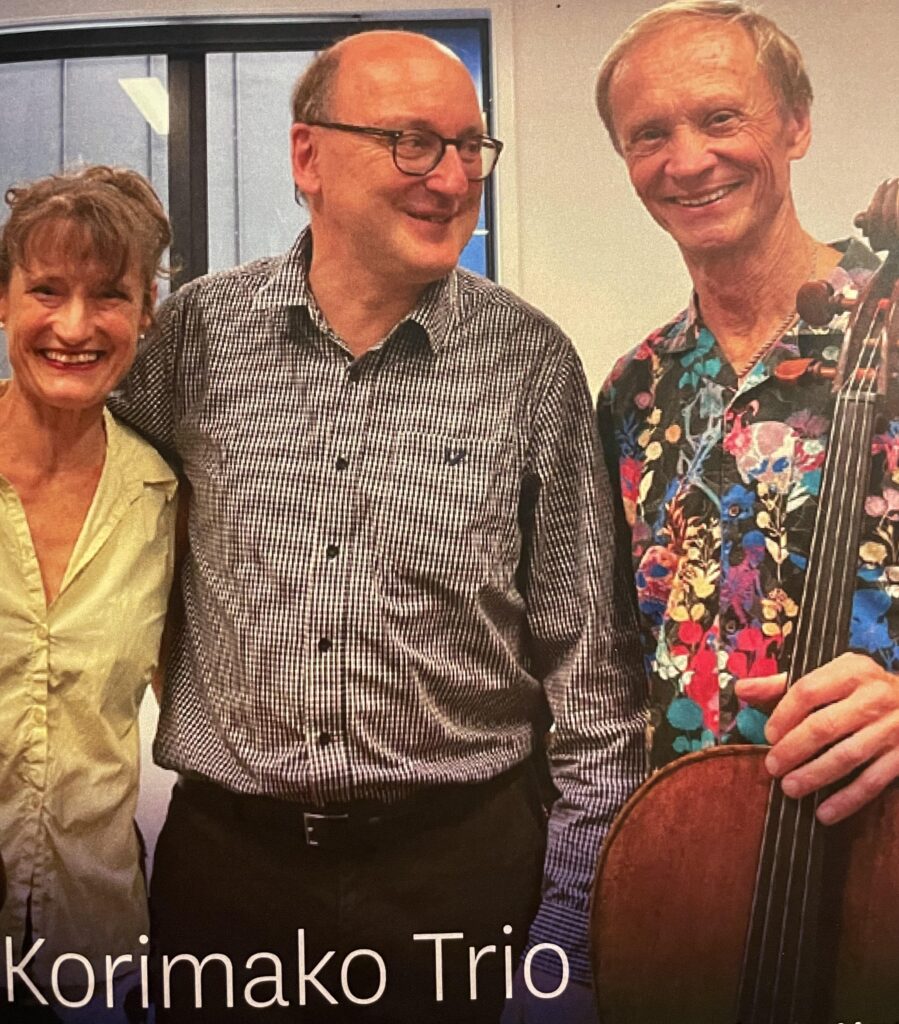
However one chooses to view these regular Wednesday lunchtime concert occasions they have given many Wellingtonian classical music-lovers much joy with a stimulating variety of performers and repertoire. In this case we were thoroughly spoilt as regards the concert’s essential ingredients, with cellist Rolf Gjelsten, late of the New Zealand String Quartet, but more recently affiliated with Korimako, a piano/string trio formed with pianist Michael Endres and violinist Helene Pohl, and here joining forces with pianist Nicole Chao, most readily associated with the much-acclaimed Duo Enharmonics together with fellow-pianist Beth Chen.

I had heard Rolf Gjelsten’s solo playing on a couple of occasions, most recently in an absolutely delightful performance of JS Bach’s Third Violincello Suite in C Major at a “Long Hall” Roseneath concert; but I’d not heard Nicole Chao as a solo recitalist since briefly at a 2009 song-recital concert with soprano Nicola Holt, where for an instrumental interlude she gave an atmospheric, by turns finely-detailed and splendidly volatile performance of Chopin’s Fourth Ballade. Though not solo performances this time round, today’s offerings readily demonstrated the technical and interpretative skills of each of the players, brought together beautifully here in St.Andrew’s.

As befitted such a positive partnership, the occasion featured an actual milestone in the repertoire of the solo ‘cello with Ludwig van Beethoven’s ground-breaking Cello Sonata in A Major Op.69. Though this was the third actual sonata of five written for the instrument by Beethoven, this one was the first which gave “equal partnership” status to the ‘cello in a sonata, instead of  (as with the composer’s two Op.5 works, described as “piano sonatas with accompaniment by the ‘cello”) merely providing a supporting role for the keyboard. In fact Beethoven wrote this work for the same cellist, Nikolaus Kraft, who had taken part in the first performance in 1808 of the composer’s Triple Concerto.

At the work’s beginning the ‘cello celebrates its new-found status with its solo announcement of the opening theme, effortlessly floated into being by Rolf Gjelsten  before intensifying the tones with the instrument’s alighting upon a sustained E – to which Nicole Chao’s piano then replies with a lyrical “rounding -off” of the theme and a brief flourish. What follows is an enthralling exchange of ideas which each player acts upon in a sense of both thoughtful contribution and impulsive challenge to the music’s argument – I’ve always loved the music’s ascending runs in this movement, figurations that seem to me to almost “dare” each player (but especially the cellist in the second, higher figuration!) to markedly “sound” and relish these ascents, a kind of “flight of fancy” that’s contrasted with the earthily, no-nonsense agitato plungings into the succeeding episodes by both instruments. The minor-key passage which constitutes the development is delivered with the same focused combination of energy and fancy, breathtaking in its “give-and-take” rapport throughout lyrical and impassioned sequences. And ‘cellist’s and pianist’s instinctive capacity for mutual understanding beautifully bring off the sequence which transforms what sounds like a “third exposition” into the movement’s coda, turning Beethoven’s simplest of phrase-resolutions into a precious kind of homecoming, complete with a “grandstand finish” for the pundits!

The allegro molto Scherzo became something of an “anything you can do” game of syncopated daring, exhilarating to give oneself over to and feel “borne along“ by the players’  sharply-focused trajectories – again, music with contrasting episodes afforded by an obsessively grumbling trio and a po-faced pizzicato coda. No slow movement as such – but an opening sequence of rapt lyrical beauty, wrought by playing that seemed to commune with listeners in mutual enjoyment, before abruptly and mischievously breaking into a precipitous, fleet-fingered (footed?) dance, one which delights as much in contrast of mood as anywhere else in this sonata. So Gjelsten and Chao revelled as much in the music’s “sotto voce” excitement as in the hell-for-leather passages, enabling the energies unleashed by Beethoven to tingle expectantly throughout both exuberant and more circumspect passages – such a COMPLETE performance!

Those of us who had seen the concert’s original listing were expecting the Tchaikovsky Rococo Variations to follow, but the printed programme at the church had listed only the Beethoven work – so some people (feeling with every good reason satisfied with what they’d already heard) were getting up to leave when the musicians reappeared for the second item. As well most returned, because the Tchaikovsky work, normally heard in concert played by ‘cello and orchestra, was given simply gorgeous treatment by Gjelsten and Chao, to the point where I found myself preferring the ‘cello-and-piano combination to the original!

I would imagine most cellists are aware of the controversy accompanying this work from its inception, largely due to the activities of its dedicatee, Wilhelm Fitzenhagen, a German cellist and fellow-professor at the Moscow Conservatory, who had given the first performance of the work in 1877. Fitzenhagen had been asked by Tchaikovsky for advice regarding his finished “first-draft” for ‘cello and piano, but the composer wasn’t prepared for the extent to which his dedicatee then “revised” the score with the changes (both in the solo and accompaniment parts) then being incorporated into the published ‘cello-and-orchestra score). Though Tchaikovsky was documented as being furious at Fitzenhagen’s changes, his displeasure never actually translated into action, and the score was published in 1889 in the dedicatee’s version.

Tchaikovsky’s own version of the work wasn’t performed until 1941 in Moscow, but the score of the original had to wait until 1956 to be completely reconstructed, along with the cello-piano arrangement (though even the reconstructed version has been questioned because of the methodology used!). Several recordings have now been made of the original, though the Fitzenhagen version still regularly appears in concert and on record. It wasn’t made clear at today’s concert whether the version used by the musicians was Tchaikovsky/Fitzenhagen, or echt-Tchaikovsky (enquiries to this end are proceeding!).

I grew up with the “Fitzenhagen edition” of the work (used by practically all the  versions on record at the time), as per the recording by Rostropovich with Rozhdestvensky and the Leningrad Philharmonic, and loved it to pieces, though I also heard Janos Starker play the work with the NZSO in the1980s in Palmerston North (also a fabulous concert!). I bought what I believed to be the first-ever recording of Tchaikovksy’s original version of the work, made by cellist Raphael Wallfisch as long ago as 1983, but haven’t played it as much as I have the earlier recording, preferring to my shame the “dark side” territory of Fitzenhagen’s version – it seems to me that the only crime regarding the latter’s rearrangement of the work was that he wasn’t Tchaikovsky!

What we got here from Gjelsten and Chao sounded to my ears pretty well like the version I’d become accustomed to – and the playing gave me such pleasure I hardly stopped for a moment to consider just whose work I was hearing. Undoubtedly the sheer elan and sensitive beauties of the playing here influenced my feelings concerning the matter, but I felt the music in this instrumental format reflected even more deeply the composer’s love for Mozart and the classical style surrounding his work – and the “theme” itself wasn’t an existing rococo or classical melody, but Tchaikovsky’s own.

The work’s two concluding sequences here sounded particularly captivating – the Andante presented a sorrowful minor-key song, with the melodic line augmented by echo-like effects from both instruments, the whole rounded off by piano musings and a wistful ascending ‘cello phrase. It had an intimacy which the piano-and-orchestra version couldn’t replicate. Then, with the Allegro vivo Finale and Coda we got a spirited, exhilarating finish, with the cello’s vigorous utterances made playful by the piano’s counter-melody before both instruments finished the piece with suitably demonstrative gestures. We couldn’t have asked for anything more satisfying from two musicians in absolute accord with one another and with the music!


Melencolia – ANTHONY RITCHIE – Three String Quartets, from the Jade String Quartet

MELENCOLIA
ANTHONY RITCHIE’S STRING QUARTETS 1-3
Jade String Quartet
Miranda Adams, Charmian Keay (violins).
Robert Ashworth (viola), James Yoo (’cello)

Producer: Kenneth Young
Engineers: John Kim, Steve Garden
RATTLE RAT-D159 2025

After first-time listening right through in a single, totally absorbed (occasionally transfixed) sitting to a recently issued Rattle Records recording of Anthony Ritchie’s three string quartets, here played by the remarkable Jade String Quartet, I found myself afterwards wishing my tongue could utter the thoughts that arose in me!

Rousing myself from the daze I’d drifted into, I couldn’t help thinking of a similar “body” of works I’d recently been made familiar with to an unprecedented degree – the string quartets of another composer, Dmitri Shostakovich, whose music has been “spotlit” here in Aotearoa New Zealand, during the latter’s 50th death anniversary year. It simply and suddenly occurred to me (I freely admit, on an acquaintance that was, at this stage, hardly in-depth in either case!) that both composers seemed to have taken pains to reserve a certain concentrated quality of utterance for the string quartet medium.

In Shostakovich’s case, beleaguered as he was for writing “public” music (symphony, opera, concerto, cantata) which didn’t “conform” with the authorities’ need for artists to produce “uplifting, positive-sounding” works that reflected the joys of life under the rule of the great dictator, Josef Stalin, the composer turned to the “more private” medium of the string quartet to utter those personal aspirations, comments, and criticisms which for many years couldn’t be made in public. Only with the death of Stalin in 1953 was any kind of freedom of expression mooted for artists, and even then and afterwards there were disapproving “official” voices raised against some of Shostakovich’s later works.

Hardly a jot of semblance links Shostakovich with Anthony Ritchie regarding the conditions under which they wrote their music, except for the fact of both having to wait long periods for certain of their works to be performed after composition – Shostakovich 25 years after the composition of his 4th Symphony, Ritchie a whopping 37 years for his First String Quartet to be premiered after its completion! What forcibly struck me when hearing the Jade Quartet’s stupendous new Ritchie recording was the music’s startling originality and definitive focus, a “this is what I mean” kind of voice that I found put me frequently in mind of the Russian composer with his string quartets, and the single-mindedness of those uncompromising utterances.


                   Anthony Ritchie

Ritchie’s three quartets reach over a period of no less than forty years, with the first one written in 1983, while the composer was studying in Hungary at the Liszt Academy in Budapest, researching the music of Bela Bartok for his PhD. Writing music in such resonating surroundings could have made it difficult to fetch up a properly distinctive voice, but in the First Quartet’s opening Solo viola and trio Ritchie’s deep-browed solo viola voice straightaway captures something in the folkish air that awakens different responses…. such that could perhaps prove both accompanists, and even further, themselves become caretakers of the journey.

Quartet 1 has overlapping 7/4-like phrases, with beautifully- and delicately-inversed vertical figures, morphing into and out of pizzicato, as the motif plays “lost-and-found” in a plethora of activity. The bows bounce upon strings, then each theatrically lapses into sequences of theatrical recitative as the others gossip in pairs –  “What a rude glissando! – Yes, wasn’t it!”. The reputedly 7/4 rhythm returns, with arco, pizzicato – and silence! The next Solo ’cello and trio opens exotically, with folkish phrases and “turns”, before the solo cello enters, working wonderfully declamations into the line, before unaccountably appearing to fall asleep! Are the other instruments then dreaming the ‘cello, or is the ‘cello dreaming them?

Quartet 2 delightfully plays “catch-me-if-you-can” passages, with cheeky “portrait” poses taking turns before being off again, entangling themselves convivially in each others’ figurations! – exhilarating! – More reflections, before there’s a surreptitious swoop, and exclamations of  “pretend fright” before the façade is gone without a trace. Immediately, more serious business arrives in Duets – gone are the triplet-rhythmed fun-and-games, for these are the heavies, working in pairs, and not even the most impassioned pleas will stop them, it seems! A respite is brief, as the attack resumes from the air, but the responses hold their ground!

The tumult slows and morphs into Quartet 3  without a break – a disjointed world with its inhabitants trying to join forces with growing intensities and desperations! – Again, we’re taken straight to the next and last movement, Four solos – each vying for supremacy, pleading its case, so eloquent and piteous! – the tumult gradually ceases as the voices realise they have done what’s possible and viable for themselves and for one another – and we suspect that it’s the viola who returns to have the last word!

The Jade String Quartet:  Robert Ashworth (viola), Maranda Adams (violin),  Charmian Keay (violiin),  James Yoo (‘cello)

The Jade String Quartet has more-or-less taken over guardianship of this astonishing work of late, giving only the second public performance in Auckland last year (2024), and subsequently making this recording – the group’s espousal of the work’s determinedly-focused sense of youthful adventure on the composer’s part will surely win the music many new friends.

As for the equally compelling String Quartet No. 2 (2003), the work was commissioned and premiered by the Nevine String Quartet on a Chamber Music New Zealand tour, the group then then recording the work for Atoll Records on a CD (Octopus – Atoll ACD112) which featured several of Ritchie’s chamber music pieces. Less immediately recorded than the Jade Quartet, the Nevine’s reading brings out more of the work’s spaciousness and, particularly in the second movement, an attractive “Whistler-like” ambience, the music’s blue-grey colourings and lullabic tones at once so suggestive and evanescent. Elsewhere, the newer recording’s closer balance and the Jade’s sharper and more volatile responses engage the listener in what feels like a more tactile and primitive kind of engagement – the music’s swaggering gait at the very beginning has tremendous physicality, and contrasts beautifully with the “sighing” sequences that decorate the later ostinato passages, the ending’s piquant gesturings drawing us wonderingly into the silences.

Wonderful writing throughout the Like a Lullaby second movement – with the Nevines we lose ourselves in the ambiences, whereas the Jade Quartet doesn’t relinquish its tight grip on our sensibilities, heightening the sense of unease and shadows that are unresolved. The violin’s “voice from the gloom” stimulates other voices to follow, then leads the way out when the tensions reach disturbing levels, allowing the angst to gradually ebb away – incredible playing in both versions!

The third movement’s Allegro Pesante has more incisive, razor-sharp attack from the Jade Quartet, almost unrelenting in its penetrative persistence, contrasting the “slow waltz” aspect of the Trio all the more with the soulful melancholy of its lines, as does the return of the biting opening reacquaint us with its fearful obsessive manner. Both performances vividly characterise the finale’s juxtapositioning of its Misterioso opening with a driving allegro molto, the music’s sharply contrasting moods reflecting the extent of variation exhibited in human behaviour, an anomaly suggested by the dissonance of the work’s final  chord.

Moving our time machine’s dial forward once again we encounter Ritchie’s String Quartet No, 3, not inappropriately subtitled “In Time”, and composed specifically for the Jade Quartet in 2023. Its programme is ostensibly an oblique commentary on the stages of human life in general term, the movements “framed” by a First Dance and a Last Dance, and sporting pensive titles such as Heartbeat, Perpetual Motion and Funeral March, each bearing associated “mortal coil” confluences.

First Dance is vibrant and changeable, good-humoured and acerbic, essentially interactive, and expressing joy in its sharing – a marked contrast with Heartbeat, where everything is subjected to the “steady beat of time”, the responses to the plucked rhythms occasionally “out of synch”, suggesting arrhythmia or ectopic beats as part of the human condition. There’s also touches of Haydn’s drollery in places, as with the latter’s “The Clock” Symphony.

Perpetual Motion is something else again, the rhythms angular and anxious, going in and out of both conviction and certainty – the playing builds up wonderfully aggregated trajectories before the music self-reflectedly winds down, a single voice cast adrift – “frei aber einsam” – its solitariness a contrast with that of the following Funeral March, and its intensely communal outpourings of emotion from those still living. After this, Last Dance is something of a surprise, a kind of “is that all there is?” response to the certainty of life’s ending – the music conjures up a determination to vitalise existence with almost folk-fiddle-like movement, energy and life, to the point of obsessiveness and even hints of desperation – but the final gesture is determinedly upbeat and unequivocal!

This is a release to put with two other landmark recordings of string quartets by New Zealand composers that I’ve enjoyed over the years – Anthony Watson’s on a 1994 Continuum CD  (CCD1065), and Gareth Farr’s recorded by the Morrison Music Trust on MMT 2019.  The new disc of Anthony Ritchie’s trio of quartets from the superb Jade String Quartet has already given me the utmost pleasure, as outlined above – and I look forward to many more rehearings, both here and in concert! Thoroughly recommended!

SHOSTAKOVICH – “unpacked” and emptied out – a life’s remarkable music

Estella Wallace introduces her new work “Of Sorrows” at the Prefab Hall, Wellington’s “Shostakovich Unpacked” – photo: Maeve O’Connell

SHOSTAKOVICH UNPACKED – Concert Series from the New Zealand String Quartet

DMITRI SHOSTAKOVICH – Piano Quintet in G Minor Op. 57 (1940)
Sonata for Viola and Piano Op.147 (1975)

ESTELLA WALLACE – Of Sorrows, for String Quartet (2025)  – world premiere

Gillian Ansell (viola, New Zealand String Quartet)
Peter Clark (violin, New Zealand String  Quartet)
Anna Van Der Zee (guest violinist, New Zealand String Quartet)
Andrew Joyce (guest ‘cellist, New Zealand String Quartet)
Jian Liu, piano

Prefab Hall, Jessie St., Wellington
Tuesday, 25th November, 2025

Shostakovich and his music have never before had it quite so good in Wellington New Zealand – throughout this year of years for the composer (the fiftieth anniversary of his death) his music has undergone an exploration of a concentrated focus not previously experienced to the same extent in the capital. I recall a few great Shostakovich moments from past NZSO concerts here – among them, Kurt Sanderling (in the Town Hall in 1981) conducting the composer’s Fifth Symphony, and Vasily Petrenko (at Michael Fowler) with the epic “Leningrad” Symphony – but these were drops in the ocean compared with the relative riches served up to us during 2025. Orchestra Wellington’s stunning Shostakovich season took in the first five symphonies and a shortened concert version of the composer’s notorious opera “Lady Macbeth of the Mtsensk District”  (sadly, the NZSO seemed to completely ignore the commemoration, even though given carte blanche regarding any of the ten remaining Shostakovich symphonies by Orchestra Wellington’s programming). As well, various chamber ensembles with players made up of both current and ex-New Zealand String Quartet members performed a number of the string quartets and several of the other chamber works. Yes, we could have done with some solo piano music as well (as far as I know Wellington awaits a first complete performance of the composer’s remarkable Op.87 Preludes and Fugues for solo piano) but one must instead be truly grateful for what we were enabled to receive! – in short, quite a year!

This evening’s concert in the New Zealand String Quartet’s enterprising “Shostakovich Unpacked” series gave us a delightful “bonus” item in the form of a new piece written by Estella Wallace, a student at Te Koki New Zealand School of Music, and the winner of a new “Finlayson Prize for Composition”. This competition was developed in partnership between the NZSM and SOUNZ Centre for New Zealand Music, and sponsored by the Hon. Christopher Finlayson in the form of prize money and a number of professional development opportunities for the winner – composition students had been invited to create new works “inspired by or responding to” the music of Dmitri Shostakovich.

Estella Wallace herself introduced her work “Of Sorrows” to us at the concert’s beginning, speaking about her love of Shostakovich’s music in general, and her fascination with his Viola Sonata which we were to hear tonight. She talked about using fragments and themes from the music into her work, as well as her own responses to “the tension and sorrows” of the life he had lived. Her piece tread an adroitly-shaped path balanced between tension and melancholy right from its beginning with arresting opening chords reiterated to interrupt a violin recitative, and melodic lines that followed savaged by frenetic scherzo-like figurations, the thematic material coming thick and fast, via driving trajectories and wailing melody-lines. These gave way to eerily ambient chordings from sul ponticello violins, to which the viola joined, its melody darkly “coloured” by the other instruments – introspective and truly desolate –  bringing the work to a poignant conclusion. These thoughts – jotted down “on the run” – came, in the capable hands of the New Zealand String Quartet, from a powerful and deeply-engraved impression on this listener and on an appreciative audience at the end.

Perhaps it would have been even more appropriate to have played Wallace’s piece as a prelude to the Viola Sonata at the second half’s beginning  – still, in view of the frequent contrasts of mood in Shostakovich’s work as a whole, it did no violence to contrast this opening piece’s sobrieties with the Piano Quintet’s arresting and  flamboyantly ceremonial, neo-Baroque piano solo opening, here spectacularly and sonorously played by Jian Liu. The quartet of strings echoed the music’s declamatory splendour before setting off with the viola in attendance on a sombre waltz which, however, developed with the other instruments into a full-scale, almost epically-surging elaboration of the material of the kind the composer admired in intricate Baroque music but also felt as if it owed something to late-romantic fulsomeness!

The Fugue which followed, begun quietly by the strings and then joined by the piano, gradually became more impassioned, with the exchanges intensifying until the piano commandingly took centre-stage with a grand recitative statement followed by the other instruments in more conciliatory tones which brought our sensibilities closer to a sense of “peace”, possibly a reaction of the composer’s to the turmoil he experienced during  the years leading up to the Fifth Symphony. Towards the end the strings brought out a richly-phrased theme which, together with the piano, sighed, reiterated, grumbled, and then resounded with finality.

Next, the Allegretto Scherzo danced its way cheekily into the soundscape, its somewhat artless theme nevertheless keeping the music’s energies on task with (readily inverted) clarion calls, and ”shepherding” the music back from trio-sounding excursions into vortex-like episodes which rather alarmingly build up unwanted tensions until suddenly things were defused, and brought back in line – as the famed conductor Sir Thomas Beecham once observed in a different context, this music couldn’t help but give the idea, in places, as if a lot of yaks were there all jumping about!

The Intermezzo, marked Lento  brought pizzicato cello and arco violin  together, joined by the viola, tones invested with exquisitely-nuanced variety by Anna Van Der Zee’s solo violin and Gillian Ansell’s viola – then with Jian Liu’s piano as a patiently sonorous guide all the strings “grew” their figured  intensities in pairs, Peter Clark’s violin matching Anna Van Der Zee’s and Andrew Joyce’s ‘cello in complete accord with Gillian Ansell’s dusky utterances. And the “where to from here? question begun by a somewhat awry canonic sequence from the violins was of course resolved by the composer with the piano!

I simply adored the playing in this final movement –  the piano’s initial confidence and sparkle, the strings’ moments of chromatic unease, the fanfare-like surges of hope, the continued vacillations as the strings continued to wrestle with their doubts, the viola and ‘cello seemingly more confident at times  in a “come on” sort of way, and the piano always ready to rally the troops – the ending, when it came was like a musical smile of quiet relief, and certainly balm for tortured sensibilities…..a cherishable moment!

Gillian Ansell (viola) and Jian Liu (piano) play Shostakovich’s Viola Sonata – photo: Maeve O’Connell

And then, after the interval, we found ourselves suddenly transported to the composer’s “evening”, thirty-five years later, with his valedictory Viola Sonata. At various times Shostakovich had expressed a wish to write a viola sonata to go with  those for violin and cello that he had completed. He only just made it in relation to his failing health as he died in August 1975 shortly after the work was finished – he was able to tell its dedicatee, the violist Fyodor Druzhinin on July 5th 1975 that he had completed the work and sent it off to be published. The work was first performed privately at Shostakovich’s apartment on September 25th by Druizhinin, with pianist Mikhail Muntyan, and received its first public performance in October that same year from the same artists.

In her illuminating programme note Gillian Ansell told us what we needed to know regarding the music’s circumstances along with something of its character. Before beginning the performance she and Jian Liu demonstrated to us something of the significance of the composer’s frequent use in the work’s finale of recognisable phrases from Beethoven’s “Moonlight” Sonata.

Although much of the composer’s later music was dark and pessimistic, this work is different, especially in the outer movements. The first movement of this work is marked Moderato, and was described by the composer as a “novella”, a description which suggests something smaller or reduced in scale, more concentrated. The opening pizzicato notes (recalling Alban Berg’s Violin Concerto), led to a soulful kind of dialogue between the instruments, gradually leading to a great mid-movement outburst – great “schwung from both players – one followed by the piano quoting the opening pizzicato notes nd the violin playing eerie sul ponticello tones. A strange, unsettling waltz-tune followed, leading to a cadenza which interspersed the opening pizzicato notes played arco, then returning to the pizzicato at the movement’s end.

The scherzo which followed used material from the composer’s unfinished opera “The Gamblers” – we enjoyed plenty of folkish “slides” and note-bending  in this sardonic and sometimes savage kind of “danse macabre” – a darkly sinister viola theme led to a kind of “trio” begun by great pizzicato and furthered by declamatory exchanges and an impassioned string solo before the dance returned, as volatile and ornery in places as before, and then gradually fading into indeterminant spaces.

The finale began with a beautifully-sustained string solo, capped off by soft pizzicato notes, out of which came the piano’s first, deeply-voiced three-note figurations  bringing to mind the spirit of Beethoven, and answered by the violin’s voicing of the “Moonlight” Sonata’s theme, simply the dotted phrase’s opening with (sometimes) the first rising note of its continuation, here repeated and varied continually. It was even brought into an impassioned cadenza, whose mood then took over the viola-and-piano exchanges, as if the composer was wrestling with demons rather than fond remembrances (with quotes from his symphonies and the Second Violin Concerto tumbling through the music), before giving up the struggle and accepting that all of this was, in fact, a farewell to life. How interesting that it was the unassuming viola to which Shostakovich had given pride of place to perform this momentous task!

This concert made a brilliant and fitting finale to the New Zealand String Quartet’s richly-crafted commemorative 2025 tribute in memory of the life and work of one of the twentieth century’s most truly significant creative artists. Heartfelt bravos to all who contributed to bringing the music of Dmitri Shostakovich into such finely-crafted focus for all of us here to enjoy!


Late-afternoon Bach and Shostakovich – worlds and times apart sounding together….

JS BACH – Suite No. 3 in C Major for Solo Violincello BWV 1009
Rolf Gjelsten  (‘cello)
DMITRI SHOSTAKOVICH – String Quartets: No 5  in B-flat (1952) / No. 2  in A Major Op. 68 (1944)
The Chamber Pot-Pourri Ensemble:
Helene Pohl, Simeon Broom (violins), Nicholas Hancox (viola), Rolf Gjelsten (’cello)

The Long Hall, Roseneath, Wellington
Saturday, 18th November, 2025

“Wuthering Heights” might have been an apter name for Roseneath’s “The Long Hall” on Saturday afternoon, when Wellington’s Point Jerningham resoundingly lived up to its reputation as the windiest spot in the capital during a concert given by the Chamber Pot-Pourri Ensemble, one in which the wind played at pedal points, drones, and vigorous ostinati as constant accompaniments to the music-making.  The latter, of course, persisted and eventually triumphed, with the players’ all-pervading focus on the music happily relegating such disruptions, however tumultuous, to an incidental, scarcely noticeable in situ degree.

The Ensemble’s quartet personnel has undergone fascinating and fruitful variation over the year, in particular regarding a second violinist, and featuring luminaries such as Monique Lapins, Anna van der Zee and Peter Gjelsten in the position. For this concert the player was Simeon Broom, currently an NZSO member with a number of years’ valuable experience spent in various orchestras overseas. Each of the quartet performances in this concert demonstrated both the group’s flexibility and individual members’ skills at adaptation to fresh combinations, auguring well for continuance of presentation by the ensemble of one of chamber music’s core repertoire resources.

As well they might for the purposes of such an exploration of what is becoming increasingly apparent to me as one of the great cornerstones of musical expression of its time and its relevance for other times – Dmitri Shostakovich’s fifteen string quartets. Though Beethoven’s acclaimed cycle of quartets would seem like an obvious inspiration to any aspiring composer tackling the same genre of works, Shostakovich’s relationship with the form took a different path over time, with the young composer, mindful of his experience with the 1936 “Lady Macbeth affair”,  all too aware of those repressive conditions foisted upon creative artists within his homeland, and thus taking care with his first string quartet venture (1938) to avoid any undue excess. It was six years before he returned to the medium in 1944, confident then of giving an impression of a loyal Russian’s patriotic response to the war effort via his references in the work to Russian folk music, though the ethnic elements in this second quartet included definite references to Jewish “Klezmer” music, perhaps more for aesthetic reasons than political ones. The Third, Fourth and Fifth Quartets were less fortunate, with the composer’s increasingly dysfunctional relationship with Stalin and his cohorts resulting in his regarding the works as “for the drawer” – the Third Quartet (1946) received one performance before being withdrawn), while the other two (the 1949 Fourth and the 1952 Fifth)  languished unperformed until after Stalin’s death in 1953.

Of longer-term interest is Shostakovich’s love of the music of JS Bach – he headed a Soviet delegation in 1950  to attend in Leipzig events marking the bicentennial commemoration of Bach’s death , where he was quoted as saying “For us Bach’s legacy is an embodiment of flaming emotion, soulful humanity and true humanism, which stands in contrast to the dark world of raw evil and contempt for humanity.” Shostakovich knew the Well-Tempered Clavier intimately (he had been playing it from the age of twelve), when he encountered the 26 year-old Tatiana Nikolaeva playing selections from the work at the International Bach Competition which was one of the Leipzig bicentennial events. Her playing (which won her the competition’s first prize) inspired Shostakovich to compose his own set of 24 Preludes and Fugues, and dedicate the set to Nikolaeva, who premiered them in December of 1952 (she subsequently recorded them no less than three times!).

These Op.87 Preludes and Fugues provide a thoroughly refreshing look at musical examples of the art we readily associate with Bach – counterpoint, fugue and texture, a dynamic collection of captivating opportunities for what one commentator has described as “musical ecstasy and reflection”. And, as ‘cellist Rolf Gjelsten pointed out in his pre-concert talk today prior to playing for us Bach’s heart-warming ‘Cello Suite No.3 in C Major,  the work’s confidence, ebullience and mastery of form is a representation of the effect on Shostakovich’s own use of counterpoint and fugue in certain of his quartets, especially evident in the 1944 Fifth Quartet which we were to hear immediately after this work.

I’d recently been enjoying former Wellingtonian cellist Miranda Wilson’s “The Well-Tempered ‘Cello” (published 2022, Fairhaven Press) , describing her own saga of getting to know, working on, and eventually performing these ‘Cello Suites – so the section of the book devoted to this Third Suite occasioned some required (re)reading and (re)relishing!  She emphasises the work’s in-built resonances, being in the C-major key, and Rolf Gjelsten seemed to confirm this with his verdict regarding the work’s general affability and out-going nature – music with plenty to say and with the resonances created that supported this kind of character.

Right from that opening “downward plunge” into Bach’s flow of notes I felt a wonderful sense of well-being – the journey at first was mostly scalic, but with some wider steps and a couple of quirky jumps, and a voice which grows in variety of expression, passing through single notes, phrases, lines and episodes, and with an engagingly droll drone-sequence around the note of G, before a few moments of recitative bring us to the end.  The Allemande contrasts with the bright-and-bushy-tailed Prelude in being so gorgeously relaxed in its graceful trajectory, the sudden chain of double-stopped notes in the piece’s first half, a brief frisson of tension that resolves with a nudge of extra warmth. Rolf had told us about the Courante with its “crazy dance” aspect (Miranda Wilson refers to the piece’s “frantic-up-and-down arpeggios”!) – and to my untutored ear it seemed to possess and swap between two kinds of rhythmic trajectories at will, with beat-stresses changing as if playing a kind of game with my sensibilities!

The Sarabande, my attendant author’s “powerfully moving” rhythm, is similarly characterised by my in situ player as having “a unique kind of intensity” – I didn’t know before this concert that it’s a dance form that was banned in the 17th Century as eliciting “too erotic” a response from its participants! I’ve now been dangerously over-sensitised to its allure, and will have to watch myself over that second note in each bar, in future!  I catch myself savouring it during the performance, here, and thinking that it must be a case of “once heard, etc….!”

The Bourees plucked me our of any such fantasy world I might have ventured into. They’re wonderful, “two-sides to the coin” dances, suggesting different physical, psychological or emotional views of the same location, feeling, or situation. Here the difference seemed like a masculine/feminine distinction, a somewhat conventional response, I know, but one which a lifetime of observation has ingrained for good or ill! And I loved the Gigue, here, with its almost lazily loping stride, and especially the bariolage sections (one note repeatedly sounded in the midst of a whirl of others) which have always had a pleasantly astringent “ring”, and which were followed with a reassuring “that’s enough of that” rejoiner!

So, onto the first of the Shostakovich offerings of the afternoon we went, with the wind just as fulsomely attendant as ever! The Fifth String Quartet appropriately back-ended the Bach Suite performance, allowing the former’s compositional proximity to the composer’s own 24 Preludes and Fugues to resonate more readily, the earlier Second String Quartet having a rather different, and more removed kind of genesis. I was intrigued by other references I’d found to this later quartet’s influences, among them the music of one Galina Ustvolskaya, a former pupil of the composer’s and one he apparently harboured deeper feelings for, following the death of his first wife – Shostakovich quotes a four-note motif from Ustvolskaya’s B-flat Clarinet Trio, played by the first violin in the quartet’s first movement coda (the composer’s feelings, incidentally, were never returned, adding to the poignancy of the quote).

In his introduction to the work for us Rolf Gjelsten emphasised the composer’s predicament at having to indefinitely defer some of his music’s performances, such as this Quartet (along with his two previous quartets, one of which did get a “premiere” but was then withdrawn!). Stalin’s death in 1953 meant that this Quartet could at last come in from the cold, along with a number of other important works “awaiting their time”. It was the first of the composer’s Quartets which joined the movements together in a single sweep, and it contained a number of unusually “personal” references – elements which would come to increasingly characterise the quartets still to come.

The work’s striking opening contained a “walking” theme whose determined trajectories were set upon by trenchant figures whose intensities assailed the music until the second violin’s introduction of a more lyrical subject tossed about between the players. Gradually the mood intensified further, with both the walking and lyrical themes returning but under siege, the lines buzzing like fierce insects, out for blood, but then gradually receding as, firstly, the lyrical theme made an impassioned return, and then, from nowhere, came the aforementioned Ustvolskaya quote on the first violin, disappearing after a second, higher, more ethereal statement as the instrument took the music via a single note and accompanied by pizzicati, to the next movement.

Here, the lines portrayed a kind of stillness, a post-rampage desolation, in places a kind of austere beauty, with eerie unisons and soulful phrases clasping the ambiences and holding them fast, until the viola, obeying a lonely impulse stepped forwards with an engaging phrase in hand to begin the dance, a tart little waltz whose good-humoured gesturings gradually turned once more into the furies that beset the opening movement. And just as unexpectedly as in the opening movement, the tumult ceased, and first the violin, and then the viola impassionedly sounded the Ustvolskaya theme once again, punctuated by emphatic pizzicati from the others. As with its first appearance the theme gave little solace, more a sense of something out-of-reach, emphasised by the subsequent “walking away” of the music, the jog-trot of the finale’s opening leading to a bleaker, much reiterated theme which then dissolved into silence.

After giving us such a “living and breathing from within” response to this work’s emotionally searching sound-saga, the players allowed us an interval’s space before launching into the  stunningly contrasted physicality of the opening “Overture” to the composer’s Second String Quartet , written in 1944 – music sounding for the moment relatively free from the constraints of politics or dogmas, its folkishness serving both as Shostakovich’s loyal citizen-response to the “Great Patriotic War”, and in particular his fondness for Jewish klezmer-like idioms in the exuberant opening theme, here suggestive of a folk-celebration.

Though this remained an ensemble performance overall, throughout the work’s second movement I couldn’t help but be overwhelmed by the charismatic violin-playing of Helene Pohl in her delivery of the piece’s klezmer-like solo, mournfully expressive soliloquies over drone-like accompaniments, and with the occasional notes ambiently “bent” in what one presumes is an authentic style. At one point the ‘cello sounded a brief solo before the violin began a slow waltz, one into which melody the other instruments gradually climbed, their notes rising to agitatedly “connect” with the violin’s before falling away once more – for most of this movement the violin is played as if it has joined with its player at prayer…..

A nocturnal scherzo/waltz followed, swift, ghostly and chromatic, a real danse macabre, alternating between substance and shadow before taking its “do I wake or sleep?” leave.  In its enigmatic wake was left the finale, an astonishing theme-and-variations movement, recitative-like at the beginning between the instruments , settling down to expound and extract every ounce, strand and tone of the folk-tune introduced by the viola, and then refracted through what seemed like all possible combinations, and every single conceivable characteristic one might ascribe to the composer’s experience. All the players here – violinist Simeon Broom, violist Nicholas Hancox and cellist Rolf Gjelsten – brought into play intensities and virtuosities echoing those of Helene Pohl’s brought over from the previous movement, carrying the music through its tumultuous journey to a monumental conclusion.

I managed a few grateful words of breathless appreciation to Rolf Gjelsten at the end – and then, afterwards, the still-insistent winds were good company as I walked home, drawing out the music’s tumultuous resonances from my memory and setting them dancing in the open air, art and nature joining hands in an unexpected post-concert bonus!

Impactful Shostakovich unpacked -The New Zealand String Quartet and the Ghost Trio

SHOSTAKOVICH UNPACKED
New Zealand String Quartet  / Ghost Trio

String Quartet No. 4 in D Major Op.83 (1949)
New Zealand String Quartet ; Peter Clark (violin) / Arna Morton (guest violinist)
Gillian Ansell (Viola) / Callum Hall (guest ‘cellist)

Five Pieces for Two Violins and Piano (arr. Lev Atovmian, 1955)
Peter Clark and Monique Lapins (violins) / Gabriela Glapska (piano)

Piano Trio No. 2 in E Minor Op 67 (1943-44)
Ghost Trio: Monique Lapins (violin) / Ken Ichinose (‘cello) / Gabriela Glapska (piano)

With: ROBERT BURCH (1929-2007) – Essay to the Memory of Dmitri Shostakovich for
‘cello and piano (1975)  Callum Hall (‘cello) / Gabriela Glapska (piano)

Prefab Hall, Jessie St., Wellington
Wednesday, Ist October 2025

Part of a welcome (and essential) commemoration here in Wellington of the 50th anniversary of the death of Dmitri Shostakovich (1906-1975) has been “Shostakovich Unpacked”, a four-part series of concerts exploring some of the composer’s chamber music masterpieces. This was the third concert in the New Zealand String Quartet’s series which presents five of the composer’s fifteen string quartets along with various other chamber works from similar periods in Shostakovich’s creative life, much of which met by official disapproval, and for a time in the form of censure from no less threatening a figure than the Soviet dictator Josef Stalin.

I couldn’t make it to the two earlier concerts in the series; and after listening to the ensemble’s superbly-wrought reading of Shostakovich’s Fourth Quartet found myself wishing I had moved more sizeable portions of heaven and earth to try and do so! Still, gratitude for what one has and can do is a marvellous thing on its own terms – and the music-making in this evening’s concert was of an order that one was left to marvel at in astonishment! And, it was little short of luxury casting to have TWO ensembles of such quality performing in the same programme, with the added bonus of items featuring members of each group displaying as much enjoyment in the collaborations as the skills required to successfully bring them off.

I particularly enjoyed the contributions made by the two “guest” players in the NZSQ, each notable for their “blending into” the overall textures as for their individual voices, always alive to the potentialities of each phrase they articulated. Arna Morton’s violin sturdily and ambiently partnered leader Peter Clark’s instrument throughout the folksy first movement, while taking her instrument’s mosaic-like opportunities throughout the rest of the work with great surety. Callum Hall’s ‘cello had more opportunities for its solo voice to shine, repeatedly catching the ear with both rhythmic and lyrical enactments of resounding character. Both players seemed for the occasion a glove-like fit into the ensemble’s realisation of a work from a composer whose personal expressions of ideological belief frequently collided with censorious officialdom at the highest (and potentially deadliest) level.

Shostakovich wrote this quartet on a “high” after having attended as an official Soviet spokesman (amazingly, at the directive of Stalin himself) the “Cultural and Scientific Congress for World Peace” held in New York in March of 1949. Stalin also revoked a previous (1948) ban on the music of “formalist composers” in order to cast the visit of his “representative” to the US in a more positive light. Obviously emboldened by this, Shostakovich had straightaway begun work on the quartet on returning home in April, and finished it before the year was out. Five months later, after intense rehearsals and soul-searchings, the work was privately performed by the composer’s favourite Quartet, the Beethoven Quartet, to an invited audience, whose members immediately expressed alarm at the new work’s ostensible use of Jewish musical idioms. The upshot was that Shostakovich was persuaded to withhold the first public performance and wait “for better times” – which came with the death of Stalin in 1953, and the work’s premiere in December of that year. By this time, the composer’s cynicism at the “new era” was apparent, writing to a friend, “The times are new, but the informers are old”.

All of this history seemed of little concern as the work’s heartwarming introductory sounds were initially launched by the players – a lovely lyrical ambience whose trajectories first suggested something exotically folkish, almost bagpipe-like, with the droning lines of viola and ‘cello underpinning the rhapsodical outpourings of the two violins – tensions arose between the increasingly insistent, sometimes dissonant voices, before shifting harmonies brought viola and ‘cello into the discourse – a more sombre minor-key shift brings meanderings, a hint of a dance and a brief  return to drone-accompanied lyricism at the movement’s end. The Andantino’s first 4-note phrase on the violin straightaway had me thinking “Tchaikovsky”, but not the rest, an intensely-wrought waltz with the ‘cello silent until the player reintroduced the same “Tchaikovsky” theme  – the intensities rose and fell, with Peter Clark’s violin sounding a beautifully “covered” tone replicated by his companions, and  falling gradually away to echoed remembrances of what had gone before.

A gorgeously “chugging” figure introduced the Allegretto, Callum Hall’s ‘cello leading off with a workmanlike theme repeated by the violin, followed by a whimsical unison “trio” of violin viola and ‘cello, the ambience being of a ghostly kind of “night ride” that was then cranked up by the violin’s Jog-trot rhythms (Shostakovich paid a visit by Rossini?) and with wind-blown chromatic figurations introducing an eerie aspect to the journey. Where it eventually took us was to somewhere akin to Robert Schumann’s renowned “other realms” description of worlds of hitherto unexplored experience, a state of being often requiring courage and steadfastness for both performer and listener. Here Gillian Ansell’s viola was the ideal fulcrum for such action, a voice in the midst of the void inviting others to plunge with her into the throes of one of the composer’s most challenging, and in the circumstances, reckless undertakings.

With several audaciously delivered pizzicato chords the introduction to the finale revealed its creator’s raison d’etre for the work, which gradually built up from its robust, truculent beginnings into a kind of danse macabre drawn from Jewish-sounding dance motifs, an unbridled and unashamedly grotesque outpouring of lament in a similar vein to that sounded by the composer’s Second Piano Trio finale. It was no wonder that the work’s first private audience was disturbed at Shostakovich’s apparent insensibility to potential strife and condemnation with this music – its scale was almost orchestral in places, with powerful unisons, sharp accents, and massive chordings, all of which eventually unravelled to leave mere vestiges of desolation for us to marvel over at the music’s end.

Not in the above written order, the programme’s next item was, appropriately enough, a work written in 1975 by a little-known but still significant New Zealand composer, Robert Burch, as “An Essay to the Memory of Dmitri Shostakovich, for ‘cello and piano”, performed by Callum Hall and Gabriela Glapska, one introduced and preluded by Peter Clark, who read an additional posthumous word-tribute by Burch to his illustrious fellow-composer.

Much of the work was not inappropriately sombre, beginning with heavy introductory unison notes from both instruments, stern exchanges, either in unison between piano and ‘cello or in counterpoint with one another. The mood remained serious and studious at first, occasionally highlighting a particular rhythmic five-single-note figure on both instruments – a passage with the cello played pizzicato followed, as did afterwards an almost ad lib section, the cellist bouncing the bow on the instrument’s strings by way of advancing the theme in a different form. The piano suddenly embarked on a convoluted, rhythmically rugged expansion of the thematic material before taking up a fugue-like passage which the cello interrupted, again with the abrupt five-note passage. After a series of forceful chords from the piano, the instruments seem to enter into some kind of collusion, the ‘cello sounding long-breathed lines and Elgar-like pizzicato chordings, to which the piano replied with gently luminous harmonies in the higher registers, the cello continuing to draw out the five-note patternings in more contentedly-expressed terms of acceptance of the piano’s celestial-sounding representations.

In view of Shostakovich’s well-documented sense of somewhat ironic humour, it was appropriate to have some musical representation of his facility in this respect, with ample proof furnished by a performance of several pieces arranged for two violins and piano drawn from the composer’s various suites of “lighter” music for film and other “incidental music” activities. One of his composer-friends, Lev Atovmian, was frequently assigned by Shostakovich to produce arrangements from several of his stage and film scores, one of which was the collection Five Pieces for Two Violins and Piano. I must admit to enjoying looking further into the individual pieces’ genesis (at the risk of further elongating this review!) – the opening Prelude was from the 1955 film score The Gadfly, a mixture of tenderness and ebullience which the players designated with considerable relish. Then came the Gavotte, lovely and “bouncy”, from incidental music to The Human Comedy (1934), and followed by a poignant Elegy from the same work, a sequence originally titled The Panorama of Paris. The succeeding Waltz, supposedly from music for a cartoon film The Tale of the Priest and his servant Balda moved by turns through tense, insinuating and buoyant sequences involving a pompous priest, his beautiful daughter and a resourceful servant – however, the concluding Polka certainly added to its interest with further clarification as to the source –  taken from the Ballet The Limpid Stream, its full title was Dance of the Milkmaid and the Tractor Driver.  (Surely no commentator would pass on an opportunity for such a colourful mention!)

It almost goes without saying that violinists Peter Clark and Monique Lapins, together with pianist Gabriela Glapska, all readily brought out the fun, the quirkiness and the tongue-in-cheek sentimentality of these pieces, making the presentations as much fun to watch as to listen to. Other qualities far removed from such innocent enjoyments, and ironically involving two of the same performers here, then took over the final part of the programme. This marked the appearance of the “other” ensemble, the Ghost Trio, in which Monique Lapins and Gabriela Glapska were joined by ‘cellist Ken Ichinose for a performance of Shostakovich’s Second Piano Trio, one of the composer’s defining statements concerning, in Gabriela Glapska’s own moving notes about the music, “both intimate grief and the collective trauma of a war-torn nation”.

It was my privilege to have heard the same Ghost Trio play this work less than six weeks ago, at a concert at St.Andrew’s-on-The-Terrace, to simply overwhelming effect on that occasion  – https://middle-c.org/2025/08/ghost-trios-st-andrews-concert-haunts-the-memory/ –  I don’t propose to try and describe the music all over again, merely to report on the effect I thought the work and its performance had on a different audience. When experiencing the work alongside other music by Shostakovich I felt it made a different kind of impact for me, its “shock effect”  no longer as marked, but when performed in the wake of something like the Quartet, having a deeper, more lasting sense of unease at the enormity and insidious  power of the forces that were obviously arrayed all about the composer’s world in order to keep in place a status quo of power and control – in this case characterised by fear and terror enacted upon any refusing to co-operate. I thought the St.Andrew’s acoustic more responsive to the music as well, where every sliver of impulse seemed to send shock waves in all directions – the ambiences of the Prefab Hall made, I thought, the work’s impact a tad more diffuse, though a second hearing can easily produce variants, musicians being human beings. Though, in short, less of a “knockout” performance for me this time round, the Trio further intensified my awe and respect for the composer in this music and for the people who put themselves “on the line” to bring these works off with such searing commitment!

As did the rest of the programme – a great success for all concerned!


Beauty, grace, wit, adventure and excitement – the Aroha String Quartet and friends

Aroha String Quartet and friends                                                                         Photo: Zhongxian Jin              Back row: Nick Walshe (clarinet), Justin Sun (bassoon), Alexander Hambleton (horn),  Oleksandr Gunchenko (double bass)
Front Row: Robert Ibell (‘cello), Haihong Liu (violin) Konstanze Artmann (violin), Zhongxian Jin (viola)

MOZART – String Quartet No.22 in B-flat K.589
NIELSEN – Serenata in Vano FS 68, for Clarinet, Bassoon, Horn, ‘Cello and Double-Bass
SCHUBERT – Octet in F Major D.803. for String Quartet, Clarinet, Bassoon, Horn and Double-Bass

The Aroha Quartet: Haihong Liu (leader) and Konstanze Artmann, violins,  Zhongxian Jin, viola, Robert Ibell, ‘cello
– with Nick Walshe, clarinet / Justin Sun, bassoon / Alexander Hambleton, horn / Oleksandr Gunchenko, double-bass

St.Peter’s Church, Willis St., Wellington
Sunday, 28th September, 2025

Is there a venue in Wellington for chamber music that surpasses in ambient warmth and atmosphere the gorgeously-appointed “St. Peter’s-on-Willis” (to use the name aligned with that long-given to the well-known “St.Andrew’s-on-The-Terrace” church in the same city)?  From the moment the players of the Aroha Quartet put their bows on the strings of their instruments to begin Mozart’s adorable String Quartet in B-flat K.589, I immediately felt I was being drawn into a kind of seventh-heaven of existential bliss, one which continued for me right through the work.

As much as it was the music itself, I was particularly taken with the sound-quality of both the individual strands and the concerted blends emanating from the players. Perhaps it was at least due in equal parts to a chemistry of delight in encountering a work by Mozart that I’d never before heard (yes, really! – for some reason all my attention had been “snaffled” by the composer’s string quintets up to this point in time!) – If this was indeed a baptism of sorts, it couldn’t have taken place in an environment more conducive to enchantment of the kind that overtakes its listeners in situ, and in most instances for some time afterwards.

The other two works of the programme generated delights of a different order – in the case of the Nielsen Serenade I had already made the acquaintance of the composer’s obvious delight in wind instruments through his wondrous Wind Quintet, a work replete with the energies, drolleries and wry acceptances of life that were  on show in the brief but totally engaging “Serenata in vano”. After this, nothing could have surpassed the “all brought together” perfection of the programme with Schubert’s chamber masterpiece, the mighty Octet, casting its spell over all and sundry.

It was the Mozart work which worked the first magic of the afternoon, however –  such effortless lyricism, and with so many beautiful exchanges generating what seemed like cascades of joyously lyrical enjoyment amongst those voices, all performed with the lightest and deftest of touches by the players. The pairings of violin and ‘cello, of viola and ‘cello and then of the two violins throughout the exposition brought near-endless delight, the plunge into the development section underlining the minor-key change of atmosphere and the recapitulation enriching the interactions with tendrils of phrasing shared between the instruments, the ‘cello often playing higher than the others and the viola getting significant “running” lines to emphasise the music’s “shared” character.

The larghetto slow movement began with the ‘cello taking the theme, sensitively voiced by Robert Ibell, and winsomely replied to by the first violinist Haihong Liu, though all the players had the chance to shine with individually elaborated series of alternated downward runs throughout the movement.  Again, the passagework was exquisitely decorated and interactive, a quality noticed by the publisher Artaria, who in 1791 referred to these particular works as “concertante quartets”).

Many commentators have remarked upon the Minuet and Trio as being the most vital and progressive part of the work – its “Moderato” marking gives the music room for a decorative aspect which the players here relished to the full, the Quartet leader Haihong Liu in particular exhibiting passages of exquisitely-finished fingerwork. The Trio seemed even more “possessed” by a faery spirit bent upon evoking mischievous endeavours, the players taken to extended realms by the music’s whims of fancy, with fingers, bowing arms and sensibilities all put through their paces!

A carefree spirit as well informed the finale’s 6/8 allegro assai, rather more in the typically Mozartean manner, though with a few twists and turns along the way, some stop-start  harmonic recalibrations, and a few manic trajectoried variants, just for the fun of doing encouraging players to do them! But I thought the nicest touch was at the end where the music shaped up to a conventional tonic/dominant couple of concluding chords, before completely disarming all expectations with a sudden, gently terra firma-engaging concluding phrase!  The general sigh of pleasure at that point, both inward and outward, was palpable!

What a treat to get a (for me!) hitherto unknown piece by the irrepressible Carl Nielsen! While not all of his music is “comfortable” to listen to (some works, like the Fifth Symphony and the Wind Quintet, are glorious, and others, such as the Clarinet Concerto, are just plain irascible!), this little “Serenata in Vano” quintet brings out what the composer’s great contemporary, Jean Sibelius, described in a posthumous tribute to Nielsen as having “head and heart….in the highest degree”. It’s the humanity of this droll portrait that one essentially responds to – that of a group of musicians attempting to serenade a lady, to “lure the fair one out onto the balcony” (in Nielsen’s own words), but without success! – (“in Vano” – in Vain!) – and their subsequent “Oh, well….” kind of reaction, in which they “shuffle off home” is a particularly treasurable moment! It’s worth noting that, included in the ensemble was Robert Ibell’s ‘cello and Aleksandr Gunchenko’s double-bass, each of whom still managed to vividly convey a sense of “to-ing and-fro-ing” despite their barely transportable instruments!

And so we came to the raison d’etre of the concert, Schubert’s justly-famous Octet, the St.Peter’s acoustic as readily amenable to the sounds as it had been to that of the string quartet’s glorious outpourings  I wondered, as the players took their places, whether the strings’ balance of texture in the whole might be affected for us by their facing sideways in the ensemble rather than outward, but the sound, from where I was sitting, seemed in accord with what one expected to hear – from my seat I couldn’t see either Konstanze Artmann’s violin or Zhongxian Jin’s viola being played, but I could hear and appreciate both of their contributions clearly.

Along with the thriil of that first, arresting chord is the great moment when the allegro begins with an upward-thrusting unison, one which really sets the adventure on its path. Tempi are swift, here, with that same “gossamer” effect in the playing I noticed in the Mozart, the work varying between these diaphanous interactions and powerful unison statements to hold the movement’s “thrust” together. The solos were invariably superbly-turned, with Haihong Liu’s violin and Nick Walshe’s clarinet centre-stage for much of the time (in the latter’s case unsurprisingly as it was a clarinettist, Count Ferdinand von Troyer, who commissioned the work and played in its first performance).

The voices took both their concerted and solo opportunities – there was a lovely becalmed “trio” effect from clarinet, bassoon and horn in tandem just before the movement’s recapitulation, and both Justin Sun’s bassoon and Zhongxian Jin’s viola were heard by turns relishing their advancement of the theme as the trajectories took up again and flowed swiftly onwards. Alexander Hambleton’s horn’s brief “bloop” at one point was worth the expression on the player’s face in the aftermath, especially in light of the terrific playing elsewhere, the same player, for example making much of the “hunting-call” theme in the affecting solo just before the movement’s conclusion.

Clarinet and violin acted as “empathetic companions”  for much of the slow movement, such as in a beautiful unison passage leading back to the main theme’s return, after which numerous other solo “turns” played their part in the movement’s beauty of utterance. And then, what a contrast with the ebullient Scherzo! – the players here relished the dynamic contrasts of the exchanges, and brought out the insouciant character of the “whistling tune”  to suitably carefree effect. delivered even more insouciantly, more characterfully carefree. I liked the Trio’s determinedly po-faced  response, Robert Ibell’s cello bringing out the quasi-academic lines with plenty of “keep up” nudgings and encouragings.

The Andante variation movement at first seemed like a series of charming interludes until Schubert suddenly took the music into unrelated, more stratospheric realms, courtesy of strings playing in their upper registers and the winds  floating their lines as if beholding hitherto undiscovered territories! – fascinating! The music seemed then to almost regretfully retreat from these hints of an Elysium somewhere above, lingering for a few seconds before settling back down to more earthy pleasures, with versions of scamperings, gurglings and gentle rumbustifications, ready for the Menuetto. Here, the players make it “swing” and dance in a properly homecoming kind of way (with a very “gemachlicht” kind of Trio to reinforce the mood!).

All the more extraordinary the finale’s opening, then, replete with disturbing tremolandi and baleful chords – so theatrical in effect, yet suggesting  a personal darkness that’s somehow escaped its composer’s inner realms and made its presence felt. It leaves the following Allegro by-and-large cheerful, but with moments of anxiety (manic triplet passages from both violin and clarinet here and later), and eventually drawing us back into proximity with the movement’s opening Void-like darkness, breaking through once again  thrown into prominence at the movement’s beginning. Schubert’s response is to give voice to words he himself had written in a letter, and finish the work with joyful energies, vibrantly expressed by this performance – “When I would sing of love it turned to pain. And again when I would sing of pain it turned to love.”

Handel, Ysaÿe, Shostakovich and Mendelssohn – courses and causes at Roseneath’s Long Hall.

Helene, Rolf and Peter Gjelsten perform Handel at The Long Hall

The Chamber Pot-Pourri Ensemble presents:
GEORG FRIEDRIC HANDEL – Trio Sonata in B Minor
EUGENE YSAŸE – Ballade for Solo Violin Op. 27 No 3*
DMITRI SHOSTAKOVICH – String Quartet No. 8 in C Minor
FELIX MENDELSSOHN – String Quartet No.2 in A Minor Op.13

Helene Pohl and Peter Gjelsten* (violins)
Nicholas Hancox (viola) / Rolf Gjelsten (‘cello)

The Long Hall, Roseneath, Wellington
Saturday, 20th September
(A Concert to Benefit Kaibosh Food Rescue)

Violinist Helene Pohl’s and ‘cellist Rolf Gjelsten’s ever-resourceful Pot-Pourri Ensemble was joined today at the Long Hall by Peter Gjelsten on second violin as well as violist Nicholas Hancox. I’d previously encountered the latter’s excellent contributions to this series on a couple of occasions, but this was my first encounter with violinist Peter Gjelsten (Helene’s and Rolf’s son) in these concerts.

This was a programme which offered interest and delight through music from different eras, containing contrasts and connections of different kinds. Though not presented in chronological order, the pieces’ remarkably varied intensities could be said to form a sequence begun by Handel’s B Minor Trio Sonata No, 1 with its “boldly inventive variety and expressive range” (to quote from another review I happened to read of a recent recording of this work), and continuing throughout Eugène Ysaÿe’s brilliant demonstration of virtuosic violin-playing capabilities in one of his solo Violin Sonatas. With Dmitri Shostakovich’s dark and iconically dissident Eighth String Quartet from 1960 the intensities reached levels of extremity which the extraordinarily accomplished Mendelssohn Quartet that concluded the programme both defused and yet echoed in the music’s youthful impetuosities with considerable confidence and elan.

The opening item required just three players for two violins and a ‘cello, the ensuing combination bringing forth a delightful rendition of Handel’s delectable work, one that straightaway brought to my mind the composer’s wonderful Op.6 Concerti Grossi, and from whose manifold thematic treasury there may have even been some cribbings, as was the composer’s wont in certain instances elsewhere. Exquisite phrasings and ear-catching tonal variations brought gorgeous duetting between the two violins in the opening Andante, and a particularly fetching lead-in to the allegro ma non troppo, with the two violin lines playfully nudging one another, and the ‘cello dancing in attendance – we especially enjoyed, towards the movement’s end, the spicy discord, beautifully resolved.

The Largo which followed, gracefully and ceremonially, brought an opening sequence that was “echoed” in a subtle and more intimate way by the players, before the rather “hunky” finale made its unashamed entrance with its rustic kind of rhythmic  charm. Altogether, it was a perfect “ear-opener” with which to experience both the music’s subtleties and more forceful characterisations of mood in preparation for what was to follow.

Peter Gjelsten then introduced a solo violin item, the Sonata for Solo Violin in D minor ‘Ballade’, Op. 27, No. 3  by Eugène Ysaÿe. a one-movement work from 1923, and the third in a set of six sonatas for solo violin. Each of these works, we were told, was intended as a tribute to a famous contemporary violinist, the first being dedicated to Josef Szigeti, whose performance of one of Bach’s solo violin sonatas was Ysaÿe’s direct inspiration for the set as a whole. Today’s work was dedicated to the Roumanian violinist and composer Georges Enescu.

Ysaÿe begins the work with a rhapsodically ascending, double-stopped figure – an arresting gesture and here compellingly played! Having captured our attention, the music brought us in closer with a musing line, in places partnered by a similarly-inclined harmonising voice. Secure and definite chording joined with the long-breathed lines, the double-stopping assuming a heroic character in places, the young player giving his all to these strongly-chiselled statements, whether lyrically or heroically-stated. An almost furtive, will-o-the wisp character suddenly took over the lines, the music materialising and dematerialising as the notes from the strings responded to a more mercurial touch, out of which the heroic manner emerged even more strongly, and with a more purposeful sense of direction.

As the piece pushed excitingly onwards I got the feeling that the music and player were actually driving one another, sharing in the exhilaration of the quest approaching its raison d’etre, the completion of a uniquely-characterised journey, and one resonantly demonstrated with a resolute ascending double-stopped figure falling onto a single concluding note  –  a splendid “That’s it” gesture! Since the concert, I’ve found a sentence in an article about this music that has enhanced the enjoyment of my memory of Peter Gjelsten’s splendid performance, something which Ysaÿe himself wrote about it: “I have let my imagination wander at will – the memory of my friendship and admiration for George Enescu and the performances we gave together…..have done the rest”.

The musical discourse seemed on a roll by now, having generated sufficient interest and momentum for our sensibilities to be exposed to what seemed would be the afternoon’s most demanding and mind-stretching experience – a performance of Dmitri Shostakovich’s well-known Eighth Quartet, a work that’s haunted me for most of my music-listening life ever since hearing a famous 1960s recording (probably the first!) by the Borodin Quartet (though I wasn’t as “close to the cutting edge” as that remark sounds, as I didn’t encounter the recording until the 1970s!).

The work itself has invited plenty of animated discussion regarding what it actually signifies – there are the composer’s own words inscribed on the score – “In memory of victims of fascism and war” and his remarkable completion of the work in three days while on a visit during 1960 to Dresden, the city almost completely destroyed by Allied firebombing in 1945. Set against all of this is conjecture arising from the composer’s liberal use of the notes D-E-flat-C-B, which, in German notation is an abbreviation of his own name, DSCH (the composer had used it before in his Tenth Symphony), a motif which appears right at the work’s beginning, It proceeds to dominate the whole work, appearing in tandem with fragments of other works by Shostakovich – the First, Fifth and Eleventh Symphonies, the Second Piano Trio and the First ‘Cello Concerto – and there’s a significant quotation from the composer’s opera Lady Macbeth of Mtensk, So why all this self-quotation in a work dedicated to “victims of fascism and war?”

For those who ascribe to the composer’s posthumously-published (and widely-disputed) memoirs, Testimony, edited by Solomon Volkov, the Quartet’s subject is instead autobiographical, the music directly referring to Shostakovich’s own personal sufferings and sorrow. This view was reinforced by events of that time, of his despair and feelings of guilt having to join the Communist Party when promoted as Head of the Union of Composers of the Soviet Federation – even contemplating the option of suicide (in a letter to a friend Shostakovich wrote re the finished work, “You could write on the cover – “Dedicated to the memory of the composer of this Quartet”).

From the beginning it all feels too self-obsessed and deeply stricken to be anything but an undilutedly personal utterance – the Largo opened with the solo cello voicing the DSCH theme and the other instruments giving the same theme slow canonic treatment. The violin played eerie chromatic lines, echoed later in the movement by the ‘cello, as the accompanying instruments “held the lines”, their implacability creating all kinds of tensions and expectations, with viola and cello steadfastly continuing as the two violins counterpointed their themes – what a wonderful “mini-crescendo” mid-movement with a reiteration of the DSCH theme! – and while the ‘cello played its chromatic figures I could almost “hear” strands of Russian church chanting, before the DSCH theme gathered the strands together for a bit of pre-onslaught bolstering up…..

Almost without warning the Allegro burst upon us, assailing us with the first movement themes presented as vehemently and viciously as possible, and alongside the DSCH motiv, throwing in things like the “massacre” music figurations from the Eleventh Symphony in the lead-up to the Jewish folk-theme – all so heart-rending in this context, the players immersing themselves, body and soul, in the music’s agony! – and with the composer refusing to spare them or us when he reintroduces the DSCH as its own accompaniment before returning to the Jewish tune! – such macabre moments, with the climax followed by a wrenching split-second of silence!

One wondered during that split second whether anything else could be as shocking as what we’d just heard – the answer, when it came with just as much force and similar intent was the black humour of the third movement Allegretto, Helene Pohl’s violin throwing the DSCH motif into the air with spiteful Mephistophelean glee before beginning a waltz whose crude trajectories and mocking tones were further underlined by Peter Gjelsten’s wonderfully eerie violin trills decorating the dance’s obsessive “waltzification” of the DSCH theme. A second theme was even more pitiless in its crudity and brutality, a mood relieved only by the music suddenly switching trajectories and quoting the composer’s First ‘Cello Concerto (but with the ‘cello theme played by the violin). Then while the violins played a strangely wind-blown chromatic sequence, Rolf Gjelsten’s cello in its high register gave us a stunningly eerie-sounding passage, the music seeming as though it had lost its way – after a few more desultory waltz-measures, and another ‘Cello Concerto quote, the violin then retreated into a self-communing world, leaving the remaining instruments to rap out an ominous three-note tattoo, by way of signalling the Largo fourth movement’s arrival, a motif that recurred at various stages.

This movement’s rather more Janus-faced character was evident in its alternation  between the sobering appearances of both the DSCH quotation and the hammering three-note motif’ and what proved to be the work’s most poignant expressions of human emotion – firstly came a lament-like quote from the Eleventh Symphony, and then a moving sequence from a revolutionary song “Exhausted by the hardships of prison”, with the melody played on the violin. However the most beautiful of these was an excerpt from an aria sung by the principal character, Katarina, from the composer’s opera “Lady Macbeth of Mtsensk”, here played most affectingly on the ‘cello’s high register by Rolf Gjelsten. And even though the sequence’s last word (continuing into the final movement) was the lately ubiquitous “hammering” motif, the presence of these glimmerings of a universal kind of human spirit testified to the power of hope in the most outwardly unpromising circumstances.

No easy solution, then, was forthcoming – and the finale’s music simply deepened the work’s enigmatic profile, reinforcing the idea of the Quartet as “autobiographical”  – We heard the DSCH motive introduce the finale, lightened by a kind of counter-melody, but offering little actual redemption, leading to a dark and final reprise of those ineffably enigmatic notes before they disappeared into the silences. We sat at the end, stunned by the immediacy of it all, uncomfortably mindful of the music’s delineations of an individual’s tragedy which continues to speak for countless numbers of people – there, but for fortune awaits the world’s sorrow for any of us.

What a relief, then, after the interval, to journey into a different world, that of a young and gifted composer who’d encountered love for the first time and bravely borne its loss, both in life and in his music! Felix Mendelssohn was a child prodigy comparable to Mozart (Robert Schumann called him “the Mozart of the 19th Century), and at the time of writing the A Minor String Quartet we were about to hear, the 18 year-old had already produced 12 String symphonies, a String Quintet, the first of his five “mature” symphonies, the Overture “A Midsummer Night’s Dream” and his renowned “Octet” for strings, not to mention a number of unpublished earlier string quartets. The Quartet showed the influence of Beethoven’s late quartets, especially the latter’s inclinations towards cyclic form which many later nineteenth-century composers were to fully exploit – here, one of Mendelssohn’s own songs, Frage (“Question”) Op.9, No. 1 haunted each of the movements (the composer actually had the song published in tandem with the quartet to emphasise the connection).

Such a romantic and lyrical opening! – one that immediately bore out what cellist Rolf Gjelsten said in his introduction about music one readily imagines as having words being sung  – I loved, for instance, the loaded three-note phrase practically speaking the words “Is es wahr?” (Is it true?), just before the music swept into the Allegro vivace in the key of A Minor, aptly suggesting a telling degree of angst in the notes’ expression – (how often were composers from Beethoven onwards to use that same three note-progression for various expressive purposes, with both Liszt and Brahms immediately coming to mind!).

Being new to this work I couldn’t help but be astonished by its sheer facility, with interaction between all the players worked into a seamless flow, and no part seemingly relegated to that of a mere accompanist – no wonder that a contemporary listener to one of the young Mendelssohn’s similar efforts was overheard to say to a companion – “Which quartet of Beethoven’s is this?”

Similarly, in the Adagio non lento movement which followed, the fugato section, deliciously played, captivated with its feeling of integration of all the voices, the young composer then daring to insert a kind of dancing fugal holiday for the players, with the theme an enthusiastic, if sometimes inverted, and in places, even wayward and rumbustious fellow-traveller. By way of helping to restore order, the players then gave the return of the opening a gentle, jewelled-like rite of passage to the finish.

The Intermezzo was next, dancing its somewhat circumspect way along, when it was more-or-less “ambushed” by allegro di molto fairy-music with at first wonderfully-confusing rhythmic patternings for this hapless listener (I was eventually “sorted”, here, even without being rich!), and with lyrical lines deftly floating over the scamperings! – having run out of “puff”, the music slowed and regained its composure (with a brief but delightful whimsical coda!) – then, suddenly, from our fairyland-like observation-platforms we were assailed with fierce tremolandi from the lower strings and an anguished recitative from the first violin, the strings tumbling down a slope towards a second-tier onslaught (not quite as fierce!) of more tremolandi, this time gathering up the voices and proceeding with the finale’s agitations dramatic stuff!

We heard fast-moving passages revisiting the first-movement’s agitations, interspersed with recitative-like sequences, and another fugal-like sequence launched, as in the second movement, by Nicholas Hancox’s sonorous, ever-steady viola – the reappearance of the tremolandi that began the movement’s precipitate beginning still carried some of the young composer’s “hurt”, but after further agitations and deliberations, a third and final recitative-like series of more circumspect tremolandi-like gestures indicated a softening of resolve, as did a poignant return of the quartet’s opening. A final sounding of the three-note “Is es wahr” phrase and the dream of love was put to rest – perhaps the youthful Mendelssohn’s most candid outpouring of emotion in music, and done rich and sensitive justice here by these players.