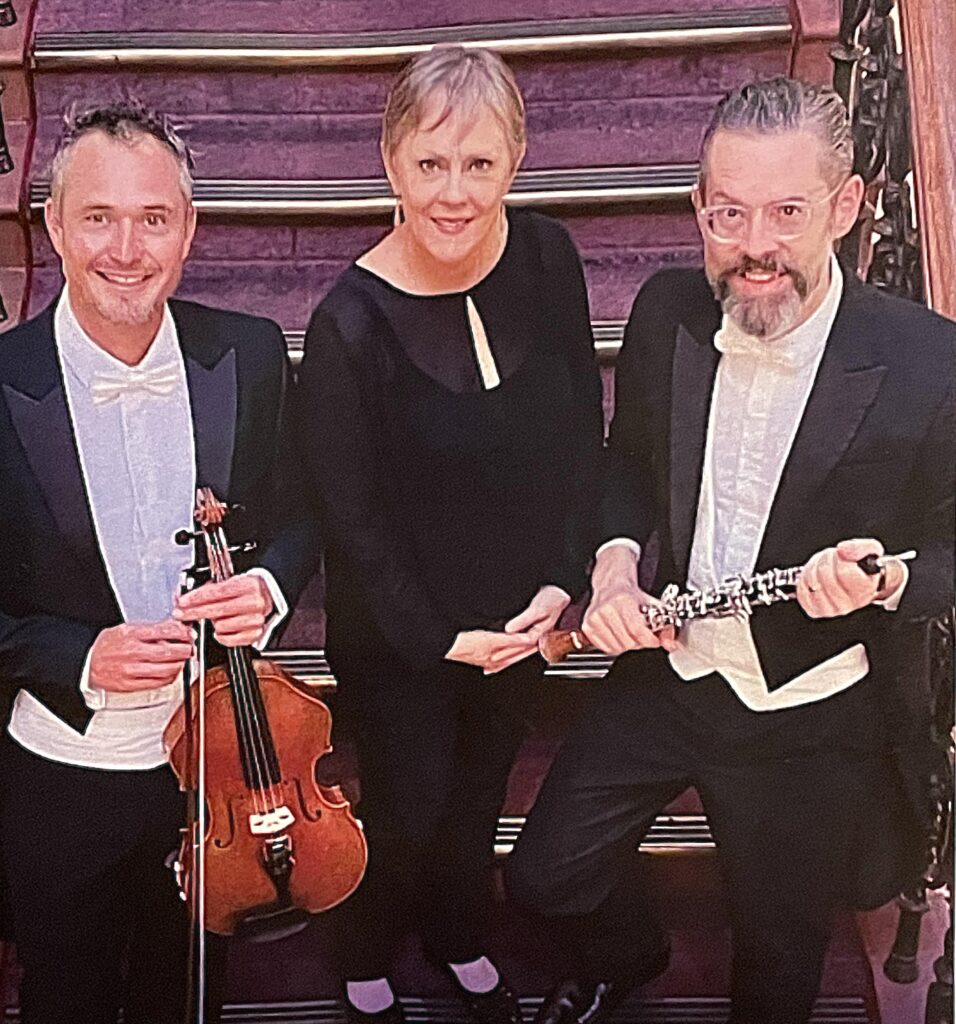
 TRIO OBSCURA
Bede Hanley (oboe), Robert Ashworth (viola), Sarah Watkins (piano)
AUGUST KLUGHARDT (1849-1902)
“Schilflieder” (Songs of the Reeds) – Five Fantasy Pieces (1872)
ALYSSA MORRIS (1984- )
“The Big Questions” (2024)
1. Who am I? 2. What is this Crazy Thing called Life? 3. How is it Possible? 4. What Comes Next?
CHARLES MARTIN LOEFFLER (1861-1935)
Two Rhapsodies for Oboe, Viola and Piano (1901)
1. Lento (un poco andante ) – L’etang (“The Pool”)
2, Un poco maestoso (Andante) – La Cornemuse (“The Bagpipe”)
JANET JENNINGS (1957- )
Five Emotional States (2025)
1.Anxiety 2.Melancholy 3.Anger 4.Relief 5.Exhilaration
Wellington Chamber Music Sunday Concerts
St.Andrew’s-on-The-Terrace, Wellington
Sunday 10th May, 2026
Trio Obscura’s name reminded me somewhat of TS Eliot’s wonderfully idiosyncratic poem “The Naming of Cats”, in which the poet describes a cat’s reverie when contemplating “…his ineffable, effable, effanineffable, deep and inscrutable, singular name”. Of course, there’s no such comparable mystery regarding “The Naming of The Trio” (its title is sufficiently and resonantly suggestive!), but there’s certainly a kind of singularity in the actual combination of “sounds” here, one which was sported blithely and cheerily by this combination of musicians!
I’d not heard of two of the four composers on today’s programme, the first of whom was August Klughardt, born in Köthen, Germany, in 1849, and who grew up during a time of turmoil in music between conservatives who held to classicism and its traditions and the progressives who wanted to explore new modes of expression. From an early age he worked at developing his performing as well as composing skills, first as a pianist and then as a conductor, in which capacity when working at the Ducal Court in Weimar he encountered Franz Liszt, who exerted a profound impression upon him, introducing him to Richard Wagner and the “New German School” of creativity (Klughardt was to conduct Wagner’s Der Ring des Nibelungen at the court in Dessau in later years). His own compositions, however, reflected a kind of eclectic attitude to the music of the times, taking elements from both traditional and progressive influences. Today his music – symphonies, concertos, operas, vocal and chamber music – is hardly known, though his chamber music is beginning to receive increased attention – an obvious influence in his work we heard today was that of Schumann (as it was in Klughardt’s own 1884 Piano Quintet, the appearance of which suggested an act of homage made by one composer to another!)
Today’s work “Schilflieder” (Song of the Reeds) took the form of five “Fantasy Pieces”, inspired by the poetry of Nikolaus Lenau (1802-50), whose work also inspired music by Franz Liszt and Richard Strauss. This particular set of verses devotes a separate stanza to the different moods of a wanderer’s day and evening in a forest and by a pond. “Schilflkieder” was written in 1872 and dedicated by Klughardt to Liszt himself – and actually achieved well-deserved attention for the remainder of the composer’s lifetime. Interestingly, Klughardt noted in the score that the oboe part could be played if necessary by the violin, a starkly practical, if somewhat radical-sounding adjustment to a sound-world!
The first piece, titled “The sun is sinking over there”, was begun by Sarah Watkins’ piano solo as a sombre preparatory. The music continued its melancholy course on Bede Hanley’s oboe, until Robert Ashworth’s viola’s entry brought a contrastingly flowing, more expressive character to the mood, seeming to have cheered the oboe up considerably when it re-entered. In this mood of appeasement the instruments ended the piece quietly together. With the following “Darkness falls, the clouds are flying”, I was straightaway taken into what seemed a Schumannesque world = the music had that same earnestly-toned sense of striving (the music marked “impassioned”), with, of course the viola’s sombre tones adding to that so-distinctive ambience! With the following, and so delectably, in places, Brahmsian “Along a secret path” I found myself straining to hear the viola at first, against the piano, (the composer’s rather than the player’s fault, here!) wanting more body of tone to make the lines sing. The oboe had no difficulty in this regard, even despite the florid nature of the piano writing, but the viola’s line I thought too subdued in places for the material.,
As for the fiery “Sunset” which followed, it sounded as if we were on board Wagner’s Dutchman’s ship battling the tempests – Sarah Watkins’ piano-playing conjured up a veritable storm through which the oboe piped strenuously and heroically, except that the viola was for the most part, to my ears, lost, swamped in the torrents of sound! Most thankfully, with the “sehr ruhig” of the final piece “On the pond, the motionless one”, we heard both exquisite solo lines and beautiful duetting between oboe and viola, suggesting perhaps moonlight on the tranquil waters after the storm, the viola spaciously raising its voice and singing its melodic traceries. The piano still generated energies aplenty with triumphant-sounding chords in places, but was content to accompany its companions over the work’s serenely lyrical close.
Another name new to me was Alyssa Morris (b.1984), an American composer whose style was described in the programme as “approachable, flashy and beautiful” – the title of her 2024 work “The Big Questions” poses the idea of confronting our very existence, pondering imponderables such as “Who am I?” / “What is this crazy thing called Life?”/ “How is it Possible?” / “What comes next?”. Reasoning that there are as many potentialities and possibilities as there are humans on this planet capable of flooding one’s sensibilities with uniquely-conceived minutae potentially delivering as much confusion as enlightenment (that sentence will do for a starter!), I strained forwards in my seat hoping to discern via the infintinesimal/infinite action of sound-impulses upon my primed sensibilities a true sense of awareness illuminating my inner being. I wasn’t sure whether the result would be any different to my listening to a favourite piece of music at any given moment of out-of-the-ordinary receptivity – but I counted myself at that particular moment as “ready for anything”.
It struck me that the composer was indulging in a kind of “sleight-of-hand” in giving us the existential titles I’ve already quoted, their “idea” actually containing the seeds of execution more than the actual sounds that followed. “Who am I?”, for example, began with a viola’s single note over which oboe and piano elaborated, recitative-style in a series of “statements” – the piano floridly invited the oboe and viola to similarly elaborate their lines. The music became very “Big American Musical” or “Big Screen”,r even “Big Country”, encouraged by fulsome instrumental tones. A by-product of these fulsome amplifications was that I felt “engaged “ with ideas while losing any specific sense of any uniquely distinctive and definitive state – was it me in this “Who am I?” moment, or was I actually experiencing with this “the craziness of the thing called Life?”
There were “clues” as to what was happening – conversational exchanges between the three instruments punctuated by crazily sassy detailings such as the viola’s sudden downward-plunging glissando, followed by pizzicato-like excuses for such off-the-wall spontaneities! Then there’s a waltz-rhythm, with the three players “bending the trajectories” in Salvador-Dali-like ways, until the famously flaccid structures raised themselves up with an effort and brought off a surprisingly “cutsie” gesture of farewell!
By this time, the question of “What comes next?” that we felt “ready for” had been gazumphed in itself so many times by the music itself we felt ready for anything! A piano solo, gesturing and ruminative, answered by the viola and echoed by the oboe (where he/she goes, we go! was almost sentimentally refrained by the ensemble) – until there was definitely a sense of something impending – was this, perhaps “The Next?” – the piano plunged into a running, surging accompaniment-like figure which had left its soloists at the starting post by accident! – but which oboe and viola catch up hurriedly! The music became a full-scale song, almost Negro-spiritual-like in manner! The instruments fulsomely decorated their lines as if approaching a kind of climax! Suddenly, everything stopped! – could this be “an end”? Was there actually such a thing? I remember when a small boy thinking “When the spaceship reaches the so-called “end of space”, what’s behind that end-wall? – there’s still more space!” Similarly, was this an ending? – or was there simply no end? Was this “What comes Next?” – will there be “no end” of “What comes next?”… except continued (and gorgeous!) soft playing? The music drifts into space – the oboe and violin hold their notes……the piano softly elaborates…..and finishes!
We needed a half-time! – the sense of “Where am I?” needed some familiar, reassuring sign-posting – also, I was uncomfortably aware of having perhaps too readily indulged in fancy throughout Alyssa Morris’s essentially “escapist” piece. I needed something more earthily “real” once again, upon which to plant my feet. Interestingly, the composer Charles Martin Loeffler (1861-1935) whose music was next on the programme was to supply me with a soupcon of empathy in this respect – Loeffler was described by violist Robert Ashworth in his introduction as “a German man trying to be French”! This was a reference to the composer’s reluctance to acknowledge his actual birthplace (Schonëberg, Berlin), and his somewhat “displaced” sense of upbringing, as he spent most of his life claiming his birthplace was in the Alsace region, which famously borders France, Germany and Switzerland! – (in fact a number of references I checked continue to maintain his claim that he was born in the French Alsacs region!)
Embarking on a career that took him from his birthplace in Germany to the United States via France, Russia, Hungary and Switzerland, the young Loeffler studied the violin in Berlin with Joseph Joachim and then composition with Ernest Giuiraud in Paris, playing in various French orchestras. After his move to the United States in 1881 he joined the Boston Symphony, with whom he performed as assistant concertmaster until resigning from the orchestra to devote his energies to composition. He’s known today as a skilled, highly fastidious and self-critical composer, belonging to no “school”, but combining his earlier French influences and sensibilities with his later “New World” experiences . In February 1931 Olin Downes, Music Critic of the New York Times, wrote in a seventieth birthday tribute to the composer, that Loeffler was “one of the representative musicians of an age”, but concluded that “his expression of that age has come from within, and not, as an imitation of fads and shibboleths of the hour, from outside.”
This work was originally planned as a set of Three Rhapsodies in 1898, but was extensively revised by Loeffler after the tragic death of the dedicatee – one of the pieces was shelved, and the two remaining works were rescored during 1901 for oboe, with viola and piano The first of these Rhapsodies became a memorial for the composer’s deceased colleague. Consequently, the piece began darkly, with the viola answering the piano’s first sombre notes strongly and whole-heartedly, more than matching the oboe’s plaintive tones, the viola here far more assertively-voiced than was the case with the Klughardt work. The style recalled the late-Romanticism of Ernest Chausson, evident in the “longing” nature of the phrases for all of the instruments, the oboe delivering a particularly beautiful solo episode at one point over the piano’s rippling phrases. A darker passage for both instruments resulted in recitative-like passages suddenly seeming to break into a dance , almost like the “friss” which follows a “lassu” in the Hungarian Rhapsodies of Liszt, the music readily ebbing and flowing across the instrumental timbres, until the sombre mood suddenly returned, the viola again richly-and darkly-toned against the plaintive oboe and piano, with the music hauntingly drifting between minor and major harmonies as the voices died away.
The Second Rhapsody (subtitled “The Bagpipe”) actually began as if it were a Liszt Rhapsody, with a florid piano passage, but then wistfully morphed into a kind of plaintive Bartokian folk-song – perhaps the bagpiper’s tune? Its repetition was suitably lump-in-the throat in its wistfulness – oboe and viola responded most rhapsodically, the “bagpipe” theme by turns lively and ruminative, either goading its listeners into dancing-mode or regaling listeners with a story. We felt regaled by story-telling tones and gestures from each of the instruments, feeling as if the listeners had “heard this tale before” and were reliving its characterisations and narrative lines! And what a particular joy it was to hear the viola sing so sonorously, next to its companions! After oboe and viola had finished their near-operatic “duet” with the piano’s sterling guidance, the three instruments engaged in a brief, gestural “are we all here, still?” exchange before letting the tones of the discursive tales find their rest.
For those who felt that the Loeffler work was much too earnest a response to those “Big Questions” posed by Alyssa Morris earlier in the afternoon, an alternative, “thistledown-on-the-wind”-like rejoiner to “Life And Its Problems” was posed by Waikato composer Janet Jennings (whose work “Voices of Women” I’ve previously reviewed on “Middle C” – see https://middle-c.org/2020/09/16161/ ) This work – “Five Emotional States” – is described in a programme note by its composer as “not to be taken seriously”, a comment that on a certain level of engagement makes plenty of good sense, but may simultaneously “beg the question” of emotional health in general for those who look beyond the work’s wondrously rollicking capacities for entertainment and into the real world of 2026 New Zealand, where people of all ages and circumstances are often forced against their will into situations where these states are all too palpably experienced. I’m not saying the work shouldn’t have been written – rather the opposite! Perhaps, though, it needs, in my opinion, not to be trivialised.
Having gotten that concern “off my chest”, may I say that the experience itself was for me an absolute riot, a palpable and resonating amalgam of delight and disturbance whose sequences I could all too readily recognise as having a degree of self-ownership of feelings generated by both inward and outer tensions – it also made me aware of the vital role that hope has to play amidst such experiences, given expression here in the section called “Relief”, and without which for me would have been akin to a horrifying, inwardly Faustian prospect of eternal damnation! Am I myself thus guilty of doing what the composer urged her audiences not to do? I was, all above concerns considered, ultimately delighted by the experience – and, to the performers, Sarah Watkins, Robert Ashworth and Bede Hanley, I dips my lid in boundless appreciation!