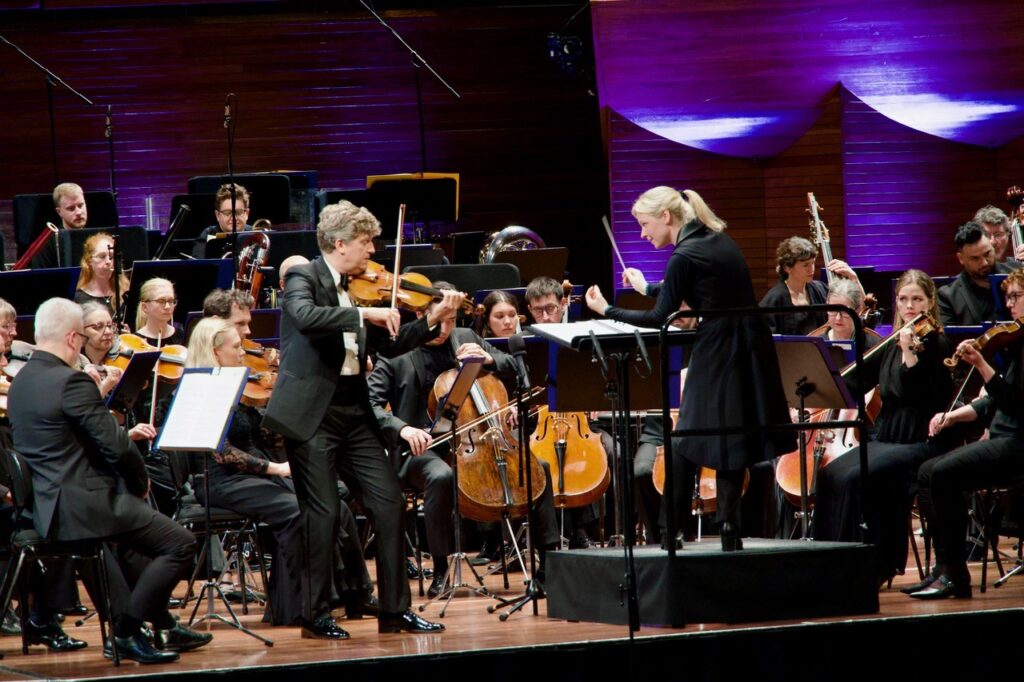
 James Ehnes (violin) and Gemma New (conductor) play Korngold’s Violin Concerto
New Zealand Symphony Orchestra presents “Titan”
THOMAS ADES – The Origin of the Harp (NZ Premiere)
ERICH KORNGOLD – Violin Concerto in D Major
GUSTAV MAHLER – Symphony No. 1 “Titan”
James Ehnes (violin)
Gemma New (conductor)
New Zealand Symphony Orchestra
Michael Fowler Centre, Wellington
Friday 22nd May 2026
Reviewed by Leila Lois
for Middle C
The evening opened with promise, with a bright and warm introduction from Gemma New, New Zealand Symphony Orchestra’s conductor and Artistic Advisor. As the first woman to hold the post of principal conductor at NZSO, New never fails to show charm and voracity. She beamingly announced the programme for the evening, which included the New Zealand premiere of Thomas Adès’ The Origin Of The Harp, Korngold’s Violin Concerto and Mahler’s Symphony No. 1, the “Titan”.
The night’s selection was delightfully whimsical, the first piece following the tale – a Celtic water nymph (of Ondine proportions) who falls in love with a mortal and tragically struggles to leave behind the ocean. One might have expected something dark and turgid but instead, the piece shimmered with phrases that at first lapped like gentle waves, then writhed and tumbled. In this tone-poem, composed in four short parts, the harp itself was not featured but suggested, appearing at the start of the fourth and final section, as a surprise, melting into the symphony as an epic denouement.
For this piece, the programme notes told us Adès implies the harp by damping the strings of a piano with BluTack, a perfectly innovative and slightly off-kilter complement to Mahler’s inventiveness in the symphony to come. A short, soothing piece that opened the evening perfectly.
Next came the Violin Concerto in D Major by Erich Wolfgang Korngold. Famous for creating Romantic style film scores, Korngold fled Nazi Germany for the Hollywood Hills in1934. The concerto found the perfect receptor in soloist James Ehnes, who realised the piece with rare care and attention, such that it was mesmeric to watch and hear. He is truly virtuoso in violin, his tone regal yet sweet – honeyed yet clean. His playing is also remarkably expressive. Beyond this, the connection between New and Ehnes was so compelling that it felt like they were the only two in the concert hall. New’s whole frame was tenderly tilted towards Ehnes, almost lovingly leaning into the melody. A synergistic moment. The piece ended with an encore where Ehnes played with feverish brilliance.
The focal piece of the night came last in the billing, Mahler’s First Symphony, also known as the “Titan”. The piece famously starts in a flood-lit forest, and the woodwind section spiralled through this deliciously on the night. Allegedly the inspiration for this first movement in the symphony came from Gustav Mahler’s childhood memory, where his father took and left him in the forest, and he spent the whole day immersed in the woodland world, enraptured.
In the second part of the opening this really shone through in the gorgeous wooden structure of the inside of the Michael Fowler Centre and exuded a sense of warmth, and calm, despite the notorious volume of Mahler’s scores. The next movement was more energetic, with the rustic party and raucous feel of the cheerful ‘ländler’ (a kind of folkloric waltz), somersaulting through the hall. The warmth of the strings and heartiness of the percussion in this section was led well – special kudos to those string players and percussionists respectively!
Onto the third movement – the emotional heart and most unnerving part of the symphony. The famous distorted solo double bass solo led expertly by Joan Perarnau Garriga played “Frère Jacques” in a minor key, giving it a grotesque, dirge-like quality. My friend, who went in “cold” to the symphony quickly picked up the unsettling familiarity of the melody, and so Mahler’s way of playing with our expectations was evident. The sardonic funeral march quality was well executed, with the famed drunken-sounding trumpets guided by section
principal, Michael Kirgan.
The final movement broke the strangeness of this with an anguished stormy brass-heavy sound, that roiled over the audience like a tempest. Again, the percussion was precise and impassioned, full of the unmistakable spirit of Mahler.
Overall a wonderfully curated night that left audiences inspired, with the Mahlerian counterpoints, tinges of the unexpected and whimsical, folkloric shades.