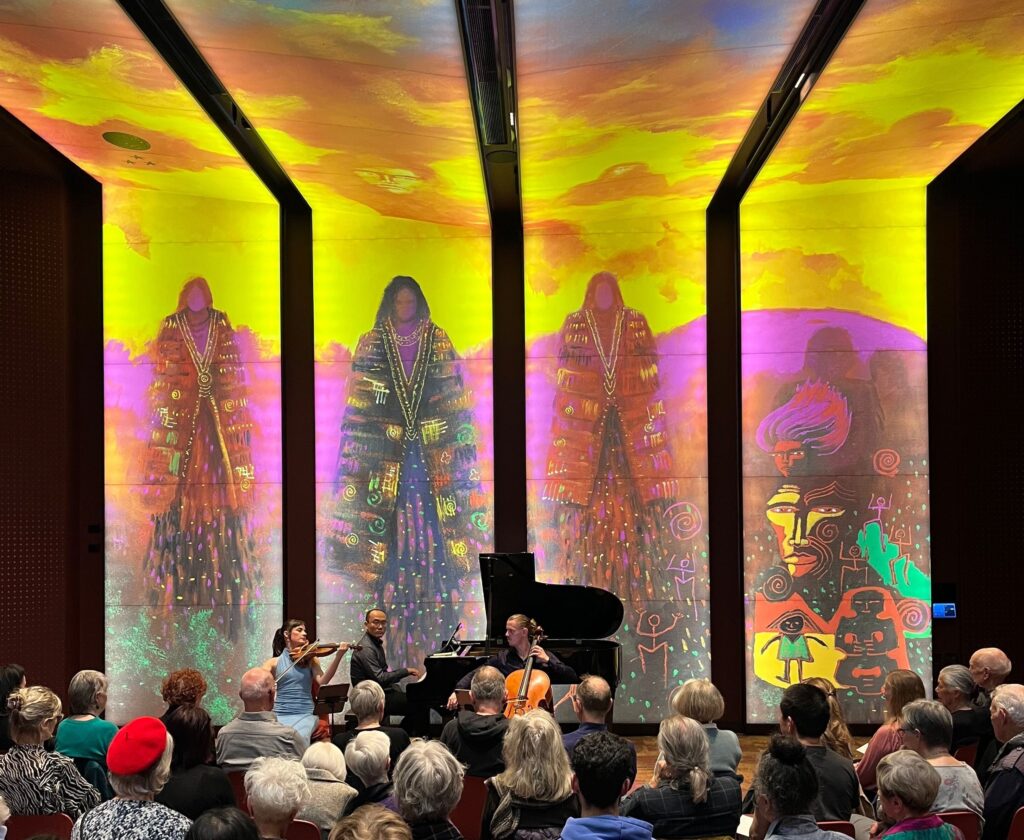
 NZTrio He Taonga Wairere performing at Nga Pou Ruahine – Te Matapihi ki te Ao Nui, Wellington
NZTrio He Taonga Wairere – Dreamscape
ROXANNA PANUFNIK – Around Three Corners (1995)
ROBERT SCHUMANN – Piano Trio No.1 in D Minor Op.63 (1847)
CLAIRE COWAN – wood: strings: hammers: flesh (2008)
CHARLES IVES – Piano Trio (1911-15)
NZTrio He Taonga Wairere – Amalia Hall (violin) / Matthias Balzat (‘cello) / Jian Liu (piano)
Nga Pou Ruahine – Te Matapihi ki te Ao Nui (Wellington Public Library)
Saturday, May 23rd, 2026
Oh, to be in Wellington! – annus mirabilis 2026! How ironic that, when we’re in the throes of an unprecedentedly savage institutionalised attack by the Coalition Government on our city’s lifeblood of productive public employment activity, we’re still able, in almost Jekyll-and-Hyde fashion, to continue to enjoy, courtesy of our classical music organisations, a wondrous – under the circumstances, little short of escapist! – level of artistic excellence in concerts given by our (mostly locally-based) performers.
I write this, having experienced over the course of two consecutive weekend days a pair of chamber music presentations of performances which, quite literally, bowled me over, Both ensembles were piano trios, whose players demonstrated a breathtaking mastery of intent, understanding and execution throughout each of the concerts – as well, we heard not only established masterpieces recognised worldwide as such, but a couple of uniquely treasurable instances of homegrown composition which would have graced any such programme anywhere
These concerts came with a number of attendant pleasures relating to factors such as venue and personnel – enough for me to give each occasion sufficient “raison d’etre” to warrant a separate review. However, their combined pleasures and inspirations certainly gave extra hope and strength to my feeling that (as has happened in the past) humanity both in this part of the world and at large will actively respond to these resonating artistic expressions with sufficient will and determination to overcome aforememtioned troubles and go on.
As outlined above, the superb NZTrio He Taonga Wairere, performing at the capital’s magnificently refurbished Public Library (Te Matapihi ki te Ao Nui) began for me this memorable two-staged feast, and with the “other” newly-formed Korimako Trio continuing the weekend’s pleasures at St.Andrew’s-on-The-Terrace Church, also in Wellington, the following day – the two events were not “linked” as such in any way except in terms of their remarkable “shared” qualities. A particular feature of the earlier NZ Trio concert was the presence of guest pianist Dr.Jian Liu, Associate Professor of Piano from Te Koki/New Zealand School of Music in Wellington, who has been at the keyboard for the Trio’s “Dreamscape” series of concerts, along with regulars violinist Amalia Hall and ‘cellist Matthias Balzat.
Besides the music we were able to enjoy the surroundings of the Library’s new music-performing space, Nga Pou Ruahine, spectacularly appointed with various artworks depicting most prominently a rawa by Darcy Nicholas of the Feminine Pillars of Life, Earth Mothers HIneahuone, Hinetitama and Hinenuitepo, one whose resonances stretch right across the ceiling, and which cast vivid impressions of the goddesses’ all-pervading influence. Earlier today I glanced through writer Elizabeth Kerr’s useful thoughts upon performance spaces for music available in Wellington and their acoustical suitability for music, a compendium to which this striking environment can be added with enthusiasm, even though I wondered about the effect of having significant walled areas on each side of glass surfaces upon the acoustics. Every venue has its own particular sound-character, and in this case I did initially prefer, I must admit, the slightly crisper St.Andrew’s-on-The-Terrace “sound” the following day for the Korimako Trio. Still, the ear does adjust quickly to all but the most intractable of acoustics at most concerts I’ve attended, though I have to say I agree with my colleague’s views over the distinct “lack of bloom” in the ever-problematic Michael Fowler Centre, awaiting as I am the return of the near-matchless sweetness of the sounds of music in the city’s Town Hall auditorium (a building mercifully spared the wrecker’s ball!).
One characteristic that Nga Pou Ruahine readily allowed us to enjoy was the “shared” aspect of the listening-space, mercifully freed from any restrictive boundary between performers and listeners (several other local venues also have this warmly-communicative quality, making music-listening such a joy!) – so it was when Amalia Hall, Matthias Balzat and Jian Liu appeared, with any initial aural “opaqueness” I’ve hinted at soon relegated to normality as the concert proceeded.
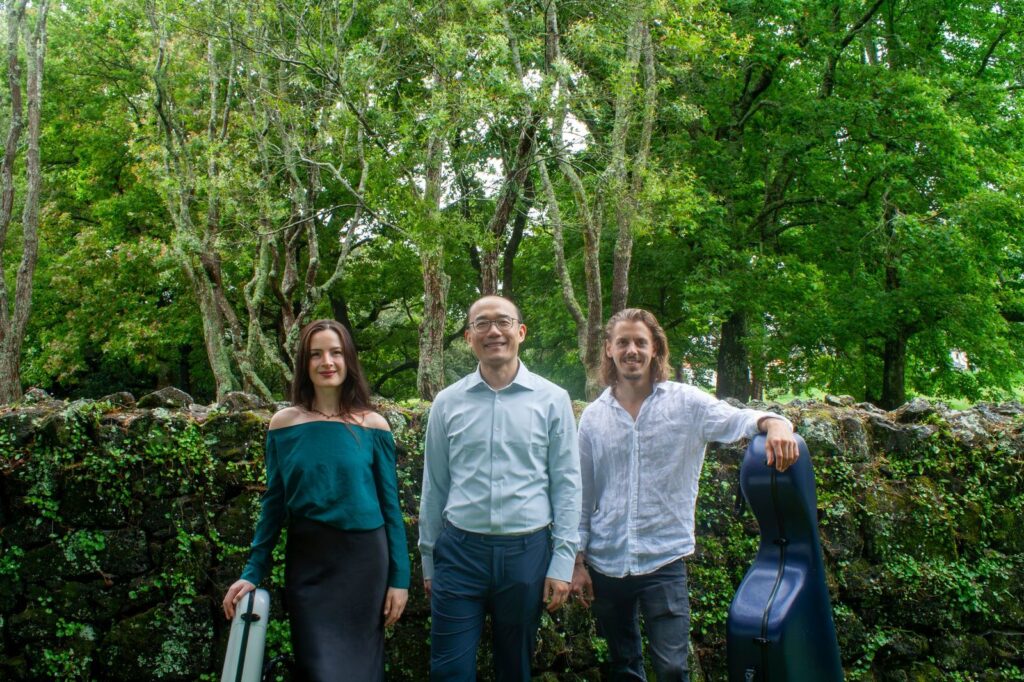 NZTrio “Dreamscape” members – Amalia Hall (violin), Jian Liu (piano), Matthias Balzat (cello)
What a programme it was! beginning with Roxanna Panufnik’s haunting “Around Three Corners” a palindromic-like piece with a theme as its centrepiece flanked by variations on either side! I thought the piece a real “adventure” one framed by opening and closing sequences with the strings repetitively “decorating” the piano’s beautifully meditative, fanciful line, and with the sounds at the end returning to the mists out of which everything had first emerged. Along the journey were adventures aplenty – sequences of true, breath-catching wonderment from both piano and violin, each living “for the moment” and the ‘cello seemingly earth-bound while looking upwards in mild bemusement – and Jian Liu directly “activating” the piano strings by reaching into the instrument’s body, bringing into play what could only be described as “interior” worlds, as the violin and ‘cello voiced pleasure/concern with “dying fall” phrases and equivocal moments of note-bending. I loved the “harrumphing” piano rumbustifications and the scintillatingly “shivery” tremolandi from both strings as the trajectories rumbled along (“Are we dreaming you or are you dreaming us?” I could imagine as thoughts were made into words!) – with a “held” violin note echoed by the ‘cello, I imagined the dream beckoning to its participants that its hour had passed for the moment, with beautiful violin tones drawing empathetic responses from the ‘cello, and deferring once more to the piano, a kind of envoi as the sounds took their leave….
It seemed a perfect scenario into which to introduce the music of Robert Schumann, surely the most instantly recognisable of any composer’s music, with its “poetically serious” energies constantly striving to break through and into the light. The players here instantly “got” the restless ebb-and-flow of emotion, its evanescent quality which spontaneously varied in intensity mid-phrase, or even sometimes, mid-note! Were they playing harmonics in the ethereal middle section of the first movement? – such an other-worldly, almost visionary aspect to the music! I loved how Jian’s playing was so attuned to the strings, as if the piano was often at times another stringed instrument! A lovely lead-back to the opening teased our expectations right to the moment of re-recognition – and a beautifully-voiced coda underlined Schumann’s reluctance to let the music go!
Schumann’s mania for near-endless rhythmic repetition in his scherzo movements (surely having an influence upon Bruckner?) generated tremendous momentums here, like “a galloping horse” in places – breathlessly exhilarating! The Trio was, in contrast, like a kind of “wafting” over the same ground, but with an entirely different kind of trajectory! The contrastingly deep piano chords which began the “Slowly, with intensity” third movement had a beautiful austerity here, which the ‘cello’s entry softened as the dialogue came beautifully together – the increased flow was nicely paced, with the piano joining the thematic ranks – how spellbinding these players then made the introduction to the finale, whose initial sighs of relief were here given an ebb-and-flow kind of physicality, in places quixotic, in others full-blooded – it had a feeling of joyous culmination, even abandonment, reminding me of the finale to the Piano Concerto!
I mean no disrespect to anybody or anything, composer, music, or performer, by declaring that the concert seemed to get even better as it went along – and not due to anything in particular, but the result of a cumulative effect of a constant stream of wonderful music and its astonishing execution! The concert’s final two items were, in a sense, incomparable with both the rest and with each other – each was a kind of idiosyncratic singularity of creativity, conceived in its own isolated surroundings, and brimming with its own time-and-place energies and purposes! First we were drawn into Auckland composer Claire Cowan’s work, wood: strings: hammers: flesh (2008) – one which the composer herself described at the time in a Schumannesque kind of poem –
and you will wear my heart on your bow
you will speak my words
music like flowers will blossom from your fingertips
and they will see right through me
Violinist Amalia Hall told us, by way of introducing the work, that she played in the ensemble which gave the first performance of Cowan’s piece. I loved its sense of shared discovery – the opening emphasised the sheer physicality of music-making, with the composer’s performers here using knuckles knocking, fingertips drumming and tapping, and hand-palms slapping and resonating upon the wood, fibres and metal objects and surfaces normally employed as conduits for conventional musical expression. Here the dimensions were enlarged, resonated and given basic, instinct-like impulse, spotlighting the frameworks and interactive relationships between performers and their instruments in an almost primitive, state-of-origin way. From this plethora of sounds came ideas using basic processes to “grow” music before our very eyes, combinations of timbres, rhythms and tones as the players and their instruments interacted, creating moments of magic (the piano strings directly activated by the pianist) and rhapsodic expression (violin and cello strings bowed and plucked) with, by turns, both startling and haunting results. As the unfolding soundscape took us through the various episodes everything became more physical and almost epic in its imaginative reach, to the point where my senses seemed overwhelmed by a kind of ferment of discovery! A final, decisive “clunk” from the players at the end broke the spell, from which I awoke to a kind of silence that hummed with a memory of having shared something of a composer’s journey, or at the very least, a brief immersion into realms (Schumann, again!) of infinite possibilities.
The evening’s final work approached the idea of music-making from the other end of the process – American composer Charles Ives (1874-1954) believed that life itself was the source for music, reflecting as many kinds of creative activities as could be discovered, and disdaining any kind of “hierarchy” that put “art-music” at the top of the pyramid and more populist styles below. An excellent programme note for the concert written by Charlotte Wilson underlined the debt owed by Ives to his father, George, himself a bandleader, and “clearly a force of nature, like his son, innately inquisitive and enquiring” and who bequeathed to Charles his own fascination for music, its essences and its different sources.
Ives’s Trio for Violin, ’Cello and Piano, completed in 1911and revised in 1915, drew much of its inspiration from his student days at Yale University, from where he graduated in 1898. Pianist Jian Liu remarked on the work’s in places riotous nature, drawing our attention to the second movement’s “TSIAJ” title (This scherzo is a joke”), and referring to its somewhat chaotic amalgam of tunes therein, emphasising that we were thus warned! Ives himself made reference to his inspirations for the work, citing a “short but serious talk” by “an old philosophy professor” as the first movement’s source of origin, then characterising the somewhat chaotic second movement as “the games and antics by the students on a holiday afternoon” – he then described the final movement as “a remembrance of a Sunday service on the campus”.
I’d heard a recording of the piece before going to the concert, so was “prepared” better than I would have been had I encountered the music as a novice listener – nevertheless I couldn’t believe the extent that the NZ Trio’s playing “made sense” of what had seemed almost like total chaos during my first listen! Here, the first movement distinctly characterised the different dialogues between, firstly, the ‘cello, and then the violin, with the piano – the first measured and circumspect, the second, more animated and even quixotic in places, as if real personalities! The second movement’s “onslaught” of themes also seemed less “randomly disorganised” here, more purposeful and driven, enabling one to really “swing along” as a listener, rather than feeling as if endlessly floundering in a sea of random ditties! Not that spontaneity was lacking – one felt driven less by desperation here and more by “good-old” riotous remembrance!
As for the finale, Moderato con moto, the musicians sounded the “perfect fifths” sequence fanfare-style, before performing (and repeating) what seemed increasingly like various enigmatic “nostalgia-rituals” – duetting soulful sequences, surviving near-dissonant encounters, tripping through brief, syncopated dance-sequences whose trajectories allowed moments of skitterish excitement, before returning to the soulfulness of the opening “duet” and revisitng the other sequences theme – until, almost out of nowhere came (incredibly moving!) the “Rock of Ages” theme, firstly on the ‘cello then the violin, and lastly (minus its concluding note) on the cello once again, the piano continuing to muse broke off before sounding the phrase’s final B-flat! Enigmatic to the end though it all seemed, the Trio allowed us to drift back into our recognisable lives by playing part of a Brahms Trio – the Andante grazioso from Brahms’ Piano Trio No. 3 in C minor. – before sending us all home!