Wellington Chamber Music Concerts presents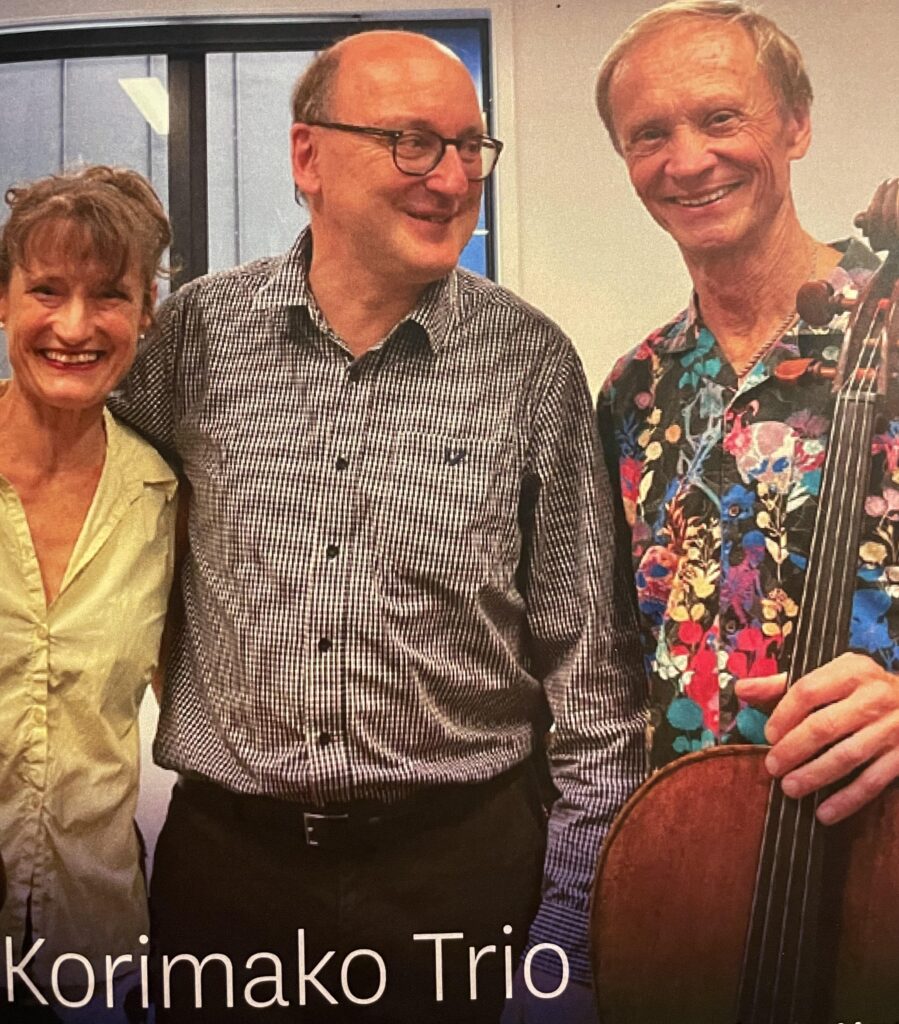 Helene Pohl, Michael Endres, Rolf Gjelsten
KORIMAKO TRIO – bringing cheer and hope to a beleagued city!
JOSEPH HAYDN (1732-1809) Piano Trio No.44 in E-flat Major Hob.XV:28 (1797)
REBECCA CLARKE (1886-1979) Duo for Viola (or Violin) and ‘Cello (1918)
ROSS HARRIS (1945 -) Duo for Violin and ‘Cello (2000)
AARON COPLAND (1900-90) Vitebsk, for Piano Trio (1929)
FRANZ SCHUBERT (1797 -1828) – Trio in E-flat Major Op.100 (1827)
Korimako Trio – Helene Pohl (violin) / Rolf Gjelsten (‘cello) / Michael Endres (piano)
St.Andrew’s-on-The-Terrace Church, Wellington
Sunday, May 24th 2026
I’ve already acclaimed the occasion of this concert given by the Korimako Trio in Middle C’s previous review (https://middle-c.org/2026/05/nztrios-sensational-dreamscape-concert-sweet-relief-for-wellington/), regarding it as one of an otherwise unconnected “twin” event – together they made for me an affirmation of immense moment for the citizens of a city whose public service fraternity is currently under a savage “siege” of decimation enacted by Aotearoa New Zealand’s present Coalition Government. There was, in fact, a THIRD stellar musical happenings over this weekend of wonderment in Wellington, with the NZSO’s “Titan” concert on Friday evening featuring Canadian violinist James Ehnes with the orchestra’s principal conductor Gemma New, an event which I couldn’t attend, but whose significance at this particular punitive time added to the poignancy of the city’s bounteous musical offerings (also reviewed in Middle C – https://middle-c.org/2026/05/nzso-reaches-for-mahlers-titan-via-ades-and-korngold/), These three happenings flew in the face of the travails experienced by thousands of workers as a result of proposals concocted by those forces doing their utmost to emasculate the capital’s significance as a living, breathing functionary of essential democratic activity.
Many people attest to the vital importance of the arts as an indication of any country’s social and intellectual “health”, even though such matters have been paid scant attention by our current elected representatives, whose principal motivations seem only to concern themselves and their functionings with (in the words of Oscar Wilde) “knowing the price of everything and the value of nothing.” One laments afresh the irony (one of many such wrought by 2026 and its scenario of “government by deprivation”) of people like myself able to enjoy stellar performances by our musicians such as those featured in these concerts, as we simultaneously witness the ongoing enfeeblement and debilitation of democratic processes and human rights by others whose priorities are power and control! Let’s hope that music-making of this strength and purpose will help bolster our fresh determination to hold onto and cherish what is being threatened – and which I suddenly realised in today’s concert composer Franz Schubert was alluding to in the final moments of his magnificent E-flat Major Trio we heard this afternoon, illustrating, to my mind, the indescribable beauty through expression of basic human dignity in the face of insuperable difficulties.
So then to today’s concert, and the Korimako Trio – a newly-formed (November 2025) ensemble, though two of its players have of course been mainstays of the country’s classical music scene for decades – violinist Helene Pohl and ‘cellist Rolf Gjelsten were members of the New Zealand String Quartet for thirty years, as, respectively, leader and ‘cellist of the group, until events brought about their decision to resign from the quartet towards the end of 2024. Enough ink has been spilled and bandwidths stretched to breaking-point over the ins-and-outs of that occurrence – suffice to say that the pair, however bloodied have remained unbowed, to the great relief of legions of their supporters, myself among them! They have already instigated various concert activities for charitable purposes, such as the well-known Arohanui Strings, the Sistema-like Charitable Trust which provides musical tuition for young children (and of which Helene Pohl is a patron), and which they continue to support. With the help of various “guest” players over 2025, the two have also continued their quartet-playing activities, specifically concentrating on a number of the quartets of Dmitri Shostakovich during what was the composer’s fiftieth death anniversary year – how fortunate we were to have such advocacy in these remarkable works, and how wonderful if it could all continue (besides the Korimako Trio activities, of course!)
A piano trio needs, by definition, a pianist – and I had heard sufficient of Michael Endres’s playing as a soloist over the years for my excitement to be considerably quickened by the news of his collaboration with the two aforementioned players. His qualities as a virtuoso soloist had been more than evident, so I was fascinated by the prospect of hearing how his solo brilliance would adapt to ensemble playing. With this in mind, I was absolutely delighted that two of the works scheduled to be performed by the Korimako ensemble were “standard classics” of the Piano Trio repertoire – one of Josef Haydn’s Piano Trios he wrote while in London, No.44 in E- Major (1797), and the second of Franz Schubert’s great Piano Trios, in E-flat Major D,929 (1827).
The third work for Piano Trio on the programme was one that has achieved a different kind of “classic” status as a representative work of the “modern” era – Aaron Copland’s challenging “Vitebsk”, written in 1929 – a work with a somewhat different, more earthy, dissonant and insistently combatative sound to that heard in the two other trios, the three instruments seemingly in places in the Copland work as much as, if not more than, at odds as in accord with one another! The remaining works on the programme, the two Duos for Violin and ‘Cello had their own singular personalities which held up fascinatingly in such diverse company – Rebecca Clarke’s two-movement work from 1938 quixotically explored two contrasting worlds of sound and feeling, while local composer Ross Harris’s eponymously-titled Duo (2000) was a set of variations on a theme which undergoes a kind of conversational change through spontaneous-sounding interplay between the two instruments.
The Haydn work which opened the concert couldn’t help but straightaway suggest the interactive nature of the afternoon’s music-making, including as it did various delightful quirks and contrasts of expression typical of the composer. Here, an engaging piano-led song-like opening was buoyed along by the strings’ impish pizzicato tones, before the music burst into rippling energies , the instruments exchanging modes for a beautifully-delivered modulating second subject theme on sighing arco strings with the piano’s sparkling decorations a delight! After the repeat came a simply gorgeous A major section, delivered here in a way which warmed our insides before a return to the movement’s opening, Haydn playing with our perceptions of what went before with insouciant wit and charm and a sense of fun! The second movement’s sombre unison opening suggested a moment of mourning or regret before the piano took it upon itself to instigate a “buck-up, Charles!” kind of solo which had a hint of the Baroque about it! I thought the finale, with its three-note descending motif, had a kind of “something’s up” aspect about its cheerfulness – and, sure enough, a sudden dramatic darkening of the mood had its say, the strings sharing the earnestly-striving new theme with the piano. “How does Haydn do it? “ I asked myself as the three-note motif returned triumphantly, despatched in a no-nonsense manner by two similarly no-nonsense chords? – no time for further wonderment, as delighted applause was in order!
Our positive mood was furthered by the next two pieces, both duos for violin and ‘cello – the first, by English-born but American-domiciled composer Rebecca Clarke, was originally written for herself, a violist, to play with her frequent pianist collaborator, May Muckle (the pair gave the first public performance of the work in New York in 1918), with the viola part able to be also played on the violin, as here. The piece’s lovely, song-like opening “Lullaby” featured a singing violin supported by the cello’s gently mesmeric ”rocking” quality, then contrasting its focus with the ‘cello’s deeper toned-voice. Both instruments reached towards a touch of Tchaikovskian fervour in places, before returning to lullabic mode and concluding the episode with more exquisitely-voiced modulations.
The “Grotesque” movement that followed might well be described as a description of dreams which decry the serenity of the sleep-inducing “lullaby”! The music’s antics straightaway engaged and delighted – quirkily acerbic up-and-down passages were flecked with sforzando-like punctuations, and contrasting elfin-like caperings vied with heavy-footed folk-dance-ish rumbustions. And, at the conclusion of this plethora of incessant interplay of “furtive” impulse and full-blooded exuberance, we got a gorgeously rib-tickling, throwaway ending!
Ross Harris’s Duo (2000) was actually written for today’s performers of the work, Helene and Rolf, adding a richly-flavoured potential to the music’s integral substance (not, incidentally, the first piece of music the composer has written for the couple, with a previous work “Wayleggo” having been gifted to them as a wedding present!). Here, the musicians’ near-impeccable credentials produced an intensity of identification at the beginning, the lines and phrasings sombre and tightly-wrought, not unlike Part Two of Stravinsky’s ‘Le Sacre du Printemps”, similarly tightly-bound, and with occasionally flecks of impulse from within suggesting impending activation. The piece’s double-stopped figurations in both the players’ parts gave the music a textural intensity and richness that suggested a string quartet, not a duo, was playing, the music moving meanwhile into playfulness (“bounced” tremolando phrasings, pizzicato irruptions and quixotic “ninth” interval-jumps!) and back to solemnity. A sudden crescendo brought agitations, quick-fire and varied, arco and pizzicato, until the players seemed to suddenly realise they were actually baton-passing rather than in conflict! In this way a Parnassus of sorts had meanwhile been ascended, with contentions drawn into a mystical kind of union of purpose, inextricably entwined! All that remained at the end was a satisfyingly-wrought resonance of accord and silence!
We welcomed back the full Korimako Trio for the final and somewhat tumultuous work of the concert’s first half. This was Vitebsk, a work brimming with youthful exuberance and zeal, written by an American composer, the young Aaron Copland, in response to a play he had seen performed in New York during the period 1925-1927. The play was The Dybbuk, written by Russian-Jewish author Shloyme Zanvl Rappoport (1863-1920), best known by his pen-name, S.An-sky. Though originally written in Russian the play was translated into Yiddish by An’sky himself for its first performance in Warsaw in 1920. The story depicts a young woman possessed by the malicious spirit (known as dybbuk in Jewish folklore) of her dead lover. Though the play subsequently became a massive success, An-sky himself died before the Warsaw production could be staged that same year.
English versions of The Dybbuk were performed in New York in 1925 and 1927, but it’s not clear which of these Copland attended – however, each production used the same incidental score, written by Russian composer, teacher and promoter of nationalist Jewish music, Joel Engel (1868-1927), which included a folk melody the latter had discovered, originally a wordless Hassidic melody (a niggun), but which became known as Mipnei ma (Why/wherefore/because of what (“has the soul fallen…”). It was this melody that made a profound impression on Copland (he called it a “noble theme”), one which he used as the basis for his trio, as for him it reflected “the harshness and drama of Jewish life in White Russia (Belarus”).
Copland called his trio after Vitebsk (a city that was the birthplace of both S.An-Sky’s and painter Marc Chagall – though Copland’s own characterisation of part of his Trio as having “a Chagall-like grotesquerie” has drawn criticism from some commentators who reject the Chagall association in the music in favour of more “klezmorim” characteristics (they point out, for example that Vitebsk as a city was a cosmopolitean one, not the type of provincial village that Chagall’s paintings depicted and that Copland himself referred to). Perhaps the main criticism of association is that Copland’s music ought to be thought of as driven not by sentimental ideas of rustic village life, but by the power of the actual legend and the resonance of such beliefs in certain communities lasting some way into the twentieth century!
Right from its tumultuous beginning this music seemed as if “owned” by the the Korimako Trio players, encompassing the work’s power, energy and extremes of emotion with astonishing immediacy and candour. It unfolded in three parts, two slower sections surrounding a central more agitated sequence. The harshly intoned opening – impassioned strings punctuated by hammered piano chords – was a repeated two-note theme representing the shofar, the ceremonial ram’s horn sounded in Jewish services. Violin and cello elaborated on these calls, their notes often resounding in discord with one another, wrenching phrases from the aforementioned folk melody Mipnei ma, before re-echoing the shofar calls. The cello’s playing of the beseeching Mipnei ma melody was taken up wholeheartedly by the violin, and with piano accompaniments lead the way back to the all-pervading shofar motifs.
This sparked off a frenetic outburst by the piano, which plunged into a headlong dance joined by the strings, a madcap frenzy of high-speed canonic-like imitation representing some kind of “possessed” agitation, at once exhilarating and disturbing, and eventually bringing forth impassioned outbursts of the Mipnei ma theme, With the return of the shofar calls, the energies seemed all but expended, with the mood quietening and a resigned and subdued version of the folk-theme dominating the final moments before being subsumed itself into the silences…..what an extraordinary journey! – and one whose themes and gestures have stayed with me to the point where I find myself writing this amid those same themes and their lasting resonances still in my head…..
After this, we all felt grateful for the luftpause of an interval – people I spoke with were transported by the drama and dynamism of the Copland in the wake of the rest of the first half’s interest and variety. I thought it was a good thing to allow some space to separate what we’d just heard from what was to come, music of almost a century earlier, albeit with its own set of existential profundities heart-warmingly maintaining their relevance for our time. This was the second of Franz Schubert’s two great Piano Trios, (in E-flat D.929) and has always been considered the one with the most gravitas for a number of cited reasons, chiefly that (a) it was the larger of the two trios and (b) it was the one of the few of Schubert’s late works that he actually heard performed in public (how bizarre and tragic that the composer never actually heard his miraculous D.956 String Quintet performed!)
Right from the beginning of the work the music in the Korimako Trio’s hands sparkled and glittered, with Michael Endres’s playing a particular joy, making the most of the ever-sparkling piano writing, be they the flourishes contributing to the work’s opening paragraph, or the flowing tones accompanying the concluding measures of the movement’s second theme . As for Helene Pohl and Rolf Gjelsten, I loved the forthright but still warmly-toned timbres of their lines both here and in the development’s rich explorations, mercifully free of the tendencies of some more recent recordings I’ve heard to try and “authenticise” (authenticate?) the string-playing, the latter, almost vibrato-less, practice to my ears starving the string lines of warmth and flexibility – both players here constantly gave us pulsating, well-nourished string sounds however strenuous the physical effort or tenuous the dynamic markings, the music-making emerging as a living, spontaneous-sounding entity. I was disappointed we didn’t get the first movement repeat, but the players obviously didn’t want to send us home TOO late that afternoon!
The famous Andante con moto second movement (based on a Swedish folk-song “See the sun go down” which Schubert had heard sung in Vienna) was here “sounded” by Rolf Gjelsten and Michael Endres with a kind of simple tenderness, the ‘cello and piano seeming to make the most profound impact with the simplest, and most direct means, and, despite its popularity, giving it a “heard for the first time” feeling that was profoundly moving, as was the instrumental combination with Helene Pohl’s violin in the major-key melody which followed. The players really made something of the central section’s series of climaxes, especially the concluding one, whose cumulative effect left me exhausted, having “held” to the music’s series of crescendoed surges of emotion right to the end! The major-to-minor sequence towards the end was also close to heartbreaking!
I’m always amazed by Schubert’s seemingly boundless capacities for renewal in his music – with the presence, for example, of two more movements after the Andante con moto’s cathartic conclusion! Having suffered heartbreak and hopelessness in the previous movement, what better and braver way could a composer reconstitute the present order than with a juicily canonic dance-routine! Piano and strings alternated in follow-the-leader sequences, and the trio was a kind of play-acting gem – a hide-and-seek sequence at the centre of things before the instruments found one another and retraced their adventurous footsteps – all charm and warm resolution!
Beautiful, expectant playing flowed from Michael Endres’ piano at the finale’s Allegro moderato beginning, deliciously answered by Helene and Rolf – together the trio adroitly contrasted the relaxed gait of the music with the boisterous crescendi that bubbled from out of the textures in places, then adding more urgency to the plaintive repeated-note melody, which meant they had to slow down for the “whirling” figurations of the piano part. Nothing was left to chance – each episode was richly characterised sharply so that nothing seemed superfluous or unnecessary, The change of mood to a minor key brought back a reminiscence of the slow movement’s theme on the ‘cello, and much agitation, before the repeated sequences brought what seemed like a full circle of acknowledgement and acceptance into play, enabling the players to spectacularly realise the composer’s wondrous embrace of his slow movement theme for the last time, and with a stunning modulation to the E-flat major key, transforming its darkness into all-embracing light – a moment of transfiguration which left us gobsmacked at the bravery of the gesture, and its enduring feeling of a kind of redemption against all odds!
What a performance! and what a blessing for all of us present to have experienced such a moment! Long may the Korimako Trio prosper amongst us and everywhere they go!